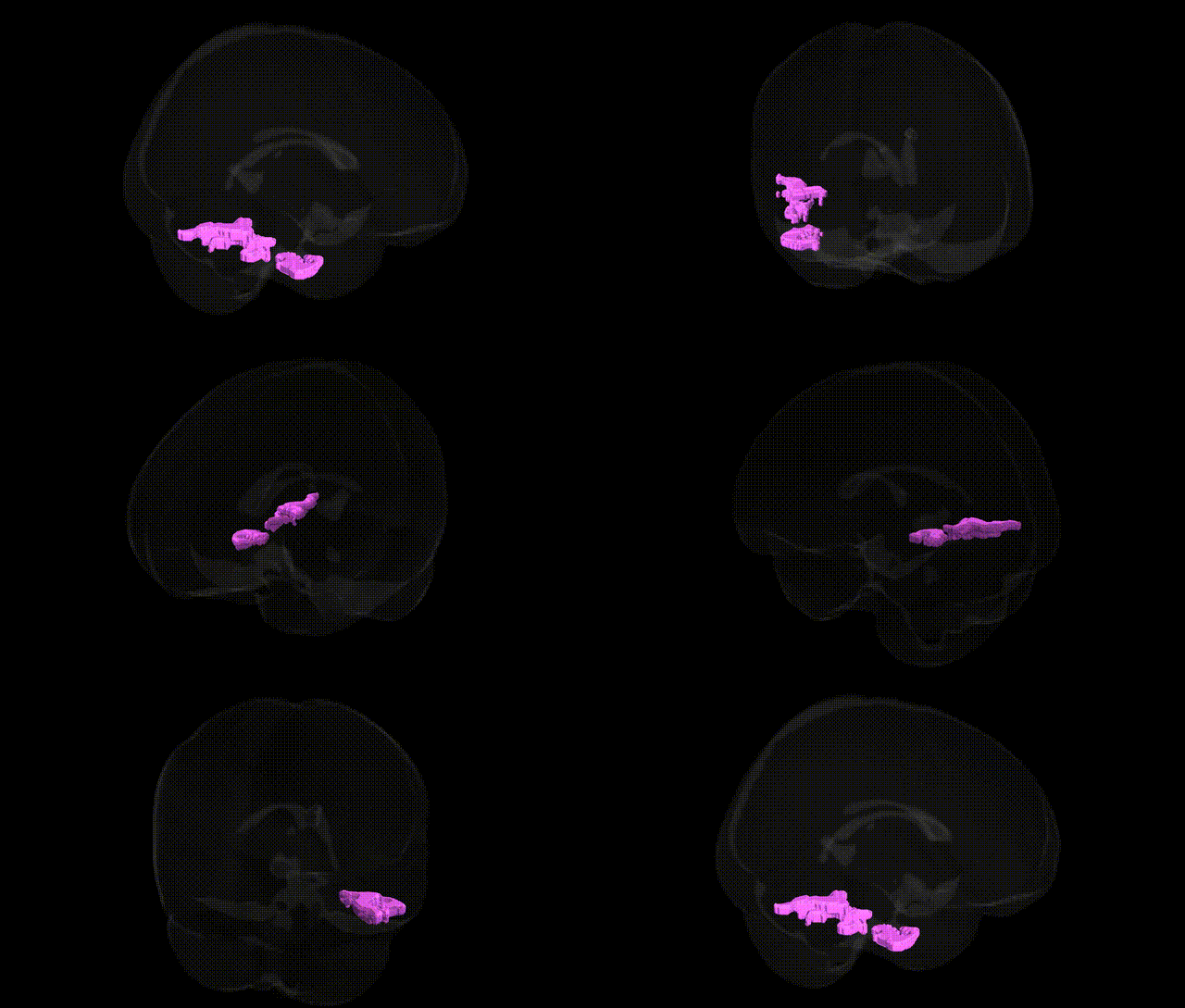
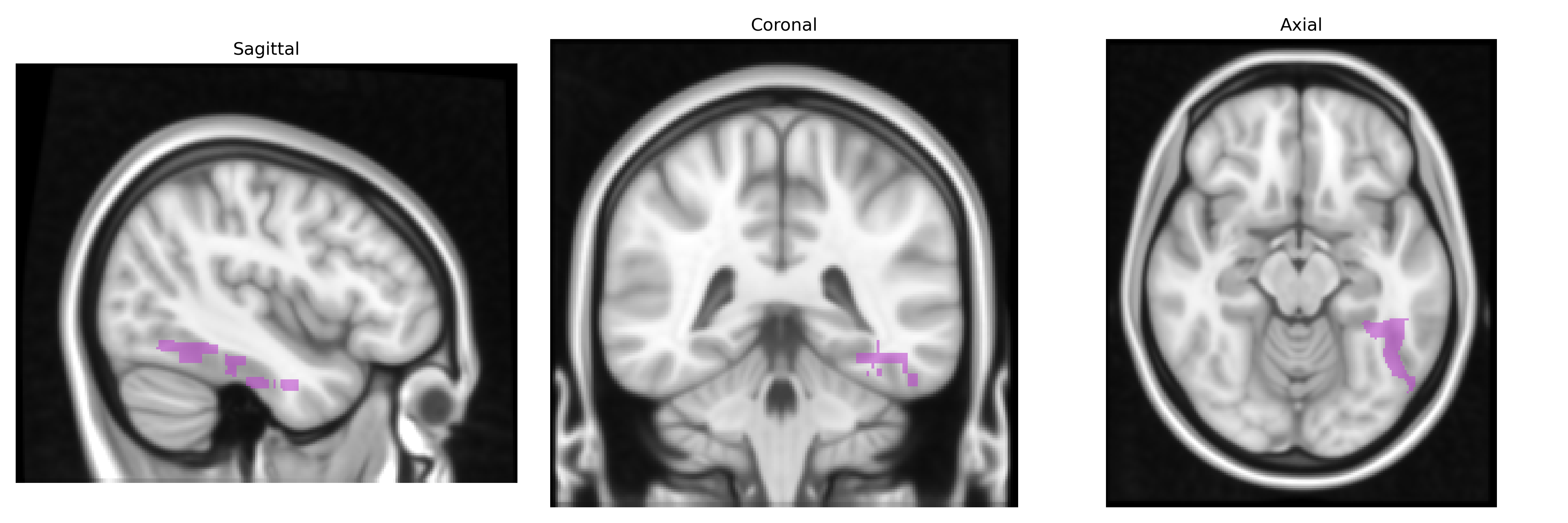
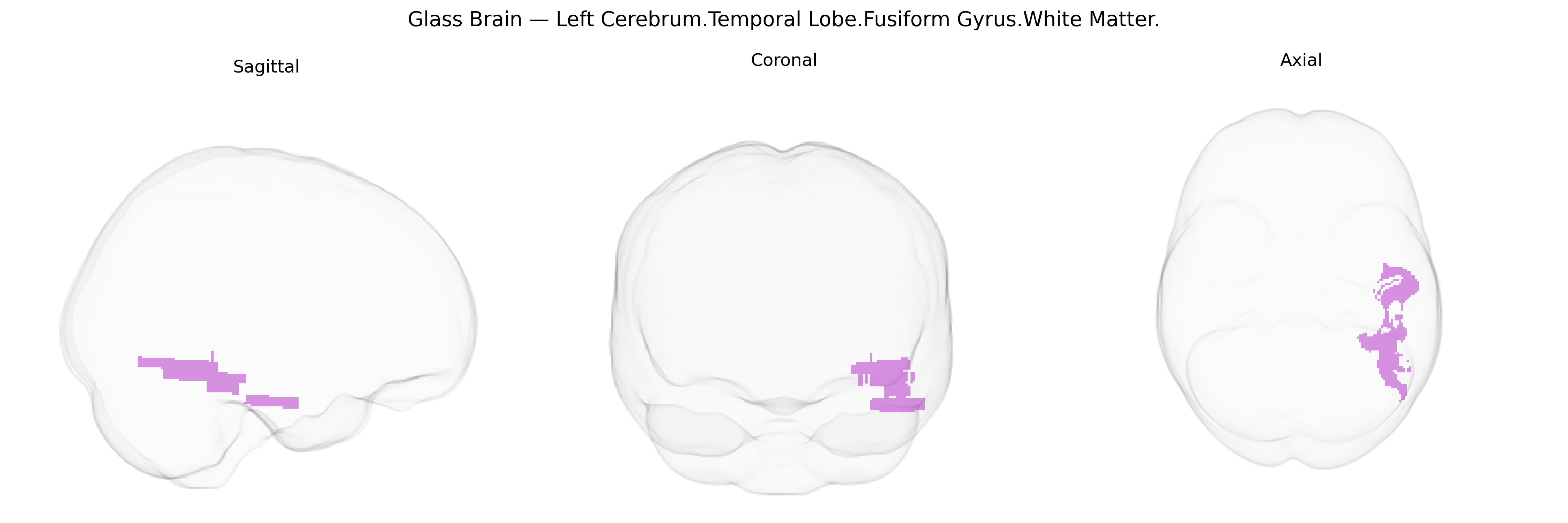
The bilateral Left Cerebrum.Temporal Lobe.Fusiform Gyrus.White Matter corresponds to the subcortical myelinated fiber pathways underlying the fusiform gyrus in the temporal lobe, supporting communication between fusiform cortical territories and other regions of the temporal, occipital, and limbic systems. This white matter includes association fibers that contribute to ventral visual stream processing, particularly object, face, and word recognition, by linking fusiform cortex with adjacent inferior temporal and occipital areas, as well as longer-range tracts connecting to frontal and parietal regions. Functionally, these fibers help integrate high-level visual information with memory and semantic systems, and lesions in or near this region can contribute to deficits such as prosopagnosia or impairments in visual word form processing, depending on the exact pathways disrupted. There is no direct link for the white matter component alone; a related cortical structure is the Fusiform gyrus.
The white matter of the bilateral fusiform gyrus in the temporal lobe—often implicated in face and visual word processing—has been linked through imaging genetics and GWAS to both general neuroanatomical variation and several neuropsychiatric and neurodevelopmental traits. Polygenic influences on fusiform white matter volume, microstructure (e.g., fractional anisotropy), and connectivity have been identified in large-scale brain-structure GWAS (such as ENIGMA and UK Biobank–based studies), implicating loci affecting myelination, axon guidance, and neuronal development (including genes involved in cell adhesion and oligodendrocyte function). Variants in and near genes such as CNTNAP2, NRG1, and those in the major histocompatibility complex (MHC) region have been associated with temporal and fusiform white matter alterations in schizophrenia and bipolar disorder, while autism spectrum disorder and specific language/reading disorders show associations between risk loci (e.g., in DCDC2, KIAA0319, and other neuronal migration genes) and changes in fusiform and adjacent temporal white matter tracts that support face, language, and orthographic processing. Fusiform white matter integrity and connectivity with ventral occipitotemporal and limbic networks also show heritable components and associations with polygenic scores for educational attainment, cognitive performance, and major depression, suggesting that this region’s white matter structure is partly shaped by common genetic variation that bridges typical cognitive variation and liability to psychiatric and learning-related disorders.
Overview generated by GPT-4o (2026).
Region ID: 128
Hemisphere: bilateral
Atlas: Talairach labels 1mm
Full Quality Version: Download MP4
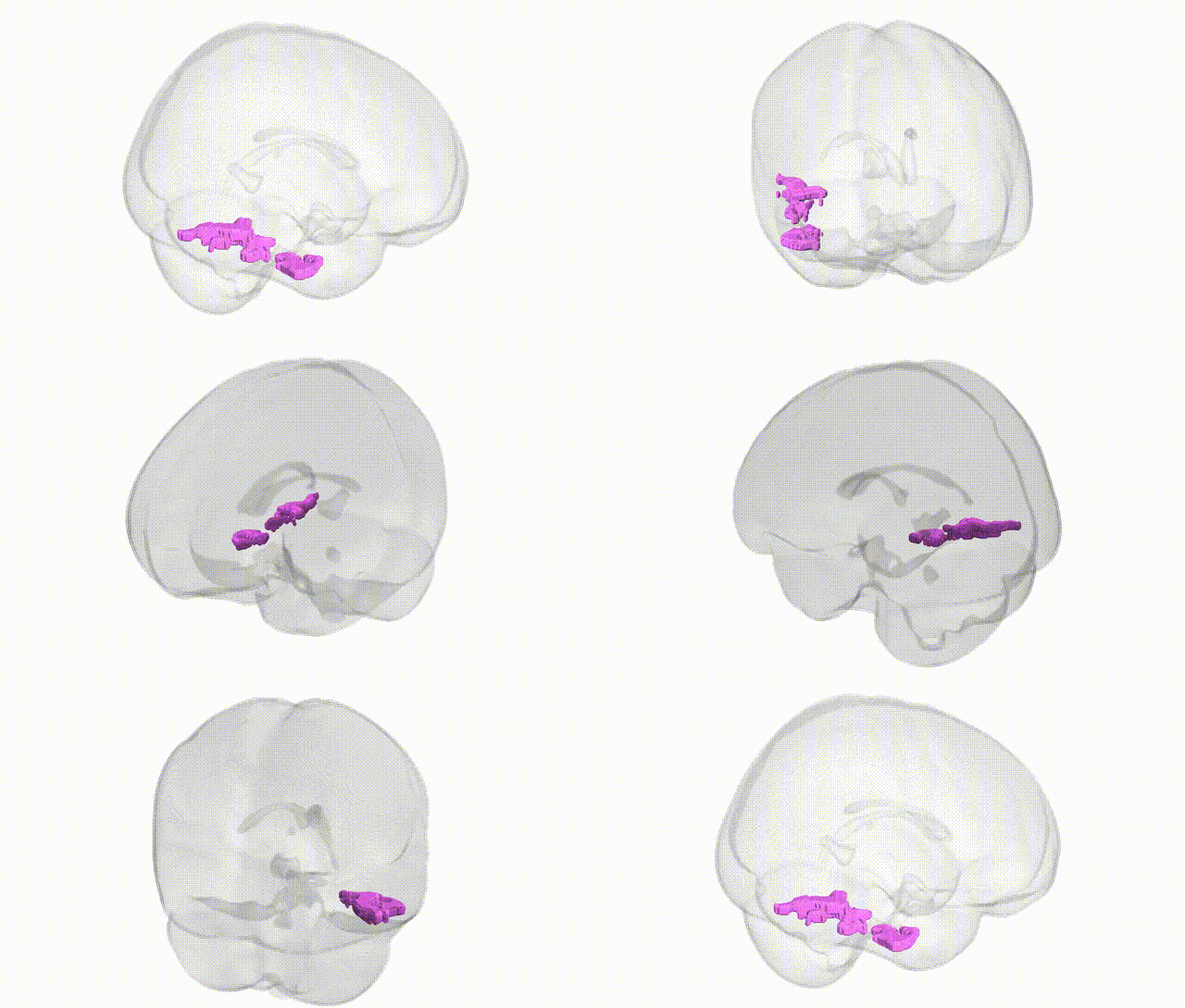
Full Quality Version: Download MP4
Wali Sidiqyar*, Gaurav Rudravaram*, Elyssa M. McMaster, Trent M. Schwartz, Adam M. Saunders, Kurt G. Schilling, Bennett A. Landman "Introducing SPINS: A Shared Public Visualization Library of Neuroanatomical Structures." Medical Imaging with Deep Learning- short paper
This resource is licensed under CC0 1.0 Universal (Public Domain).