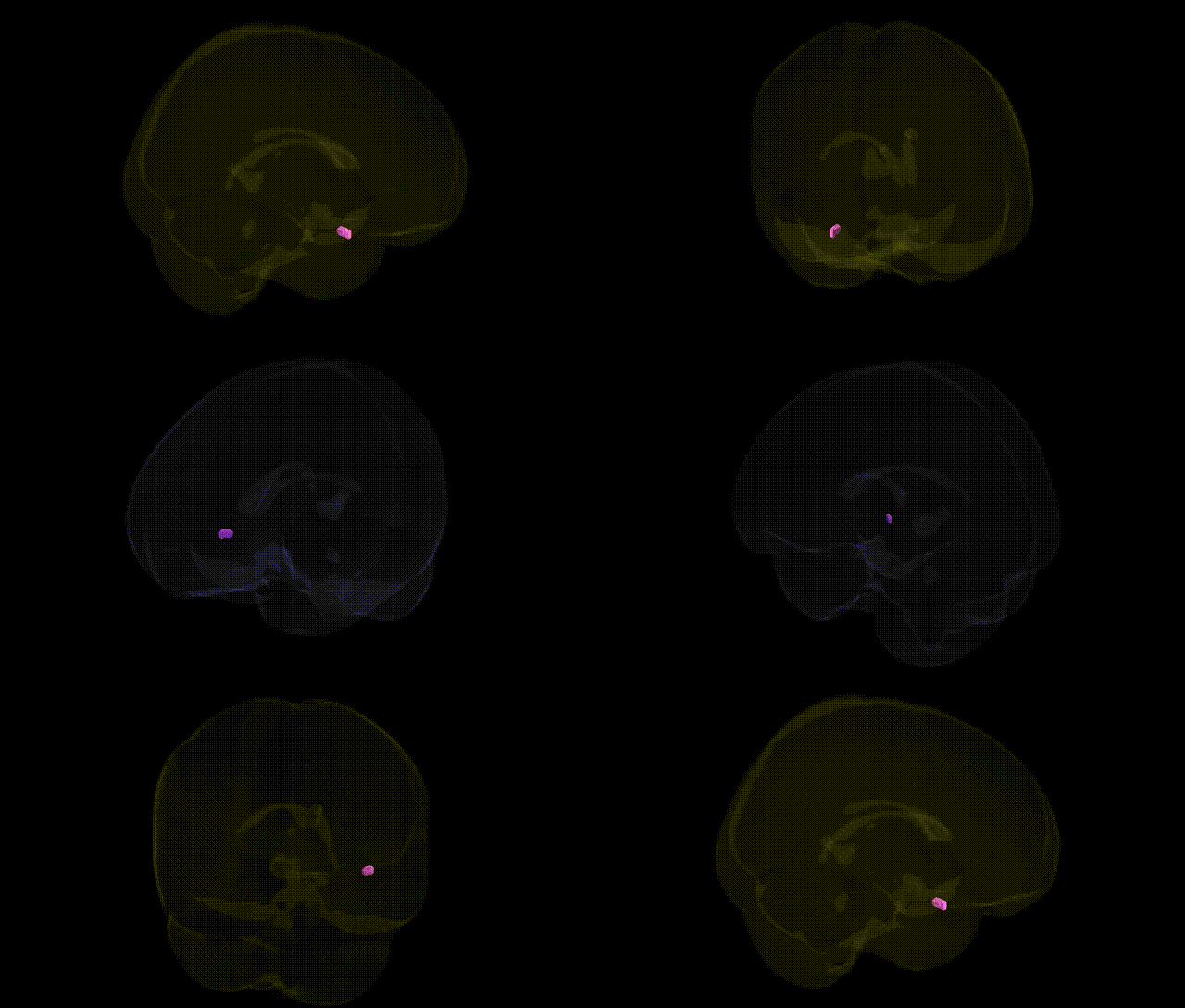
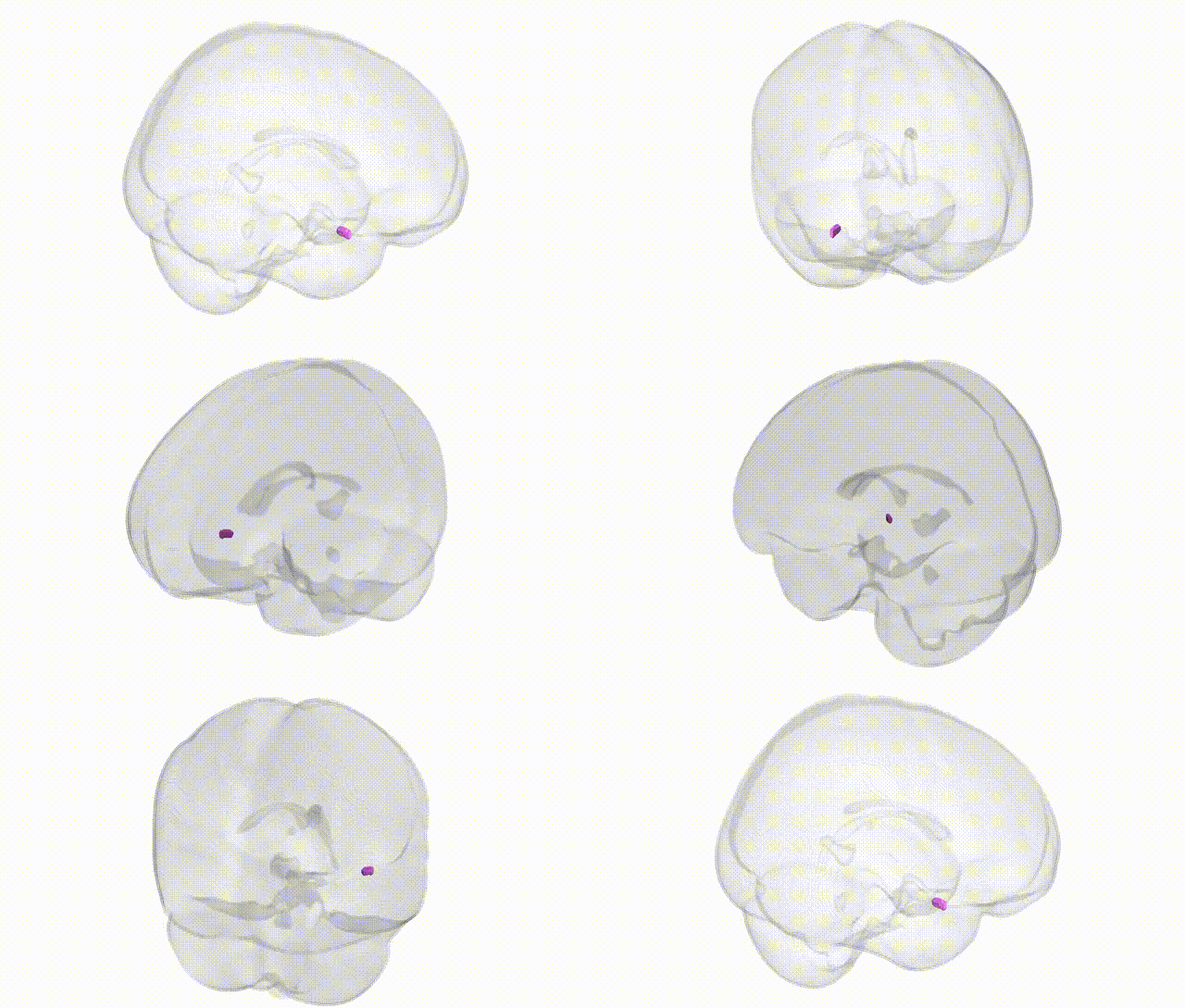
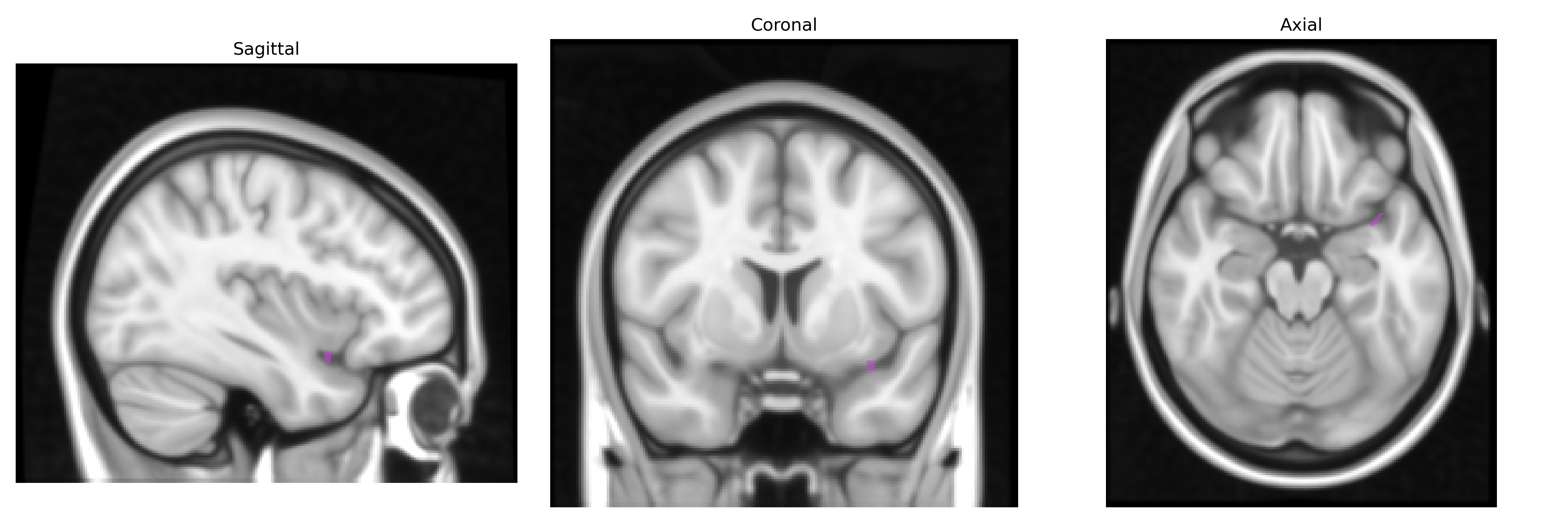
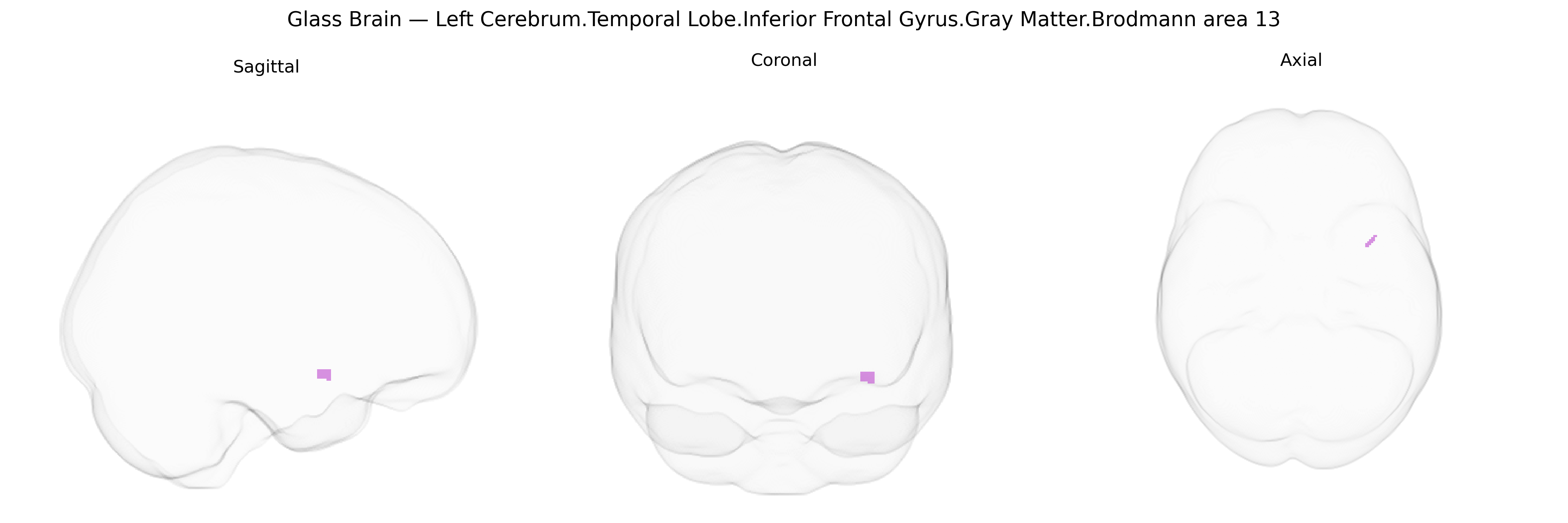
The bilateral Left Cerebrum.Temporal Lobe.Inferior Frontal Gyrus.Gray Matter.Brodmann area 13, as labeled in the Talairach 1 mm Atlas, corresponds to agranular and dysgranular cortex within the insular and adjacent frontal–temporal opercular regions, commonly associated with visceral, autonomic, and affective integration. Brodmann area 13 participates in processing interoceptive signals, taste, emotional and social cognition, and aspects of decision-making related to bodily states, with strong connections to limbic structures such as the amygdala and orbitofrontal cortex. It is involved in multimodal sensory integration and contributes to networks supporting awareness of internal bodily states and subjective emotional experience. There is no direct Wikipedia article for Brodmann area 13; a closely related structure is the insular cortex: Insular cortex.
The bilateral left inferior frontal gyrus gray matter encompassing Brodmann area 13 in the insula/ventral frontal region has been implicated in multiple genetically influenced traits and disorders through GWAS and imaging–genetics studies, although findings are typically reported for overlapping insular, ventral prefrontal, or inferior frontal regions rather than Talairach BA13 specifically. Common variant associations from large neuroimaging consortia (e.g., ENIGMA, UK Biobank) link structural measures (cortical thickness, surface area, and gray-matter volume) in the insular and inferior frontal regions to loci near genes involved in neurodevelopment, synaptic function, and axon guidance (such as MIR924HG, HMGA2, IGF2BP1, and several chromosomal regions including 3p24, 8q24, 12q14, and others), although effect sizes are small and region definitions can differ across atlases. Functionally, the broader ventral inferior frontal/insula region has been genetically associated with risk for major depressive disorder, anxiety disorders, and bipolar disorder in GWAS that identify overlapping risk loci (e.g., near CACNA1C, ANK3, SLC6A15, and several immune-related genes) whose carriers also show altered gray matter or activation in this area during affective and interoceptive tasks. Schizophrenia and psychosis risk loci (e.g., near ZNF804A, MIR137, and complement component C4-related regions) have likewise been linked to structural and functional abnormalities in adjacent frontal–insular circuits, and polygenic risk scores for schizophrenia and autism spectrum disorders show associations with altered morphology and connectivity of the inferior frontal and insular cortices. Addiction-related traits (particularly alcohol and nicotine use) and impulsivity have been associated via GWAS and polygenic score analyses with variation in ventral frontal and insular gray matter involving genes such as CHRNA5–CHRNA3–CHRNB4 and several dopaminergic and glutamatergic pathway genes. Overall, genetic associations for Talairach-derived BA13 converge on a distributed set of neurodevelopmental and synaptic genes whose variants modestly influence insular–inferior frontal gray matter structure and confer susceptibility to mood, psychotic, and addiction-related disorders, but no single gene or variant shows a specific, uniquely replicated association with this exact atlas-defined region.
Overview generated by GPT-4o (2026).
Region ID: 288
Hemisphere: bilateral
Atlas: Talairach labels 1mm
Full Quality Version: Download MP4
Full Quality Version: Download MP4
Wali Sidiqyar*, Gaurav Rudravaram*, Elyssa M. McMaster, Trent M. Schwartz, Adam M. Saunders, Kurt G. Schilling, Bennett A. Landman "Introducing SPINS: A Shared Public Visualization Library of Neuroanatomical Structures." Medical Imaging with Deep Learning- short paper
This resource is licensed under CC0 1.0 Universal (Public Domain).