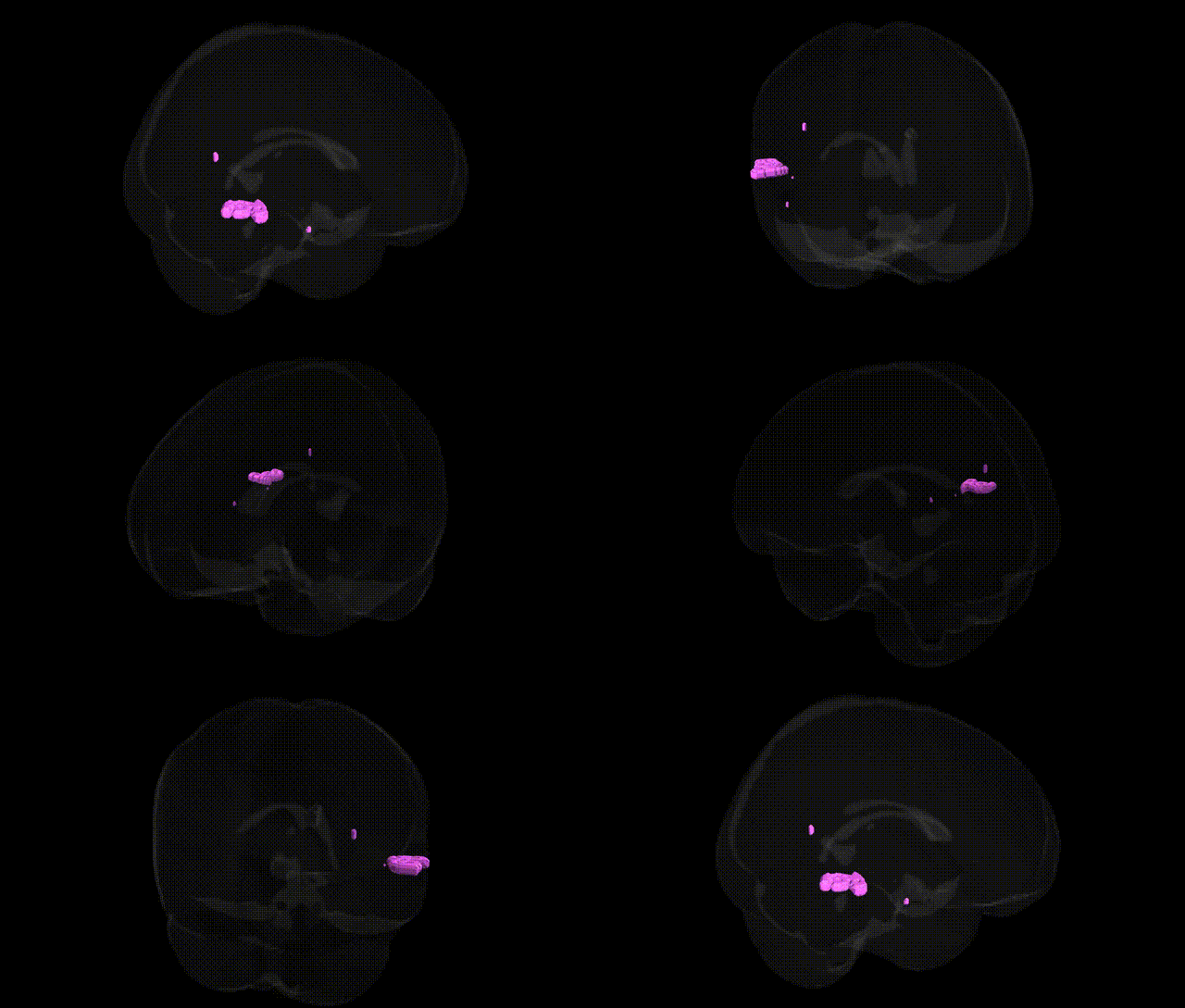
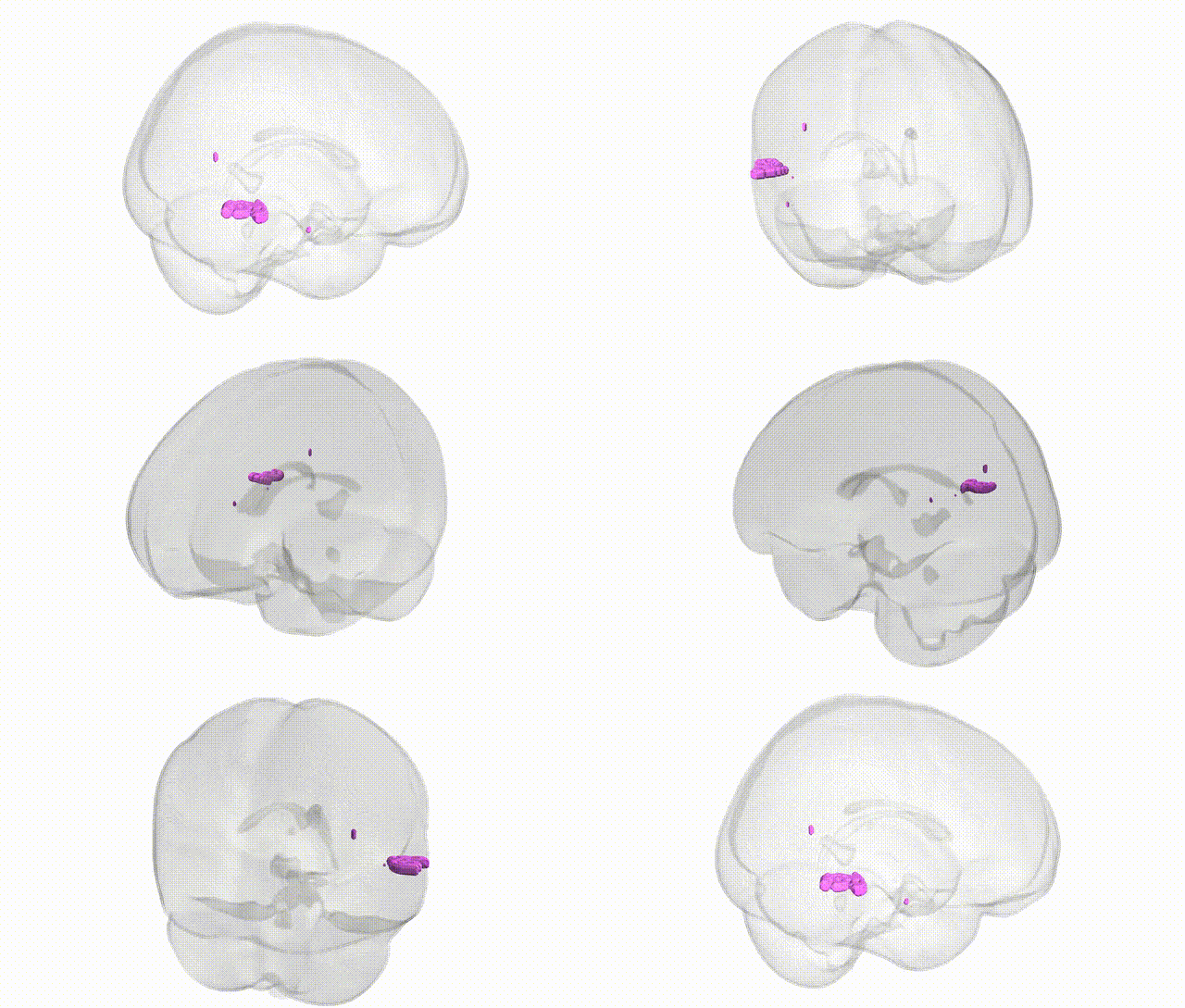
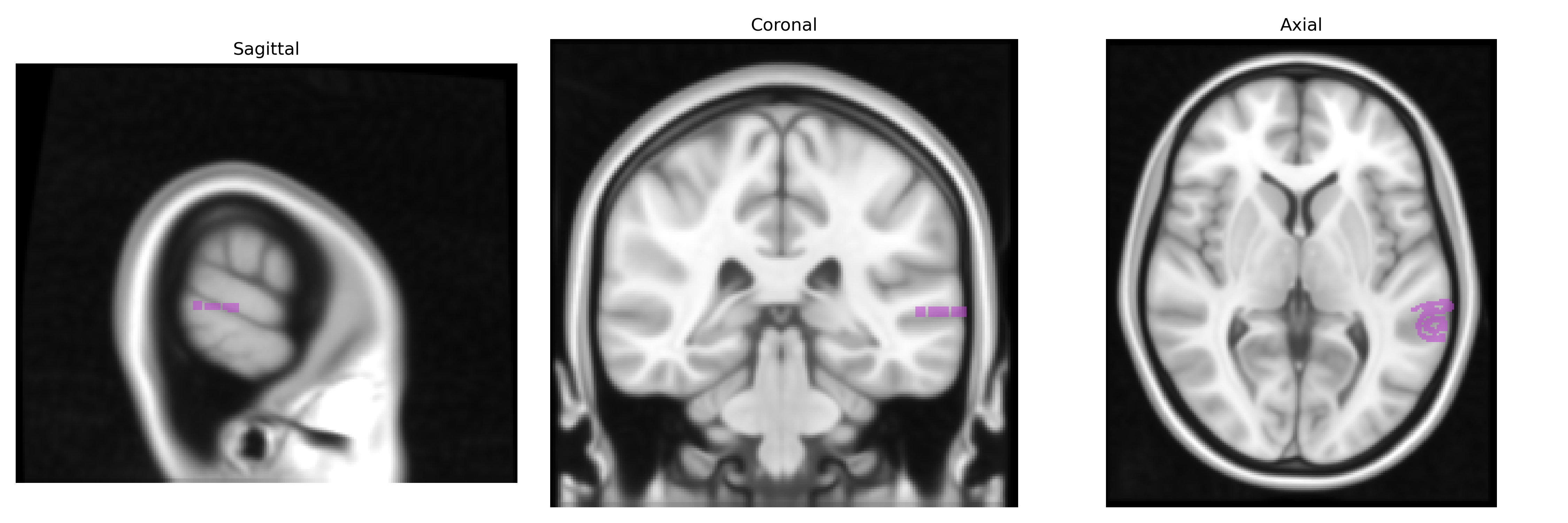
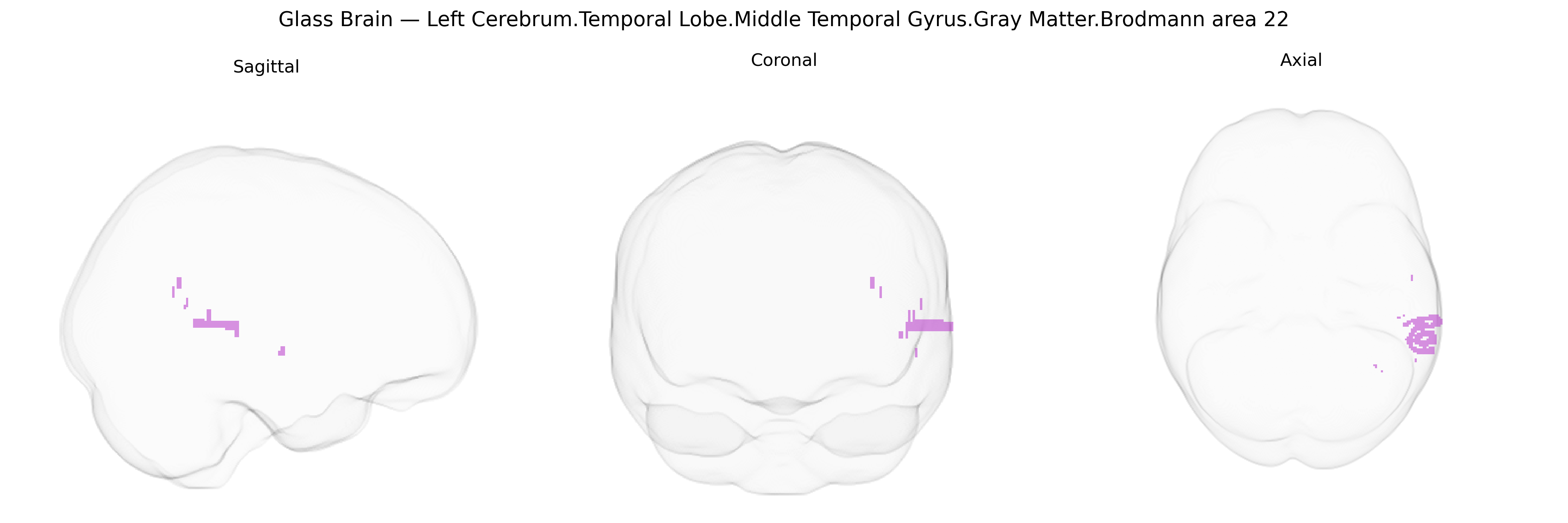
The bilateral Left Cerebrum.Temporal Lobe.Middle Temporal Gyrus.Gray Matter.Brodmann area 22 corresponds to a cortical region in the dominant temporal lobe that is critically involved in auditory processing and aspects of language comprehension, particularly the integration of complex auditory inputs such as speech. Brodmann area 22 encompasses much of the superior and middle temporal gyri, and in the left hemisphere includes Wernicke’s area, a key substrate for semantic processing and the mapping of sounds to meaning. Cytoarchitectonically, this area is characterized by a well-developed granular layer IV and pyramidal layers III and V suited for reciprocal connectivity with auditory cortices, association areas, and multimodal integration networks. Functionally, BA22 contributes to phonological decoding, lexical access, and the interpretation of prosody, and lesions in the left BA22 are classically associated with receptive (Wernicke’s) aphasia, marked by fluent but semantically impaired speech and reduced comprehension. There is no direct Wikipedia article specifically for “Brodmann area 22,” but it is closely related to Wernicke’s area.
The bilateral left middle temporal gyrus gray matter in Brodmann area 22, a core component of the superior–middle temporal language network and part of Wernicke’s region, has been implicated in multiple genetic and GWAS findings linking structure and function of this area to language, psychiatric, and neurodevelopmental traits. Imaging genetics studies show that common variants in FOXP2, CNTNAP2, KIAA0319, DCDC2, and other dyslexia- or language-related genes modulate gray matter volume, cortical thickness, or activation in left temporal language cortex, including BA22, with downstream effects on phonological processing and speech perception. Large-scale ENIGMA and UK Biobank GWAS of cortical surface area and thickness have identified associations between this region and variants near genes involved in neurodevelopment and synaptic function (for example in or near MIR124-1, EPHB2, and cell-adhesion pathways), and polygenic scores for educational attainment and cognitive performance partly track individual differences in temporal lobe morphology. Schizophrenia, bipolar disorder, major depression, and autism spectrum disorder show convergent genetic associations with altered structure, connectivity, and activation in this area, with risk loci (such as in CACNA1C, GRIN2A, complement pathway genes, and synaptic scaffolding genes) linked to temporal lobe volume reductions or language/auditory hallucination phenotypes. Additional GWAS and candidate-gene work implicate left BA22 in genetic influences on reading ability, specific language impairment, stuttering, and auditory processing traits, positioning this region as a key neuroanatomical substrate where polygenic variation in neurodevelopmental and synaptic pathways manifests as differences in language and higher-order auditory cognition.
Overview generated by GPT-4o (2026).
Region ID: 458
Hemisphere: bilateral
Atlas: Talairach labels 1mm
Full Quality Version: Download MP4
Full Quality Version: Download MP4
Wali Sidiqyar*, Gaurav Rudravaram*, Elyssa M. McMaster, Trent M. Schwartz, Adam M. Saunders, Kurt G. Schilling, Bennett A. Landman "Introducing SPINS: A Shared Public Visualization Library of Neuroanatomical Structures." Medical Imaging with Deep Learning- short paper
This resource is licensed under CC0 1.0 Universal (Public Domain).