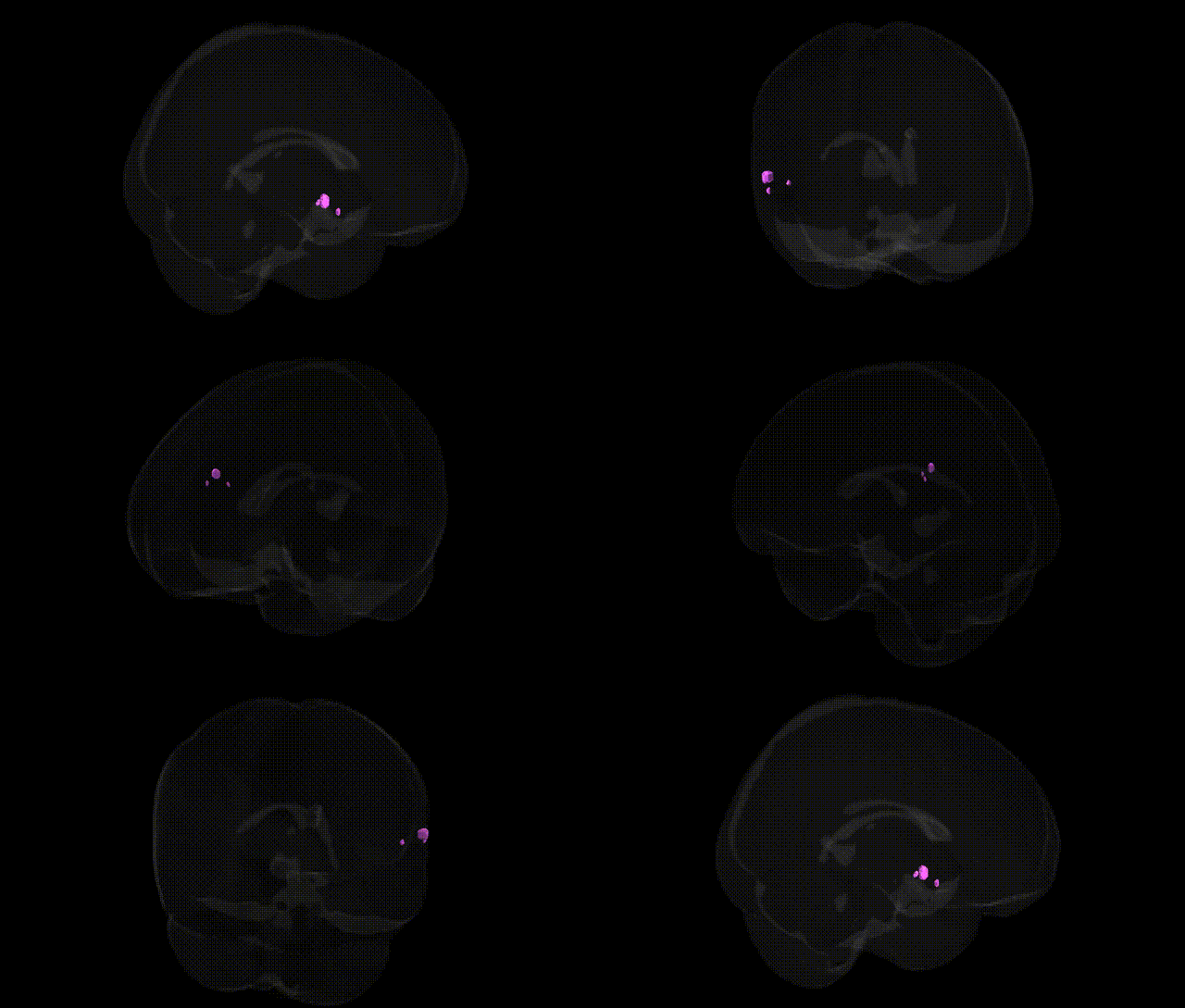
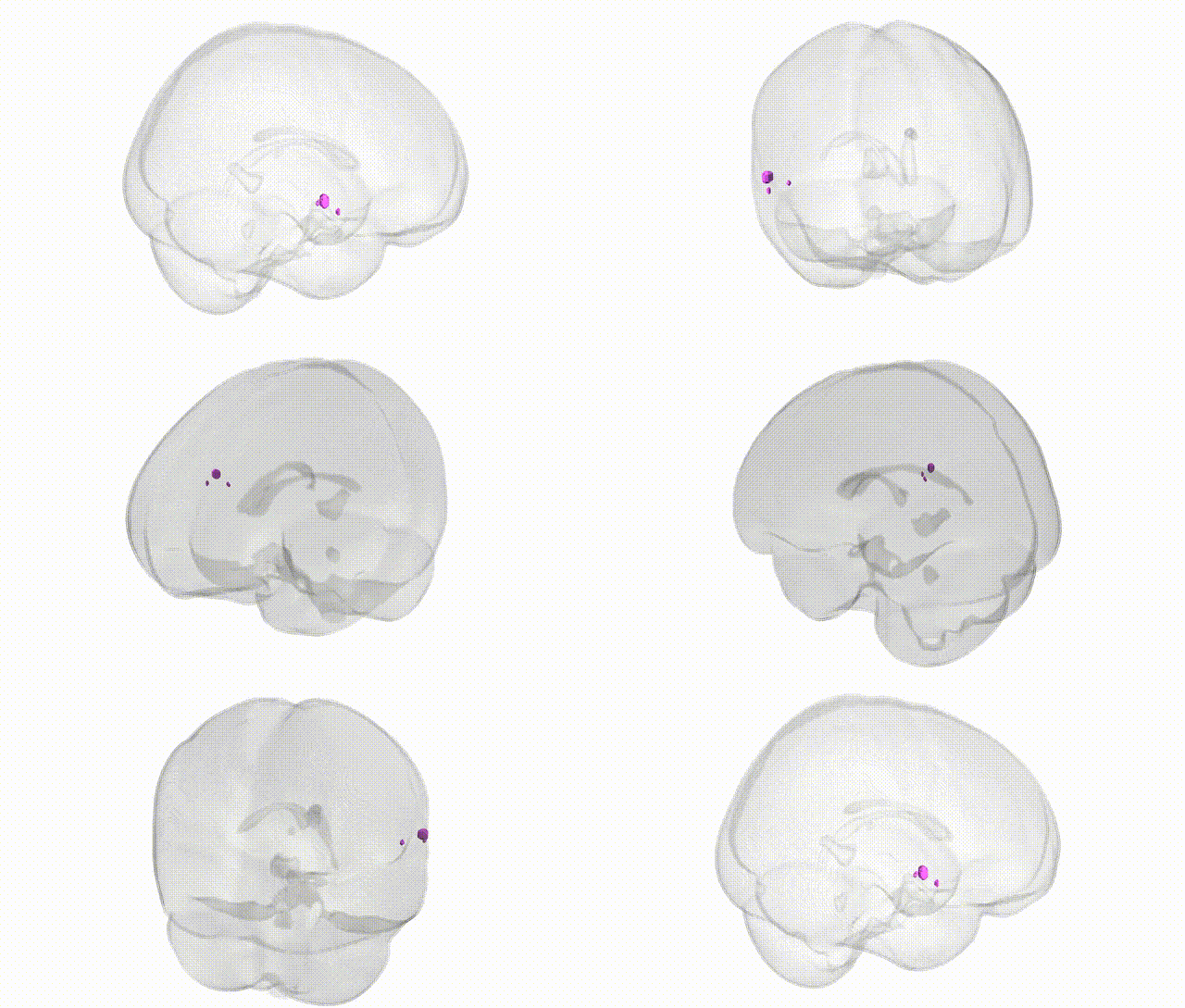
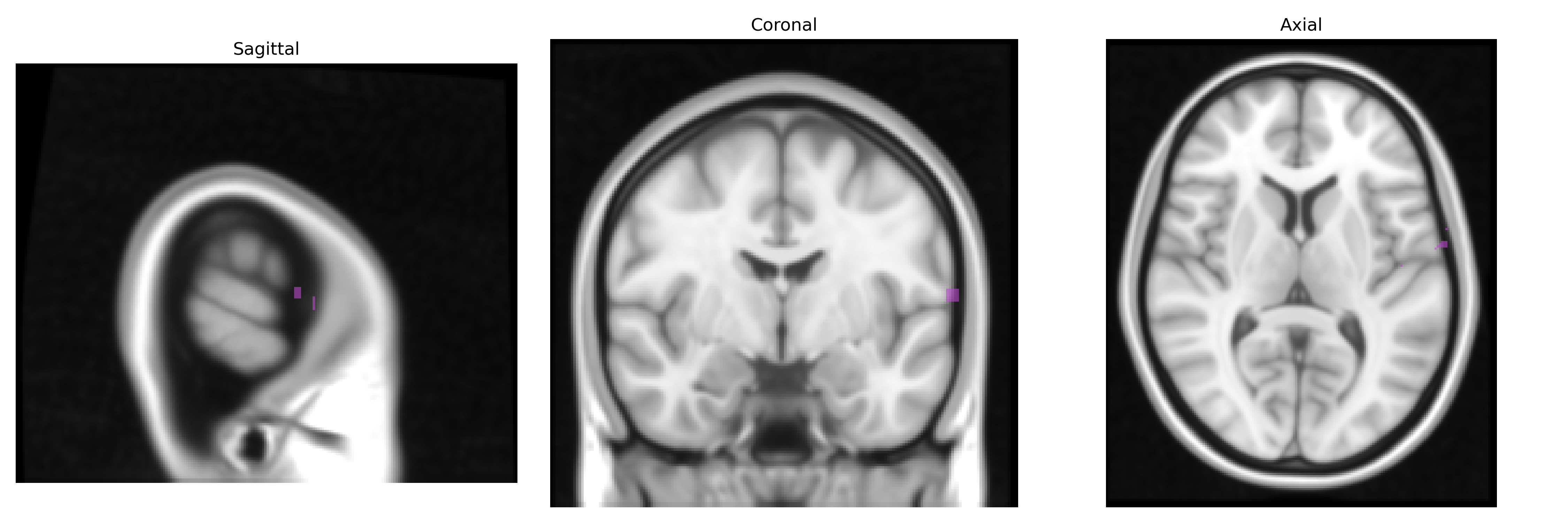
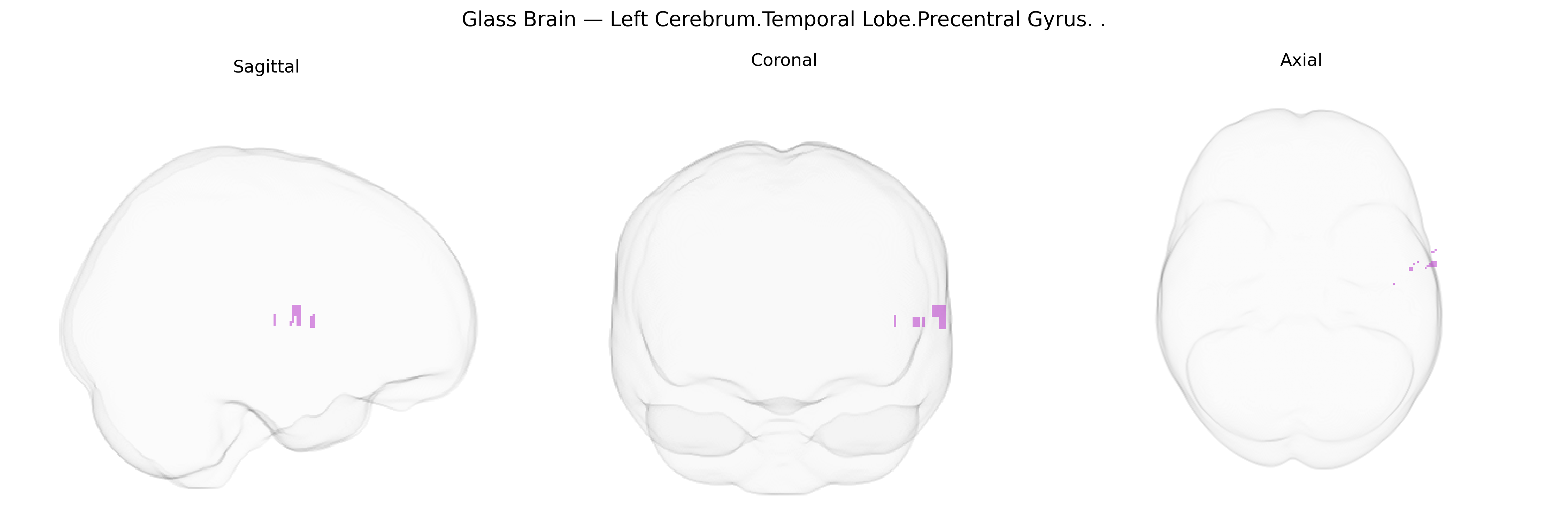
The “bilateral Left Cerebrum.Temporal Lobe.Precentral Gyrus” label from the Talairach 1 mm atlas likely reflects a registration or labeling artifact, because the precentral gyrus is classically a frontal lobe structure rather than temporal. The precentral gyrus contains the primary motor cortex (Brodmann area 4), which is critical for the initiation and control of voluntary movements, showing a somatotopic organization (motor homunculus) with medial portions representing lower limbs and lateral portions representing face and upper limbs. It receives inputs from premotor and supplementary motor areas and sends descending corticospinal and corticobulbar projections involved in fine motor control, particularly of distal musculature. Functionally, this region supports precise, goal-directed motor actions and is frequently implicated in motor deficits such as contralateral weakness or paralysis when lesioned. A related article is: Precentral gyrus.
The bilateral left cerebrum temporal lobe “precentral gyrus” label in the Talairach 1 mm atlas likely reflects a boundary/labeling artifact, but the precentral gyrus itself (classically primary motor cortex) and adjacent temporal–frontal motor regions have been repeatedly implicated in genetic studies of motor, language, and neuropsychiatric traits. GWAS and imaging–genetics studies link variation in genes related to neurodevelopment, synaptic plasticity, and axon guidance (for example, MAPT, BDNF, KIAA0319, CNTNAP2, FOXP2, and multiple polygenic scores for schizophrenia, bipolar disorder, autism spectrum disorder, and ADHD) with cortical thickness, surface area, or activation patterns in precentral and nearby perisylvian regions, including those extending into the temporal plane. Polygenic risk for schizophrenia and major depression has been associated with altered motor cortex and superior temporal morphology and connectivity, while ALS and primary motor neuron disease genetics (e.g., C9orf72, SOD1, TARDBP) are linked to precentral gyrus degeneration. Variants in language- and reading-related genes (FOXP2, DCDC2, KIAA0319) associate with structure and function in perisylvian motor–temporal regions supporting speech production and phonological processing, and common variants influencing motor skills, handedness, and cortical microstructure also show associations with precentral and adjacent temporal regions in large consortia datasets (e.g., ENIGMA, UK Biobank), indicating that this territory is a convergence zone for polygenic influences on motor, speech, and higher-order cognitive functions.
Overview generated by GPT-4o (2026).
Region ID: 678
Hemisphere: bilateral
Atlas: Talairach labels 1mm
Full Quality Version: Download MP4
Full Quality Version: Download MP4
Wali Sidiqyar*, Gaurav Rudravaram*, Elyssa M. McMaster, Trent M. Schwartz, Adam M. Saunders, Kurt G. Schilling, Bennett A. Landman "Introducing SPINS: A Shared Public Visualization Library of Neuroanatomical Structures." Medical Imaging with Deep Learning- short paper
This resource is licensed under CC0 1.0 Universal (Public Domain).