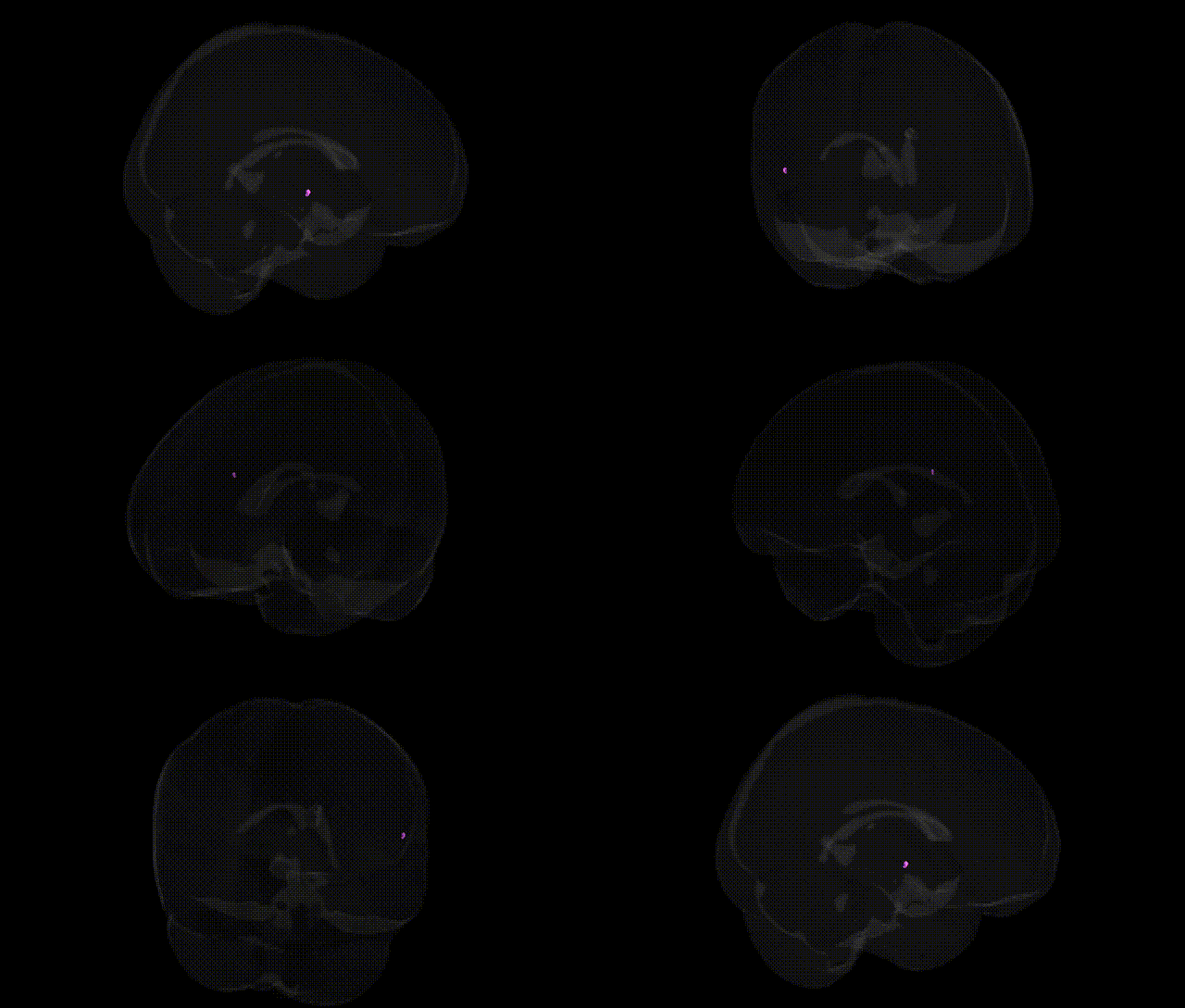
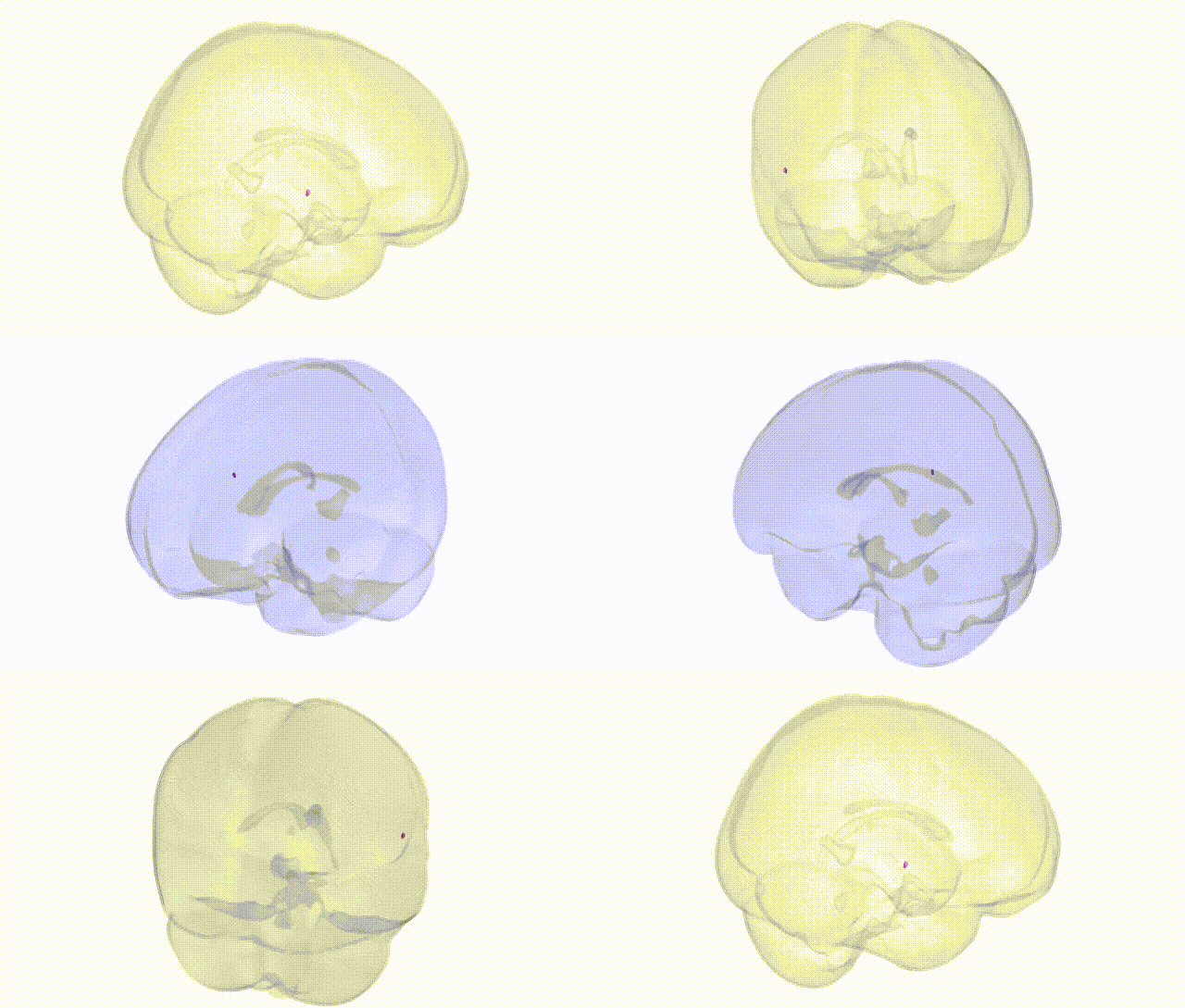
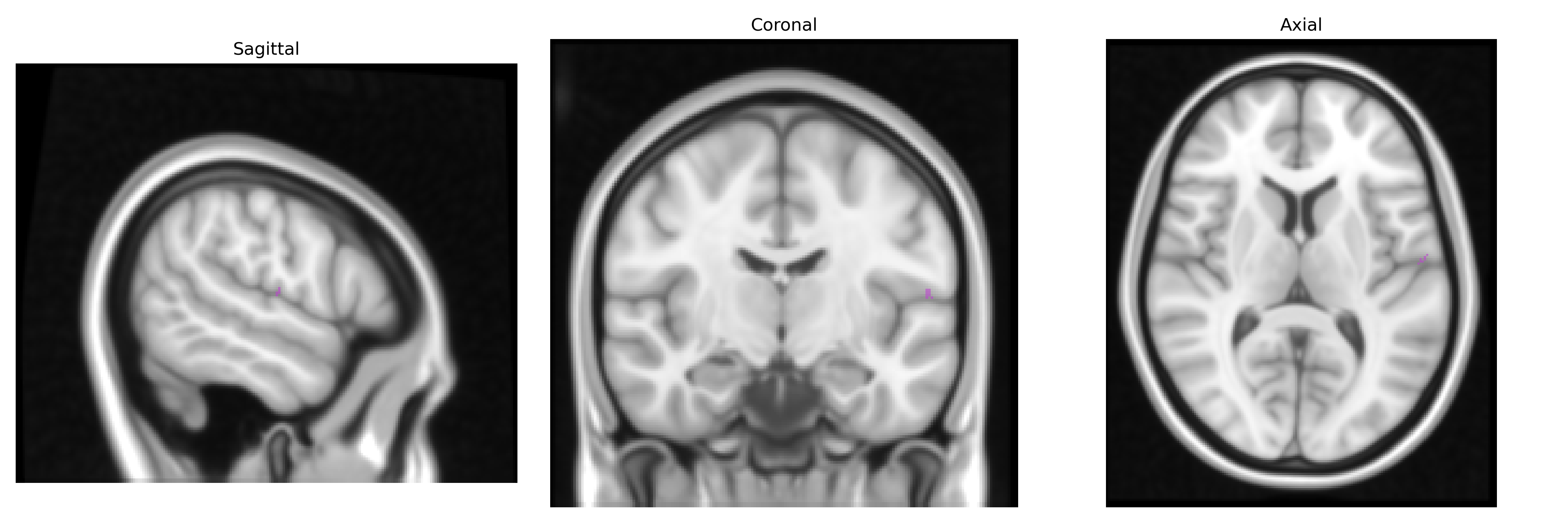
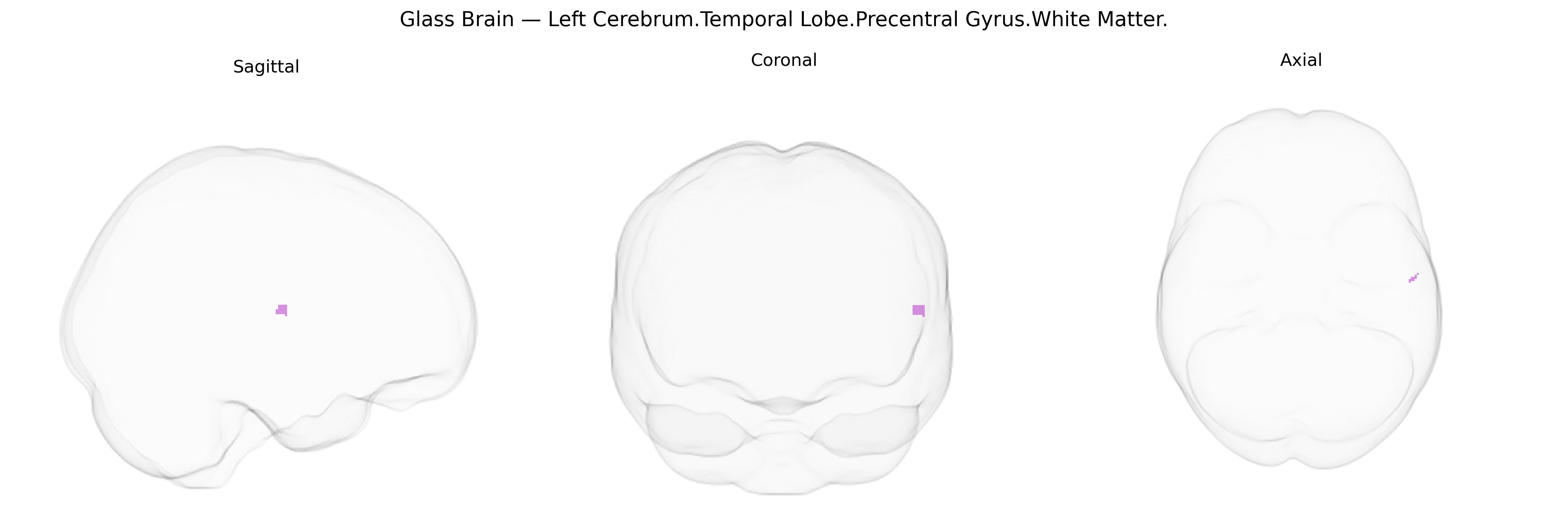
The bilateral Left Cerebrum.Temporal Lobe.Precentral Gyrus.White Matter, as labeled in the Talairach 1 mm atlas, refers to subcortical white matter tracts situated deep to the cortical ribbon of the precentral gyrus in the temporal lobe region of the left cerebral hemisphere. These fibers primarily consist of myelinated axons that connect primary and premotor cortical areas with other cortical and subcortical targets, supporting efficient communication within motor and associative networks. Functionally, this white matter contributes to the integration and transmission of signals involved in motor planning, sensorimotor processing, and higher-order associative functions mediated by temporo-frontal and temporo-parietal connections. There is no direct Wikipedia article for this exact composite label; a closely related entry describing the overlying cortical structure is Precentral gyrus.
The bilateral left cerebrum temporal-lobe–labeled precentral gyrus white matter in the Talairach 1 mm atlas corresponds mainly to frontotemporal motor association fibers, and genetic associations implicating this region arise largely from imaging–genetics and GWAS of white-matter microstructure and cortical morphology rather than from single-gene studies. Large consortia such as ENIGMA and UK Biobank have reported that common variants in genes involved in axonal guidance, myelination, and synaptic plasticity (for example, NTRK2, BDNF, MAG, and NCAM-related loci) are associated with diffusion MRI measures (FA, MD) and surface area/thickness in precentral and adjacent frontotemporal white matter tracts, including corticospinal and superior longitudinal fasciculi. Polygenic risk scores for neurodevelopmental and psychiatric disorders—particularly schizophrenia, bipolar disorder, autism spectrum disorder, ADHD, and major depressive disorder—have been linked to altered precentral and nearby temporal white-matter integrity, suggesting pleiotropic genetic effects on motor-related and associative circuits. In addition, GWAS of motor function, handedness, and speech-related traits have identified loci (for example in MAPT, FOXP2-adjacent regions, and general neurodevelopmental genes) that correlate with structural variability in this frontotemporal white matter, while neurodegenerative conditions such as ALS and frontotemporal dementia show heritable patterns of degeneration that frequently involve precentral and temporal white-matter pathways, implicating shared genetic risks across motor and cognitive networks.
Overview generated by GPT-4o (2026).
Region ID: 737
Hemisphere: bilateral
Atlas: Talairach labels 1mm
Full Quality Version: Download MP4
Full Quality Version: Download MP4
Wali Sidiqyar*, Gaurav Rudravaram*, Elyssa M. McMaster, Trent M. Schwartz, Adam M. Saunders, Kurt G. Schilling, Bennett A. Landman "Introducing SPINS: A Shared Public Visualization Library of Neuroanatomical Structures." Medical Imaging with Deep Learning- short paper
This resource is licensed under CC0 1.0 Universal (Public Domain).