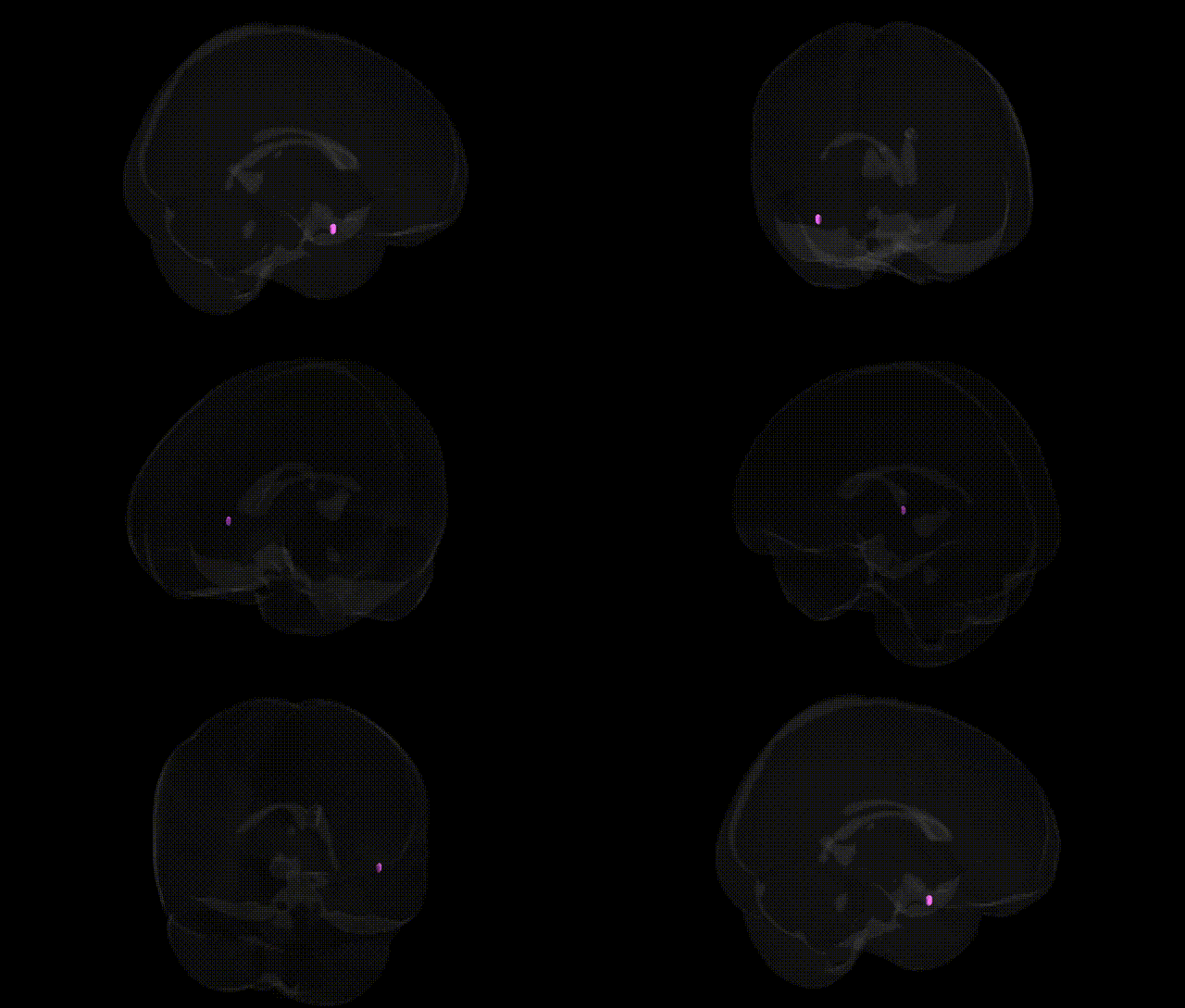
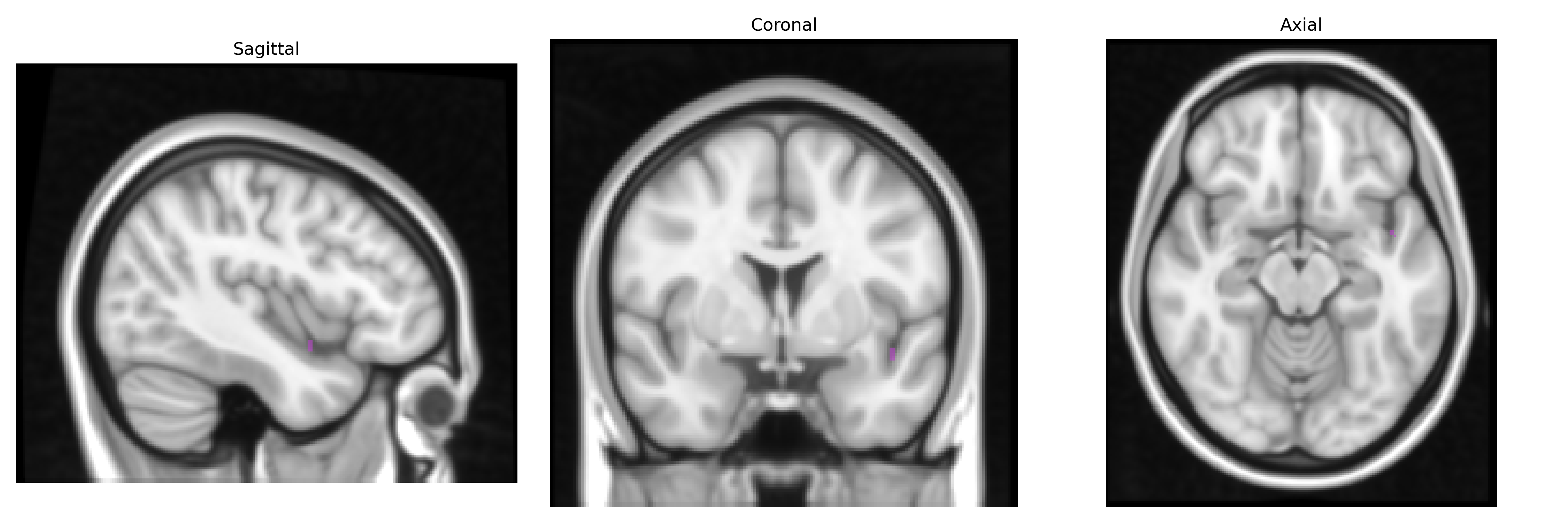
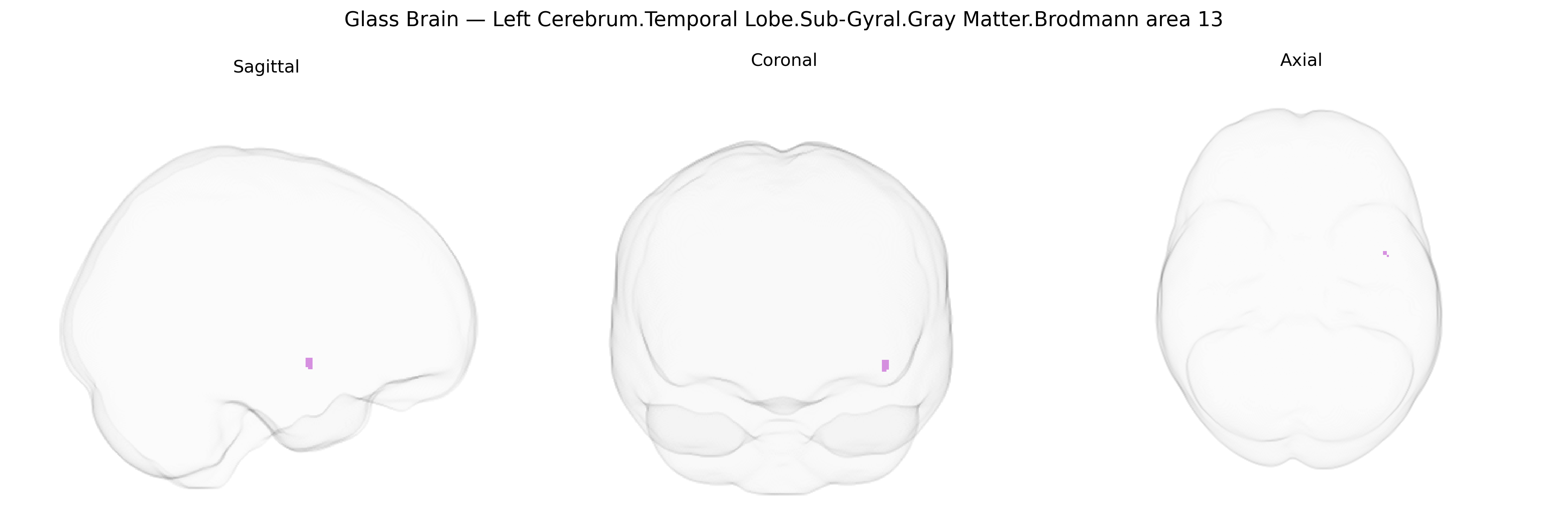
The bilateral Left Cerebrum.Temporal Lobe.Sub-Gyral.Gray Matter.Brodmann area 13 corresponds primarily to cortex within the insular region and adjacent paralimbic temporal areas that form part of the ventral agranular insula. This area is considered a key hub in multimodal integration, receiving convergent inputs from sensory, limbic, and autonomic systems, and is implicated in functions such as interoceptive awareness, emotional processing, gustation, and components of pain perception and viscerosensory regulation. Cytoarchitectonically, Brodmann area 13 is characterized by a relatively agranular pattern with prominent pyramidal neurons and dense reciprocal connections with orbitofrontal cortex, amygdala, and other temporal and limbic structures, supporting its role in integrating affective, homeostatic, and cognitive information. There is no direct link for Brodmann area 13; a closely related structure is the Insular cortex.
Brodmann area 13, located deep in the temporal lobe and often grouped with insular and paralimbic cortex, has been implicated in multiple genetic and GWAS findings through its roles in interoception, emotion, and salience processing rather than through region-specific genetic loci. Large-scale imaging–genetics consortia such as ENIGMA and UK Biobank have reported heritable variation in temporal lobe gray matter volume and cortical thickness, including insular and adjacent BA13 territories, with polygenic influences involving neurodevelopmental, synaptic, and immune-related genes (for example, common variants in genes like BDNF, SLC39A8, and complement pathway components that broadly affect cortical structure). GWAS and candidate-gene studies of psychiatric disorders that show structural or functional abnormalities overlapping BA13—particularly major depressive disorder, schizophrenia, bipolar disorder, anxiety disorders, post-traumatic stress disorder, and substance use disorders—have identified risk loci in glutamatergic, GABAergic, dopaminergic, and calcium-channel genes (such as CACNA1C, GRIN2A, DRD2) whose effects often manifest as altered temporal–insular gray matter or connectivity rather than BA13-specific signals. Additionally, genetic variants associated with traits like neuroticism, risk-taking, pain sensitivity, and autonomic regulation have been linked to insula/BA13 activation patterns in imaging–genetics studies, but current evidence supports a distributed polygenic architecture influencing broader salience and limbic networks rather than uniquely targeting the bilateral Left Cerebrum.Temporal Lobe.Sub-Gyral.Gray Matter.Brodmann area 13 region defined in the Talairach labels 1 mm atlas.
Overview generated by GPT-4o (2026).
Region ID: 366
Hemisphere: bilateral
Atlas: Talairach labels 1mm
Full Quality Version: Download MP4
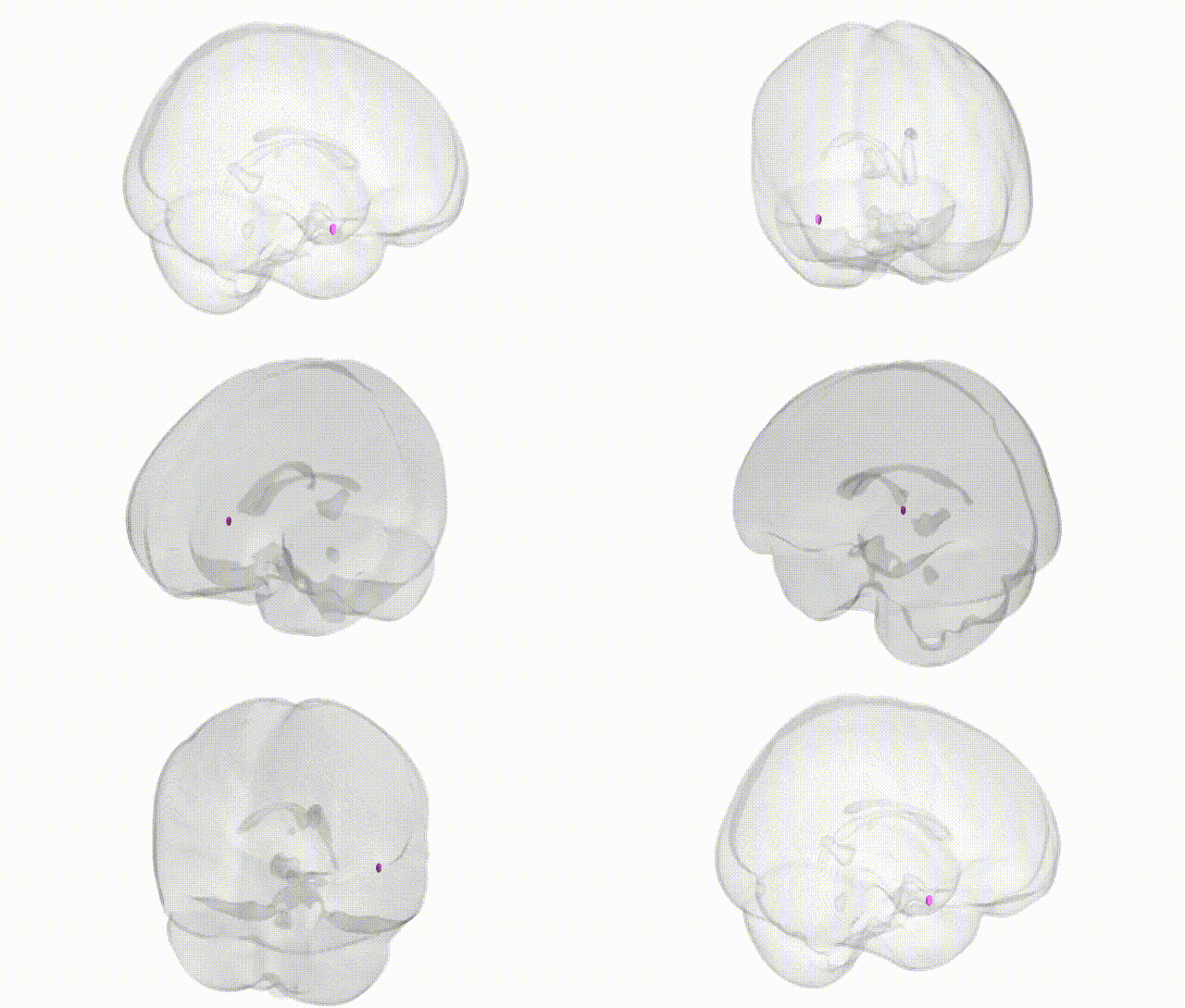
Full Quality Version: Download MP4
Wali Sidiqyar*, Gaurav Rudravaram*, Elyssa M. McMaster, Trent M. Schwartz, Adam M. Saunders, Kurt G. Schilling, Bennett A. Landman "Introducing SPINS: A Shared Public Visualization Library of Neuroanatomical Structures." Medical Imaging with Deep Learning- short paper
This resource is licensed under CC0 1.0 Universal (Public Domain).