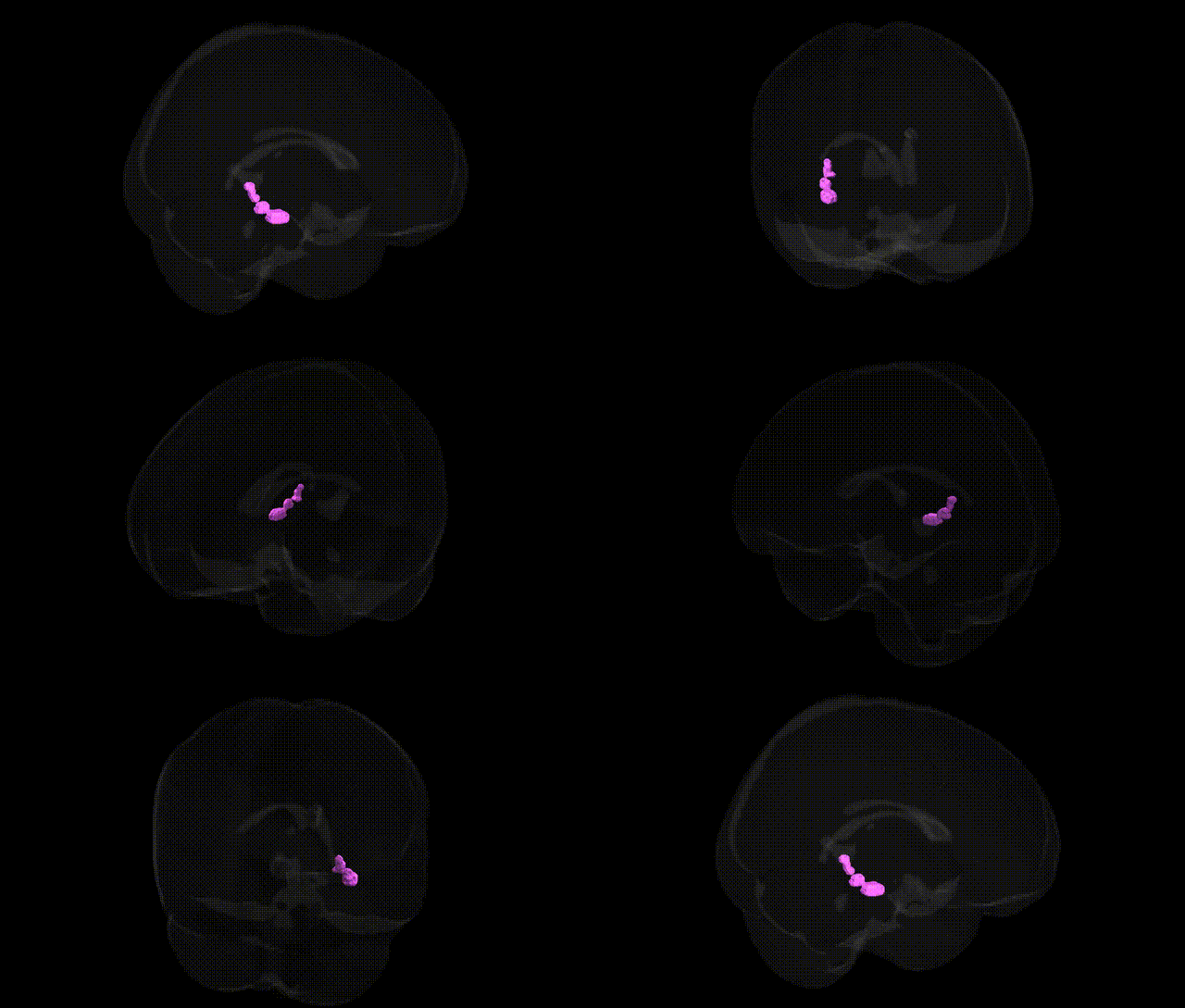
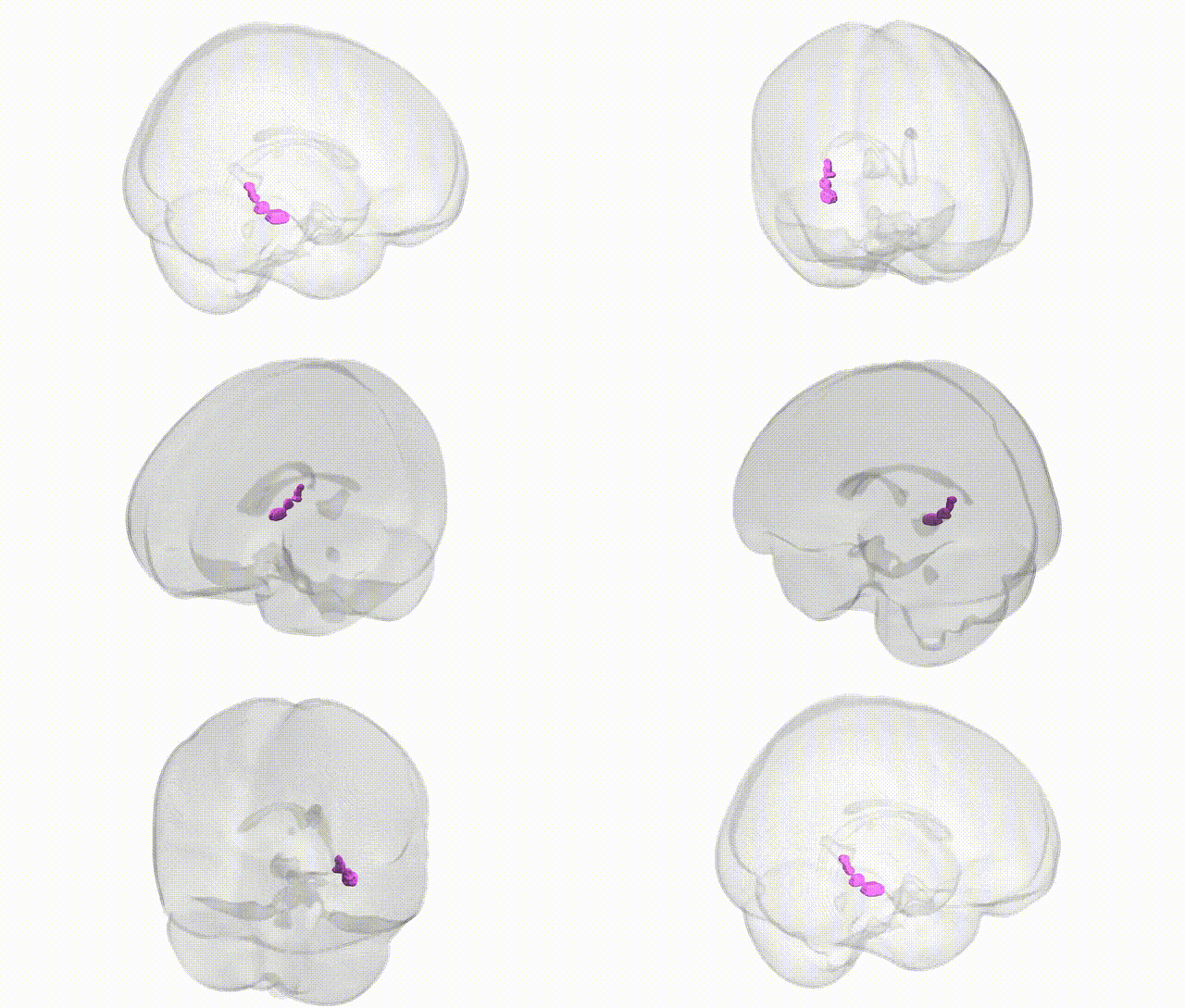
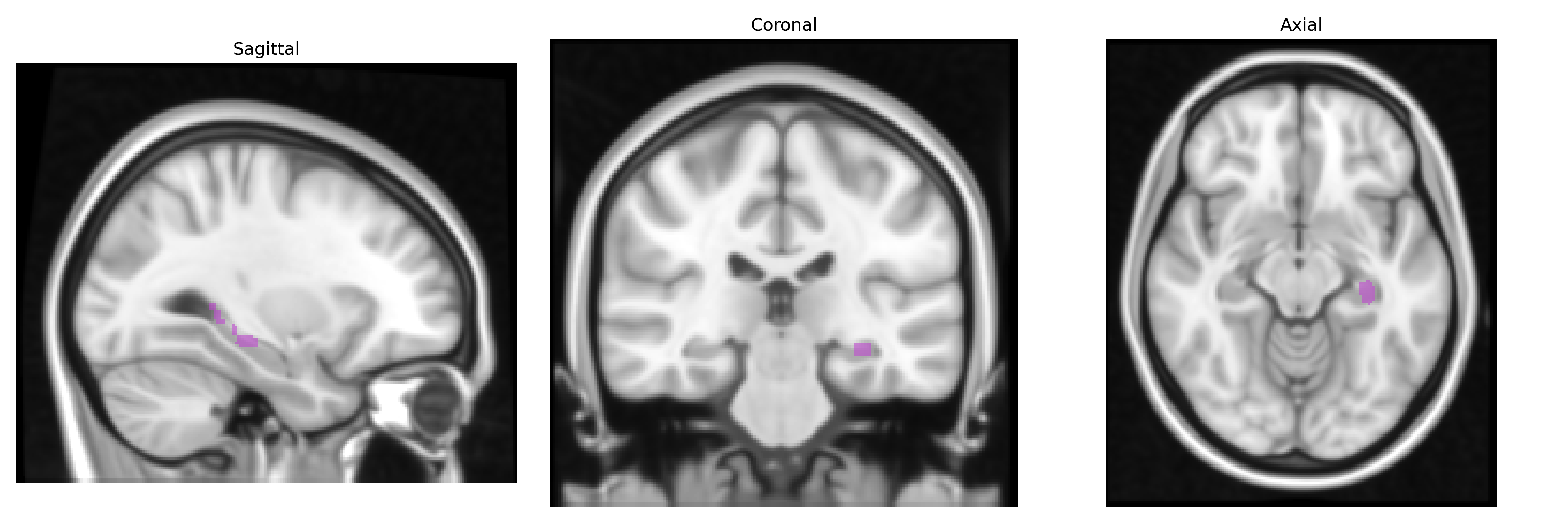
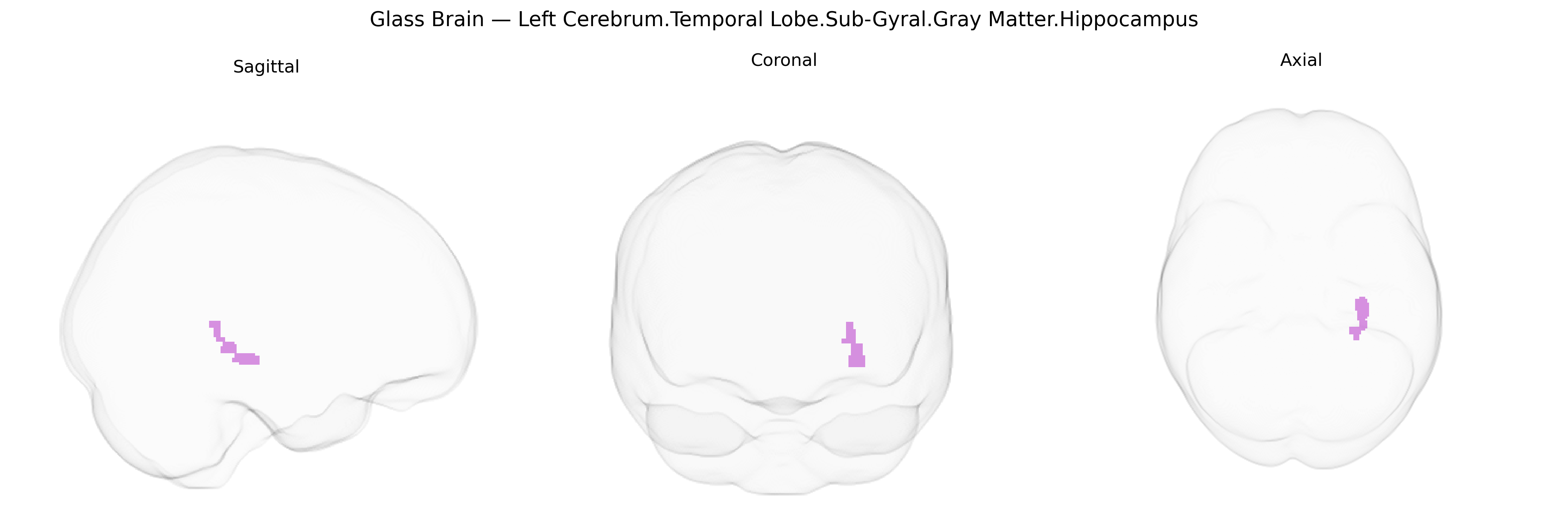
The bilateral Left Cerebrum.Temporal Lobe.Sub-Gyral.Gray Matter.Hippocampus corresponds to the hippocampal formation located deep within the medial temporal lobes, beneath the cortical gyri, and composed primarily of densely packed gray matter containing pyramidal neurons and interneurons. This structure plays a central role in the encoding and consolidation of episodic and declarative memories, spatial navigation, and contextual learning, and it is a key component of the limbic system, interconnected with the entorhinal cortex, amygdala, and prefrontal cortical regions. Histologically, it includes subfields such as CA1–CA4 and the dentate gyrus, exhibits a characteristic laminar architecture, and is highly plastic but also vulnerable to hypoxia, excitotoxicity, and neurodegenerative processes such as those seen in Alzheimer’s disease and temporal lobe epilepsy. Hippocampus
The bilateral left temporal sub-gyral gray matter of the hippocampus, as defined in the Talairach 1 mm atlas, has been repeatedly implicated in genetic studies of memory, neurodegeneration, and psychiatric disease, with numerous genome-wide association studies (GWAS) identifying loci that influence hippocampal volume, microstructure, and function. Large imaging–genetics consortia such as ENIGMA and UK Biobank have reported robust associations between hippocampal metrics and variants near or within genes involved in synaptic plasticity, neurodevelopment, and neurodegeneration, including APOE (particularly the ε4 allele) for reduced hippocampal volume and increased Alzheimer’s disease risk, and genes like BIN1, CLU, PICALM, and CR1 that contribute to amyloid and tau pathology. Polygenic risk scores for Alzheimer’s disease, schizophrenia, major depressive disorder, bipolar disorder, and post-traumatic stress disorder show negative correlations with hippocampal volume or altered connectivity in this region, supporting a shared genetic architecture between hippocampal structure and these conditions. GWAS of cognitive traits (e.g., episodic memory, general cognitive ability, educational attainment) also reveal overlapping genetic influences with hippocampal morphology, implicating loci in pathways such as glutamatergic signaling, neuronal differentiation, and calcium homeostasis. Additionally, variants affecting stress-response and HPA-axis genes (for example FKBP5 and CRHR1 in some cohorts) have been linked to hippocampal volume differences and vulnerability to stress-related disorders, while genes regulating neurogenesis and axonal growth (such as BDNF, though often through candidate-gene and smaller-sample work) have been associated with hippocampal-dependent learning and memory, collectively highlighting this region as a central, genetically modulated hub for cognition and neuropsychiatric disease.
Overview generated by GPT-4o (2026).
Region ID: 337
Hemisphere: bilateral
Atlas: Talairach labels 1mm
Full Quality Version: Download MP4
Full Quality Version: Download MP4
Wali Sidiqyar*, Gaurav Rudravaram*, Elyssa M. McMaster, Trent M. Schwartz, Adam M. Saunders, Kurt G. Schilling, Bennett A. Landman "Introducing SPINS: A Shared Public Visualization Library of Neuroanatomical Structures." Medical Imaging with Deep Learning- short paper
This resource is licensed under CC0 1.0 Universal (Public Domain).