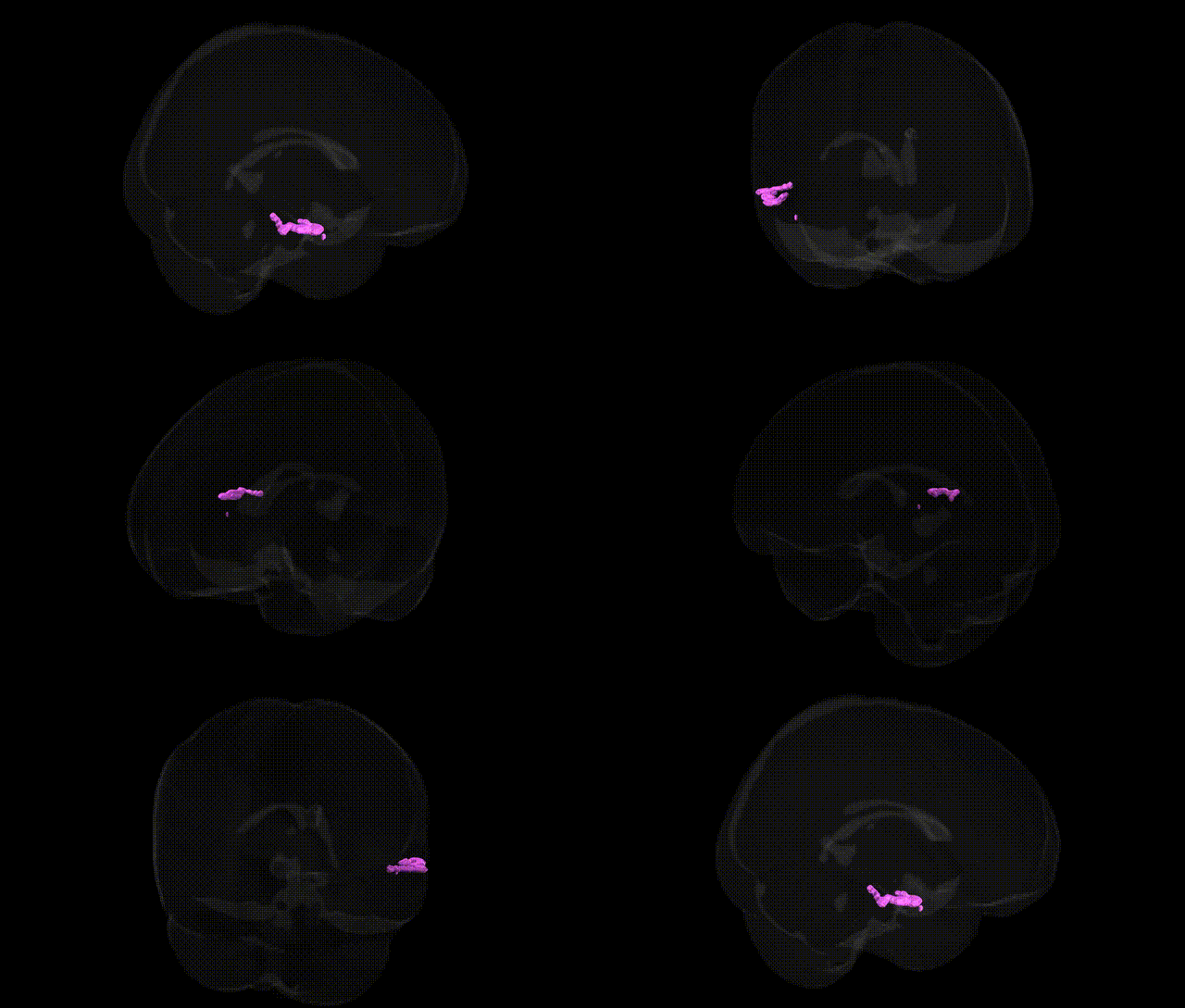
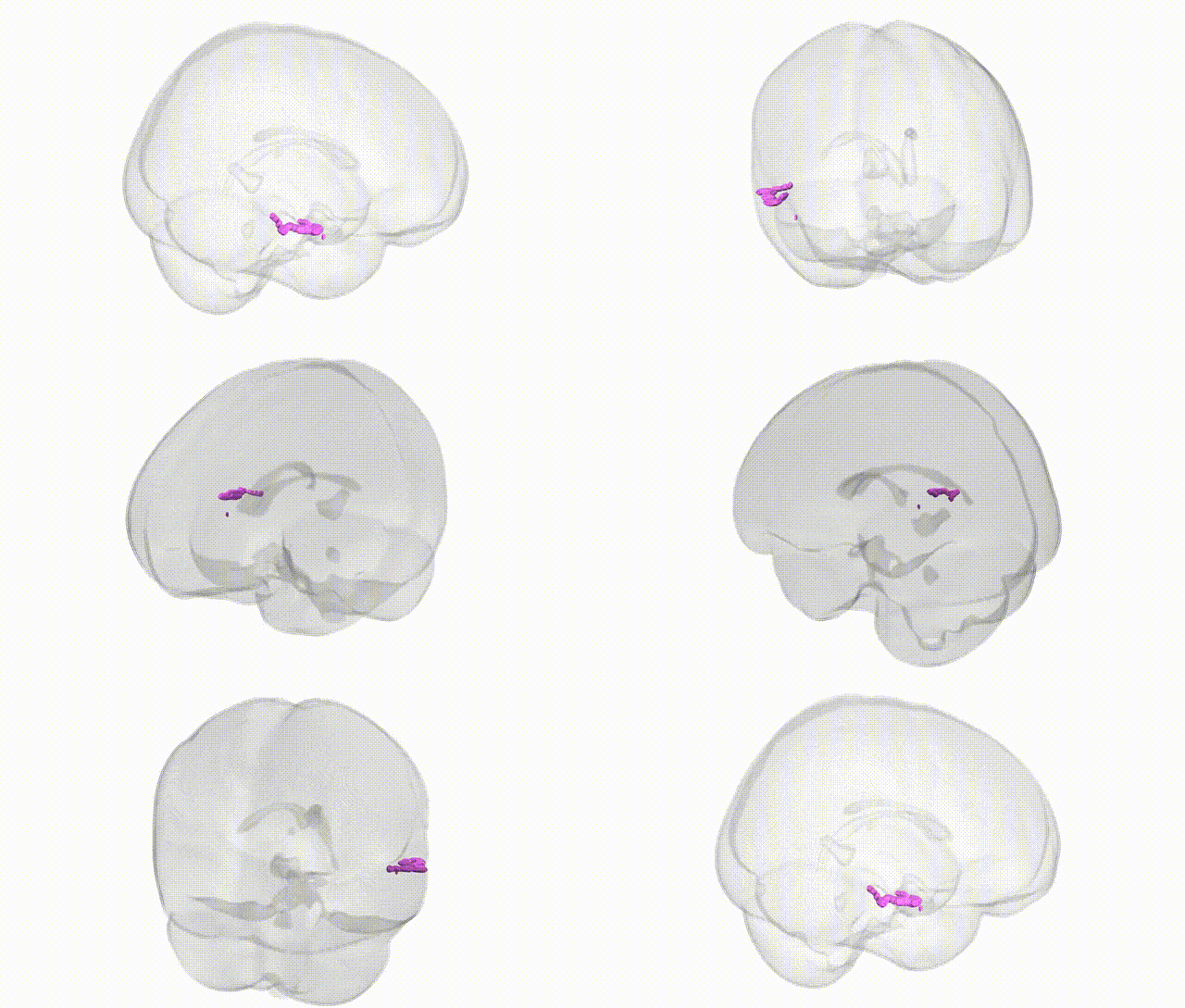
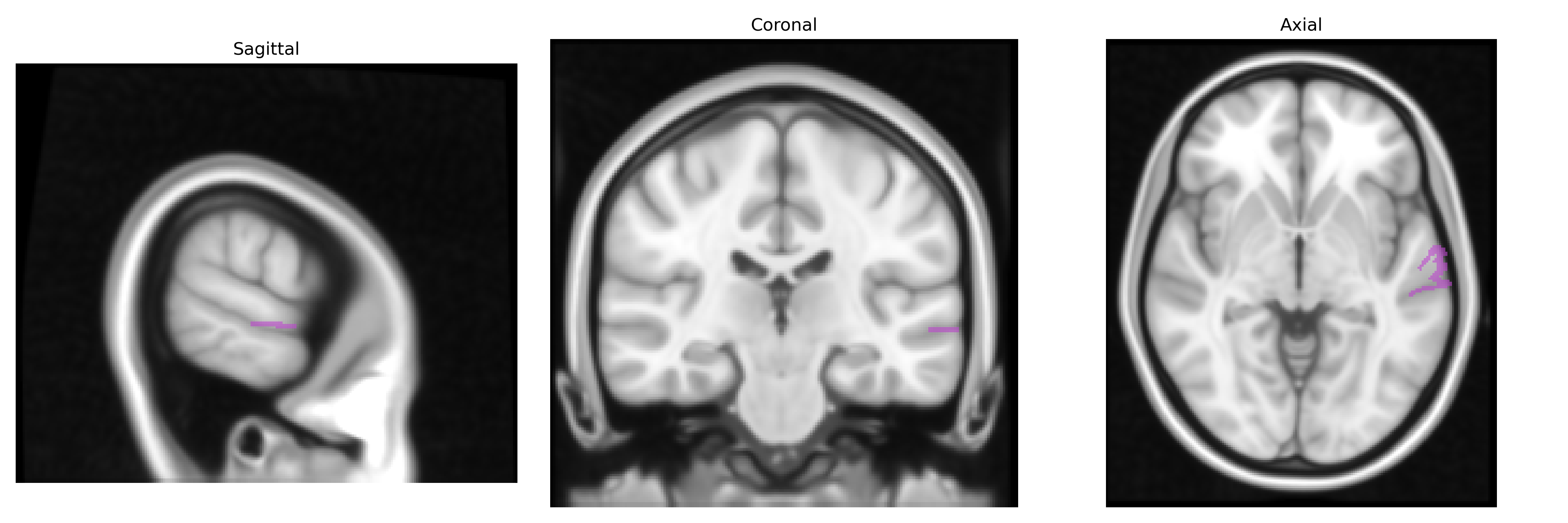
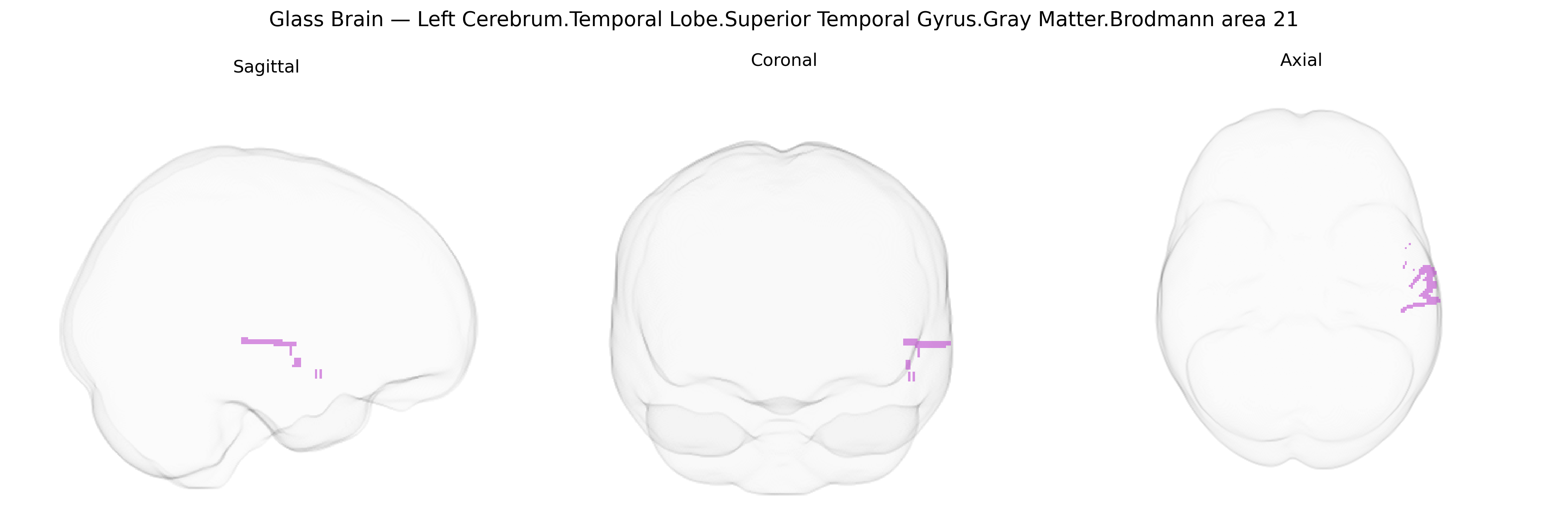
The bilateral Left Cerebrum.Temporal Lobe.Superior Temporal Gyrus.Gray Matter.Brodmann area 21 corresponds to a portion of the middle to posterior superior temporal cortex involved in higher-order auditory and language-related processing. Brodmann area 21 (BA21), located mainly in the middle and parts of the superior temporal gyrus, participates in the integration of complex auditory signals, semantic processing, and aspects of spoken and written language comprehension, and is also implicated in memory and multimodal association functions. This region shows strong connectivity with other temporal association areas, inferior parietal cortex, and prefrontal regions, forming part of networks subserving lexical-semantic retrieval, auditory object recognition, and aspects of social cognition. There is no direct link for this exact composite label; a related structure is Brodmann area 21.
The bilateral left superior temporal gyrus (STG) gray matter in Brodmann area 21, as defined in the Talairach 1 mm atlas, has been repeatedly implicated in genetic and GWAS-based studies of language, auditory processing, and neuropsychiatric risk, though most findings reference the STG more broadly rather than this micro-anatomical label alone. Twin and heritability studies show substantial genetic influence on STG thickness and volume, with specific associations reported for genes involved in neurodevelopmental and synaptic pathways (e.g., CNTNAP2, FOXP2-related networks, and DCDC2, KIAA0319 in dyslexia), often linked to asymmetries and structural variation in the left temporal cortex. Large-scale brain–imaging GWAS (such as ENIGMA and UK Biobank) have identified loci affecting temporal lobe cortical thickness and surface area near BA21, including variants in genes related to neuronal growth, migration, and myelination, although these findings typically label “superior temporal” or “lateral temporal” regions rather than Brodmann area 21 specifically. Genetic associations between STG morphology and schizophrenia, bipolar disorder, and major depressive disorder have been reported, where risk alleles for these conditions correlate with reduced gray matter or altered cortical thickness in the left temporal lobe, and polygenic risk scores for psychosis spectrum disorders show effects on temporal cortical structure. Autism spectrum disorder and specific language impairment GWAS and candidate-gene studies also implicate left temporal regions encompassing BA21, consistent with the role of this area in semantic and auditory language processing. Overall, converging evidence points to a polygenic architecture in which common and rare variants affecting neurodevelopmental and synaptic genes modulate structure and function of the left superior temporal gyrus/BA21, thereby influencing risk for language-related traits and multiple psychiatric and neurodevelopmental disorders.
Overview generated by GPT-4o (2026).
Region ID: 286
Hemisphere: bilateral
Atlas: Talairach labels 1mm
Full Quality Version: Download MP4
Full Quality Version: Download MP4
Wali Sidiqyar*, Gaurav Rudravaram*, Elyssa M. McMaster, Trent M. Schwartz, Adam M. Saunders, Kurt G. Schilling, Bennett A. Landman "Introducing SPINS: A Shared Public Visualization Library of Neuroanatomical Structures." Medical Imaging with Deep Learning- short paper
This resource is licensed under CC0 1.0 Universal (Public Domain).