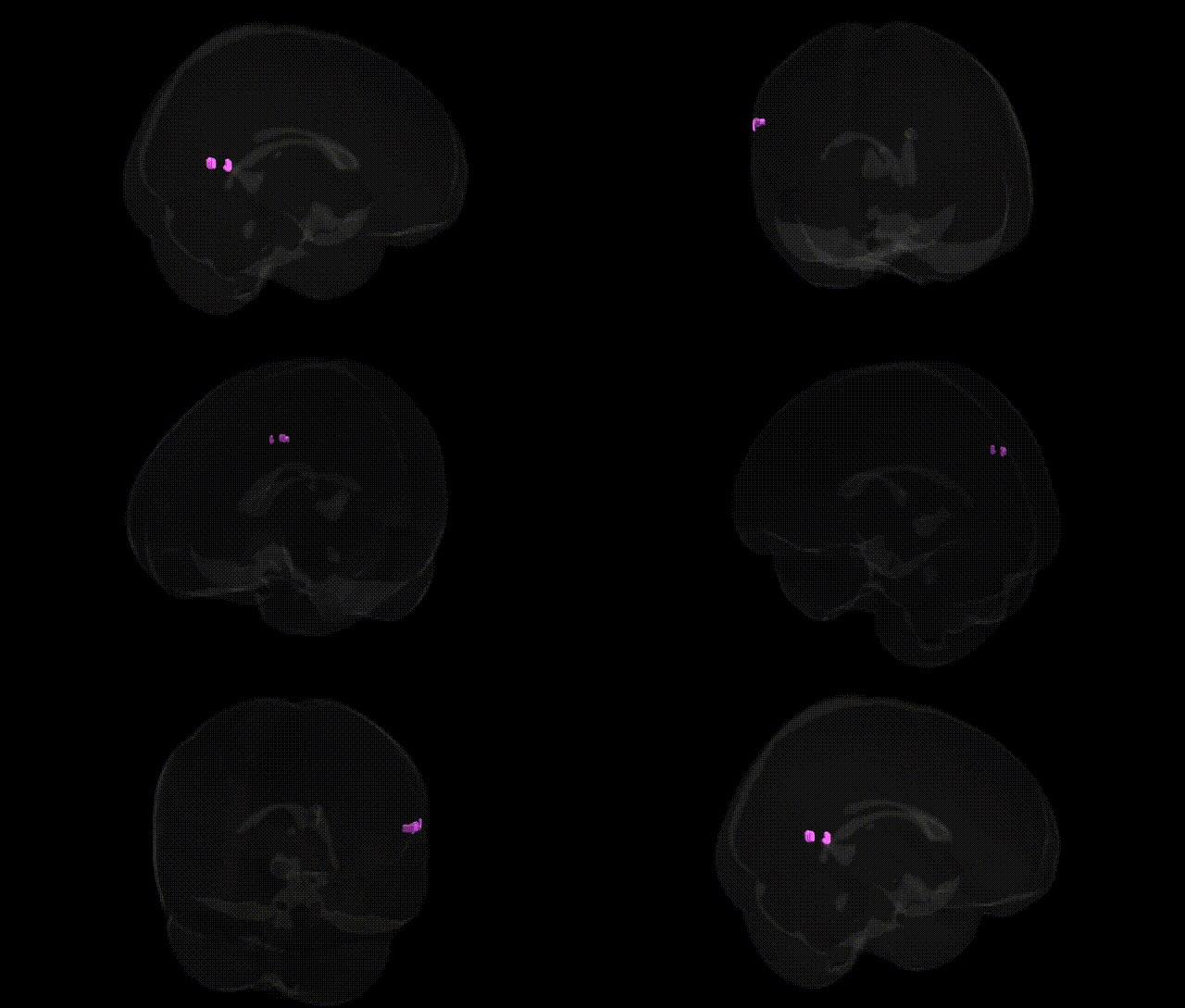
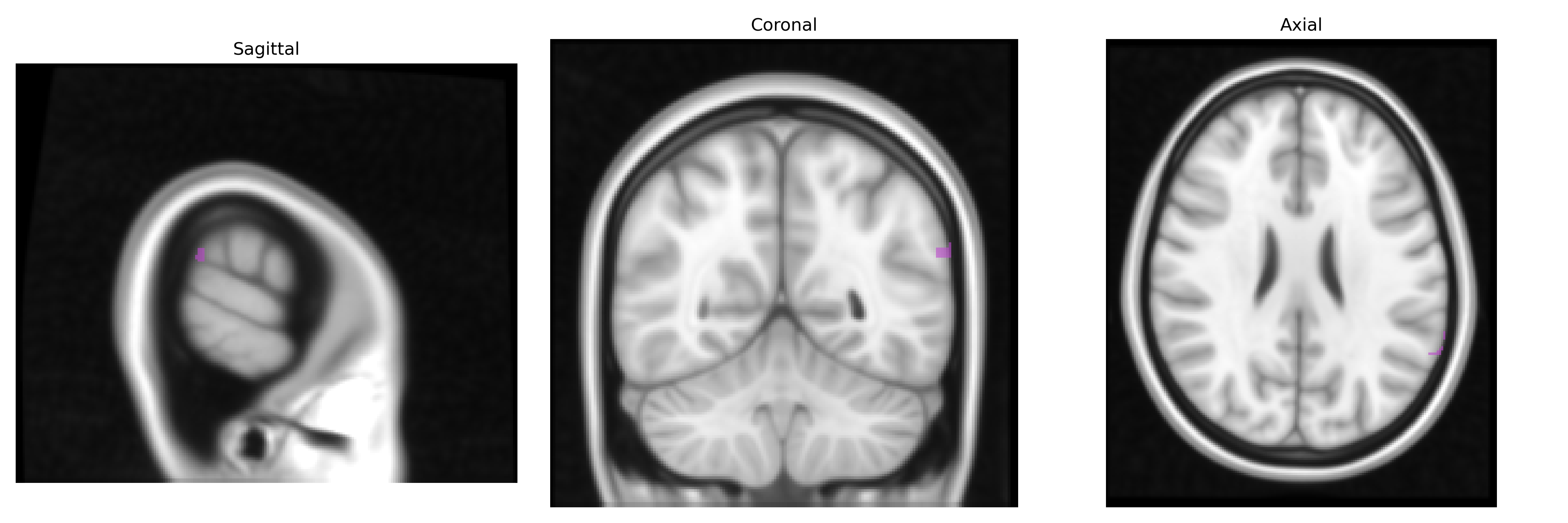
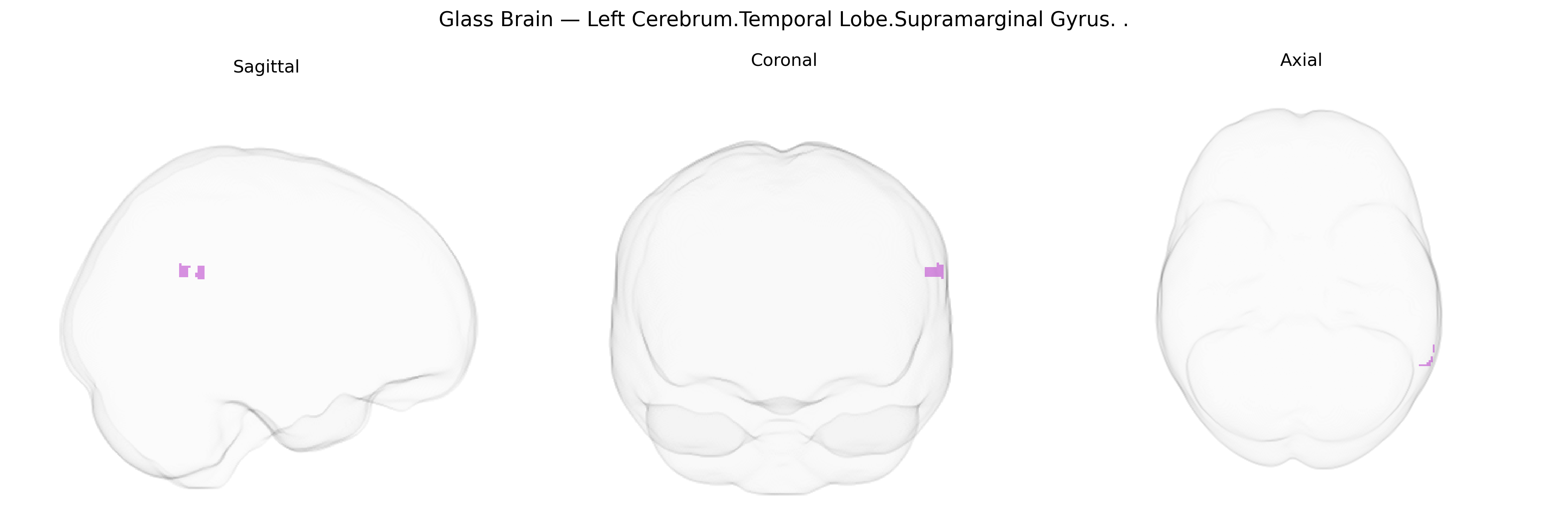
The bilateral Left Cerebrum.Temporal Lobe.Supramarginal Gyrus in the Talairach 1 mm Atlas refers to the supramarginal gyrus located at the posterior portion of the temporal lobe, bordering the inferior parietal lobule and wrapping around the posterior end of the lateral (Sylvian) fissure. This cortical region is involved in multimodal association processes, integrating auditory, somatosensory, and visual information, and plays key roles in phonological processing, language comprehension, articulation, and aspects of social cognition such as empathy and perspective-taking. It participates in the dorsal language stream and contributes to mapping auditory speech input onto articulatory representations, with functional asymmetries often observed between hemispheres, particularly in language-dominant (usually left) cortex. There is no direct Wikipedia article for this exact atlas label; a closely related structure is the Supramarginal gyrus.
The bilateral left supramarginal gyrus (a parietal region bordering the temporal lobe in the Talairach 1 mm atlas) has been repeatedly implicated in genetic studies of language, reading, and higher cognitive functions, with convergent evidence from GWAS and imaging–genetics work. Common variants in genes such as DCDC2, KIAA0319, ROBO1, and CNTNAP2, originally linked to dyslexia and language impairment, have been associated with altered structure or activation of the supramarginal gyrus during phonological and reading tasks, while polygenic scores for educational attainment and intelligence show associations with supramarginal cortical thickness and surface area in large cohorts such as UK Biobank. Schizophrenia, bipolar disorder, and major depressive disorder GWAS have identified polygenic effects that manifest in altered supramarginal gray matter volume and connectivity, with risk variants in genes including CACNA1C, ZNF804A, and MIR137-related loci associated with structural and functional changes in this region. Autism spectrum disorder and attention-deficit/hyperactivity disorder polygenic risk have also been linked to supramarginal morphometry and atypical activation during social cognition and attentional tasks. In addition, GWAS of brain imaging phenotypes (ENIGMA and related consortia) have reported associations between supramarginal gyrus volume or surface area and loci near HMGA2, IGF1, and other growth and neurodevelopment-related genes, underscoring this region’s role as a genetically influenced hub for language, multimodal integration, and psychiatric risk.
Overview generated by GPT-4o (2026).
Region ID: 868
Hemisphere: bilateral
Atlas: Talairach labels 1mm
Full Quality Version: Download MP4
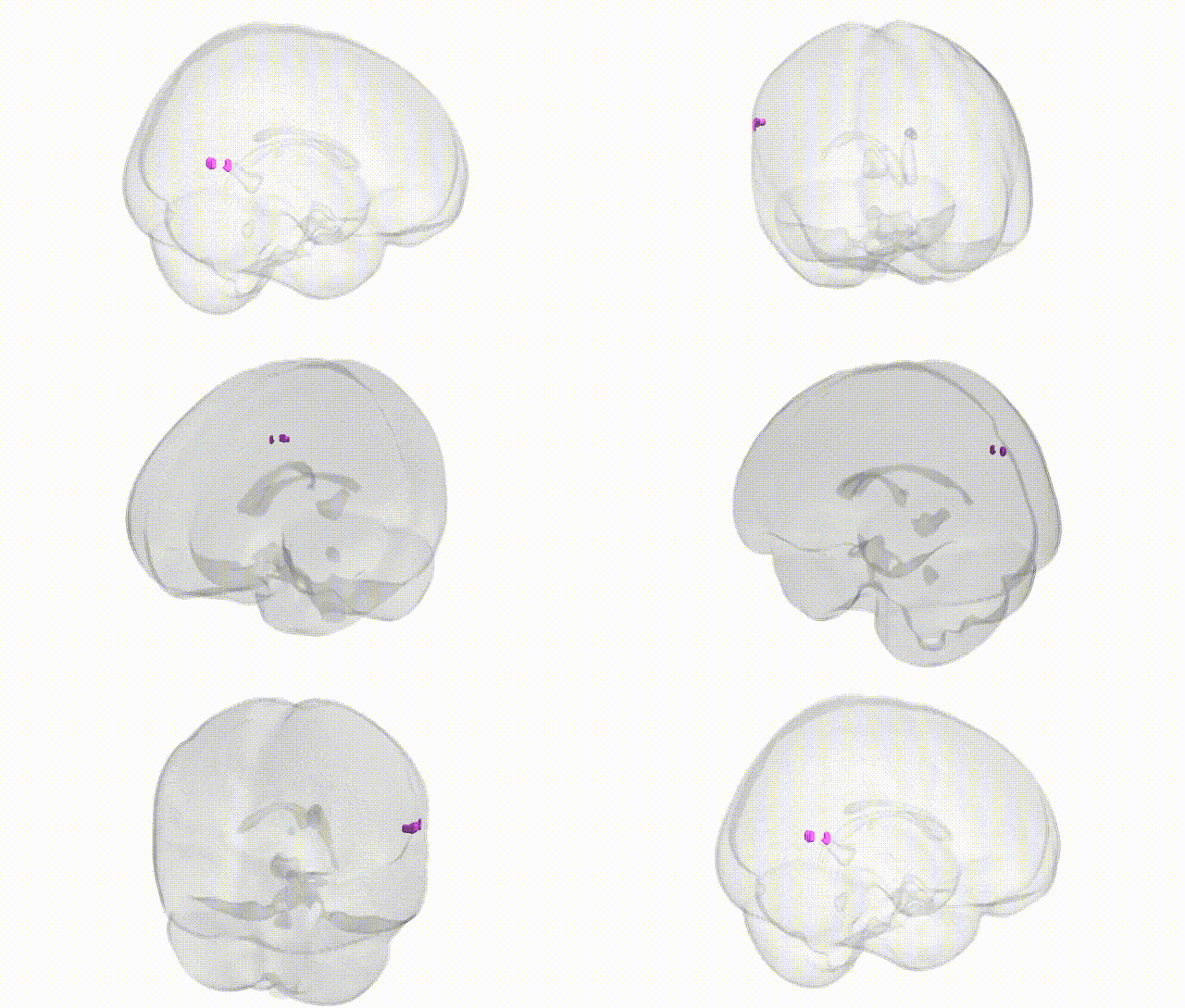
Full Quality Version: Download MP4
Wali Sidiqyar*, Gaurav Rudravaram*, Elyssa M. McMaster, Trent M. Schwartz, Adam M. Saunders, Kurt G. Schilling, Bennett A. Landman "Introducing SPINS: A Shared Public Visualization Library of Neuroanatomical Structures." Medical Imaging with Deep Learning- short paper
This resource is licensed under CC0 1.0 Universal (Public Domain).