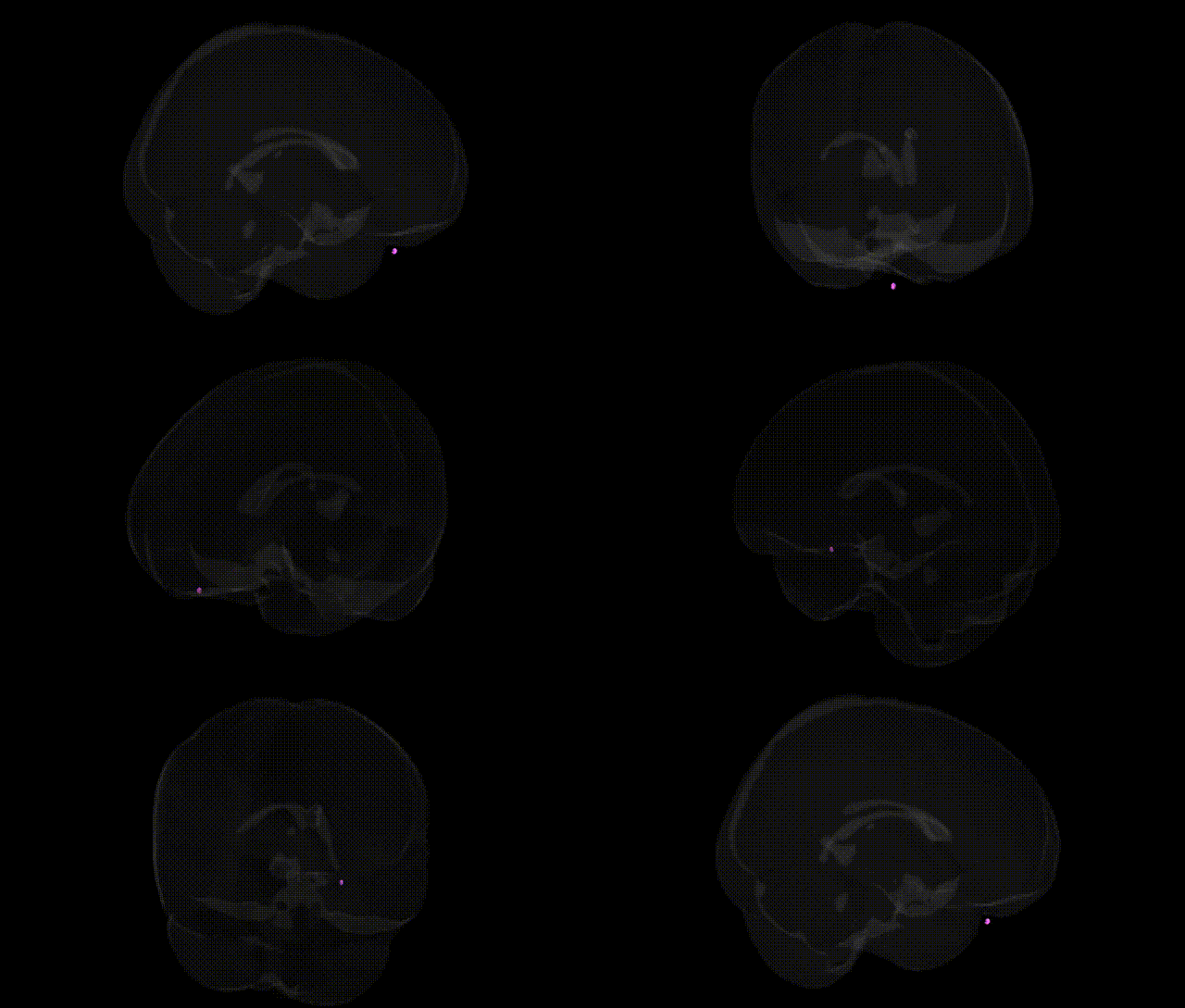
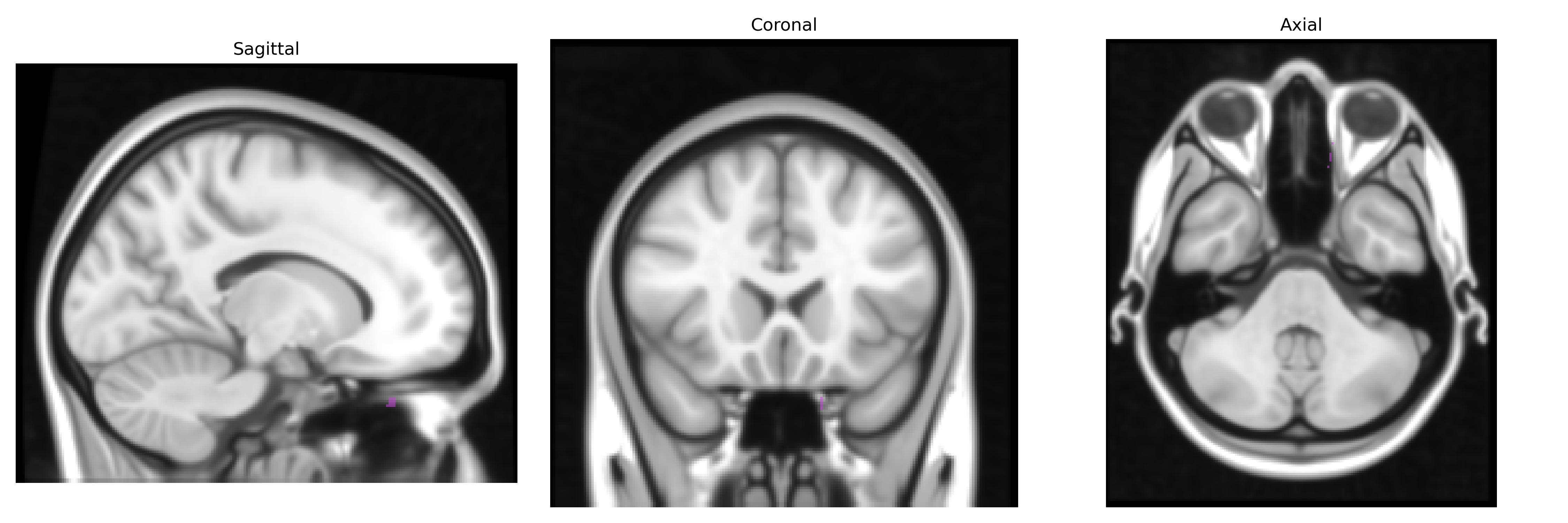
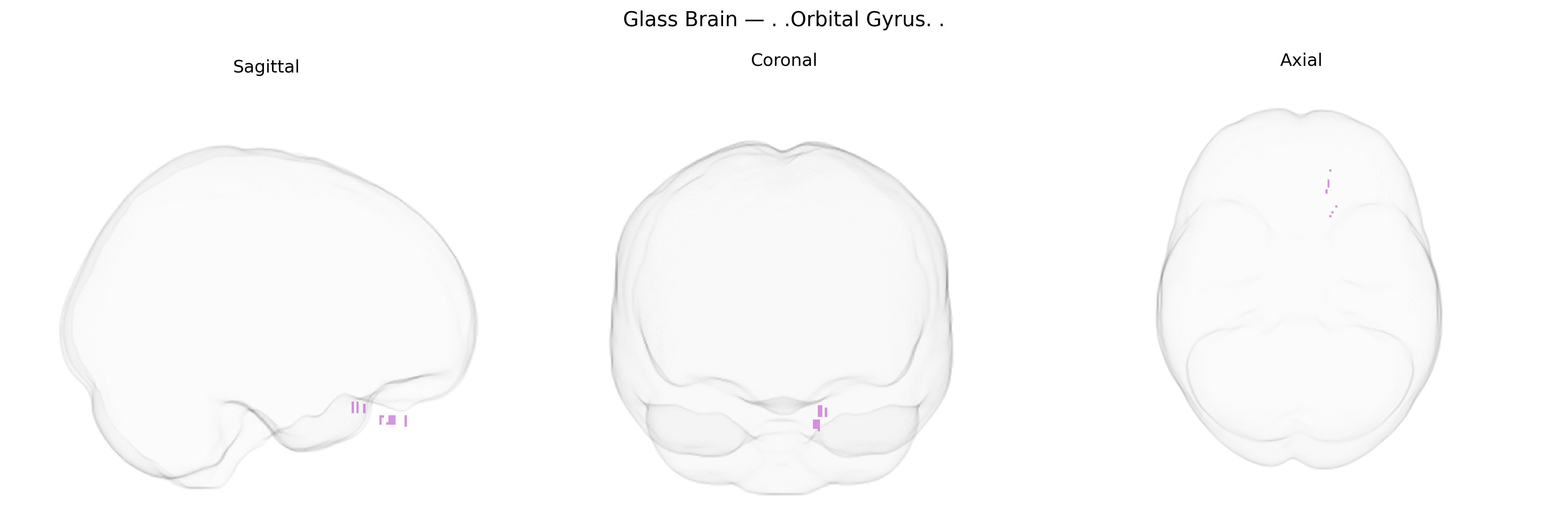
The bilateral orbital gyrus refers to cortical regions on the ventral surface of the frontal lobe that overlie the orbits (eye sockets) and form a major component of the orbitofrontal cortex. These gyri are involved in integrating multisensory information with reward, emotion, and decision-making processes, contributing to evaluation of stimulus value, adaptive behavioral responses, and regulation of social and affective behavior. Anatomically, they receive inputs from sensory association cortices, limbic structures (including amygdala), and thalamic nuclei, and project to other prefrontal, limbic, and subcortical regions implicated in motivation and autonomic regulation. In the Talairach 1 mm atlas, the label “orbital gyrus” typically corresponds to these ventral frontal convolutions rather than a single cytoarchitectonic area. There is no direct Wikipedia article specifically for “orbital gyrus”; a closely related structure is the Orbitofrontal cortex.
The bilateral orbital gyrus, corresponding broadly to orbitofrontal cortex (OFC) regions in the Talairach 1 mm atlas, shows genetic associations primarily through imaging genetics and GWAS of brain structure, function, and related psychiatric and behavioral traits rather than direct “orbital gyrus–specific” loci. Heritability studies indicate that OFC volume, cortical thickness, and functional activation are moderately heritable, with common variants in genes such as BDNF, COMT, SLC6A4 (5-HTTLPR), DRD2/DRD4, and genes in glutamatergic and GABAergic pathways influencing OFC structure or reactivity, especially in emotion regulation and reward paradigms. Large-scale GWAS of cortical morphology (e.g., ENIGMA and UK Biobank) have identified numerous loci (including variants near genes involved in neurodevelopment, synaptic function, and cell adhesion such as HMGA2, KIAA0586, and others) associated with orbitofrontal surface area or thickness, although these are typically reported at a broader regional level rather than a specific orbital gyrus subfield. Genetic risk for major depressive disorder, bipolar disorder, schizophrenia, obsessive–compulsive disorder, and substance use disorders has been linked to altered OFC/orbital gyrus morphology and connectivity, with polygenic risk scores for these conditions correlating with structural or functional measures in this region. Additionally, GWAS on personality, impulsivity, risk-taking, and decision-making behaviors have implicated variants that modulate OFC-related circuits, suggesting that genetic influences on the orbital gyrus contribute to vulnerability for mood, anxiety, psychotic, and addiction-related phenotypes, as well as individual differences in reward processing and cognitive control, even though most findings remain regionally coarse and not restricted to the Talairach-defined bilateral orbital gyrus label.
Overview generated by GPT-4o (2026).
Region ID: 111
Hemisphere: bilateral
Atlas: Talairach labels 1mm
Full Quality Version: Download MP4
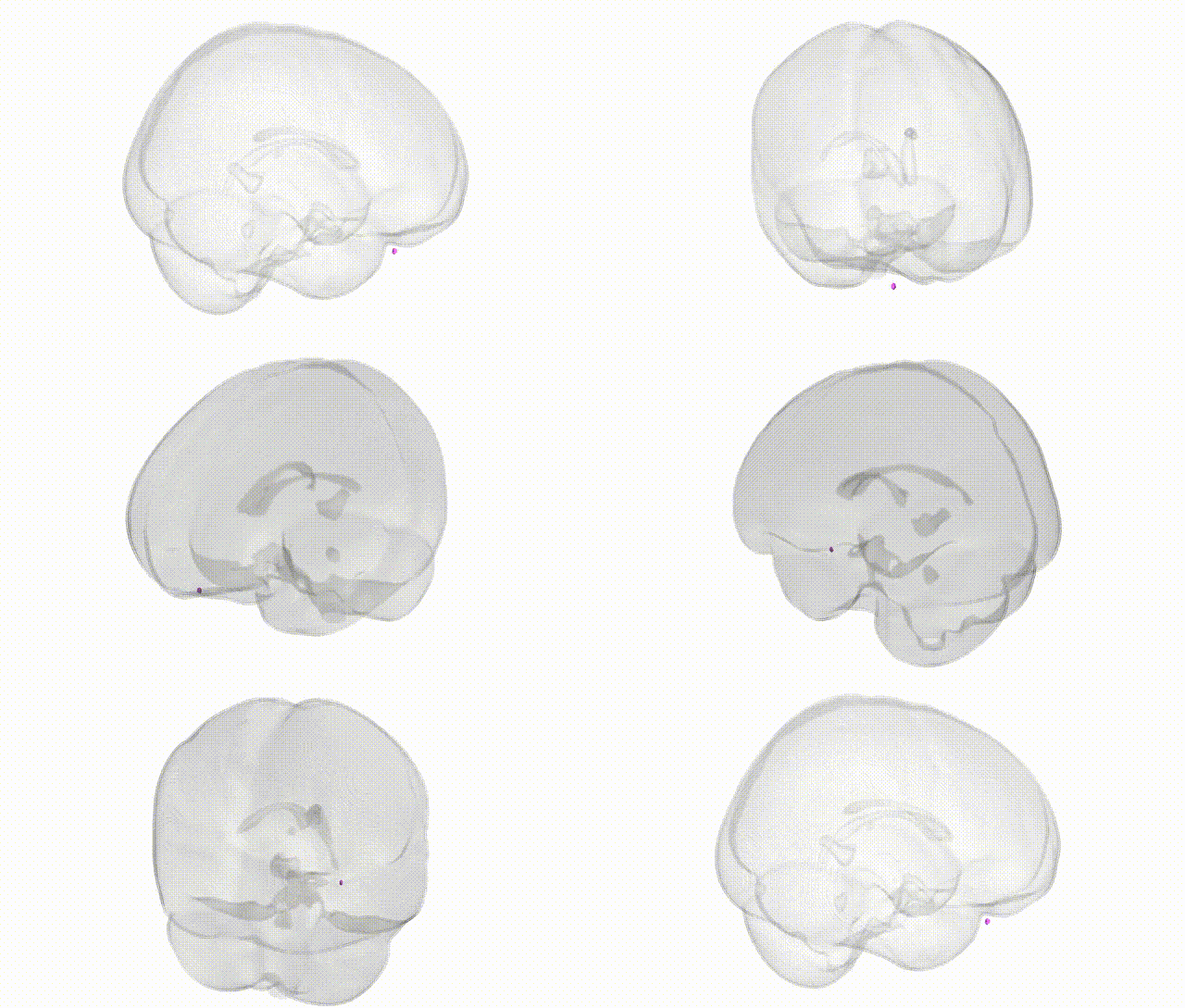
Full Quality Version: Download MP4
Wali Sidiqyar*, Gaurav Rudravaram*, Elyssa M. McMaster, Trent M. Schwartz, Adam M. Saunders, Kurt G. Schilling, Bennett A. Landman "Introducing SPINS: A Shared Public Visualization Library of Neuroanatomical Structures." Medical Imaging with Deep Learning- short paper
This resource is licensed under CC0 1.0 Universal (Public Domain).