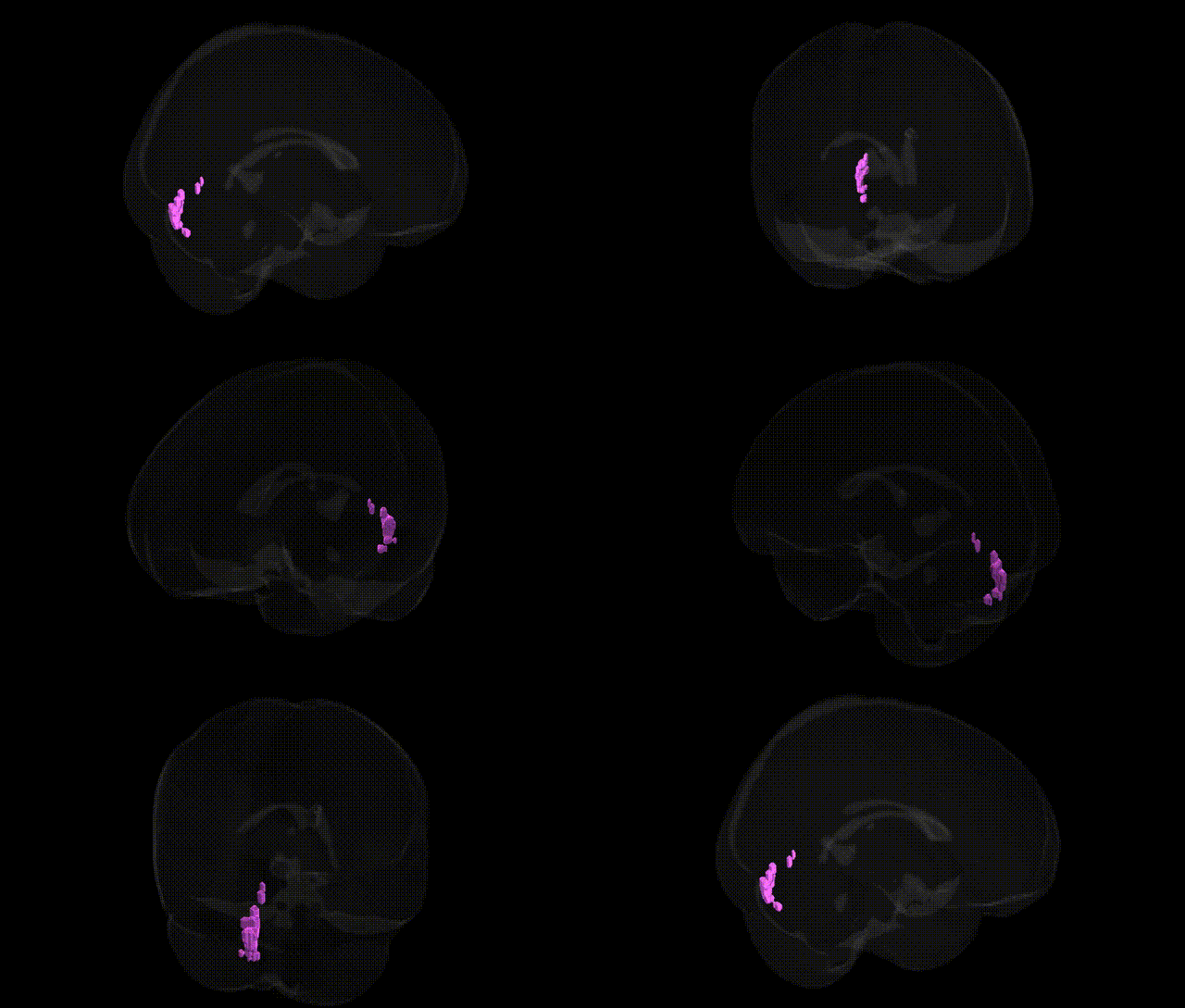
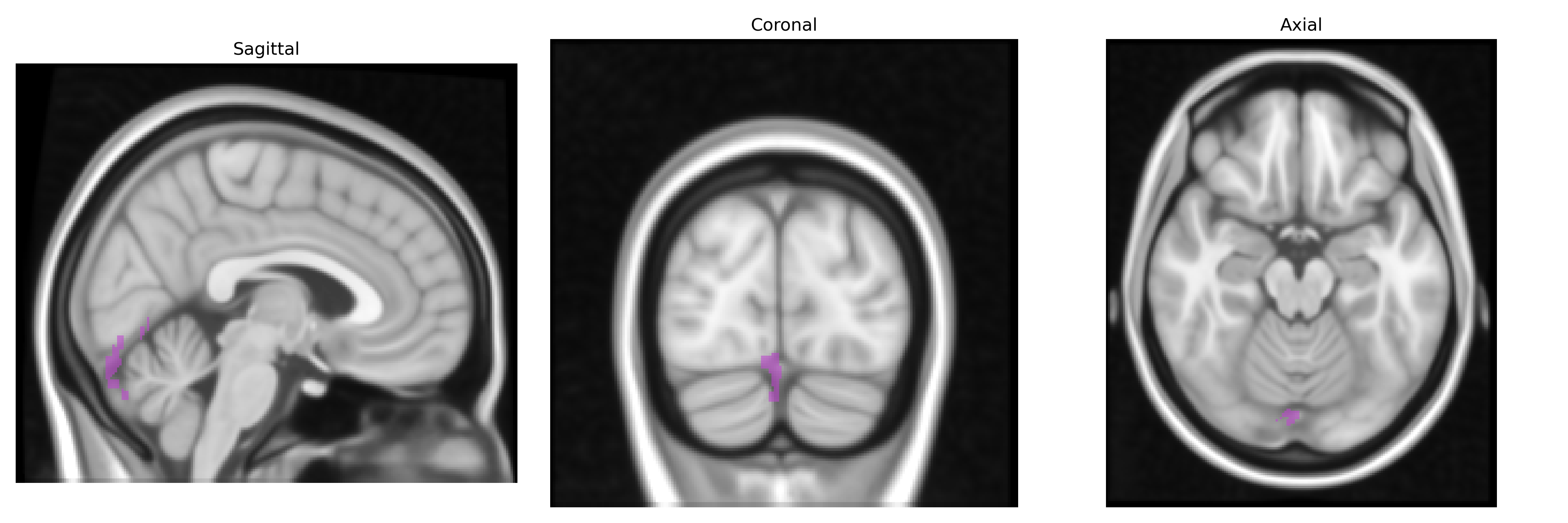
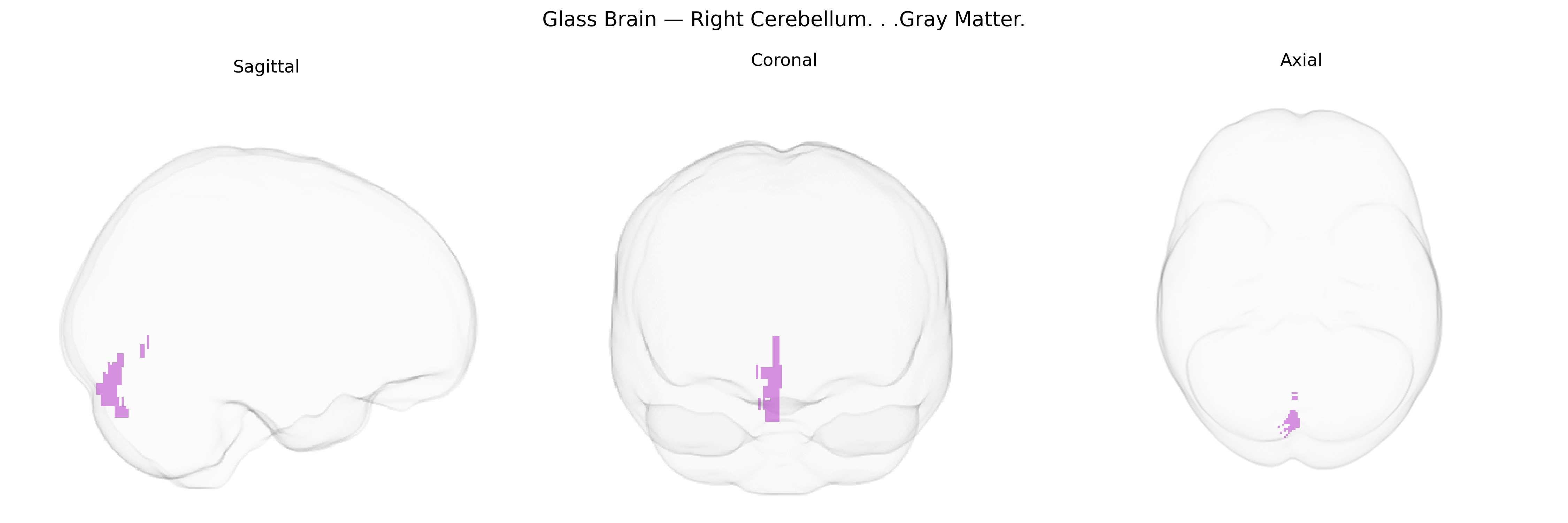
The bilateral right cerebellum gray matter comprises the cortical regions of the cerebellar hemispheres on the right side, involved in fine-tuning motor activity, balance, and posture, as well as higher-order functions such as motor learning, timing, and aspects of cognition and language processing. Structurally, it consists of tightly folded folia of cerebellar cortex organized into three layers—molecular, Purkinje cell, and granular—overlying the cerebellar white matter and deep nuclei. Functionally, it receives extensive input from the cerebral cortex via pontine nuclei and from proprioceptive pathways, and sends output back to motor and association areas of the cerebrum through the cerebellar deep nuclei and thalamus, contributing to coordination, error correction, and adaptive control of movement and behavior.
Cerebellum
The right cerebellar gray matter, as defined in the Talairach 1 mm atlas, has been implicated in a range of genetic associations primarily through imaging genetics and large-scale GWAS linking regional cerebellar volume and morphology to common variants. Polygenic influences on cerebellar structure are robust, with heritability estimates often exceeding 70%, and numerous loci identified in GWAS of total and regional cerebellar volume, many mapping to neurodevelopmental and synaptic genes involved in axon guidance, neuronal migration, and synaptic plasticity. Variants in genes such as CACNA1A, ATXN1/2/3, GRID2, and PRKCG, as well as genes affecting Purkinje cell function, are associated with hereditary cerebellar ataxias and spinocerebellar degeneration that frequently show right-hemispheric cerebellar involvement on imaging, including gray matter loss. In psychiatric and neurodevelopmental disorders, common risk variants for schizophrenia, bipolar disorder, major depression, ADHD, and autism spectrum disorder—identified in large GWAS by consortia such as Psychiatric Genomics Consortium—exert effects on cerebellar gray matter, with imaging–genetic studies and polygenic risk score analyses repeatedly linking higher polygenic burden to alterations in bilateral cerebellar morphology, connectivity, and function. Cerebellar gray matter in the right hemisphere is also implicated in genetically influenced cognitive and affective traits; for example, loci associated with intelligence, educational attainment, and neuroticism show downstream associations with cerebellar structure and functional activation patterns, consistent with the cerebellum’s role in cognitive control and emotion regulation. Additionally, GWAS of stroke, neurodegenerative disorders (e.g., Alzheimer’s disease), and essential tremor have identified risk loci whose carriers exhibit selective cerebellar gray matter changes, occasionally lateralized to the right, underscoring that the right cerebellar cortex is a convergent anatomical target of diverse genetic risks affecting motor, cognitive, and psychiatric phenotypes.
Overview generated by GPT-4o (2026).
Region ID: 65
Hemisphere: bilateral
Atlas: Talairach labels 1mm
Full Quality Version: Download MP4
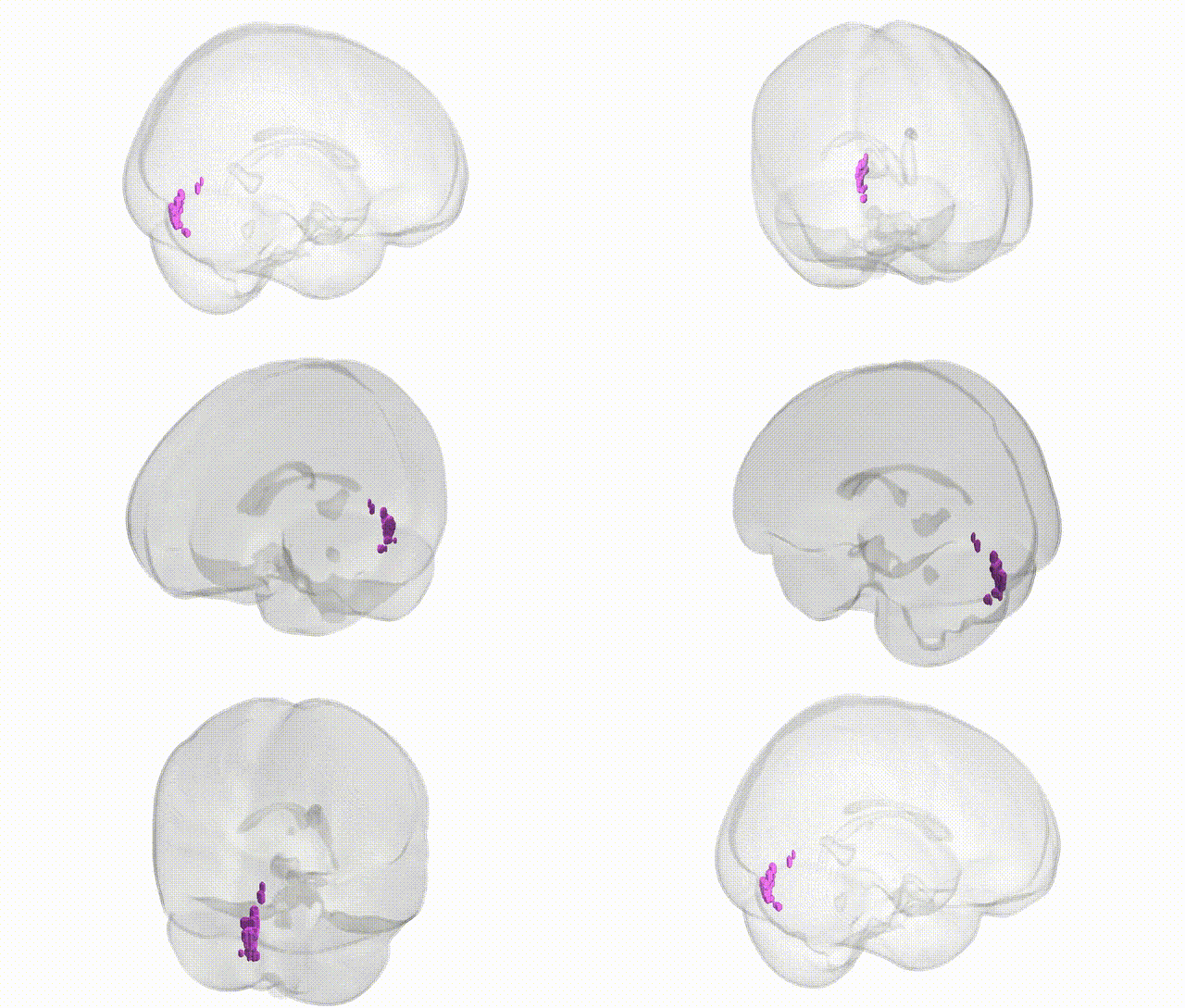
Full Quality Version: Download MP4
Wali Sidiqyar*, Gaurav Rudravaram*, Elyssa M. McMaster, Trent M. Schwartz, Adam M. Saunders, Kurt G. Schilling, Bennett A. Landman "Introducing SPINS: A Shared Public Visualization Library of Neuroanatomical Structures." Medical Imaging with Deep Learning- short paper
This resource is licensed under CC0 1.0 Universal (Public Domain).