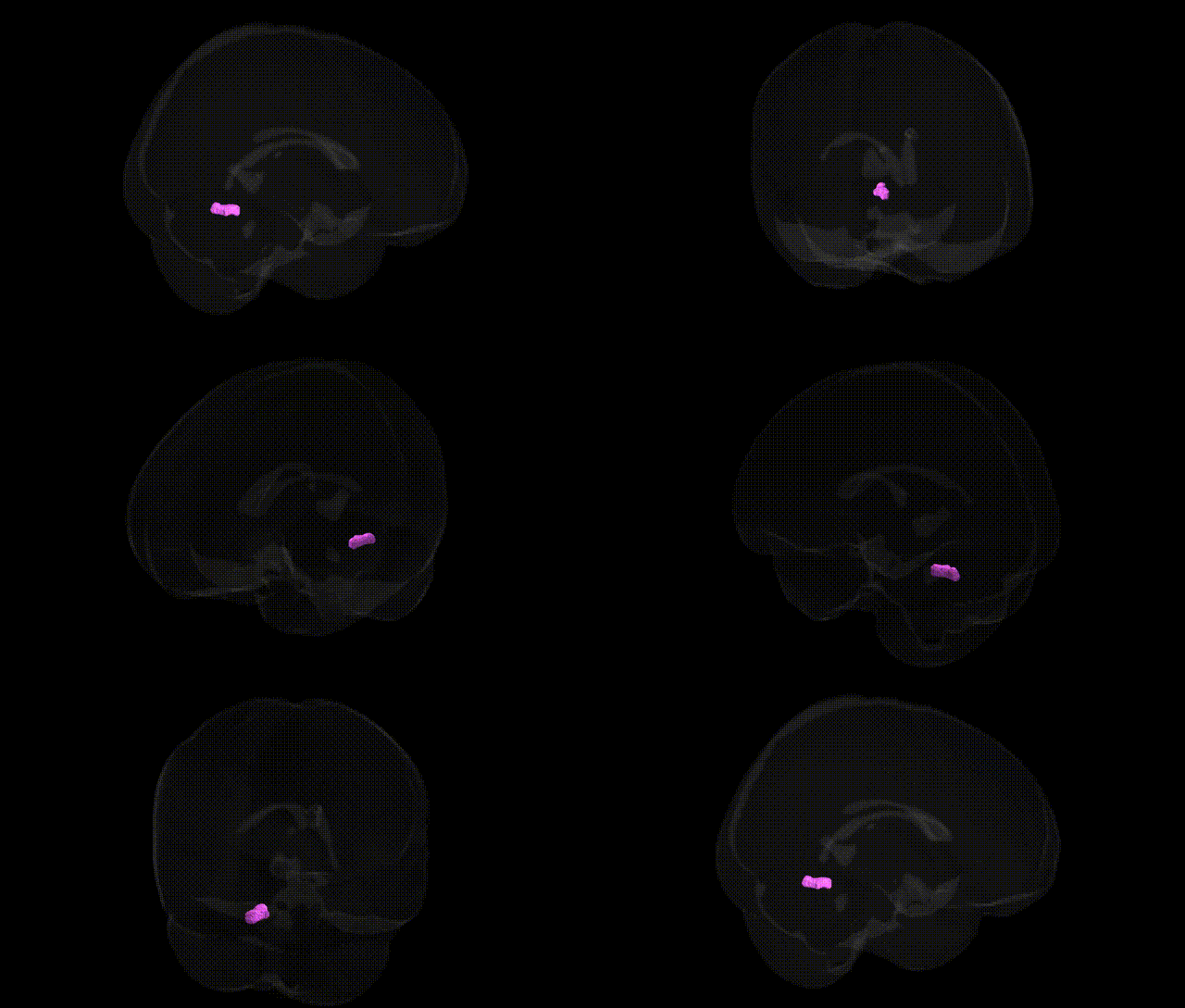
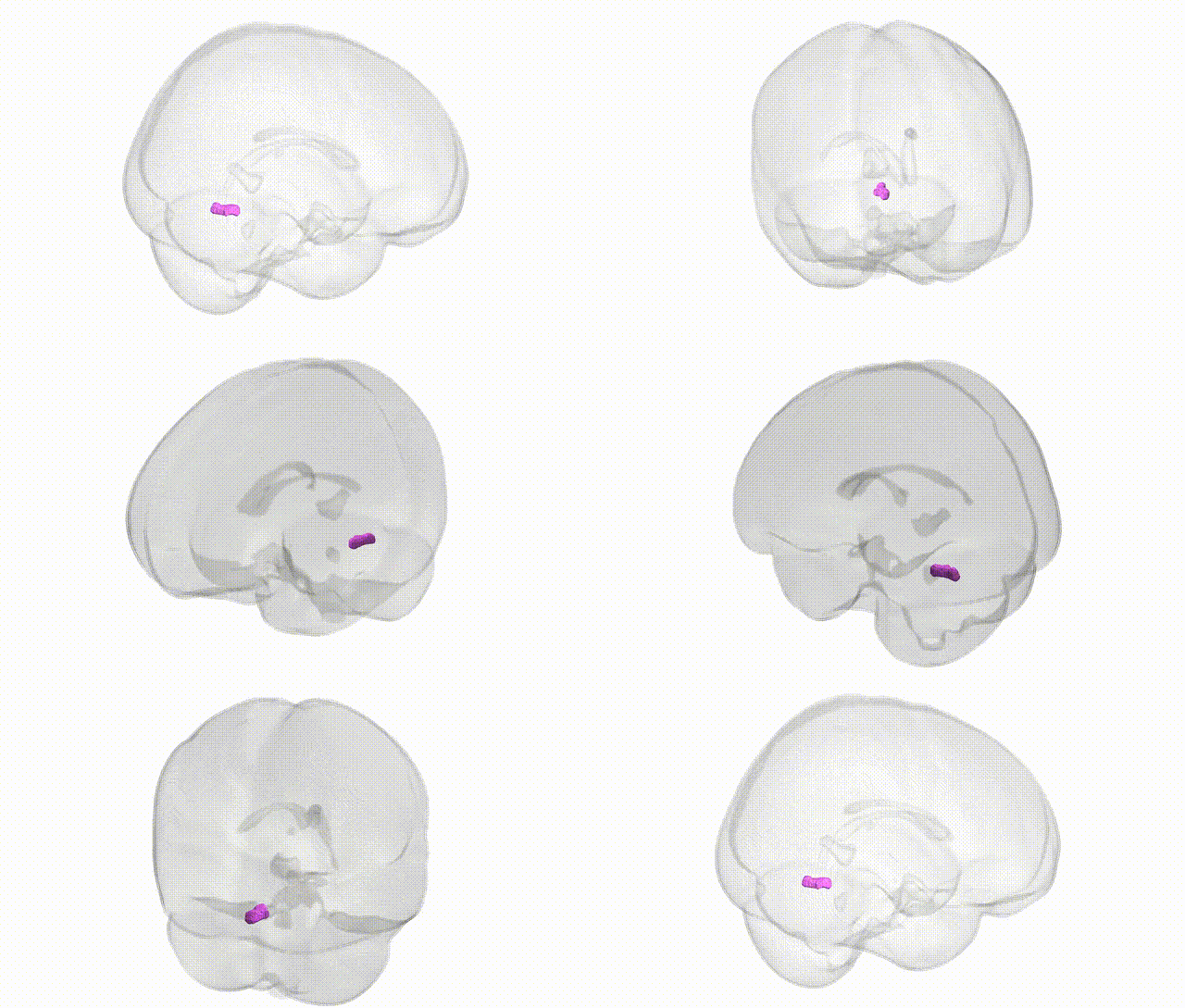
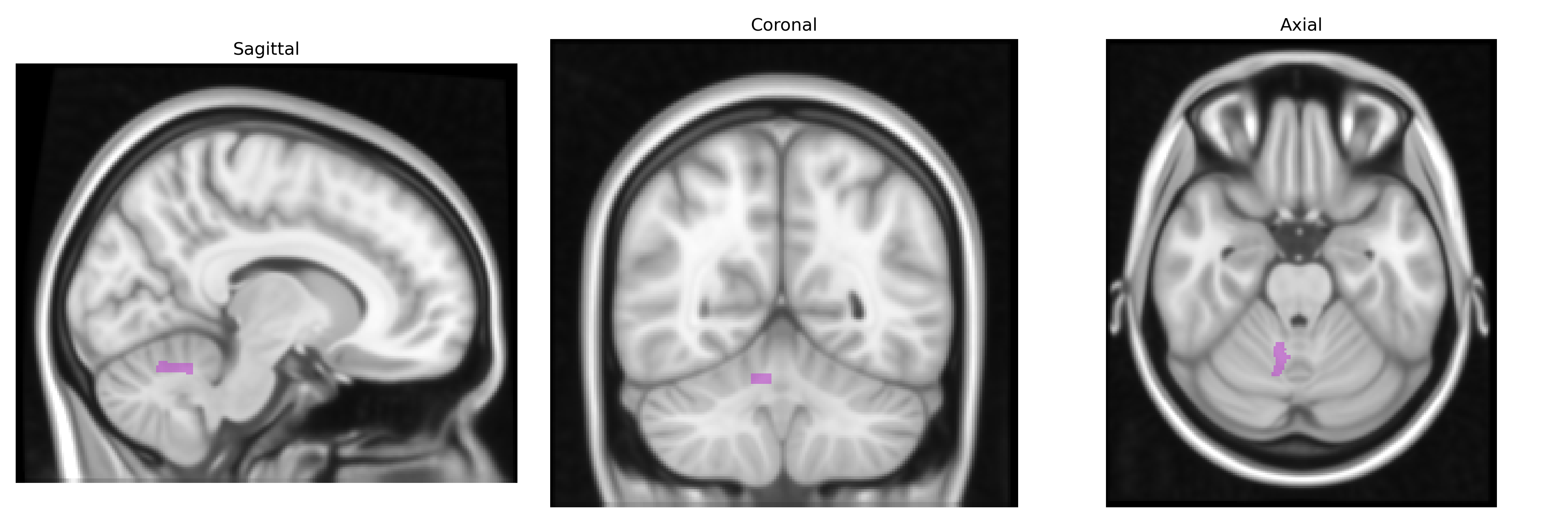
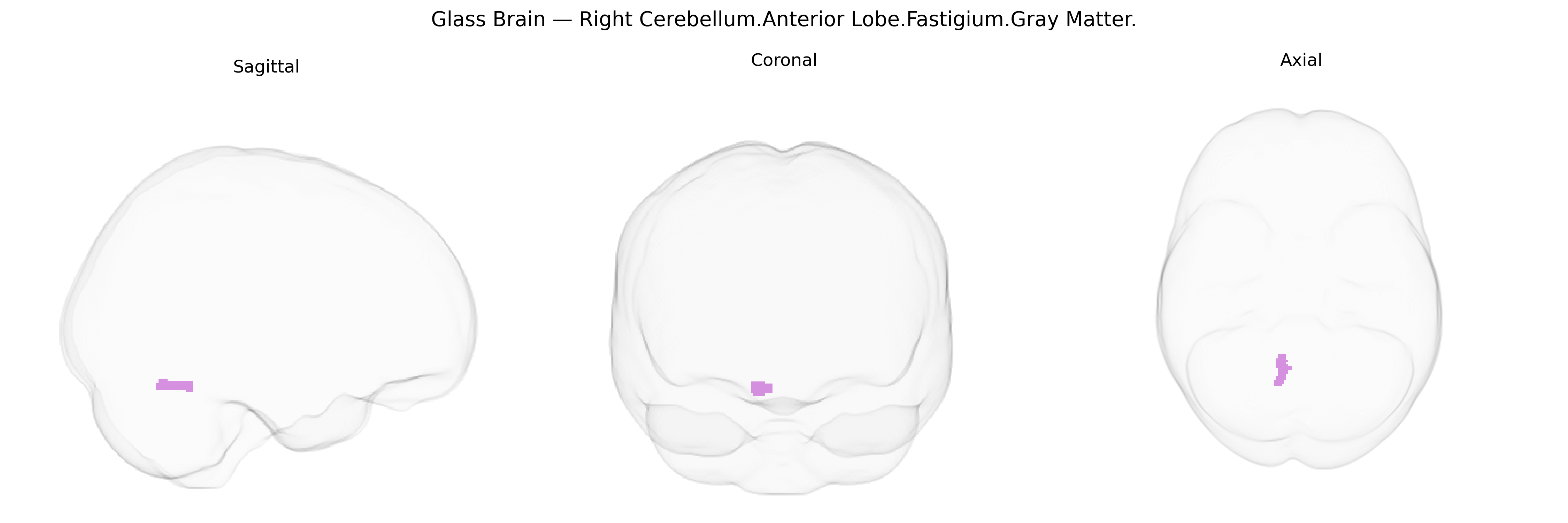
The bilateral Right Cerebellum.Anterior Lobe.Fastigium.Gray Matter corresponds to gray matter within the fastigial region of the anterior lobe of the right cerebellar hemisphere, a midline-associated, deep cerebellar zone involved in vestibulocerebellar and spinocerebellar integration. This region receives primarily proprioceptive and vestibular input and contributes to axial and proximal muscle control, postural stability, and gait via projections from the fastigial nucleus to vestibular and reticular nuclei and subsequently to spinal cord pathways. Functionally, it participates in coordination of trunk and balance-related movements and in the fine-tuning of motor execution, particularly for stance and locomotion, with implications for disorders of equilibrium and truncal ataxia when damaged. There is no direct link for this specific composite region; a related structure is the Cerebellum.
The bilateral Right Cerebellum.Anterior Lobe.Fastigium.Gray Matter, as defined in the Talairach 1 mm atlas, lies within the anterior cerebellar vermis region, which has been implicated in genetic studies primarily through its roles in motor coordination, balance, and affective regulation rather than through region-specific GWAS hits. Large-scale imaging–genetics consortia such as ENIGMA and UK Biobank show that interindividual variation in cerebellar gray-matter volume, including anterior lobular and vermis regions, is highly polygenic and influenced by common variants in genes involved in neurodevelopment, synaptic function, and axon guidance (for example, loci near MAPT, KIAA0586, and various cell-adhesion and cytoskeletal genes), though these findings typically report broader lobular or whole-cerebellum measures rather than the fastigium specifically. In Mendelian and rare-variant contexts, genes associated with midline cerebellar malformations that affect the anterior vermis and fastigial region—such as FOXC1, ZIC1/ZIC4, LHX1, and PTF1A—have been linked to cerebellar hypoplasia, Dandy–Walker spectrum anomalies, and related congenital ataxias. Psychiatric and neurodevelopmental disorder GWAS (e.g., for schizophrenia, bipolar disorder, and autism) have identified polygenic architectures that, when mapped via imaging–genetics or transcriptomic/functional–mapping pipelines, converge on circuits involving the cerebellar vermis and anterior lobes, consistent with observed structural and functional alterations in these disorders, but do not yet provide robust, reproducible single-locus associations specifically tied to Right Cerebellum.Anterior Lobe.Fastigium.Gray Matter in the Talairach framework.
Overview generated by GPT-4o (2026).
Region ID: 163
Hemisphere: bilateral
Atlas: Talairach labels 1mm
Full Quality Version: Download MP4
Full Quality Version: Download MP4
Wali Sidiqyar*, Gaurav Rudravaram*, Elyssa M. McMaster, Trent M. Schwartz, Adam M. Saunders, Kurt G. Schilling, Bennett A. Landman "Introducing SPINS: A Shared Public Visualization Library of Neuroanatomical Structures." Medical Imaging with Deep Learning- short paper
This resource is licensed under CC0 1.0 Universal (Public Domain).