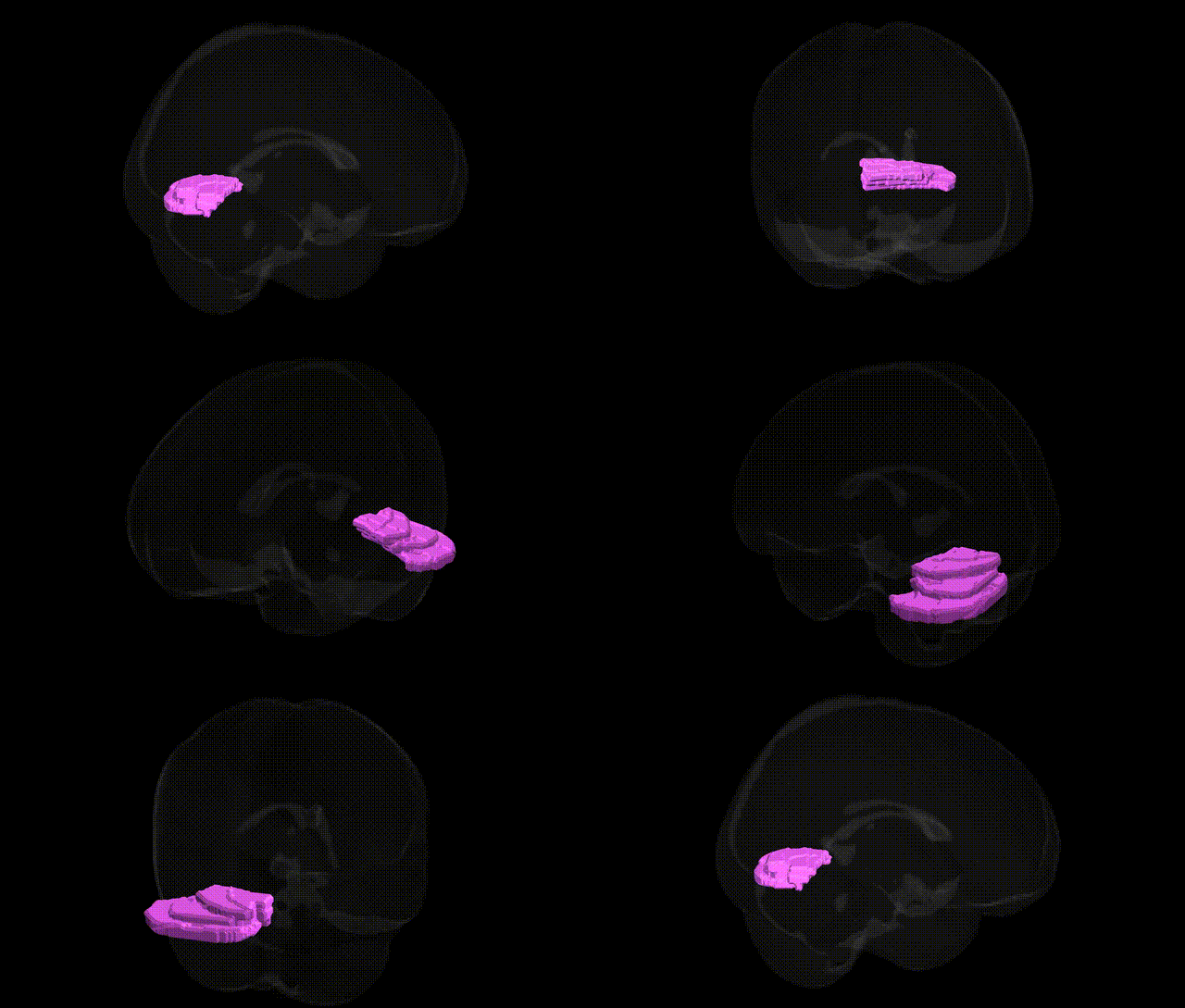
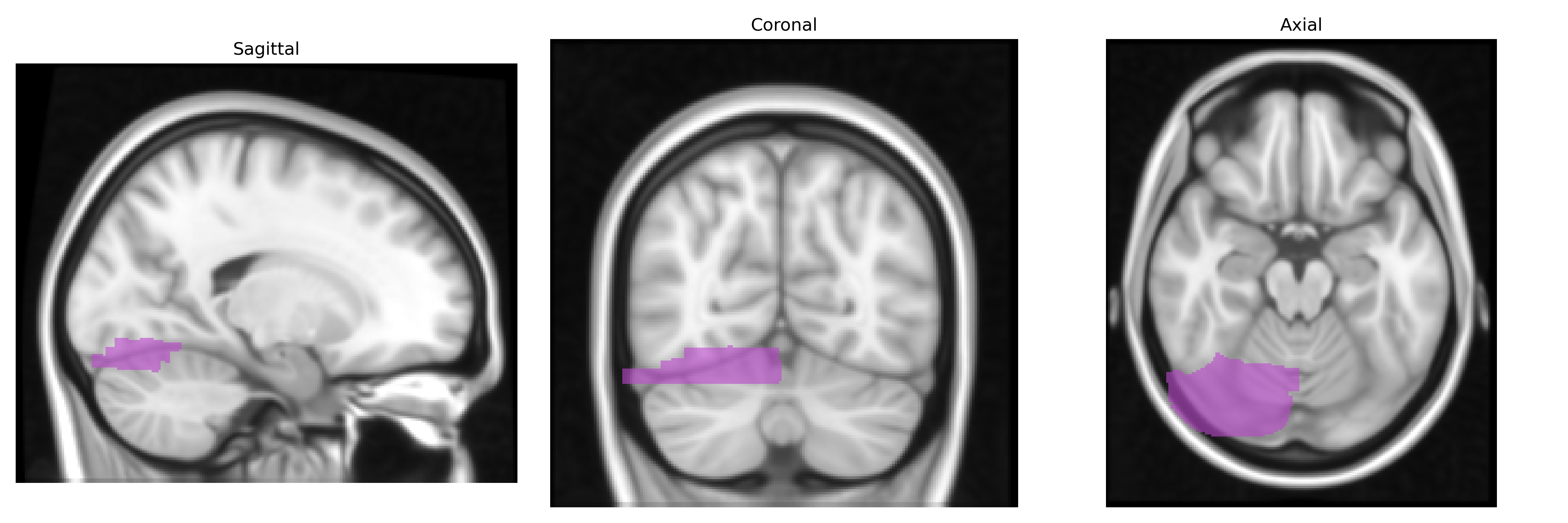
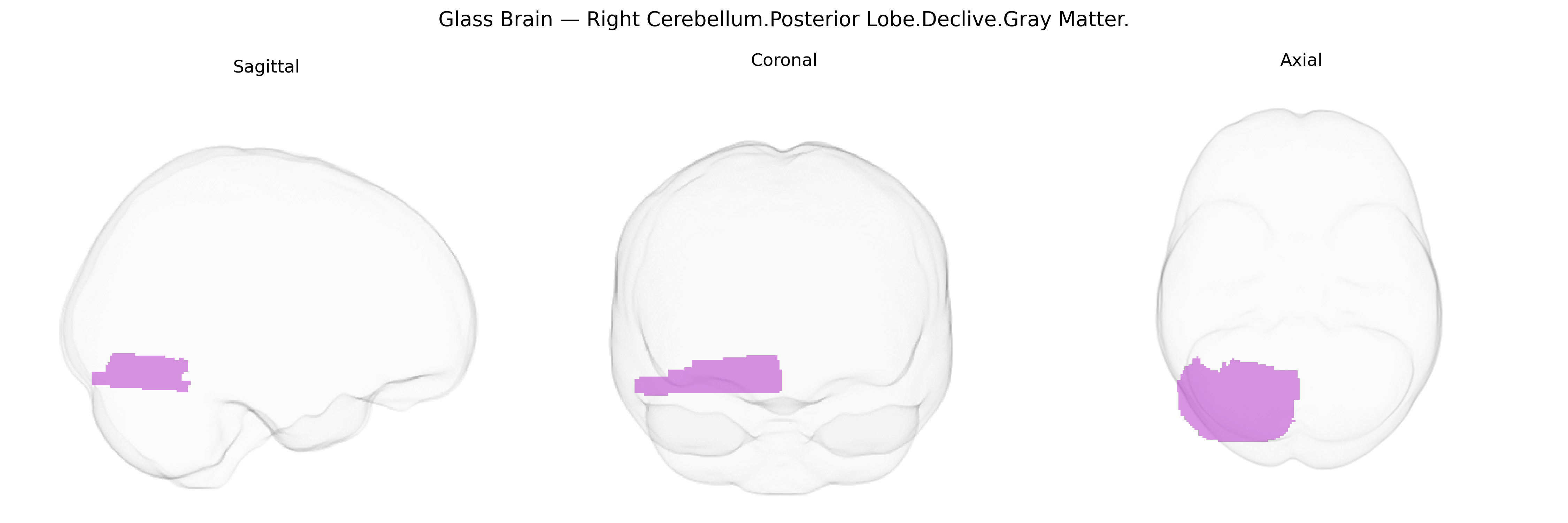
The bilateral Right Cerebellum, Posterior Lobe, Declive, Gray Matter corresponds to a portion of lobule VI of the cerebellar posterior lobe, located on the dorsal surface of the cerebellar hemisphere just posterior to the primary fissure. This region is composed of cortical gray matter organized into cerebellar cortical layers (molecular, Purkinje cell, and granule cell layers) and is implicated in the fine-tuning of motor coordination, posture, and eye–hand tracking, as well as in higher-order functions such as aspects of visuospatial processing and cognitive timing. Functionally, activity in the declive has been associated with error correction in ongoing movements and with certain components of procedural learning, integrating sensory input with motor commands via extensive connections to brainstem nuclei, thalamus, and cerebral association cortices. There is no direct Wikipedia article specifically for the “declive” of the cerebellum; a closely related structure is the Cerebellum.
The bilateral right cerebellar posterior lobe (declive, gray matter) has been implicated in genetic studies primarily through large-scale neuroimaging GWAS that examine cerebellar volume, cortical thickness, and functional connectivity rather than this subregion in isolation. Common variants in genes involved in neurodevelopment and synaptic signaling—such as those in the MAPT region on chromosome 17, and loci near KIAA0586, DLG2, and GABRA2—have shown associations with global cerebellar morphology and specific lobular volumes in UK Biobank and ENIGMA-based studies, with some effects extending to posterior cerebellar regions involved in cognition and affect regulation. Polygenic risk scores for psychiatric disorders including schizophrenia, major depression, bipolar disorder, and ADHD have been linked to structural and functional alterations in posterior cerebellar territories, and autism spectrum disorder risk loci (e.g., in genes like CNTNAP2 and SHANK3) have been associated with atypical cerebellar development and connectivity patterns encompassing declive-related areas. Additional GWAS of motor coordination, cognitive performance, and educational attainment have identified variants (such as in HMGA2 and IGF1 pathways) that correlate with cerebellar size and microstructure, suggesting genetically mediated contributions of the posterior cerebellum to higher-order cognitive and motor traits. Although no large GWAS has singled out the right declive gray matter as an independent locus of association, convergent evidence from cerebellar imaging genetics, neurodevelopmental disorder studies, and trait-based GWAS indicates that genetic influences on neurodevelopmental, synaptic, and cytoskeletal pathways contribute to variation in this region and its involvement in motor, cognitive, and affective phenotypes.
Overview generated by GPT-4o (2026).
Region ID: 158
Hemisphere: bilateral
Atlas: Talairach labels 1mm
Full Quality Version: Download MP4
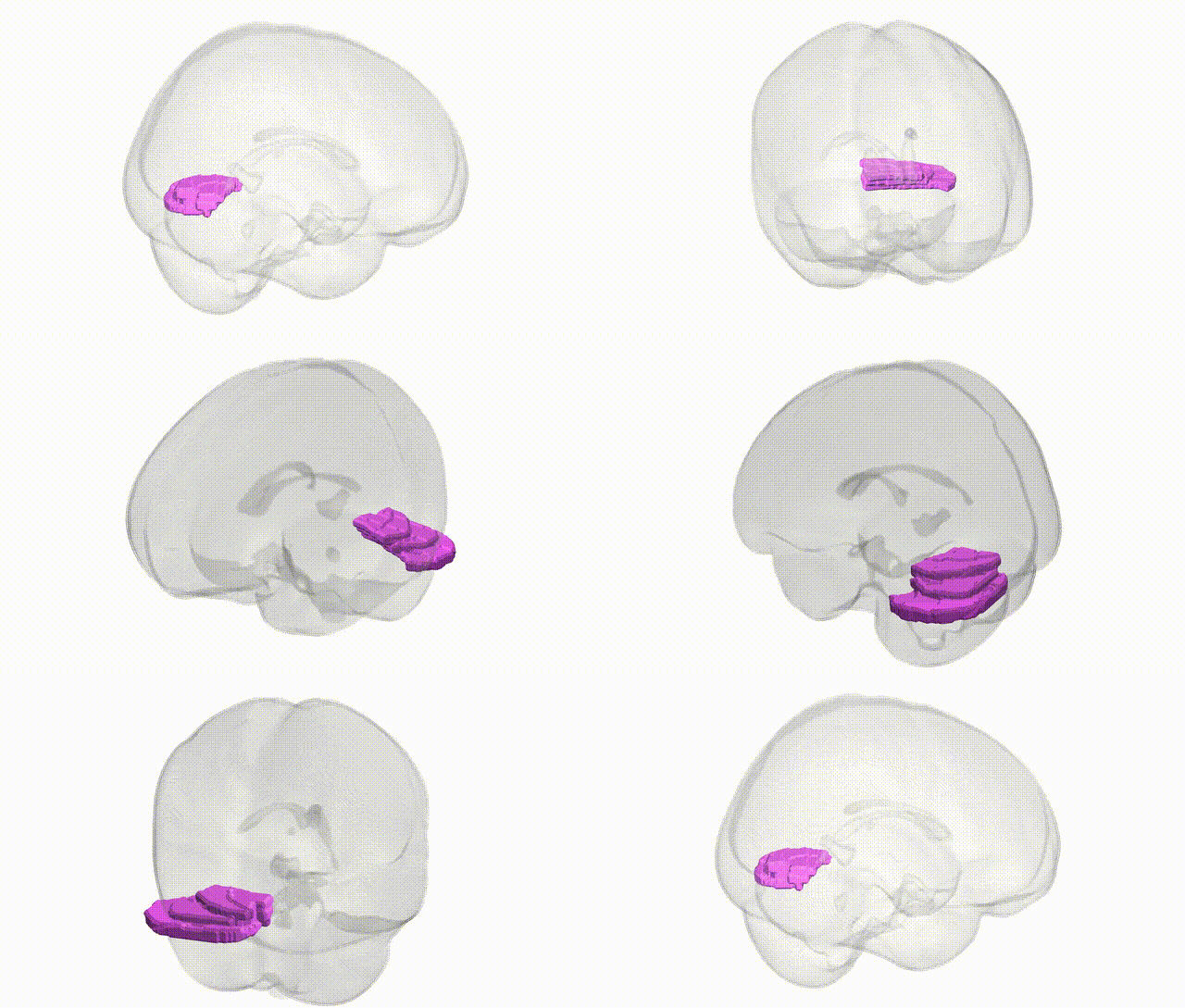
Full Quality Version: Download MP4
Wali Sidiqyar*, Gaurav Rudravaram*, Elyssa M. McMaster, Trent M. Schwartz, Adam M. Saunders, Kurt G. Schilling, Bennett A. Landman "Introducing SPINS: A Shared Public Visualization Library of Neuroanatomical Structures." Medical Imaging with Deep Learning- short paper
This resource is licensed under CC0 1.0 Universal (Public Domain).