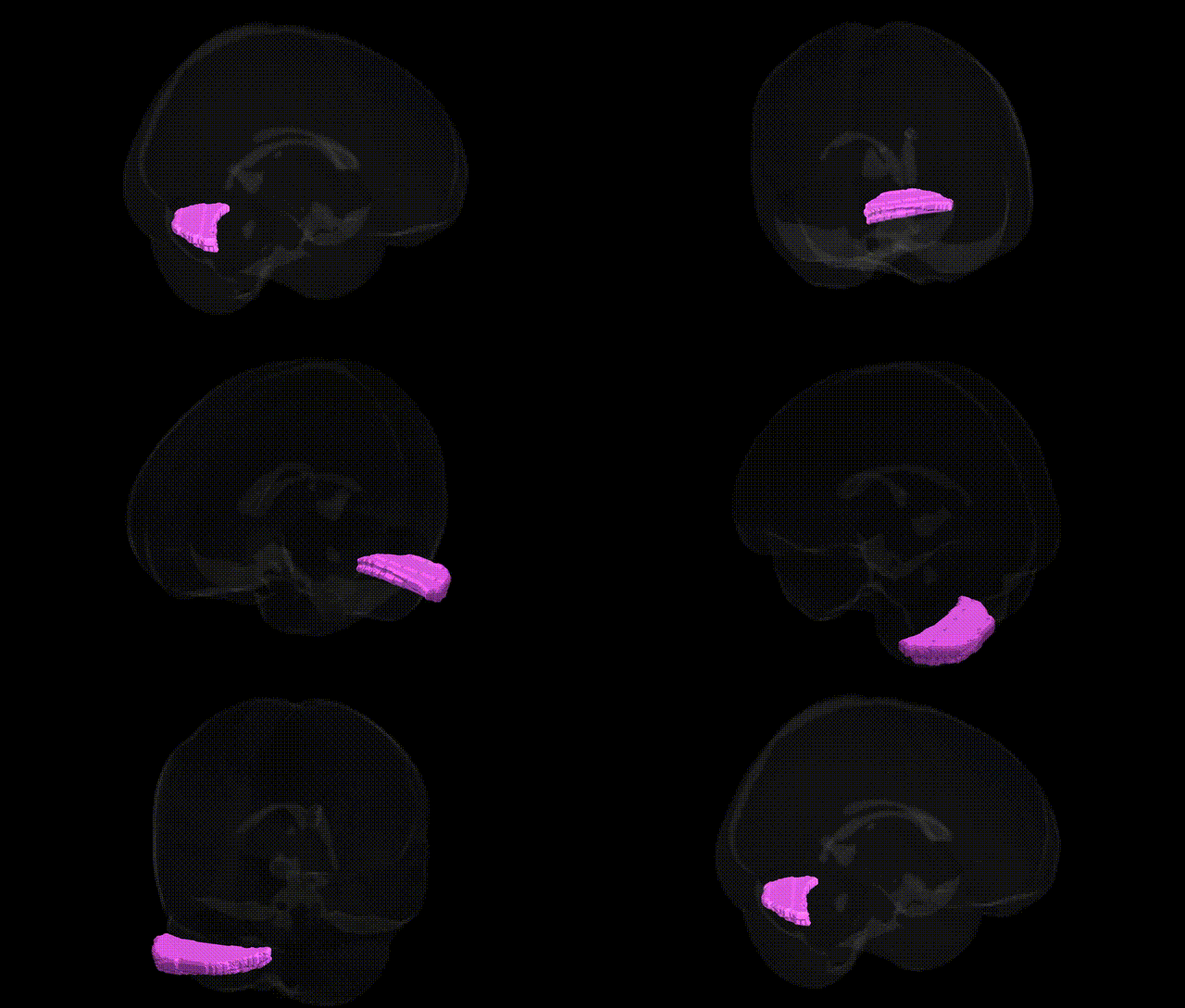
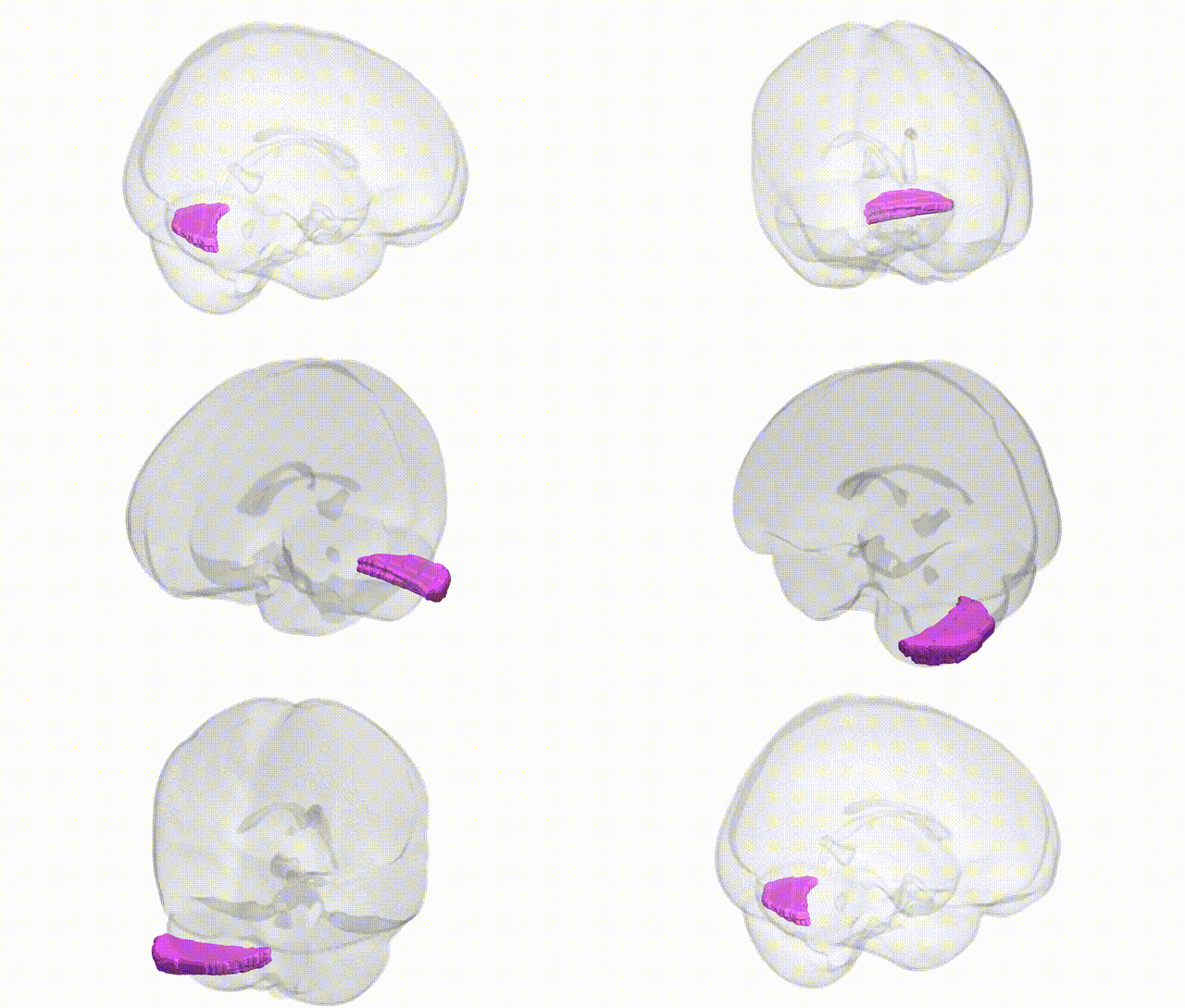
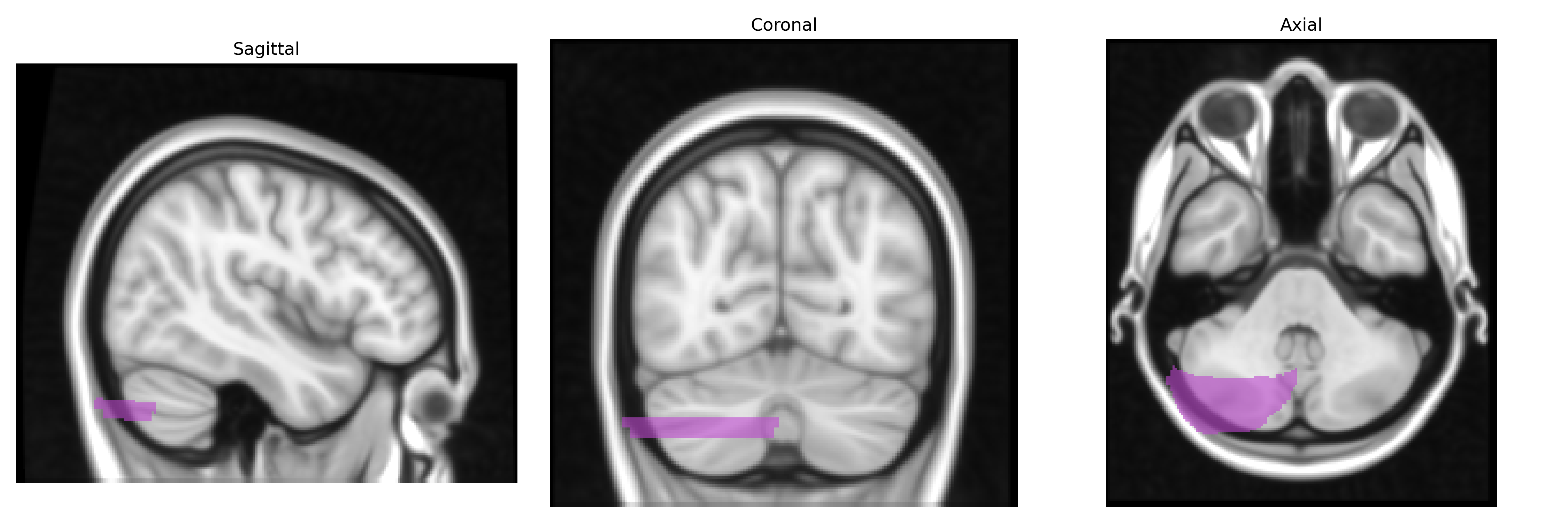
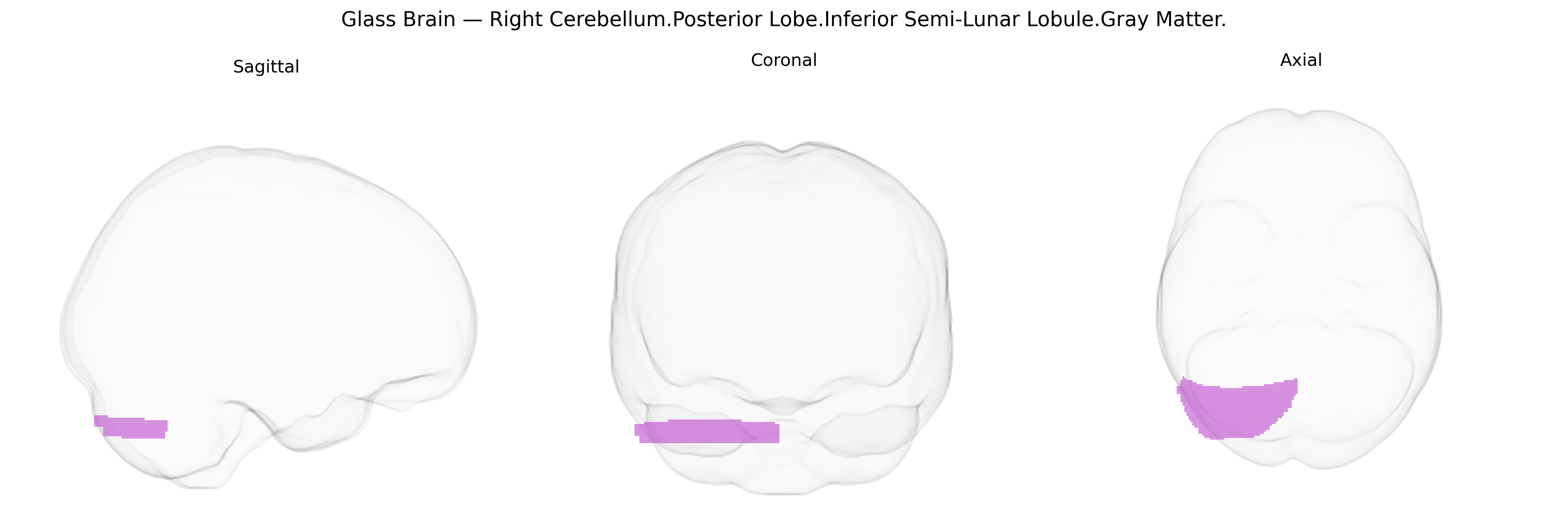
The bilateral Right Cerebellum Posterior Lobe Inferior Semi-Lunar Lobule Gray Matter corresponds to a portion of the cerebellar cortex within the posterior lobe, likely overlapping what is often termed Crus II of the cerebellar hemisphere. This gray matter region participates in higher-order sensorimotor integration and cognitive-associative processing, receiving inputs from cerebral association cortices via pontine nuclei and projecting to deep cerebellar nuclei that influence thalamo-cortical circuits. Functionally, it is implicated in fine-tuning complex, sequential, or coordinated movements, as well as in aspects of language, working memory, and executive functions, consistent with the broader role of the posterior cerebellum in “cognitive cerebellar” networks. There is no direct Wikipedia article for this exact lobule; a related structure and encompassing region is the Cerebellum.
The bilateral Right Cerebellum Posterior Lobe, specifically the inferior semilunar lobule (often overlapping Crus II and adjacent posterior cerebellar cortex in the Talairach 1 mm atlas), has been implicated in several genetic and genome-wide association contexts, though most findings target larger posterior cerebellar territories rather than this subregion alone. GWAS and imaging-genetics studies have shown that polygenic influences on total and regional cerebellar gray matter volume, including posterior lobules, are enriched for neurodevelopmental and synaptic genes, such as variants in genes affecting axon guidance, neuronal migration, and calcium channel function (e.g., CACNA1C and related loci identified in brain-structure GWAS). The posterior cerebellum, including the inferior semilunar region, is a key node in cognitive and affective circuits, and volumetric or functional alterations here have been reported in disorders with known genetic components, including autism spectrum disorder, schizophrenia, bipolar disorder, major depression, and attention-deficit/hyperactivity disorder, often linked to polygenic risk scores rather than single variants. Large-scale consortia (e.g., ENIGMA, UK Biobank) have identified SNPs associated with cerebellar volume and morphology, with posterior lobules frequently contributing to associations between cerebellar structure and genetic risk for psychiatric traits, cognitive performance, and neurodevelopmental conditions, but the evidence remains indirectly mapped to the inferior semilunar lobule via parcel-based atlases and has not yet yielded a robust, region-exclusive set of genetic associations.
Overview generated by GPT-4o (2026).
Region ID: 2
Hemisphere: bilateral
Atlas: Talairach labels 1mm
Full Quality Version: Download MP4
Full Quality Version: Download MP4
Wali Sidiqyar*, Gaurav Rudravaram*, Elyssa M. McMaster, Trent M. Schwartz, Adam M. Saunders, Kurt G. Schilling, Bennett A. Landman "Introducing SPINS: A Shared Public Visualization Library of Neuroanatomical Structures." Medical Imaging with Deep Learning- short paper
This resource is licensed under CC0 1.0 Universal (Public Domain).