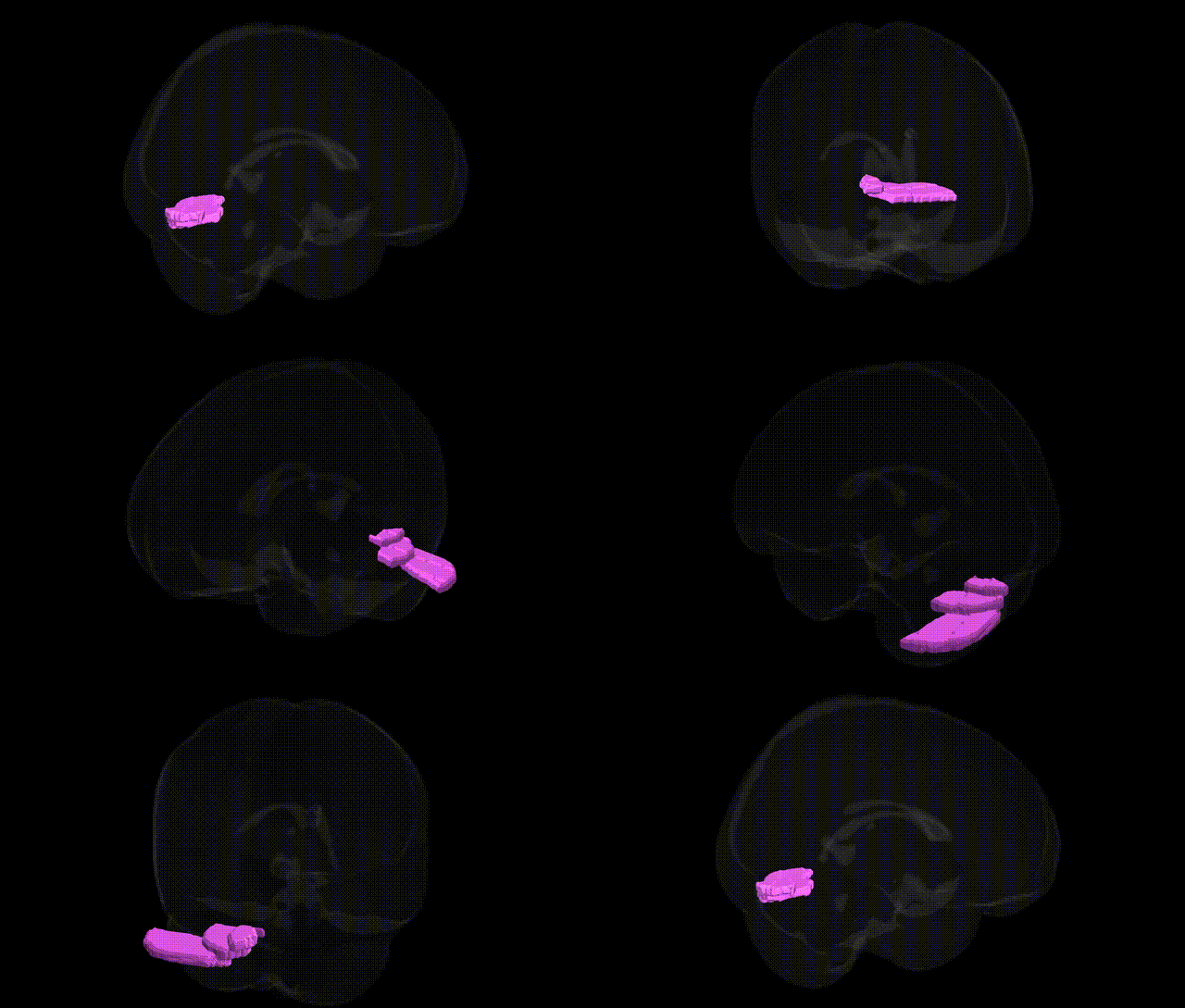
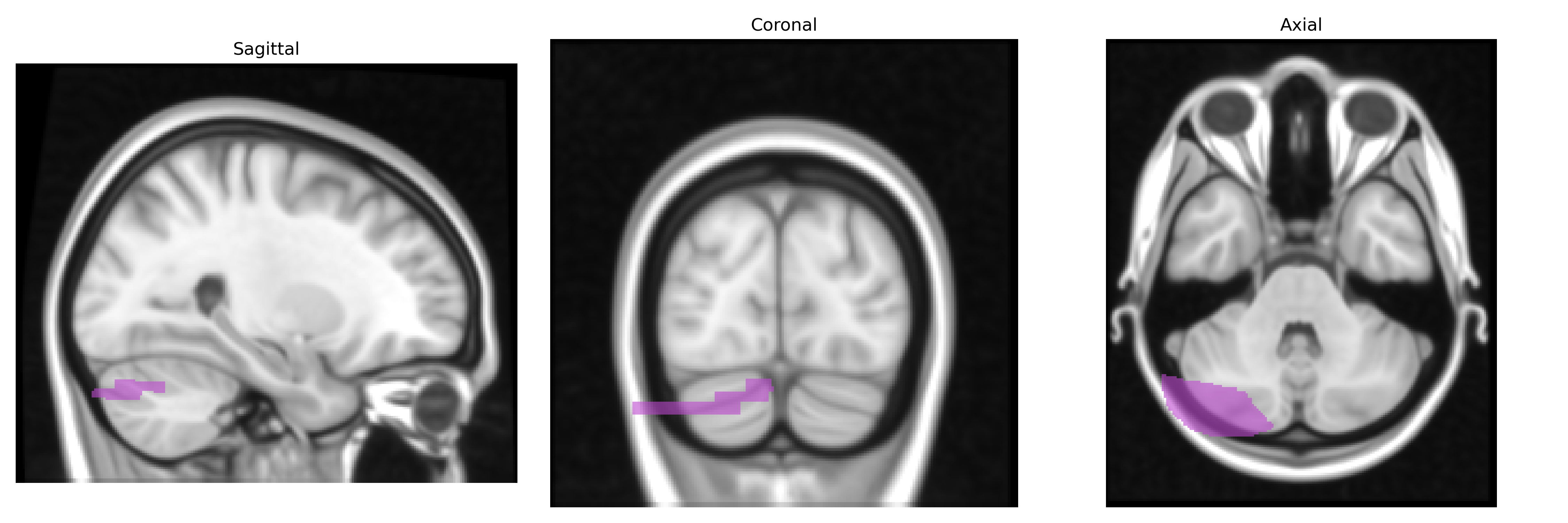
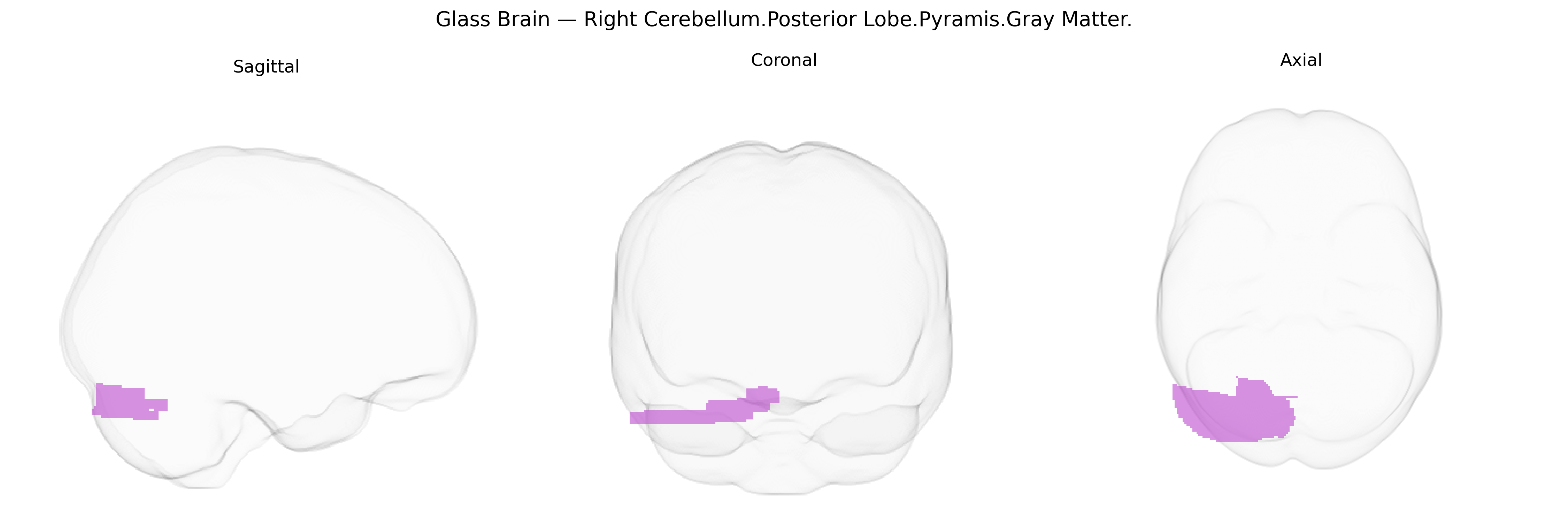
The bilateral Right Cerebellum Posterior Lobe Pyramis Gray Matter corresponds to a portion of the cerebellar vermis located within the posterior lobe of the cerebellum, specifically the pyramis, which is a midline lobule involved in modulating posture, balance, and coordination of axial musculature. As gray matter, this region primarily contains neuronal cell bodies and local circuitry that integrate afferent input from spinal, vestibular, and cortical sources to fine-tune motor outputs via deep cerebellar nuclei. Functionally, the pyramis participates in the regulation of trunk and proximal limb movements and contributes to the adaptive control of motor patterns required for stable gait and upright stance. There is no direct Wikipedia article for the cerebellar pyramis in this labeling context; a closely related structure is the cerebellar vermis: Cerebellar vermis.
The bilateral right cerebellar posterior lobe, specifically the pyramis gray matter (Talairach 1 mm Atlas), has been implicated indirectly in genetic studies through its roles in motor coordination, affective regulation, and cognitive processing, rather than via region-specific GWAS hits, which rarely resolve to such fine-grained cerebellar subregions. Large-scale imaging–genetics consortia such as ENIGMA and UK Biobank have shown that overall cerebellar gray matter volume and posterior cerebellar lobules exhibit significant SNP-based heritability and polygenic influences, with associations enriched for genes involved in neurodevelopment (e.g., synaptic formation, axon guidance, and neuronal migration pathways) and neuropsychiatric risk loci. Variants and polygenic risk scores linked to schizophrenia, major depressive disorder, bipolar disorder, autism spectrum disorder, ADHD, and neuroticism have been associated with altered cerebellar structure or functional connectivity, including posterior cerebellar regions that encompass the pyramis, though most studies report cluster- or lobule-level effects rather than isolating this specific gyrus. GWAS of motor coordination, balance, and gait, as well as cognitive traits such as processing speed and working memory, also implicate cerebellar networks structurally and functionally overlapping with the posterior lobe. Overall, the right cerebellar posterior lobe pyramis gray matter is best understood as part of a broader heritable cerebello-cortical circuitry influenced by distributed polygenic risk rather than by single, region-unique genetic associations.
Overview generated by GPT-4o (2026).
Region ID: 62
Hemisphere: bilateral
Atlas: Talairach labels 1mm
Full Quality Version: Download MP4
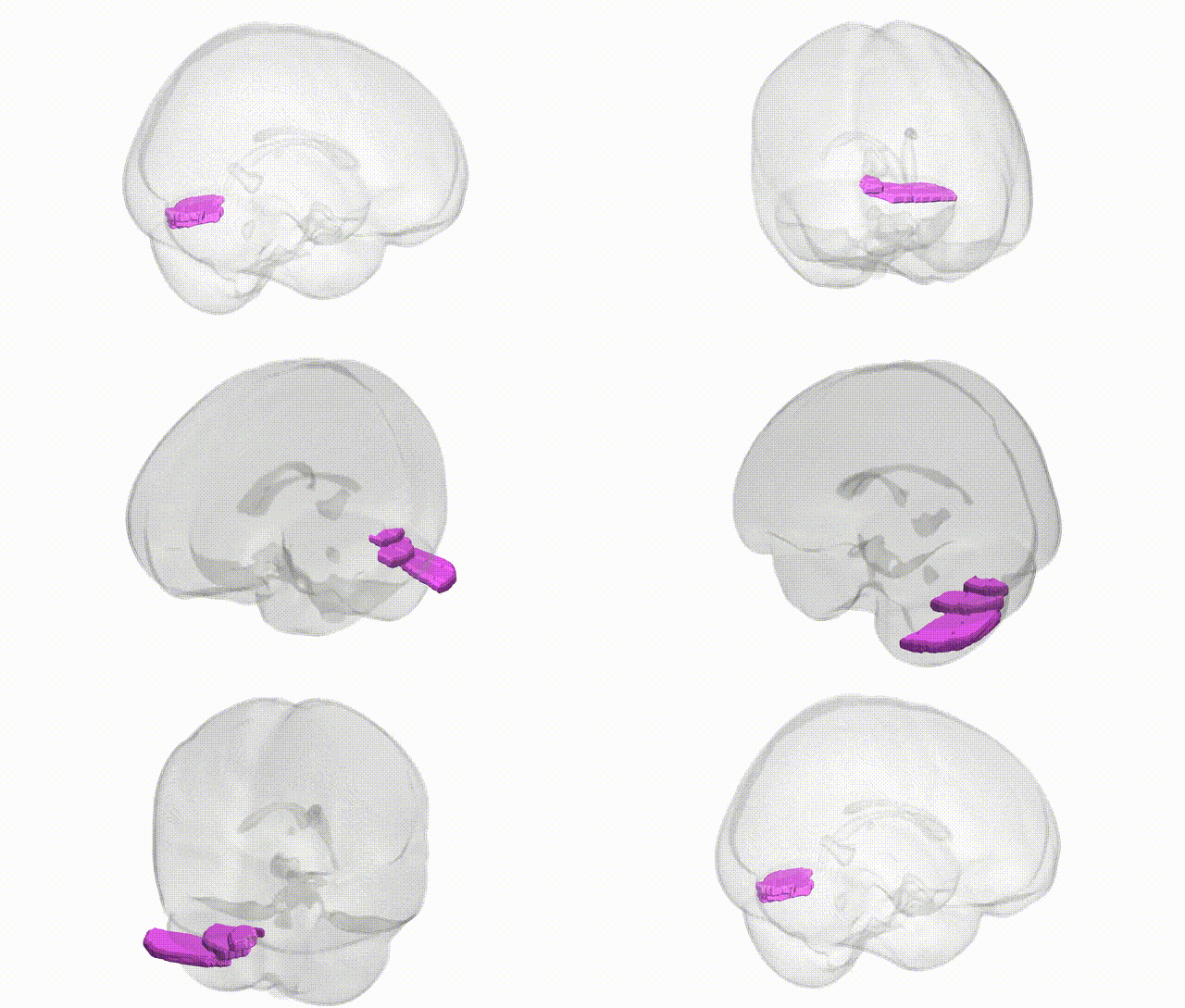
Full Quality Version: Download MP4
Wali Sidiqyar*, Gaurav Rudravaram*, Elyssa M. McMaster, Trent M. Schwartz, Adam M. Saunders, Kurt G. Schilling, Bennett A. Landman "Introducing SPINS: A Shared Public Visualization Library of Neuroanatomical Structures." Medical Imaging with Deep Learning- short paper
This resource is licensed under CC0 1.0 Universal (Public Domain).