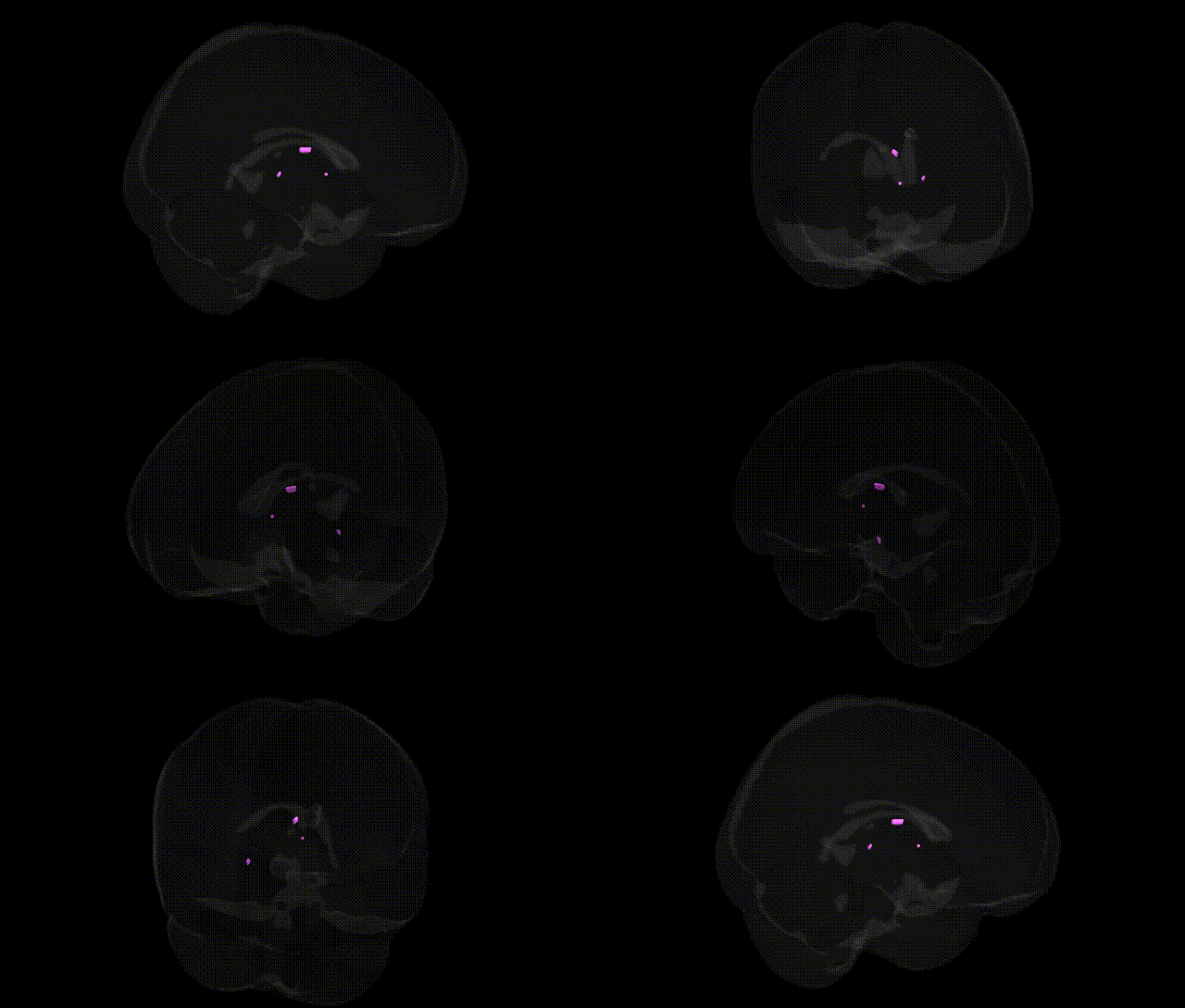
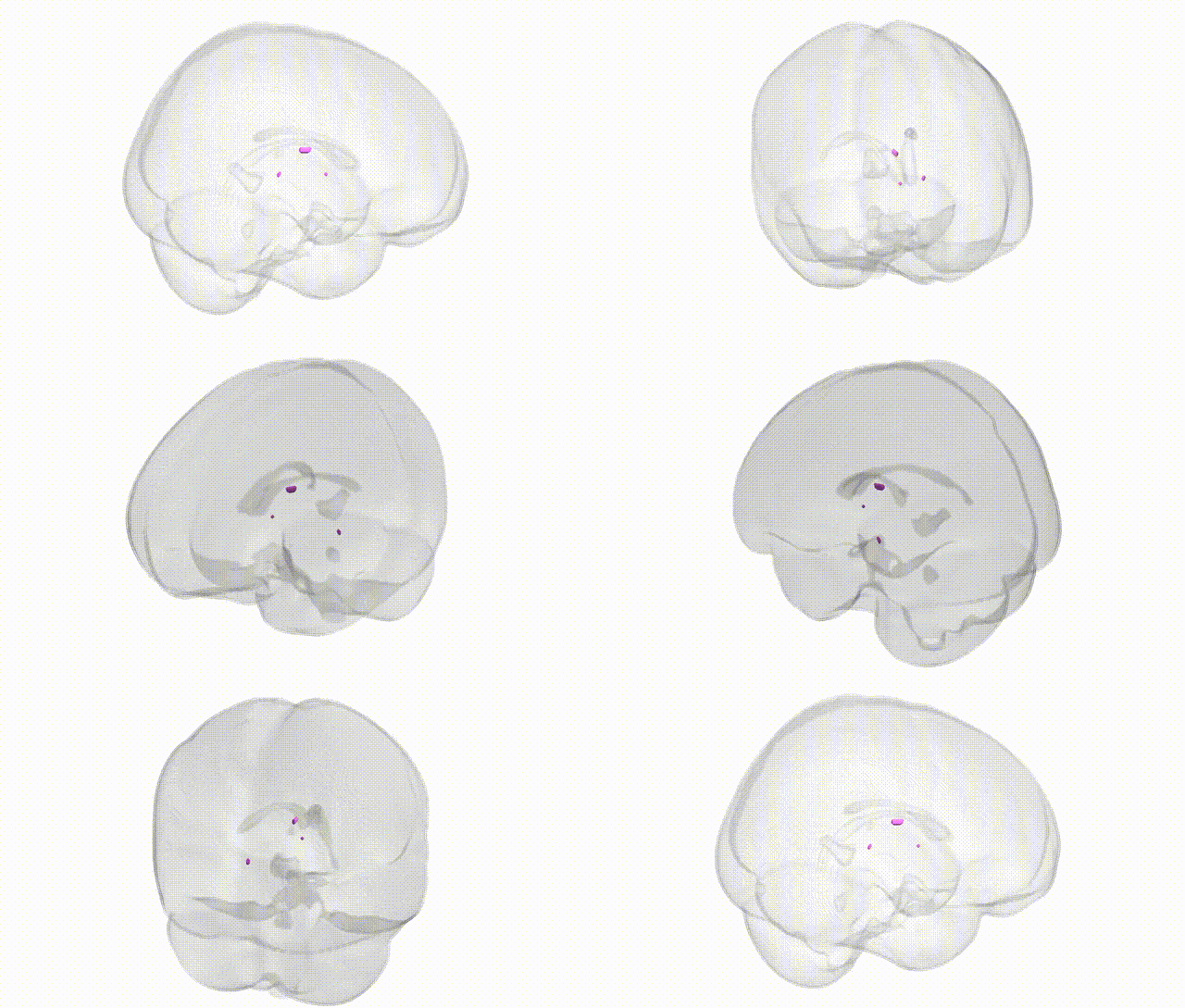
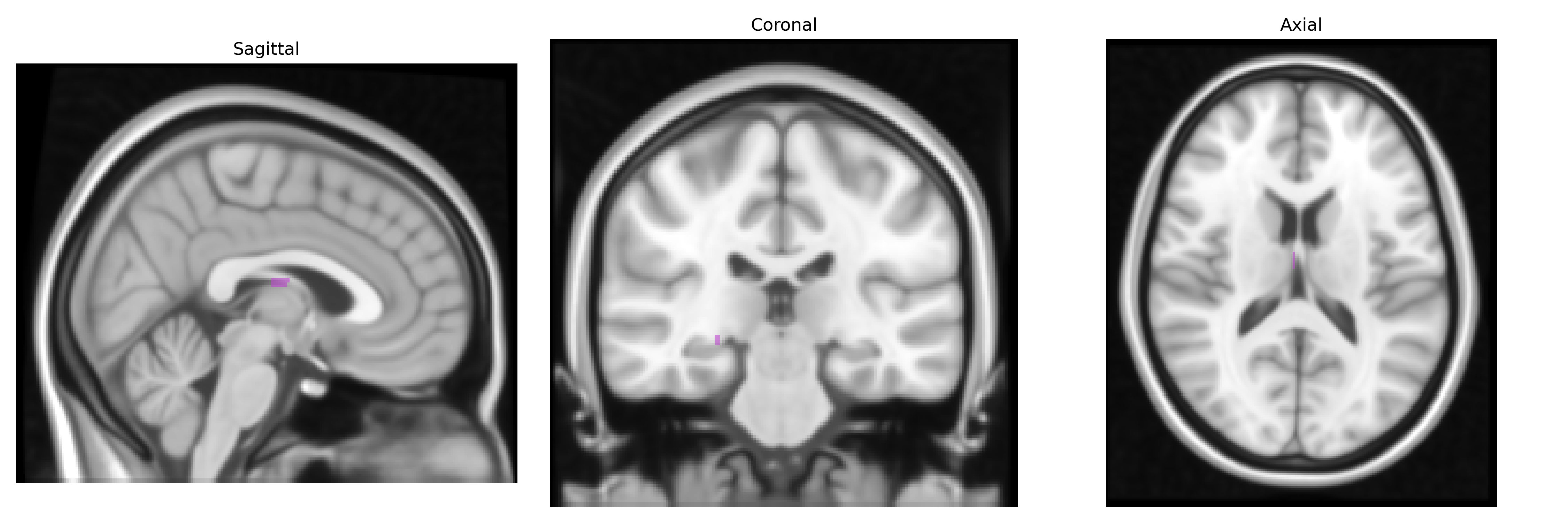
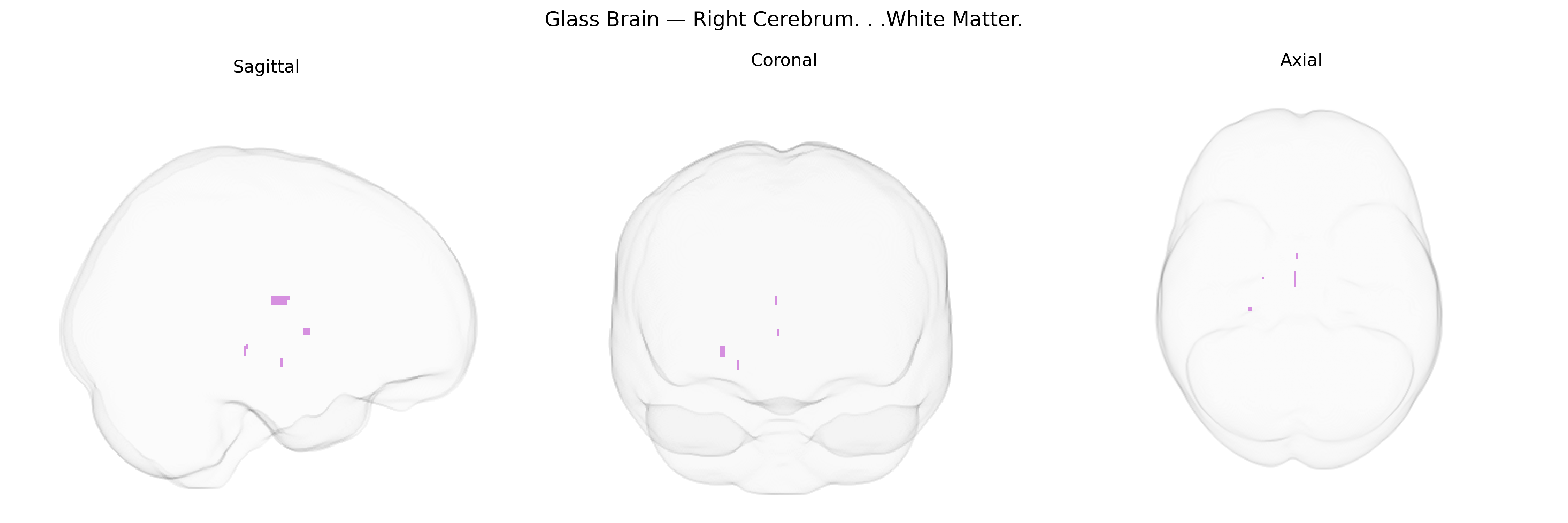
The bilateral right cerebrum white matter refers to the myelinated fiber tracts occupying the subcortical compartment of the right cerebral hemisphere, forming an extensive conduction network that interconnects cortical areas, subcortical nuclei, and the brainstem. These fibers include association tracts (linking cortical regions within the same hemisphere), commissural tracts (primarily callosal fibers crossing the midline to the left hemisphere), and projection tracts (connecting cortex with thalamus, basal ganglia, brainstem, and spinal cord). Structurally, right cerebral white matter supports efficient signal transmission, contributes to hemispheric specialization (such as aspects of visuospatial processing and prosody), and underlies large-scale functional networks critical for cognition, sensorimotor integration, and consciousness. Cerebral white matter
Genetic associations with bilateral right cerebral white matter, as defined in the Talairach 1 mm atlas, largely emerge from genome-wide association studies (GWAS) of global and regional white-matter volume, microstructure (e.g., fractional anisotropy, mean diffusivity), and related connectivity measures, which often treat hemispheres jointly but include right-hemisphere contributions. Common variants in genes involved in myelination and axonal integrity—such as those related to oligodendrocyte function (e.g., MAG, MOG), axon guidance (e.g., ROBO1/2), and cell-adhesion and extracellular matrix pathways (e.g., CNTN4, NCAM, LAMB1)—have been associated with variation in total and regional white-matter metrics, including tracts coursing through right cerebral hemispheric white matter. Large consortia studies (e.g., ENIGMA, UK Biobank) have identified loci near or within genes such as DCC, NTRK2, and genes regulating neurodevelopmental signaling that correlate with white-matter integrity and volume, which in turn show genetic correlations with neuropsychiatric disorders (schizophrenia, bipolar disorder, major depression), neurodevelopmental conditions (autism spectrum disorder, ADHD), and cognitive traits (intelligence, educational attainment). Additional GWAS of leukoaraiosis, small-vessel ischemic disease, and white-matter hyperintensities—often implicating vascular and inflammatory genes (e.g., COL4A1/2, HTRA1, NOS3) and APOE—have linked genetic variation to structural changes in cerebral white matter bilaterally, including the right hemisphere, supporting shared genetic architectures between right cerebral white-matter characteristics, cerebrovascular pathology, and complex brain-related traits.
Overview generated by GPT-4o (2026).
Region ID: 357
Hemisphere: bilateral
Atlas: Talairach labels 1mm
Full Quality Version: Download MP4
Full Quality Version: Download MP4
Wali Sidiqyar*, Gaurav Rudravaram*, Elyssa M. McMaster, Trent M. Schwartz, Adam M. Saunders, Kurt G. Schilling, Bennett A. Landman "Introducing SPINS: A Shared Public Visualization Library of Neuroanatomical Structures." Medical Imaging with Deep Learning- short paper
This resource is licensed under CC0 1.0 Universal (Public Domain).