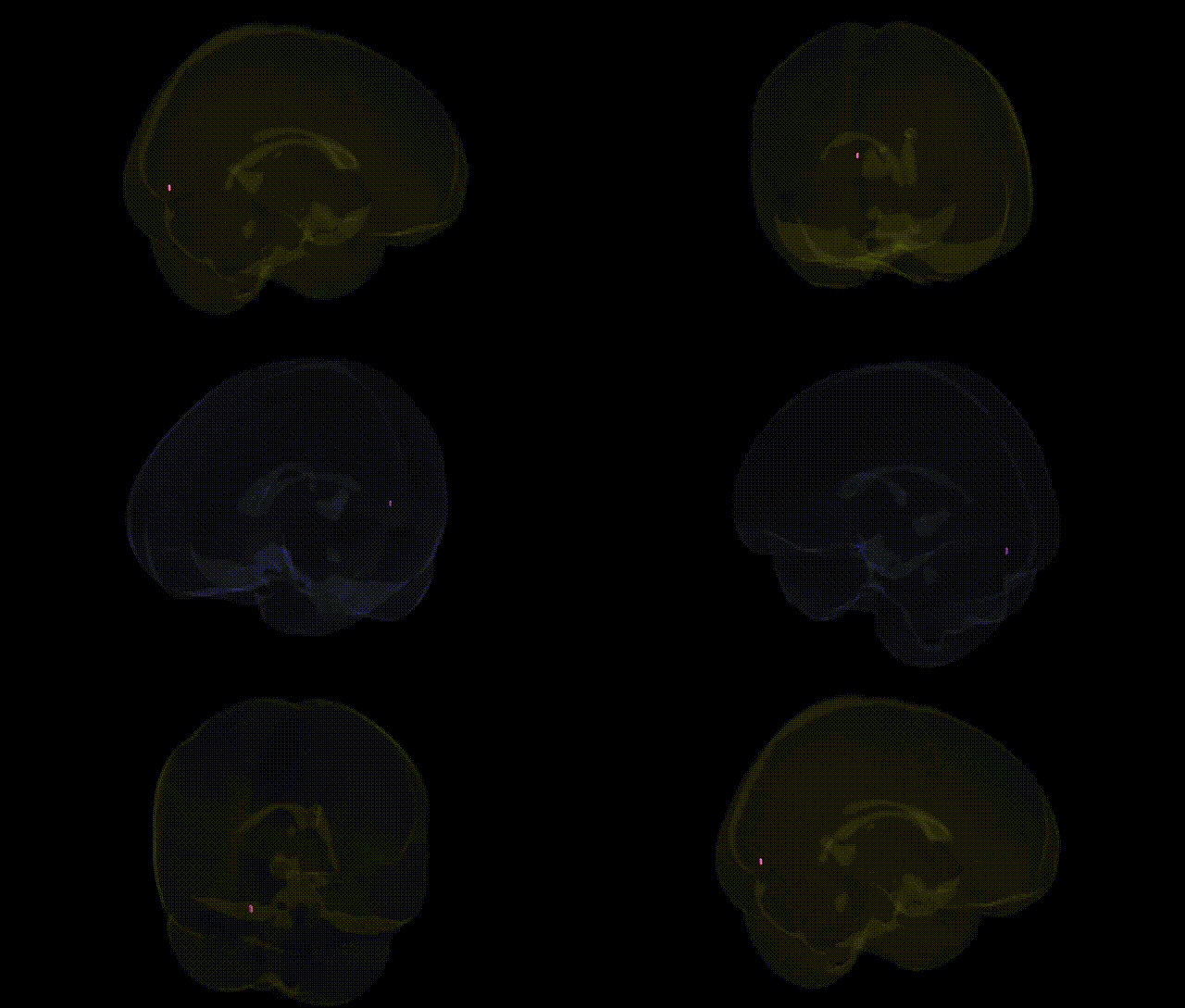
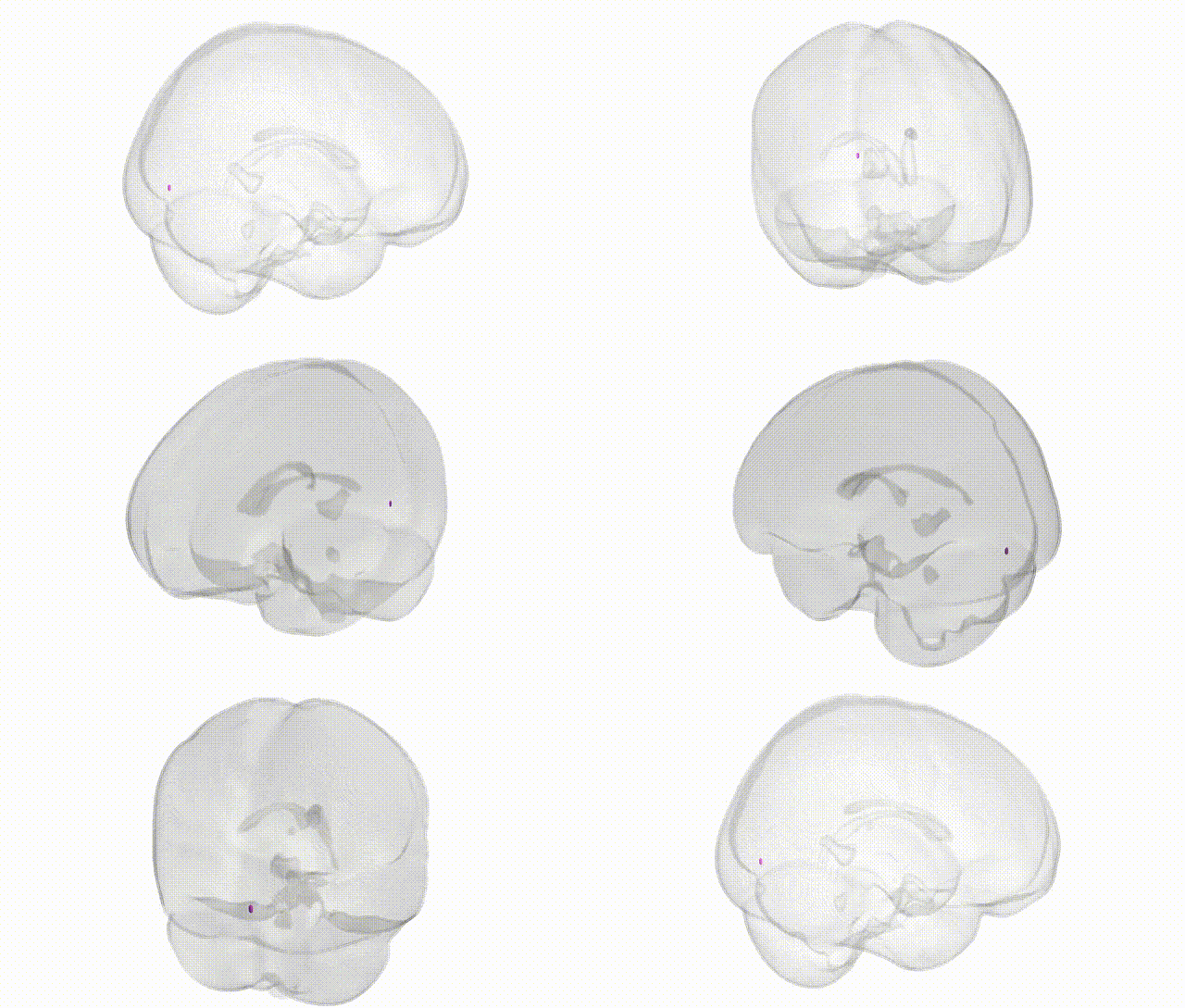
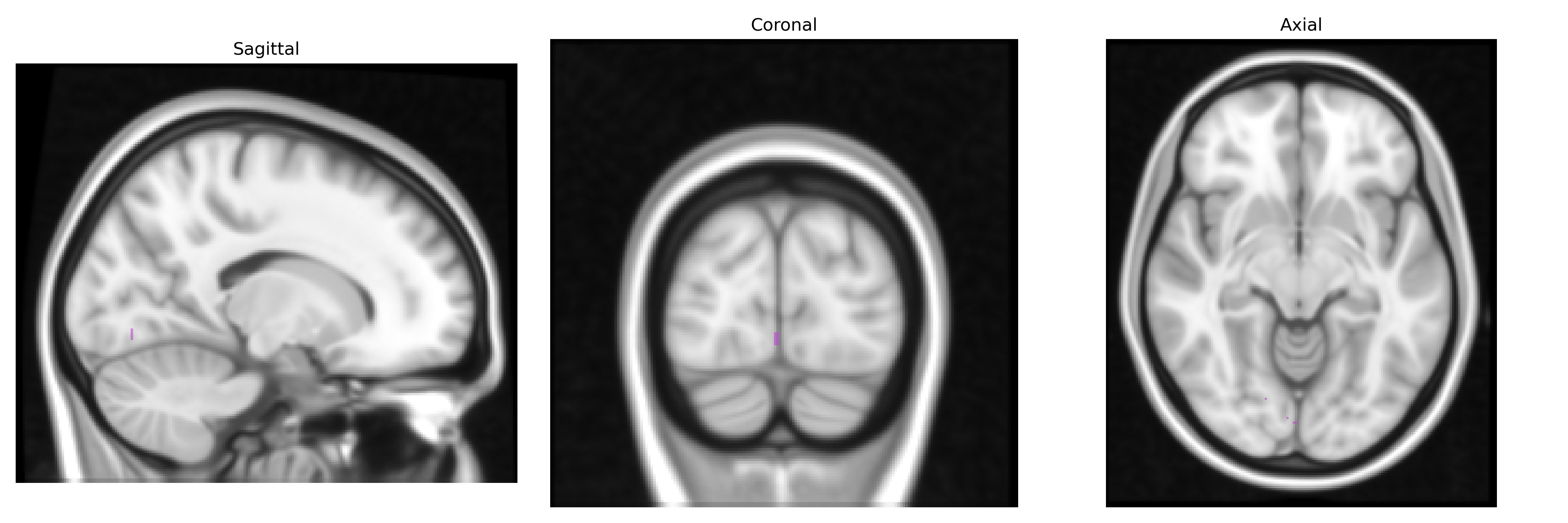
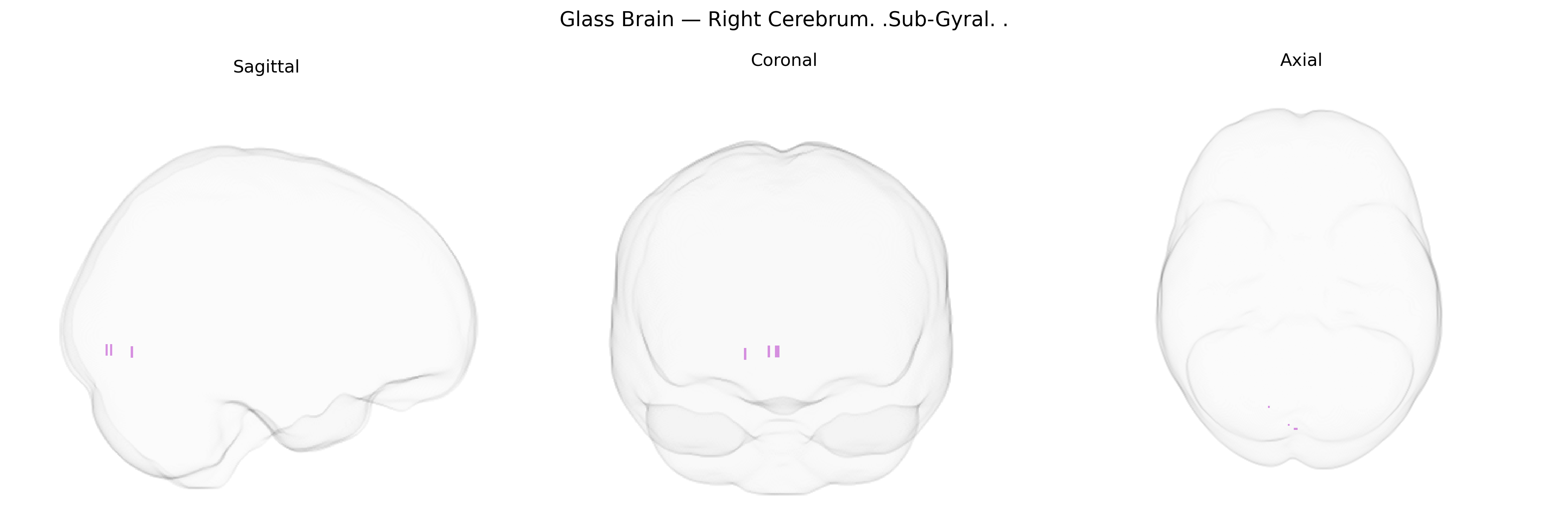
The bilateral Right Cerebrum, Sub-Gyral, refers to subcortical white matter immediately deep to the cerebral cortex in the right hemisphere, encompassing association, projection, and commissural fibers that interconnect cortical gyri, link cortex with subcortical nuclei and brainstem, and integrate sensory, motor, and higher-order cognitive functions across widespread networks. This region contains myelinated axon bundles organized into short U-fibers that connect adjacent gyri and longer tracts that support intrahemispheric communication, contributing to functions such as language prosody, visuospatial processing, attention, and aspects of executive control typically associated with right-hemisphere specialization. The “sub-gyral” designation in the Talairach 1 mm atlas is thus a macroanatomical label for deep white matter beneath multiple gyri rather than a single discrete nucleus or tract, and its functional profile depends on the overlying cortical areas and the specific fiber systems coursing through it. There is no direct Wikipedia article for “Right Cerebrum, Sub-Gyral”; a closely related structure is the Cerebrum.
The “bilateral Right Cerebrum, sub-gyral” label in the Talairach 1 mm atlas corresponds to deep white matter and adjacent subcortical regions underlying multiple cortical areas, so genetic associations are typically reported for specific overlying lobes (e.g., frontal, temporal, parietal) or nearby structures rather than this composite label itself. Large-scale neuroimaging GWAS, such as those from ENIGMA and UK Biobank, have identified numerous common variants (for example in genes like HMGA2, IGF1, and various loci near MAPT, FOXP2, and CNTNAP2) that influence regional cortical thickness, surface area, and white-matter microstructure in right-hemisphere frontal and temporal regions whose sub-gyral tissue would partly fall within this Talairach label. These genetic effects are frequently shared across hemispheres and are implicated in cognitive traits (intelligence, language skills, educational attainment), neurodevelopmental and psychiatric conditions (schizophrenia, bipolar disorder, autism spectrum disorder, ADHD, and major depression), and neurodegenerative diseases (Alzheimer’s disease, frontotemporal dementia), where risk loci often show structural or connectivity effects in right frontal, temporal, and parietal networks. Additionally, brain-wide polygenic influences on global white-matter integrity and intracranial volume include variants in genes related to neurodevelopment, axonal guidance, and myelination (e.g., genes involved in oligodendrocyte function and synaptic plasticity), which by definition affect sub-gyral cerebrum bilaterally, although current GWAS generally lack the spatial resolution to isolate findings specifically to the “Right Cerebrum, sub-gyral” Talairach label.
Overview generated by GPT-4o (2026).
Region ID: 313
Hemisphere: bilateral
Atlas: Talairach labels 1mm
Full Quality Version: Download MP4
Full Quality Version: Download MP4
Wali Sidiqyar*, Gaurav Rudravaram*, Elyssa M. McMaster, Trent M. Schwartz, Adam M. Saunders, Kurt G. Schilling, Bennett A. Landman "Introducing SPINS: A Shared Public Visualization Library of Neuroanatomical Structures." Medical Imaging with Deep Learning- short paper
This resource is licensed under CC0 1.0 Universal (Public Domain).