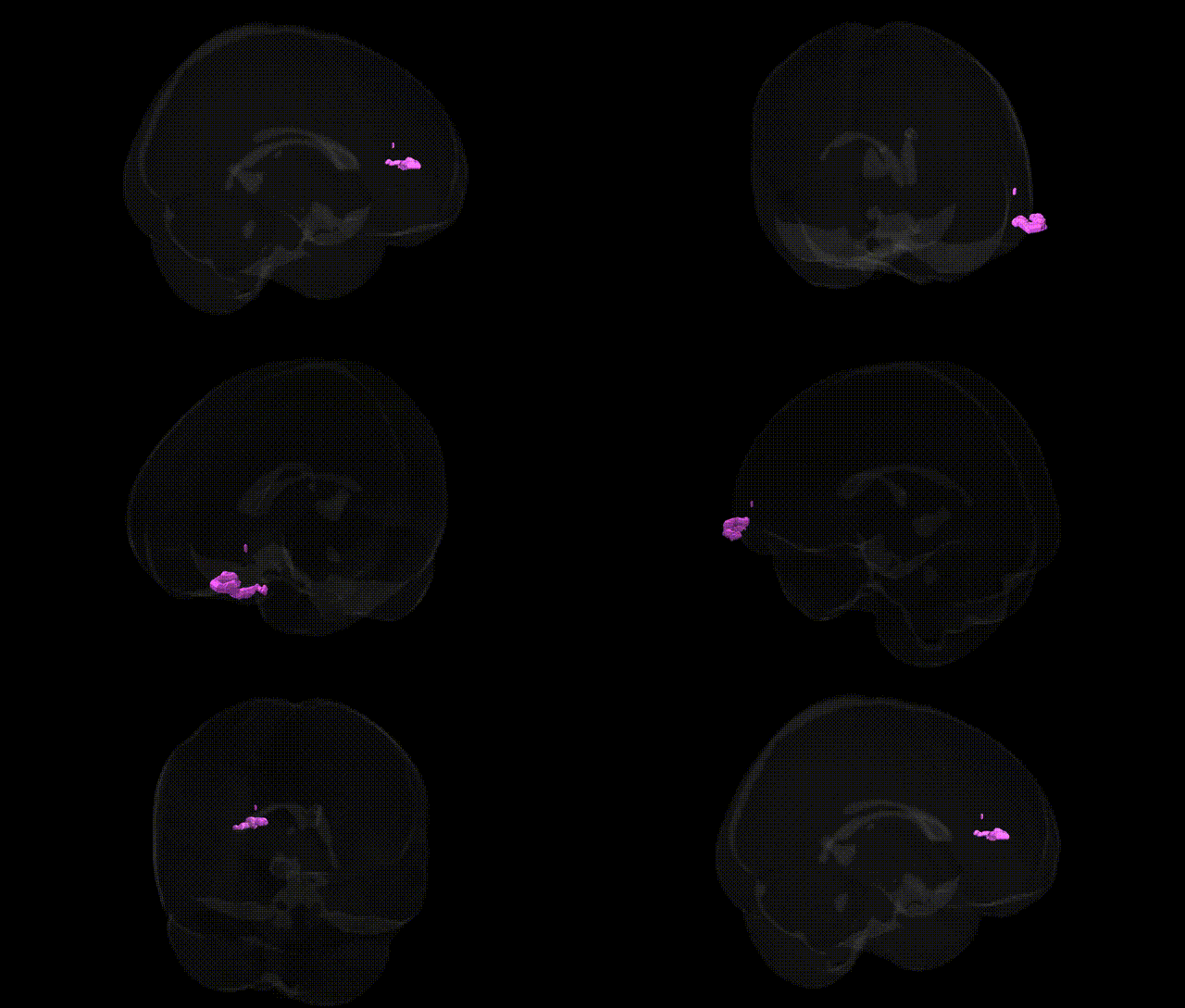
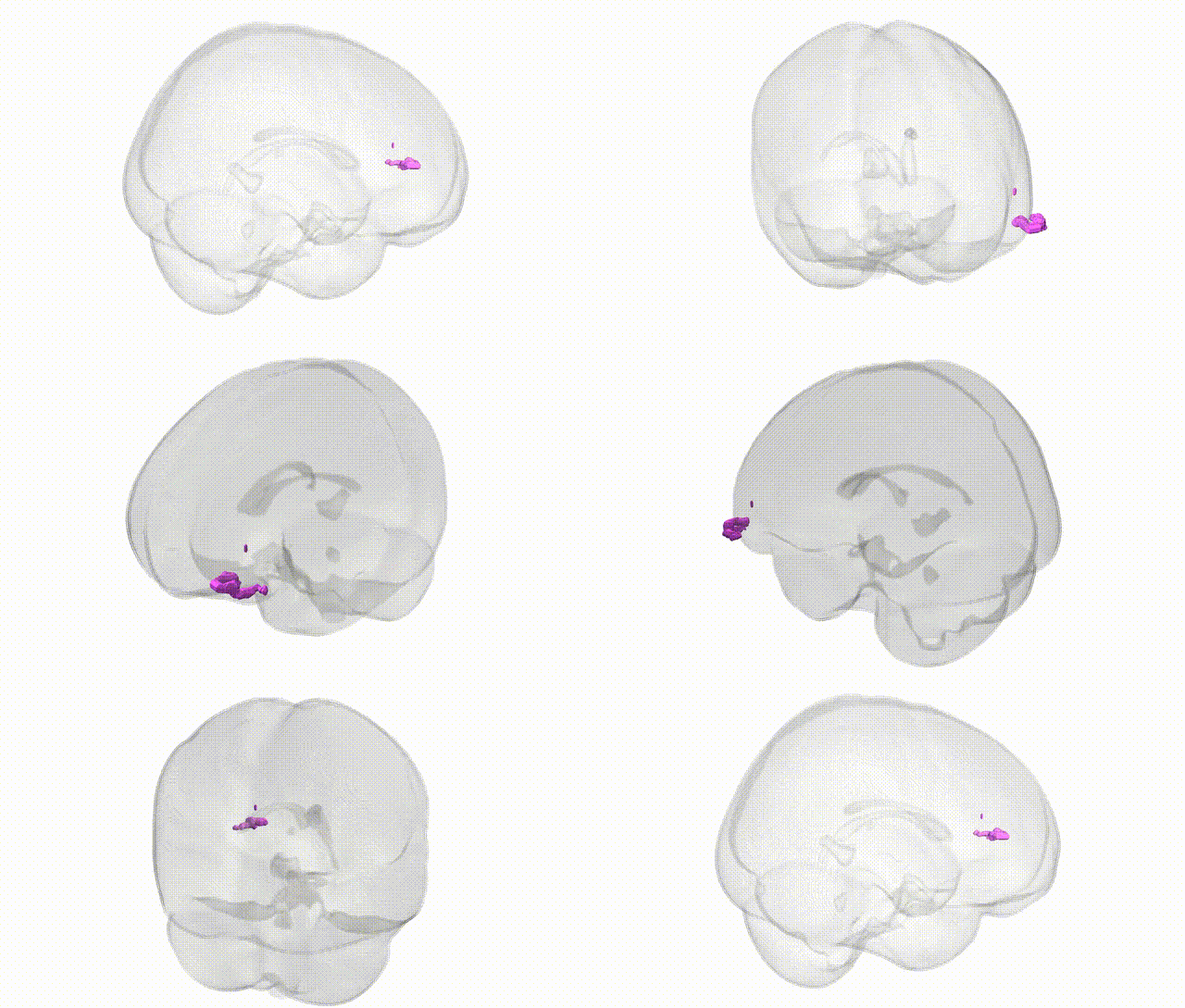
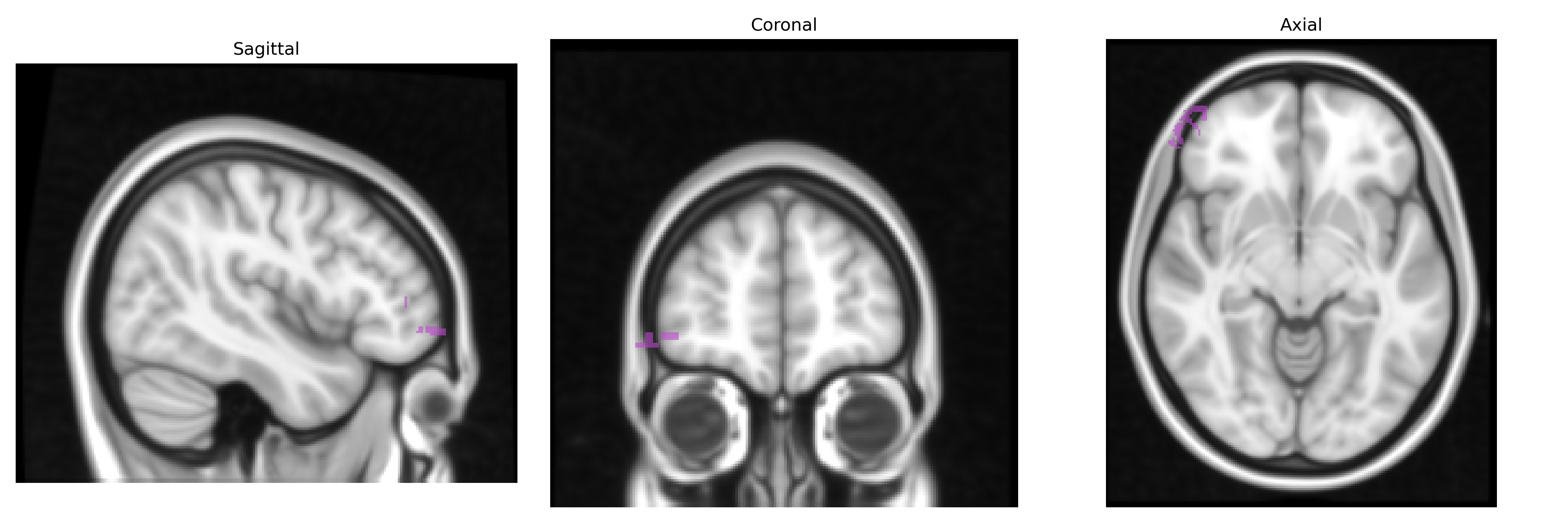
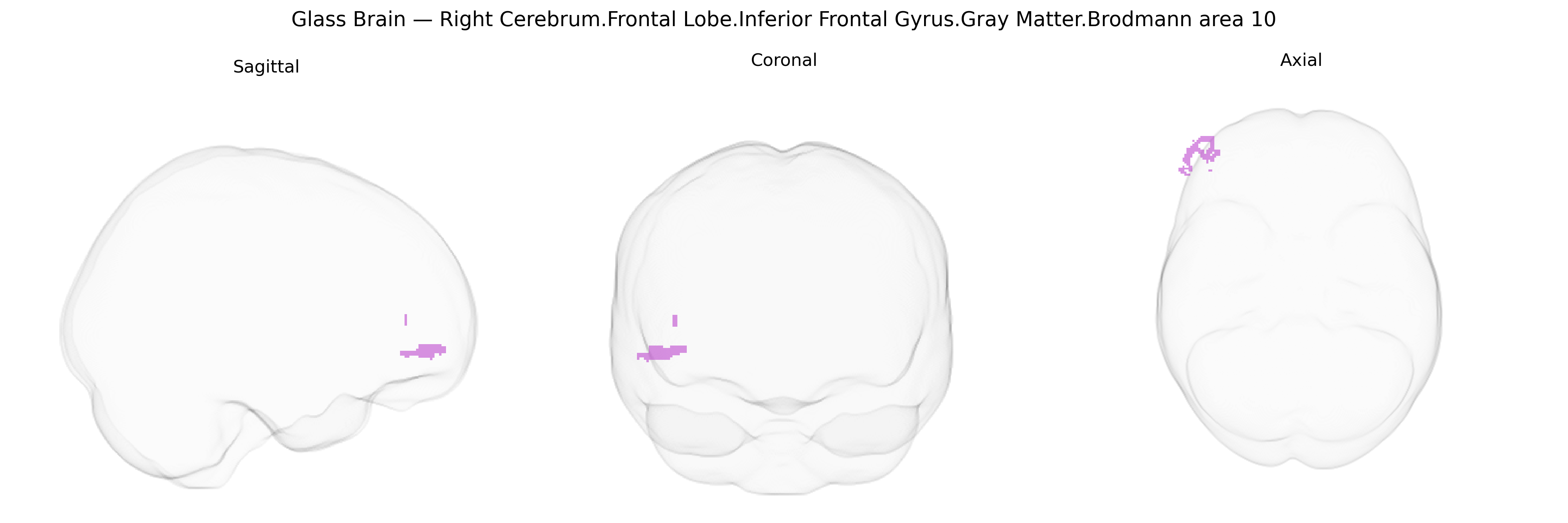
The bilateral Right Cerebrum.Frontal Lobe.Inferior Frontal Gyrus.Gray Matter.Brodmann area 10, as defined in the Talairach 1 mm atlas, corresponds to a rostral portion of the prefrontal cortex situated at the anterior part of the inferior frontal gyrus within the frontal lobe. Brodmann area 10 is among the most anterior cortical fields (often considered part of the frontopolar or anterior prefrontal cortex), characterized by a highly granular cytoarchitecture and extensive connectivity with other prefrontal, limbic, and association cortices, as well as subcortical structures. Functionally, this region has been implicated in higher-order cognitive operations such as prospective memory, multi-tasking, complex decision-making, social cognition, and the integration of internal goals with external stimuli, contributing to abstract reasoning and long-term planning. There is no direct Wikipedia article for this specific Talairach label, but a related area is Brodmann area 10.
The bilateral right Brodmann area 10 (frontopolar prefrontal cortex within the inferior frontal gyrus/rostral frontal lobe as defined in the Talairach 1 mm atlas) has been implicated in genetic studies primarily through imaging-genetics and GWAS of brain structure and function rather than region-specific single-gene associations. Large-scale GWAS of cortical morphology (e.g., ENIGMA and UK Biobank) have identified common variants in genes related to neurodevelopment, synaptic function, and axonal guidance (such as those near PAX6, MEF2C, TBR1, and multiple intergenic loci) that influence prefrontal cortical thickness and surface area, with effects often including the frontopolar/anterior frontal territory overlapping BA10. Polygenic risk scores for schizophrenia, bipolar disorder, major depressive disorder, and autism spectrum disorder have been associated with structural and functional alterations in BA10, including changes in gray matter volume and connectivity within the default mode and frontoparietal control networks. Variants in genes modulating dopaminergic and serotonergic signaling (e.g., COMT, DRD2, 5-HTTLPR/ SLC6A4) have repeatedly been linked to prefrontal activation patterns during high-level cognitive tasks—such as prospective memory, abstract reasoning, and social cognition—that robustly recruit BA10. GWAS of cognitive traits (intelligence, educational attainment, executive function) and personality dimensions (e.g., openness, neuroticism) have shown that polygenic influences on these traits track with structural and functional measures in frontopolar cortex, further supporting a genetically mediated role for BA10 in complex cognition and affect regulation. Although no single variant is uniquely specific to right BA10, convergent genetic evidence from neuroimaging GWAS, psychiatric risk studies, and candidate gene work points to this region as a key target of widespread neurodevelopmental and neuromodulatory genetic effects relevant to mood disorders, psychosis, autism, and higher-order cognitive traits.
Overview generated by GPT-4o (2026).
Region ID: 484
Hemisphere: bilateral
Atlas: Talairach labels 1mm
Full Quality Version: Download MP4
Full Quality Version: Download MP4
Wali Sidiqyar*, Gaurav Rudravaram*, Elyssa M. McMaster, Trent M. Schwartz, Adam M. Saunders, Kurt G. Schilling, Bennett A. Landman "Introducing SPINS: A Shared Public Visualization Library of Neuroanatomical Structures." Medical Imaging with Deep Learning- short paper
This resource is licensed under CC0 1.0 Universal (Public Domain).