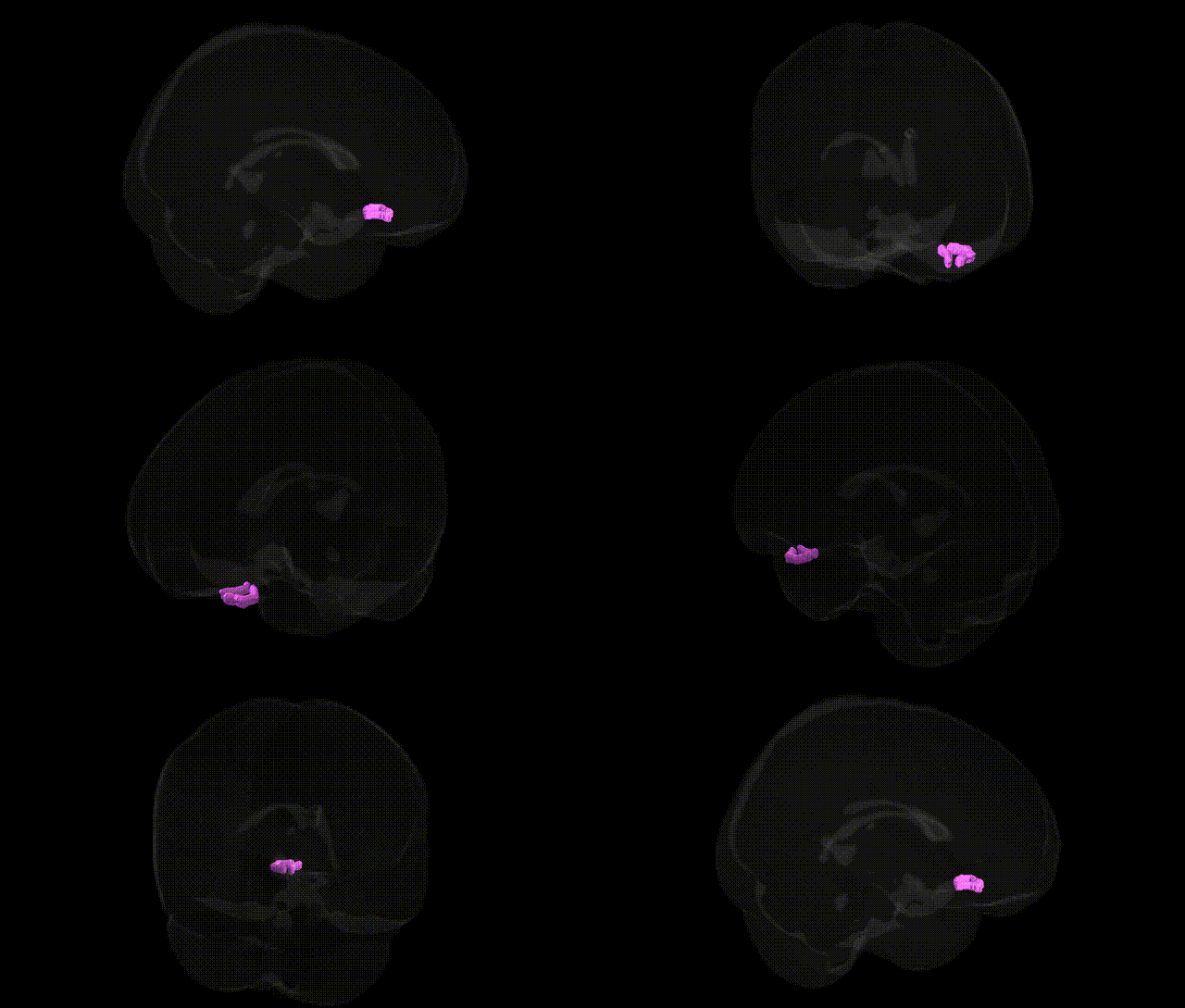
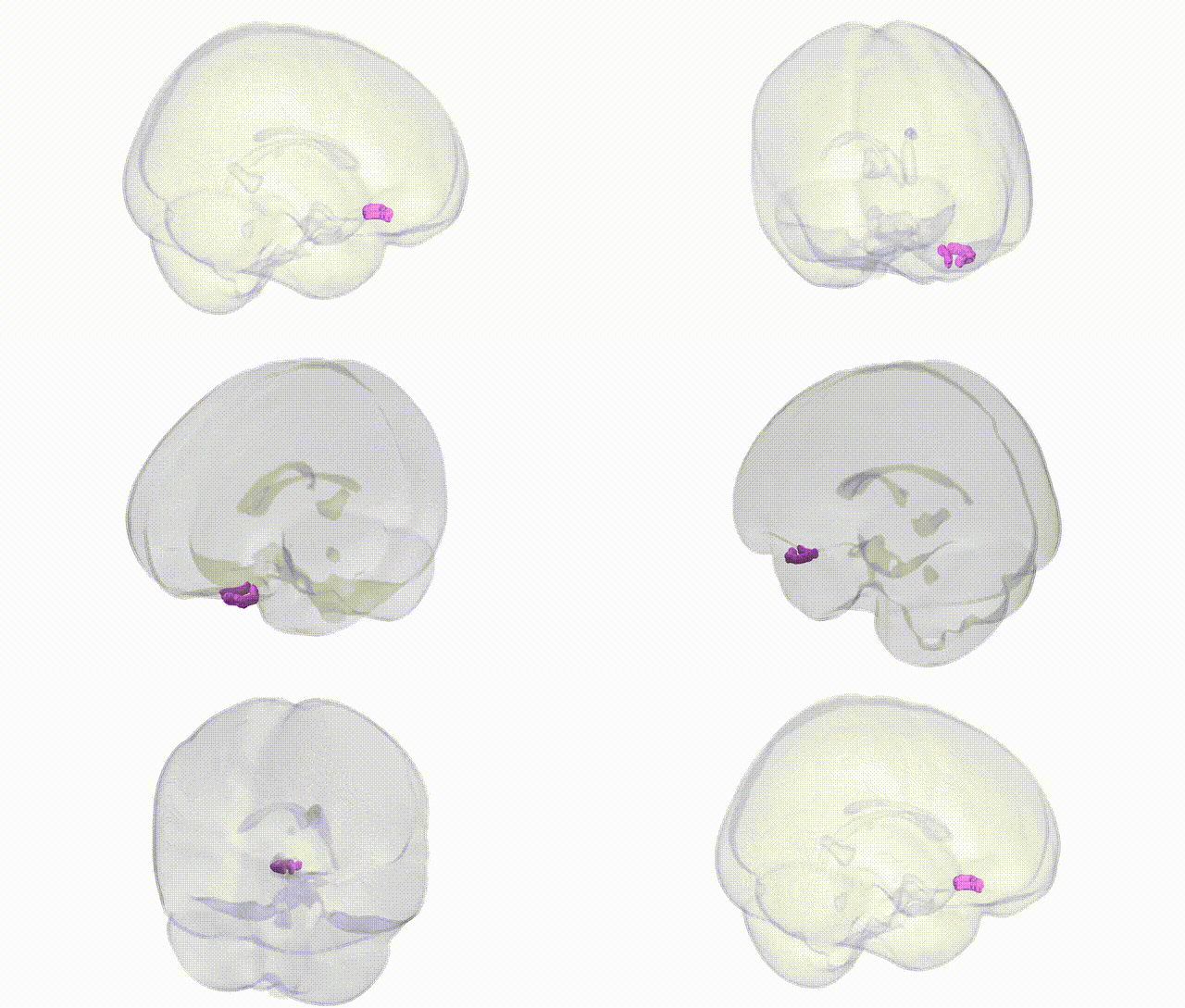
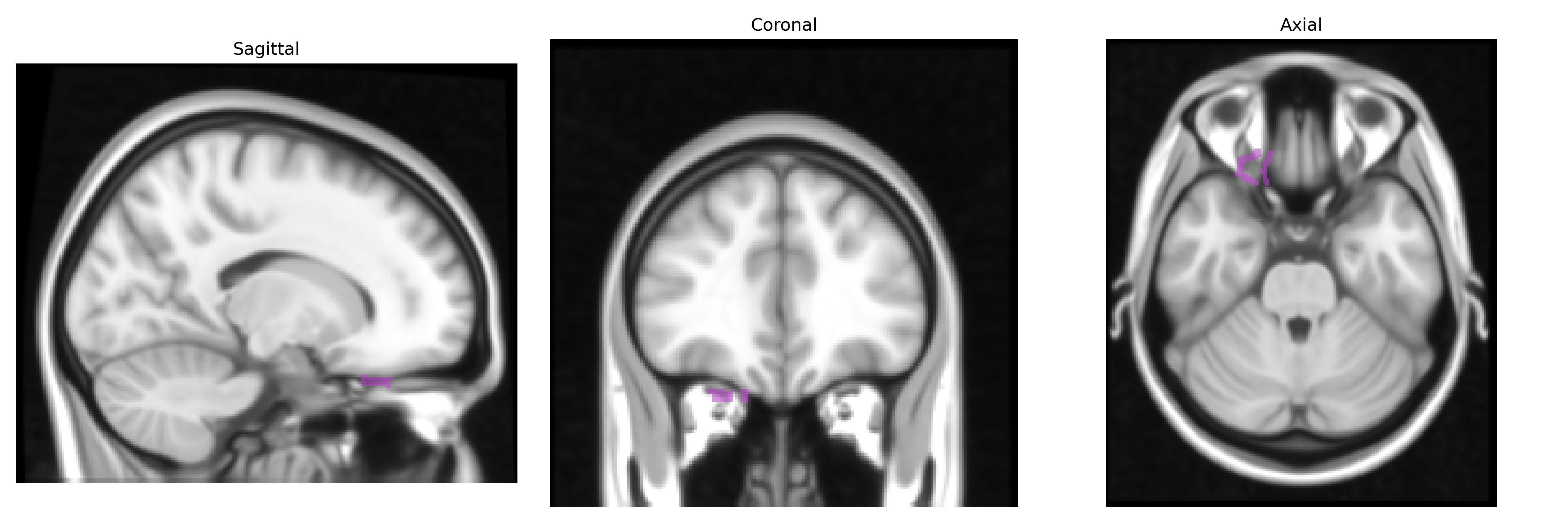
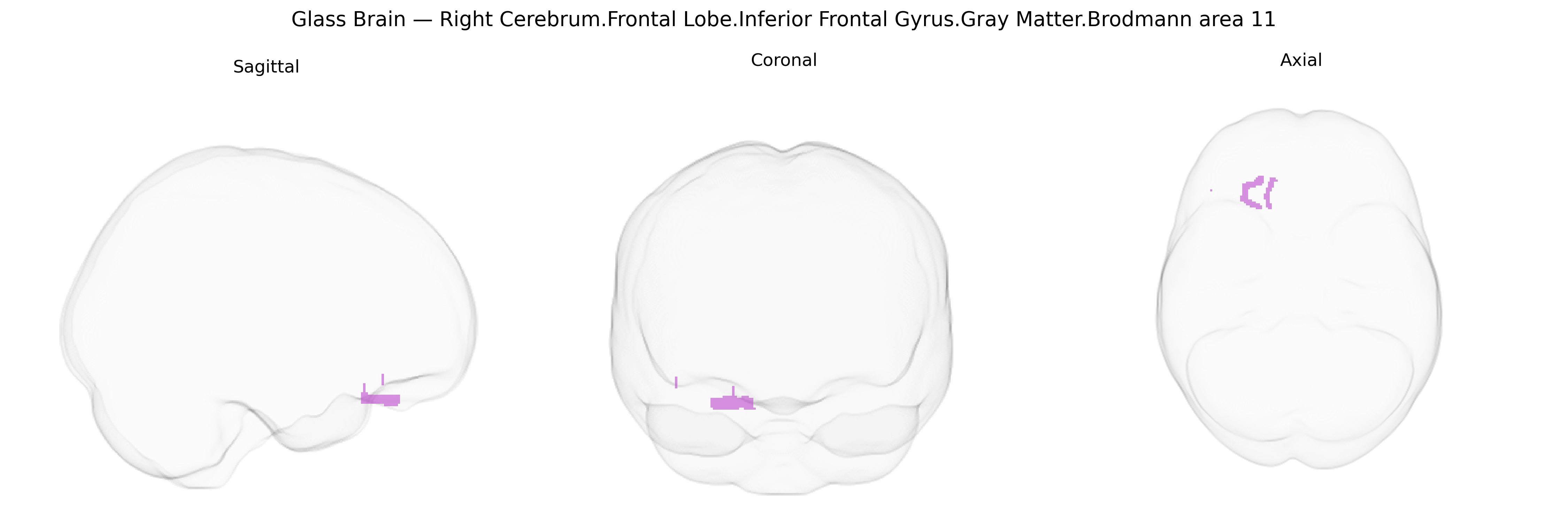
The bilateral Right Cerebrum.Frontal Lobe.Inferior Frontal Gyrus.Gray Matter.Brodmann area 11 corresponds to a ventral portion of the prefrontal cortex located on the orbital surface of the frontal lobe, anterior and inferior to areas implicated in motor and language control. In the Talairach 1 mm Atlas, this region falls within the inferior frontal gyrus gray matter, forming part of the orbitofrontal cortex involved in reward evaluation, emotional and social decision-making, and integration of sensory and affective information to guide complex behavior. Neuronal populations here participate in value-based learning, regulation of impulsive responses, and modulation of autonomic reactions associated with emotional stimuli. This area is highly interconnected with limbic structures such as the amygdala and hippocampus, as well as other prefrontal regions, supporting higher-order cognitive control over motivational and affective processes. There is no dedicated Wikipedia article for this specific Talairach label; a closely related structure is Orbitofrontal cortex.
The bilateral right inferior frontal gyrus gray matter in Brodmann area 11, an orbitofrontal sector defined in the Talairach 1 mm atlas, has been implicated in multiple genetic and GWAS-based associations through imaging–genetics and imaging–GWAS studies linking orbitofrontal and inferior frontal morphology, activation, or connectivity to specific variants and polygenic architectures. Common variants in genes involved in dopaminergic and serotonergic signaling (such as DRD2, DRD4, COMT, and SLC6A4) have been repeatedly associated with structural and functional differences in inferior frontal and orbitofrontal regions, often in the context of impulsivity, response inhibition, and reward processing. Large-scale consortia (e.g., ENIGMA, UK Biobank–based GWAS) have identified SNPs in or near genes related to neurodevelopment, synaptic plasticity, and extracellular matrix regulation that show significant associations with frontal cortical thickness, surface area, or volume, including inferior frontal and orbitofrontal sectors, though the spatial resolution of these analyses typically does not isolate Brodmann area 11 at a 1 mm Talairach-defined level. Genetically influenced variation in this region has been linked to risk for major depressive disorder, bipolar disorder, schizophrenia, obsessive–compulsive disorder, substance use disorders, attention-deficit/hyperactivity disorder, and traits such as neuroticism, risk-taking, and cognitive control, mostly via polygenic risk scores affecting orbitofrontal/inferior frontal structure or function. However, current evidence reflects regional and network-level associations rather than variants uniquely and specifically mapped to the right Brodmann area 11 inferior frontal gyrus at high anatomical precision, and most genetic effects appear modest, distributed, and shared across broader prefrontal circuits.
Overview generated by GPT-4o (2026).
Region ID: 192
Hemisphere: bilateral
Atlas: Talairach labels 1mm
Full Quality Version: Download MP4
Full Quality Version: Download MP4
Wali Sidiqyar*, Gaurav Rudravaram*, Elyssa M. McMaster, Trent M. Schwartz, Adam M. Saunders, Kurt G. Schilling, Bennett A. Landman "Introducing SPINS: A Shared Public Visualization Library of Neuroanatomical Structures." Medical Imaging with Deep Learning- short paper
This resource is licensed under CC0 1.0 Universal (Public Domain).