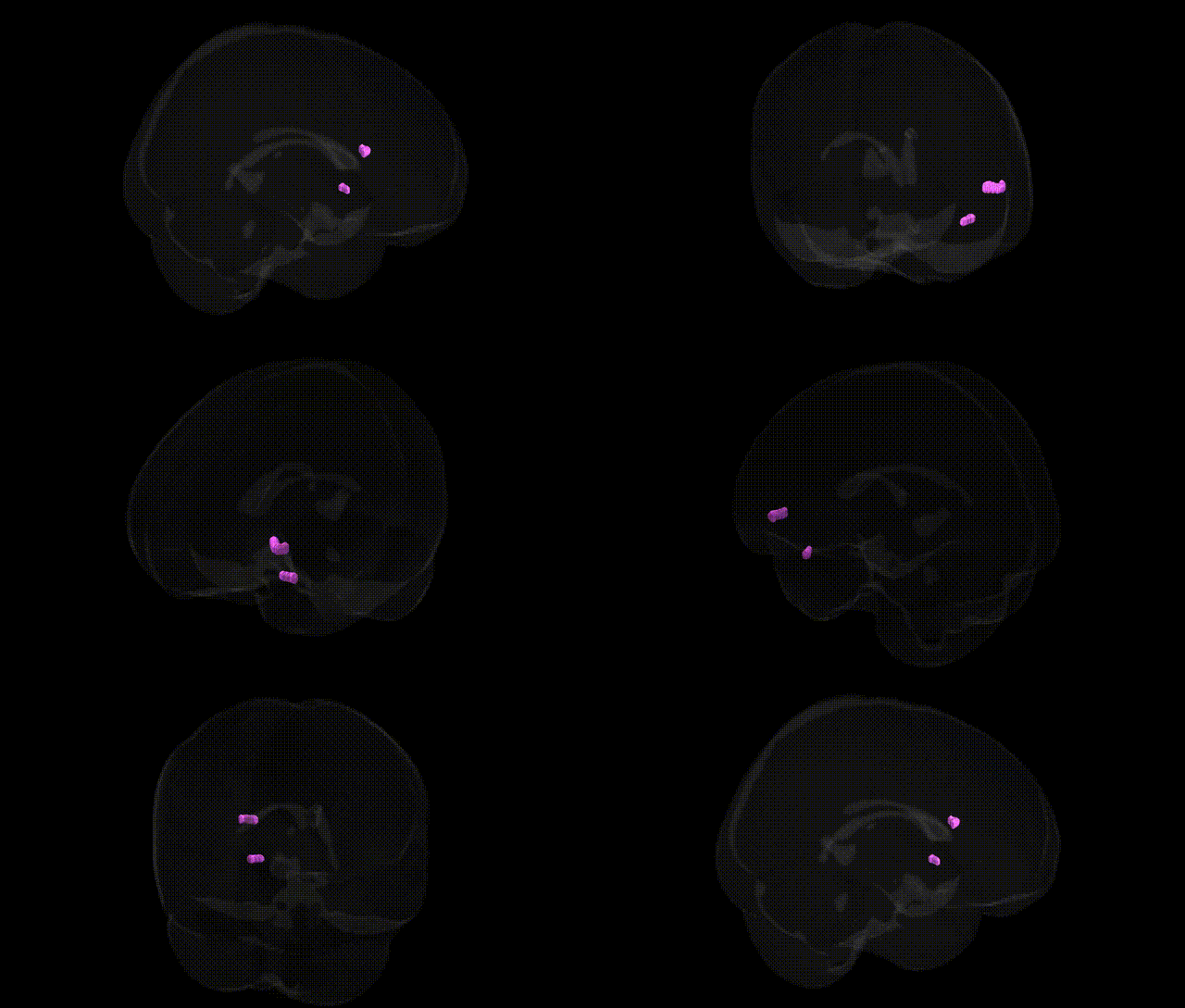
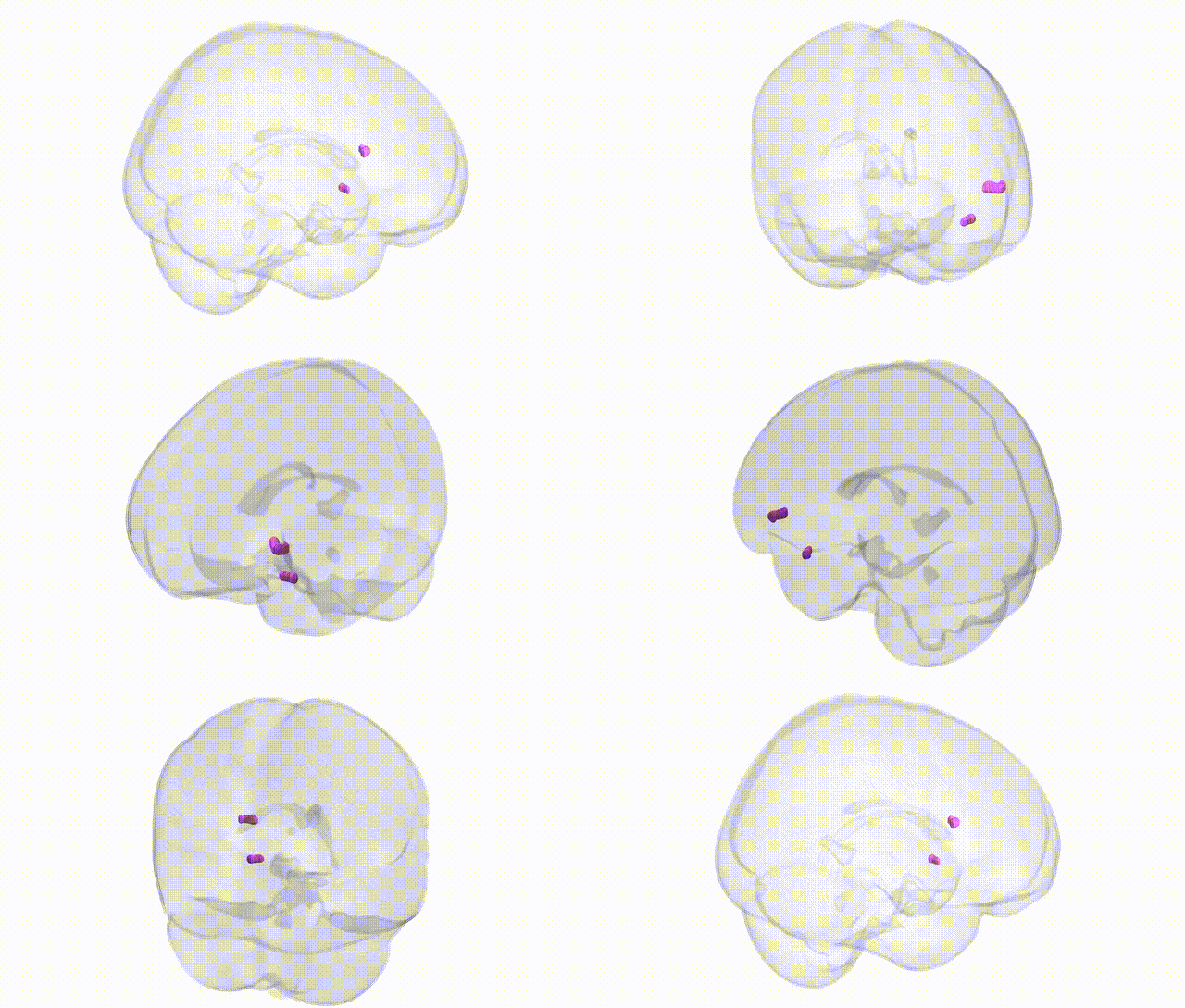
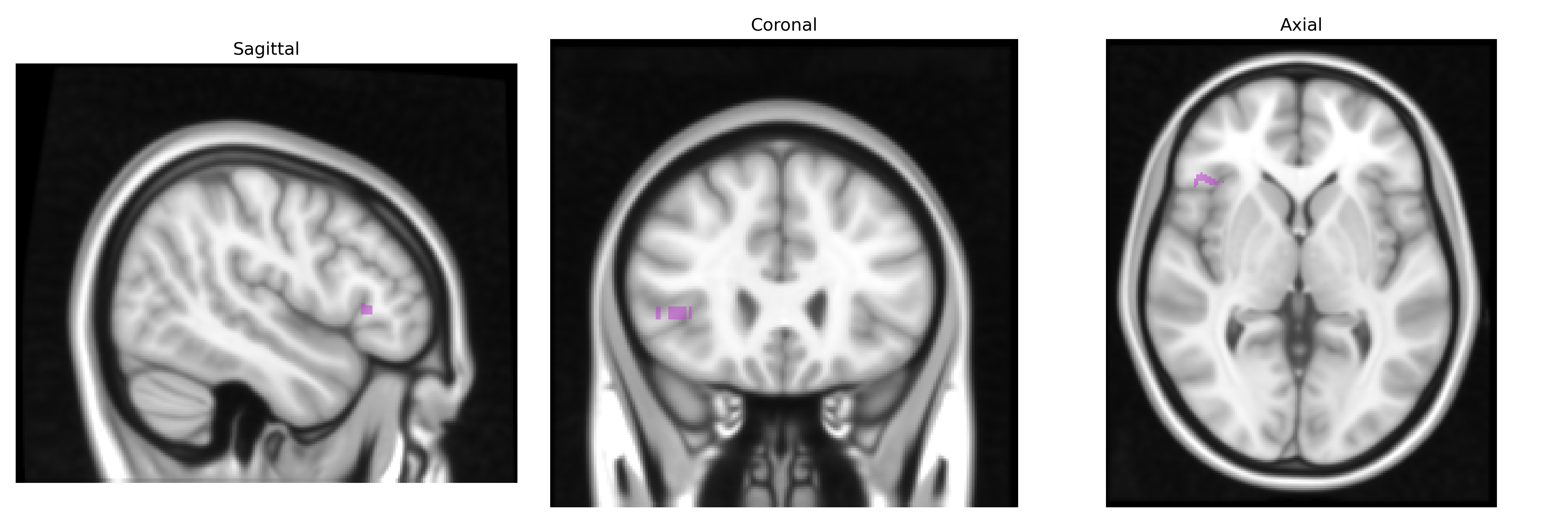
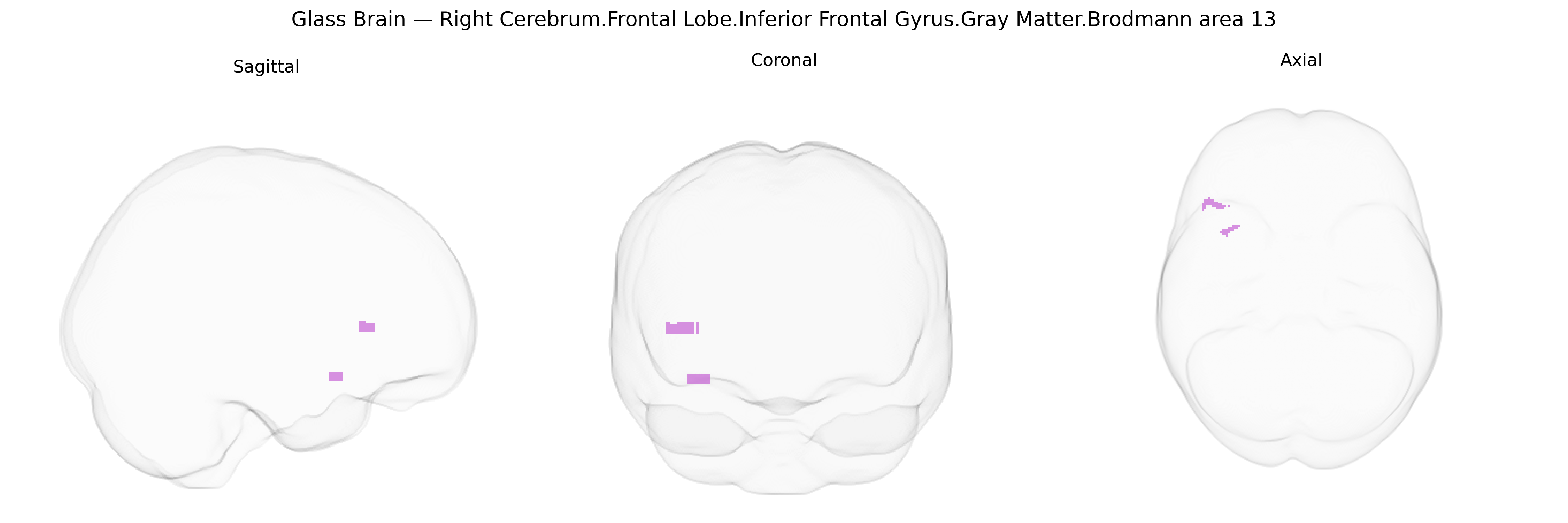
The bilateral Right Cerebrum.Frontal Lobe.Inferior Frontal Gyrus.Gray Matter.Brodmann area 13, as labeled in the Talairach 1 mm atlas, corresponds to a portion of the orbitofrontal cortex situated on the ventral surface of the frontal lobe, within the inferior frontal gyrus and adjacent orbital gyri. Brodmann area 13 is involved in higher-order integrative functions, including reward evaluation, affective and social decision-making, and the modulation of autonomic and emotional responses based on contextual information. This region receives multimodal sensory input and has reciprocal connections with limbic structures such as the amygdala and hippocampus, as well as with other prefrontal areas, supporting its role in integrating emotional and cognitive signals to guide goal-directed behavior and adaptive choice. There is no direct link for this exact region; a related structure is the Orbitofrontal cortex.
The inferior frontal gyrus (IFG) in the frontal lobe, including regions overlapping Brodmann area 13 in some Talairach-based parcellations, has been implicated in numerous imaging-genetics and GWAS-based endophenotype studies rather than a single, well-defined genetic signature, with many associations arising from intermediate traits such as cortical thickness, gray matter volume, and functional activation. Large-scale brain-structure GWAS (e.g., ENIGMA and UK Biobank–based analyses) have identified common variants in genes involved in neurodevelopment, synaptic plasticity, and neuronal differentiation—such as MIR137, HMGA2, and various loci near genes regulating cortical patterning—that influence IFG and adjacent frontal cortical morphology, though these effects are typically small and highly polygenic. Genetic risk variants for neuropsychiatric disorders that often show structural or functional alterations in the IFG, including schizophrenia, major depressive disorder, autism spectrum disorder, and attention-deficit/hyperactivity disorder, are enriched in pathways related to synaptic function and neuronal signaling (for example, genes like CACNA1C, GRIN2A, and DRD2 appearing in broader frontal-cortex–linked polygenic architectures), and polygenic risk scores for these conditions correlate with IFG volume or activation measures in several cohorts. Additionally, GWAS of cognitive traits and educational attainment have demonstrated that polygenic scores for general intelligence and executive function are associated with variation in inferior frontal and orbitofrontal gray matter, consistent with the role of this region in language, inhibitory control, and decision-making, although no single variant or gene can be said to specifically “encode” bilateral IFG/BA13 structure or function, which remains an archetypal highly polygenic, pleiotropic brain phenotype.
Overview generated by GPT-4o (2026).
Region ID: 295
Hemisphere: bilateral
Atlas: Talairach labels 1mm
Full Quality Version: Download MP4
Full Quality Version: Download MP4
Wali Sidiqyar*, Gaurav Rudravaram*, Elyssa M. McMaster, Trent M. Schwartz, Adam M. Saunders, Kurt G. Schilling, Bennett A. Landman "Introducing SPINS: A Shared Public Visualization Library of Neuroanatomical Structures." Medical Imaging with Deep Learning- short paper
This resource is licensed under CC0 1.0 Universal (Public Domain).