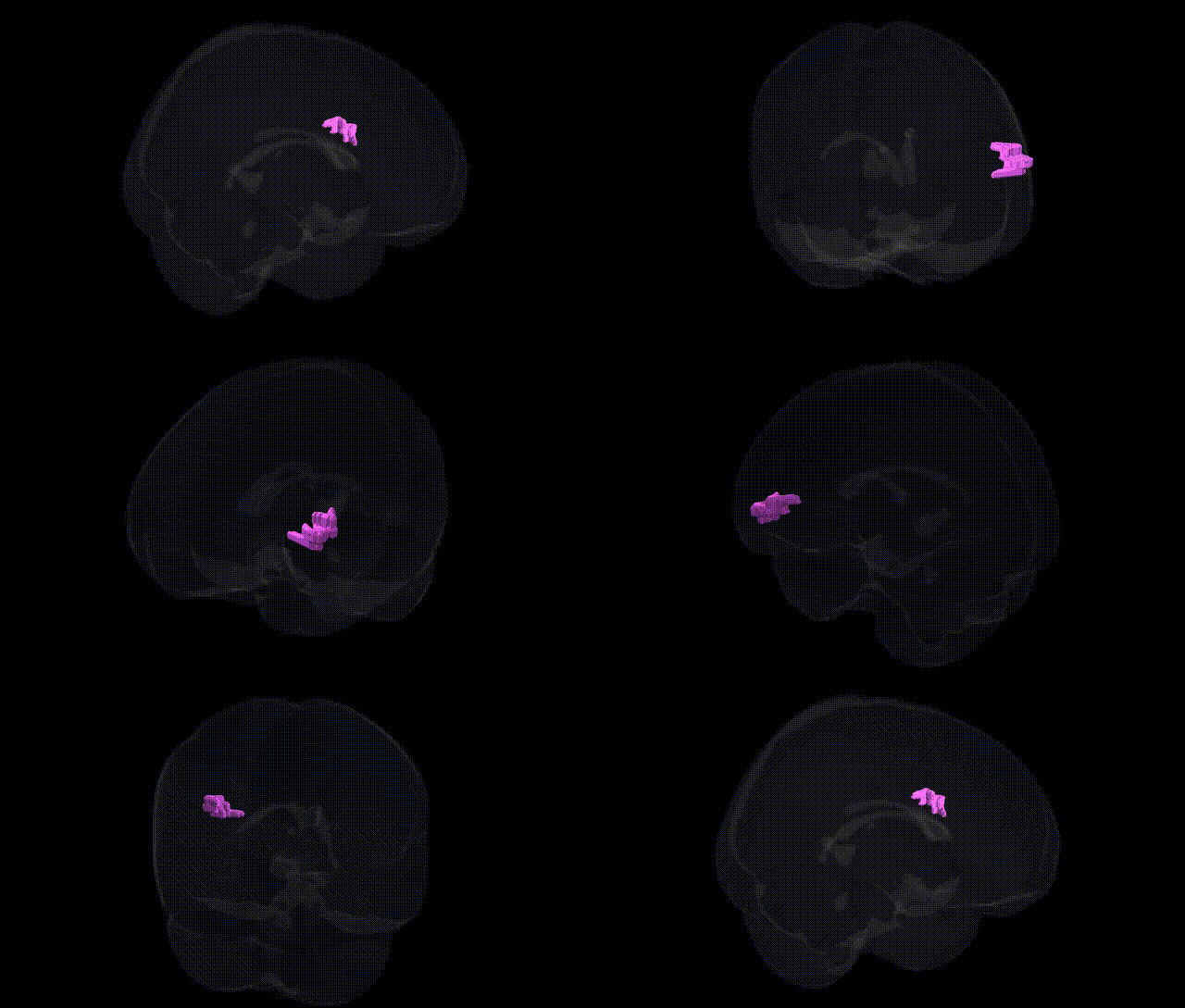
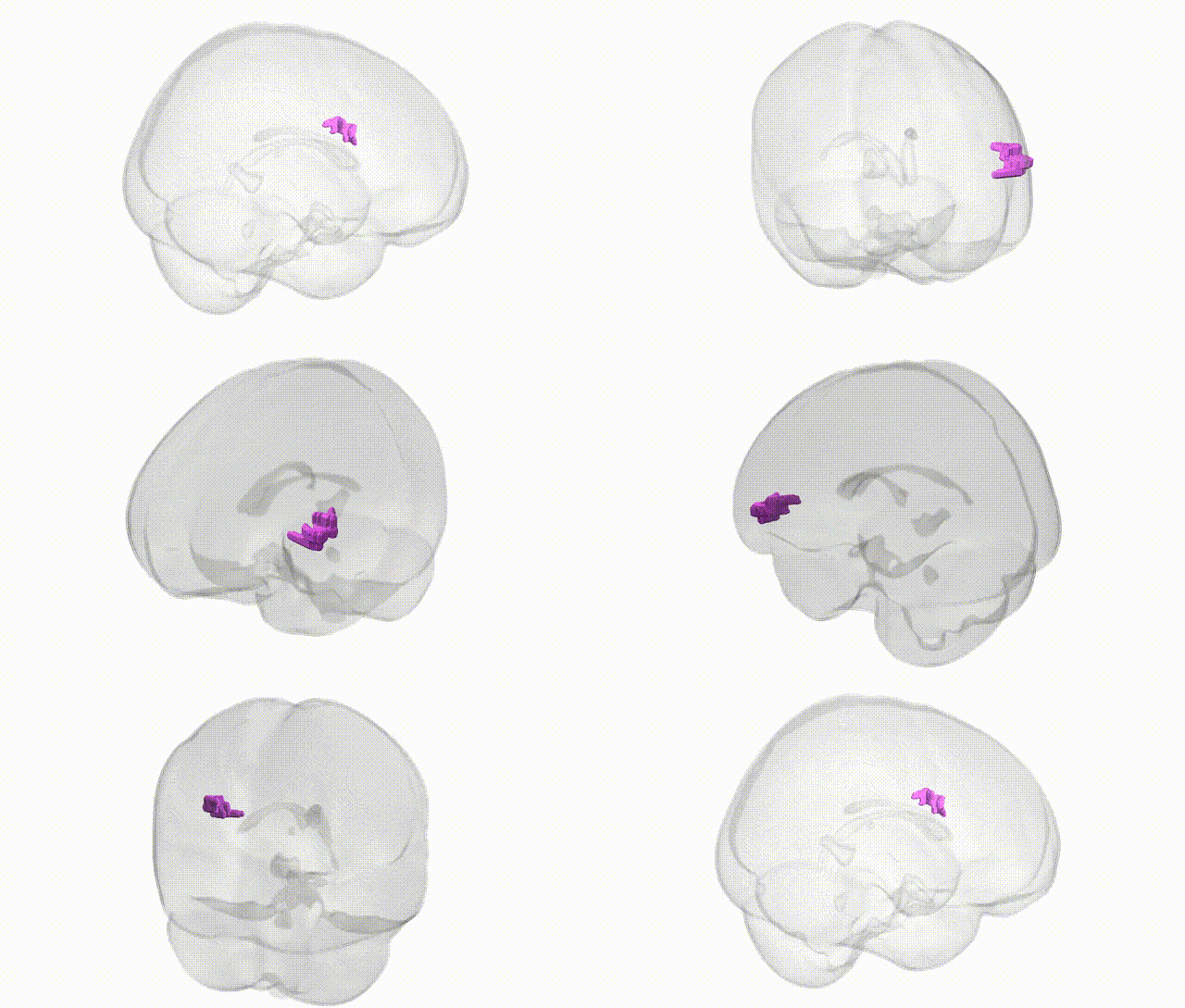
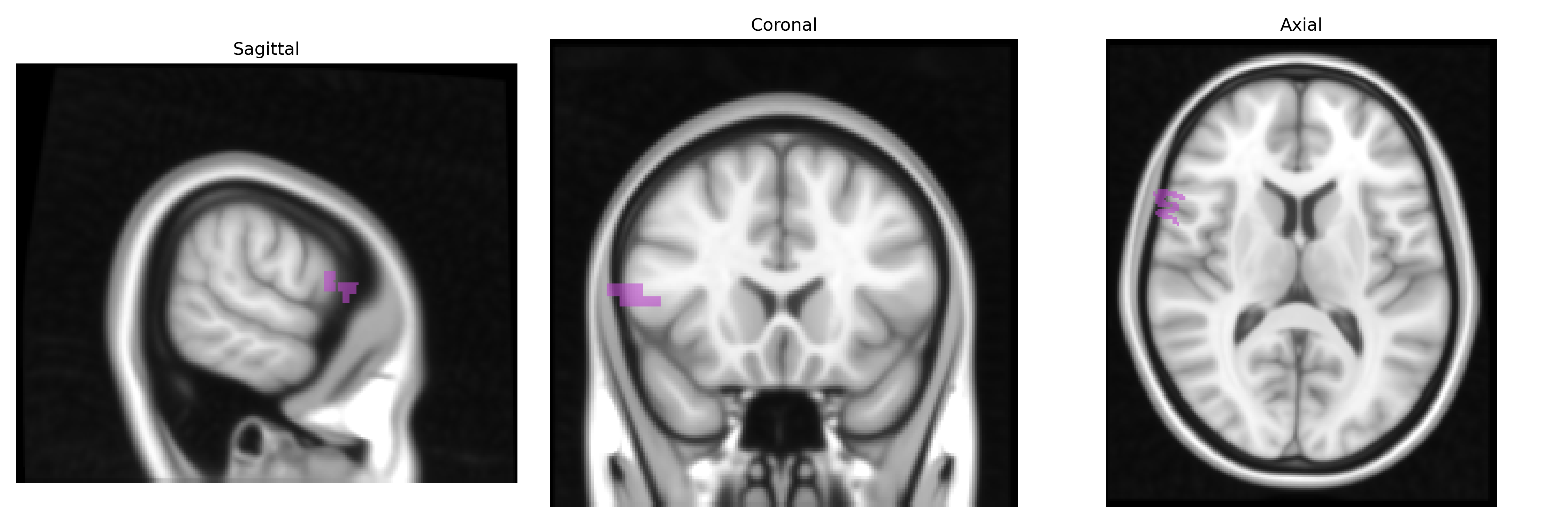
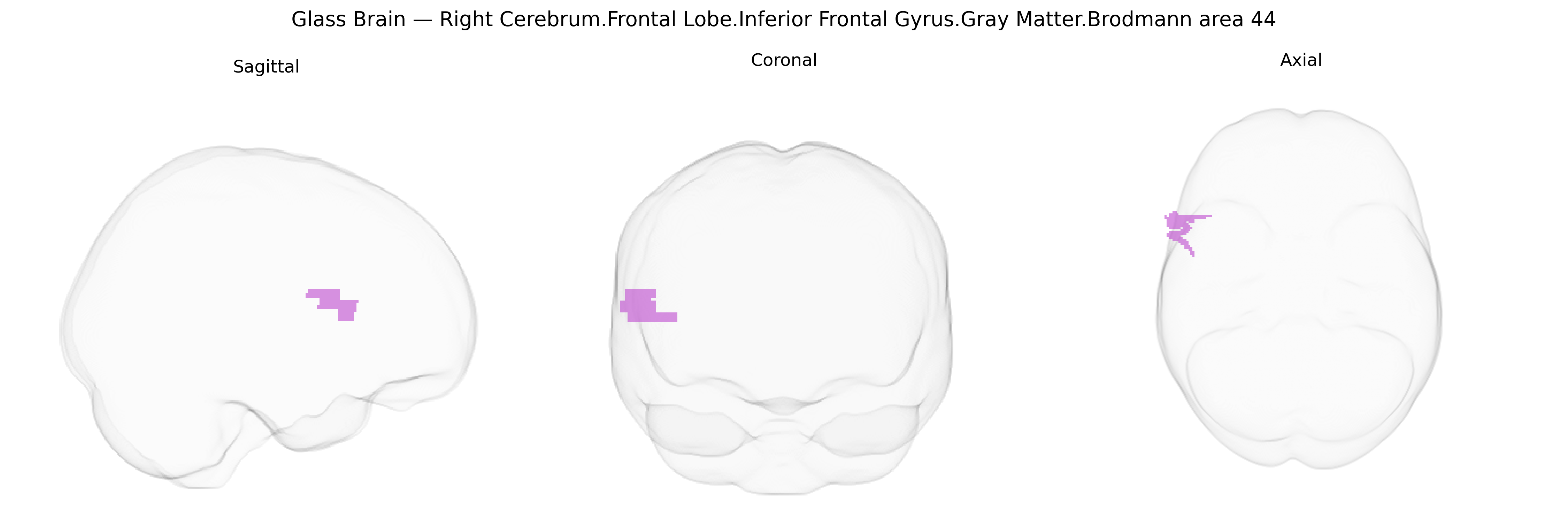
The bilateral Right Cerebrum.Frontal Lobe.Inferior Frontal Gyrus.Gray Matter.Brodmann area 44 corresponds to a cytoarchitectonically defined subdivision of the inferior frontal gyrus (classically involving portions of the pars opercularis) implicated in language and speech-related motor functions, often considered part of the broader Broca’s complex in the dominant hemisphere. In the Talairach 1 mm atlas, this region lies in the posterior inferior frontal cortex anterior to the precentral gyrus, with its gray matter contributing to phonological processing, articulation planning, and aspects of syntactic and working memory operations, as well as participation in action observation and imitation networks. While lateralization favors left-hemisphere dominance for core linguistic roles, the right-hemisphere homolog of Brodmann area 44 is associated more with prosody, affective components of communication, and complementary motor and cognitive control processes. There is no direct link for this exact Talairach label; a related structure is Brodmann area 44.
Brodmann area 44 (BA44) in the inferior frontal gyrus, a core component of the language-related “Broca’s area,” has been implicated in multiple genetic and GWAS-based associations through its roles in speech, language, executive control, and social cognition. Rare coding variants in FOXP2 were first linked to orofacial dyspraxia and grammatical language impairment involving BA44-anchored speech–language circuits, while common FOXP2 and CNTNAP2 variants have been associated with language abilities and developmental language disorder, with functional imaging showing altered activation in inferior frontal regions. Polygenic and GWAS meta-analyses of cortical thickness and surface area have identified loci near genes such as MAPT, KIAA0586, and microtubule- or synaptic-related genes that modulate frontal lobe morphology, including inferior frontal gyri, and these overlap with risk loci for neurodevelopmental and psychiatric conditions. Schizophrenia and autism spectrum disorder GWAS highlight synaptic and transcriptional networks (e.g., complement pathway, calcium channel genes, and chromatin regulators) that show enriched expression in frontal association cortices, including BA44, consistent with observed structural and functional abnormalities in this region in case–control imaging genetics studies. Additional imaging-genetics work links BA44 gray matter volume and activity to polygenic scores for educational attainment, general cognitive ability, and ADHD, suggesting a distributed genetic architecture where many small-effect variants in neurodevelopmental and synaptic genes shape the structure and function of this inferior frontal area.
Overview generated by GPT-4o (2026).
Region ID: 749
Hemisphere: bilateral
Atlas: Talairach labels 1mm
Full Quality Version: Download MP4
Full Quality Version: Download MP4
Wali Sidiqyar*, Gaurav Rudravaram*, Elyssa M. McMaster, Trent M. Schwartz, Adam M. Saunders, Kurt G. Schilling, Bennett A. Landman "Introducing SPINS: A Shared Public Visualization Library of Neuroanatomical Structures." Medical Imaging with Deep Learning- short paper
This resource is licensed under CC0 1.0 Universal (Public Domain).