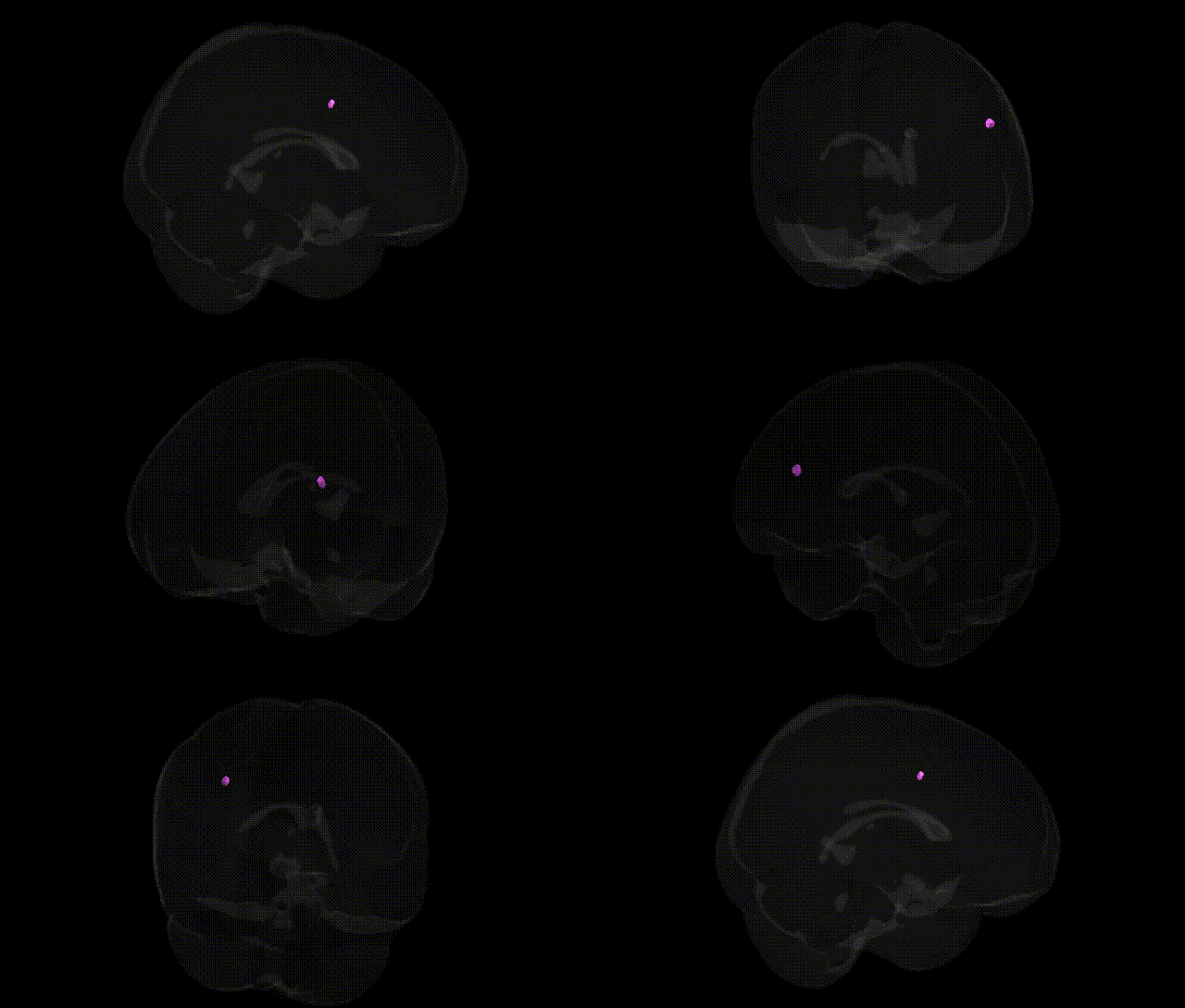
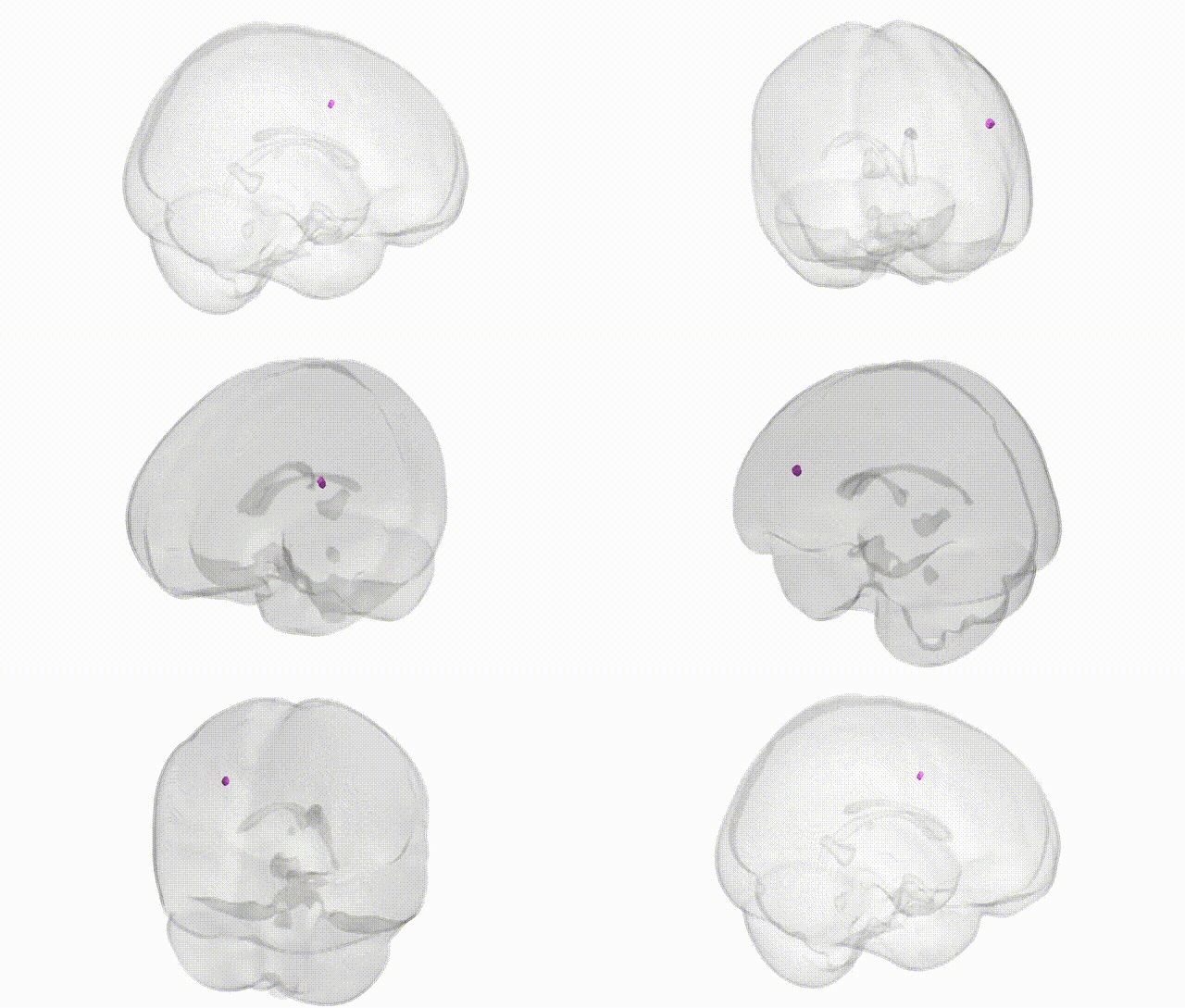
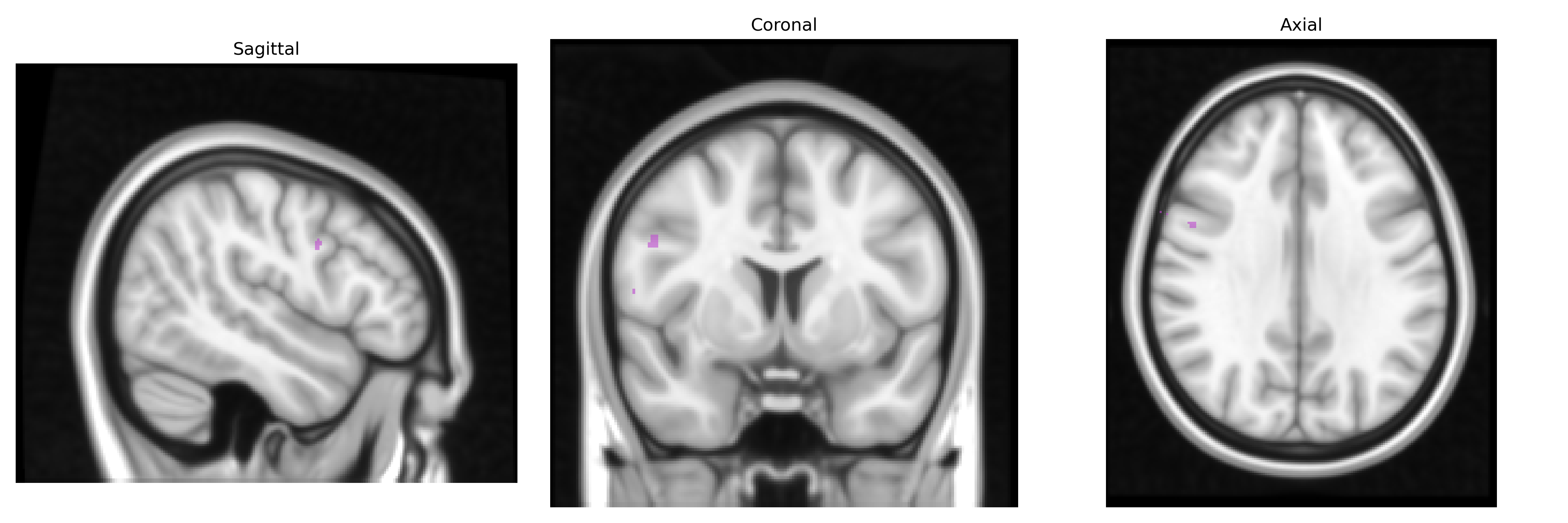
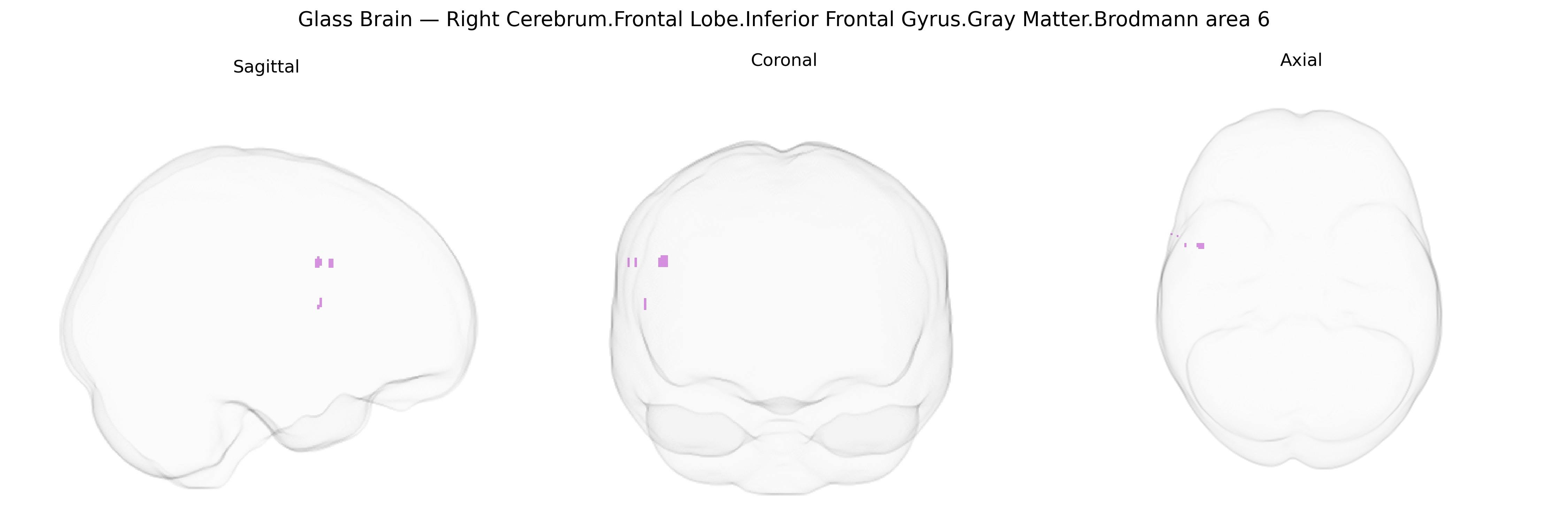
The bilateral Right Cerebrum.Frontal Lobe.Inferior Frontal Gyrus.Gray Matter.Brodmann area 6 corresponds to premotor portions of the inferior frontal gyrus located anterior to the precentral gyrus, involved in higher-order motor planning, preparation of voluntary movements, and integration of sensory and cognitive inputs into motor programs. As part of the broader premotor cortex, this region contributes to the sequencing and coordination of complex orofacial and limb movements, including those relevant for speech and gesture, and participates in distributed networks for motor learning and action selection. Cytoarchitectonically, Brodmann area 6 is characterized by an agranular frontal cortex lacking a distinct granular layer IV and containing prominent pyramidal neurons that project to primary motor and spinal motor regions, thereby modulating both cortical and subcortical motor pathways. There is no direct Wikipedia article for this specific Talairach-defined subregion; a closely related structure is the broader Brodmann area 6.
The bilateral right inferior frontal gyrus (IFG) gray matter in Brodmann area 6, as defined in the Talairach 1 mm atlas, lies at the intersection of premotor, executive, and inhibitory control circuitry, and genetic associations largely reflect these functions rather than the atlas label itself. GWAS and imaging-genetics studies implicate multiple polygenic influences on cortical thickness and surface area in the IFG and adjacent premotor regions, including common variants in genes related to neurodevelopment (e.g., CNTNAP2, DISC1, BDNF, and synaptic scaffolding genes), although effects are typically small and distributed across the cortex rather than specific to BA6. IFG and nearby premotor cortex structure and activation have been repeatedly linked to ADHD, schizophrenia, autism spectrum disorders, obsessive–compulsive disorder, and substance-use disorders, often through genetic risk scores or candidate variants affecting glutamatergic, GABAergic, and dopaminergic signaling (such as DRD2, COMT, and GRM3), which modulate response inhibition and cognitive control supported by this region. Large-scale ENIGMA and UK Biobank studies show that polygenic risk scores for schizophrenia, bipolar disorder, major depression, and ADHD are associated with subtle volumetric and cortical-thickness alterations in frontal regions including IFG/BA6, and GWAS of brain imaging phenotypes have identified loci (e.g., near HMGA2 and other neurodevelopmental genes) that influence global and regional cortical morphology encompassing premotor and inferior frontal territories. Additionally, genetic variants associated with language ability, stuttering, and reading disorders have been linked to functional and structural differences in IFG networks, though these often emphasize classical language areas (BA44/45) and extend into premotor BA6. Overall, genetic findings for this right BA6 IFG region are highly polygenic and nonspecific, embedding it within frontal cortical networks whose structure and function are modestly modulated by common neurodevelopmental, neurotransmission-related, and psychiatric-risk variants identified in GWAS of brain morphology, cognition, and neuropsychiatric disorders.
Overview generated by GPT-4o (2026).
Region ID: 810
Hemisphere: bilateral
Atlas: Talairach labels 1mm
Full Quality Version: Download MP4
Full Quality Version: Download MP4
Wali Sidiqyar*, Gaurav Rudravaram*, Elyssa M. McMaster, Trent M. Schwartz, Adam M. Saunders, Kurt G. Schilling, Bennett A. Landman "Introducing SPINS: A Shared Public Visualization Library of Neuroanatomical Structures." Medical Imaging with Deep Learning- short paper
This resource is licensed under CC0 1.0 Universal (Public Domain).