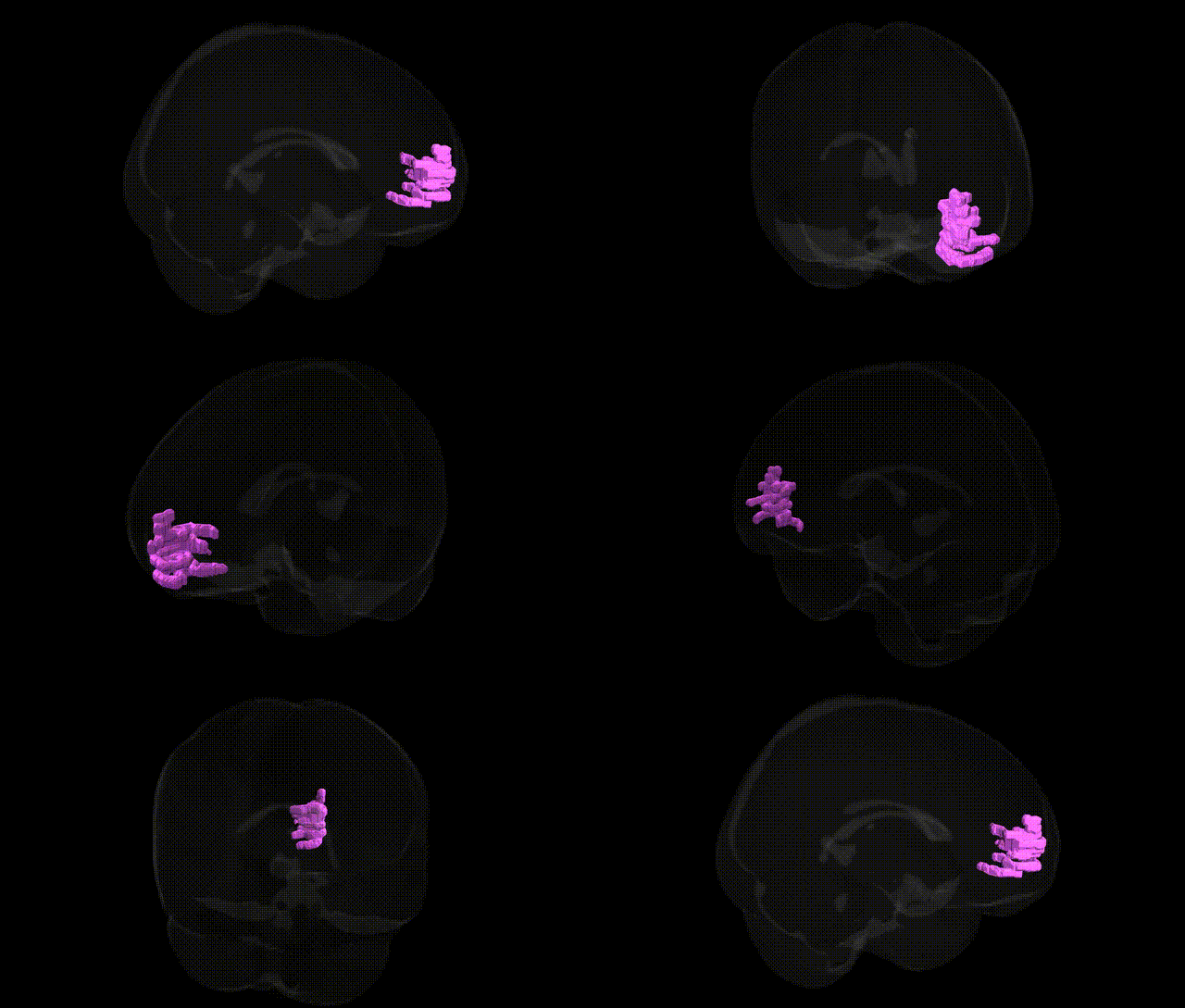
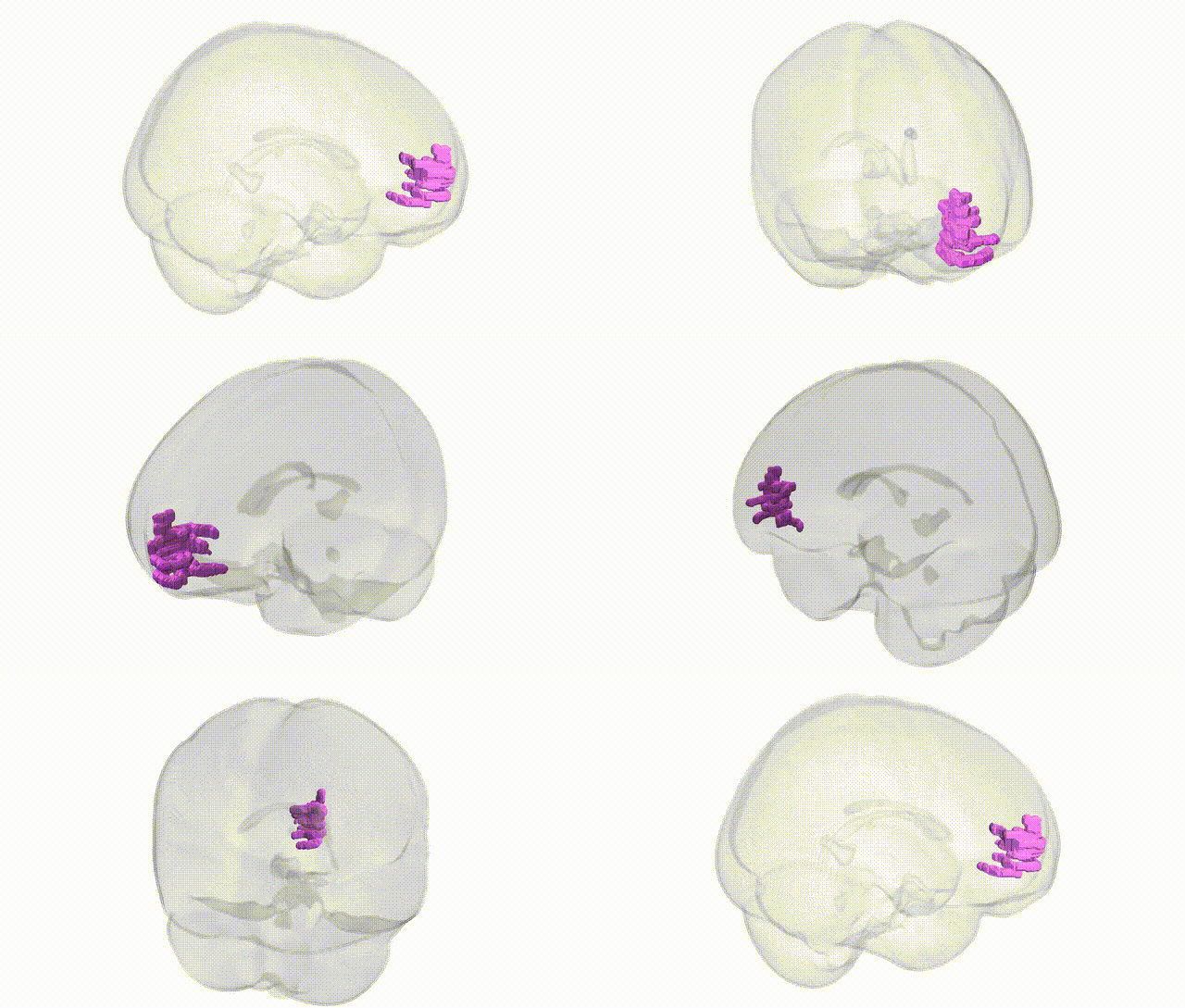
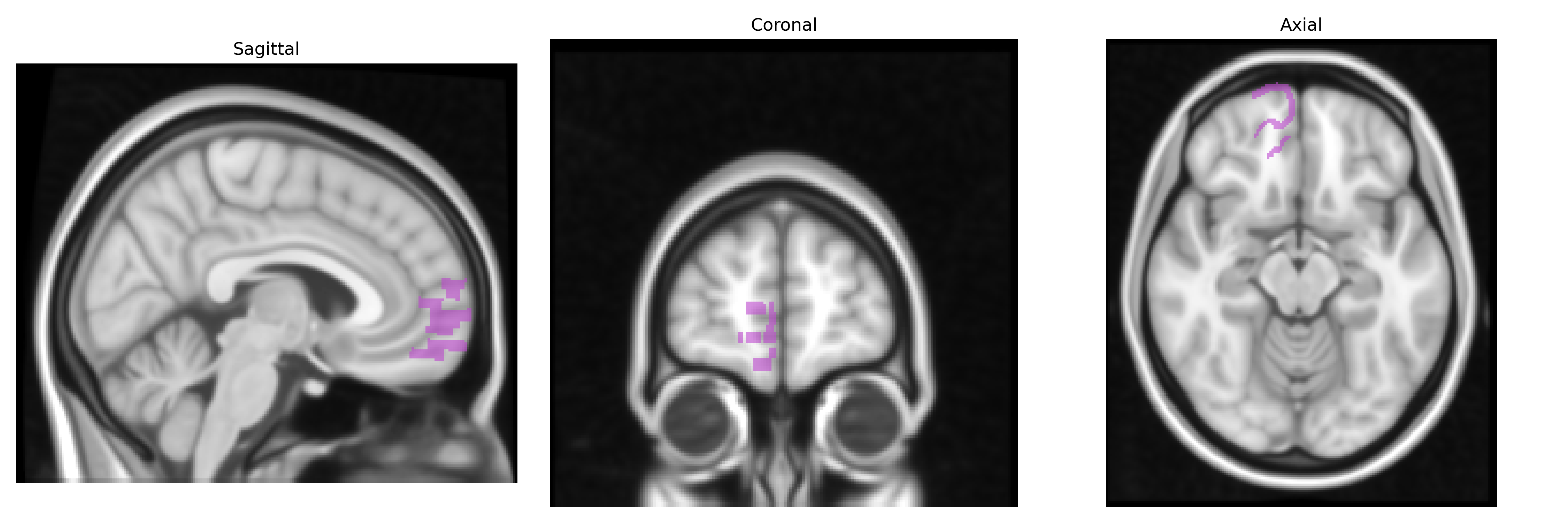
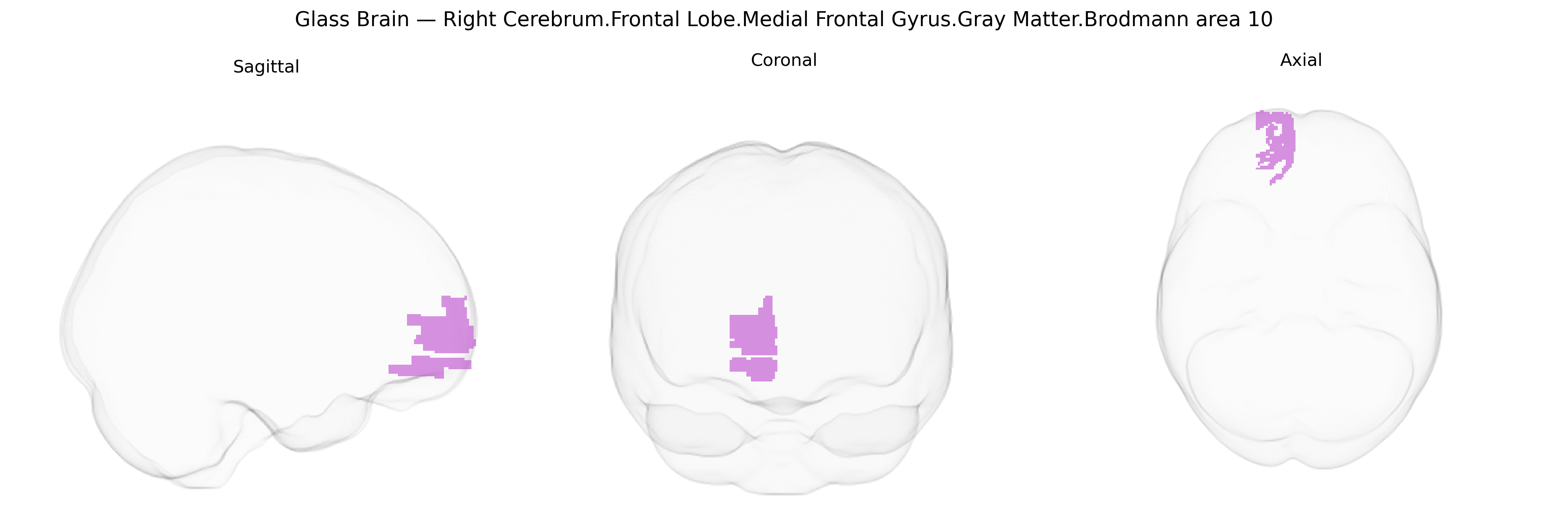
Bilateral Right Cerebrum.Frontal Lobe.Medial Frontal Gyrus.Gray Matter.Brodmann area 10 corresponds to the anterior portion of the medial prefrontal cortex within the frontal pole, encompassing higher-order association cortex implicated in complex cognitive and socio-emotional functions. Brodmann area 10 is among the most evolutionarily expanded regions in humans and is strongly associated with prospective memory, multitasking, integration of internal goals with external stimuli, and high-level decision-making. Functionally, this region participates in the default mode network, contributing to self-referential thought, mentalizing, and future-oriented planning, as well as modulation of attention between internal mentation and externally directed tasks. Lesions or dysfunction in this area have been linked to impairments in judgment, planning, social cognition, and aspects of mood regulation. A related article is: Brodmann area 10.
The medial frontal gyrus in Brodmann area 10 (BA10), particularly in right frontal cortex, has been repeatedly implicated in genetic studies of higher-order cognition, psychiatric risk, and personality-related traits, though often at macroanatomic (medial prefrontal/dorsolateral prefrontal) rather than Talairach-precise levels. Imaging genetics and GWAS meta-analyses of cortical thickness and surface area have linked common variants in genes involved in neurodevelopment and synaptic function (e.g., CNTNAP2, DISC1, NRGN, CACNA1C, GRM3, and several loci near MIR137) to structural variation in medial prefrontal regions encompassing BA10, frequently in the context of schizophrenia, bipolar disorder, major depressive disorder, and autism spectrum disorder. Large consortia such as ENIGMA and UK Biobank have identified genome-wide significant loci (e.g., in HMGA2, IGF1, and regulatory regions near KIAA0586, CENPW) associated with frontal lobe gray-matter measures that include medial frontal/BA10 territories, some of which also show pleiotropic associations with cognitive performance, educational attainment, and general intelligence. Variants in serotonin- and dopamine-related genes (DRD2, COMT, 5-HTTLPR-linked regions), while not consistently reaching GWAS-level significance for structure, have been correlated with BA10 activation and connectivity in task-based fMRI, linking genetic differences to decision making, prospective memory, social cognition, and value-based choice that depend heavily on BA10. Additionally, risk alleles for obsessive-compulsive disorder, attention-deficit/hyperactivity disorder, and anxiety traits show convergent evidence of altered medial prefrontal/BA10 structure or function, suggesting that polygenic liability for these conditions partly manifests in this region’s gray matter and circuitry, though the majority of associations are region-level (medial prefrontal or frontopolar cortex) rather than specific to the bilateral right Talairach-defined BA10 parcel.
Overview generated by GPT-4o (2026).
Region ID: 408
Hemisphere: bilateral
Atlas: Talairach labels 1mm
Full Quality Version: Download MP4
Full Quality Version: Download MP4
Wali Sidiqyar*, Gaurav Rudravaram*, Elyssa M. McMaster, Trent M. Schwartz, Adam M. Saunders, Kurt G. Schilling, Bennett A. Landman "Introducing SPINS: A Shared Public Visualization Library of Neuroanatomical Structures." Medical Imaging with Deep Learning- short paper
This resource is licensed under CC0 1.0 Universal (Public Domain).