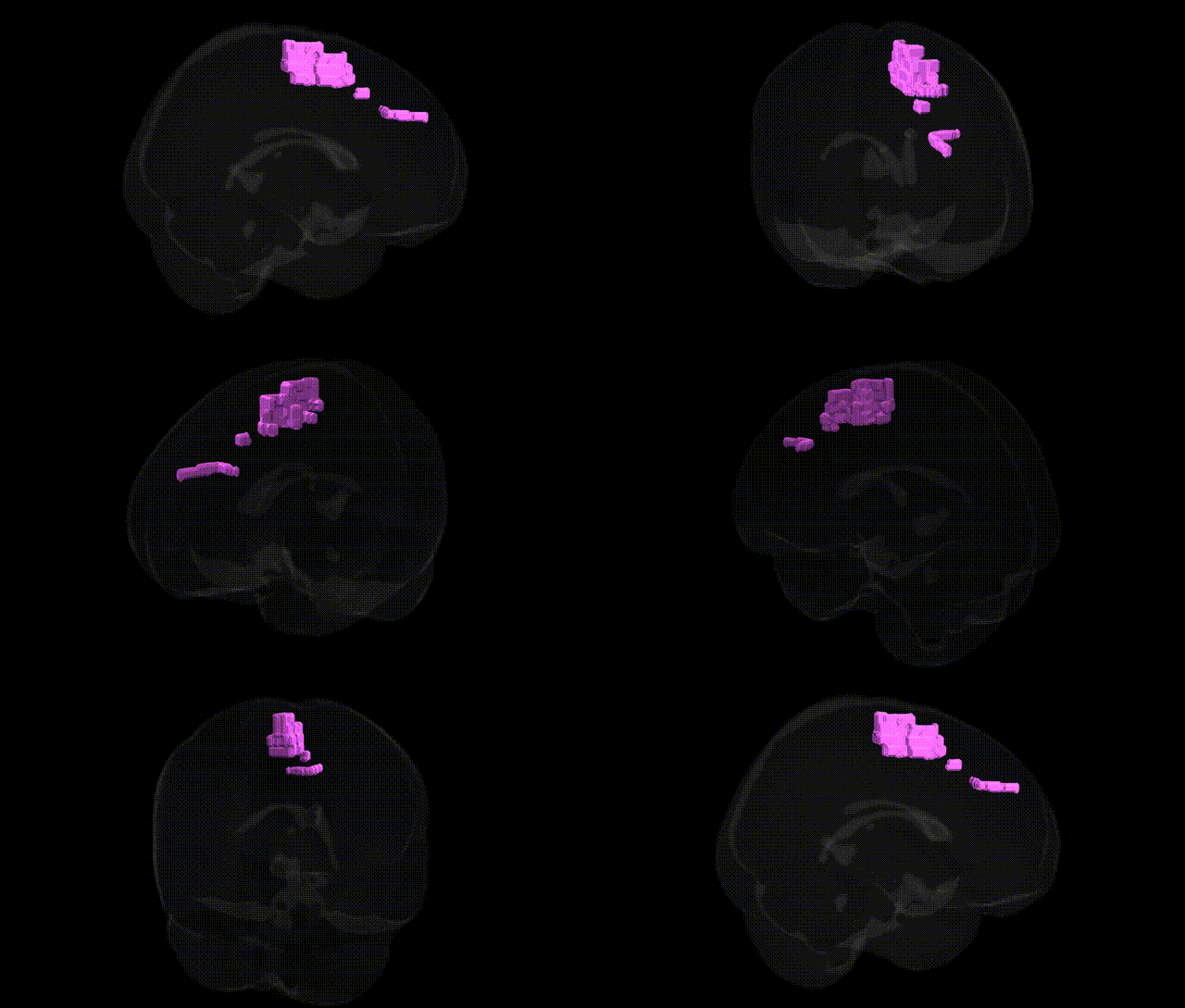
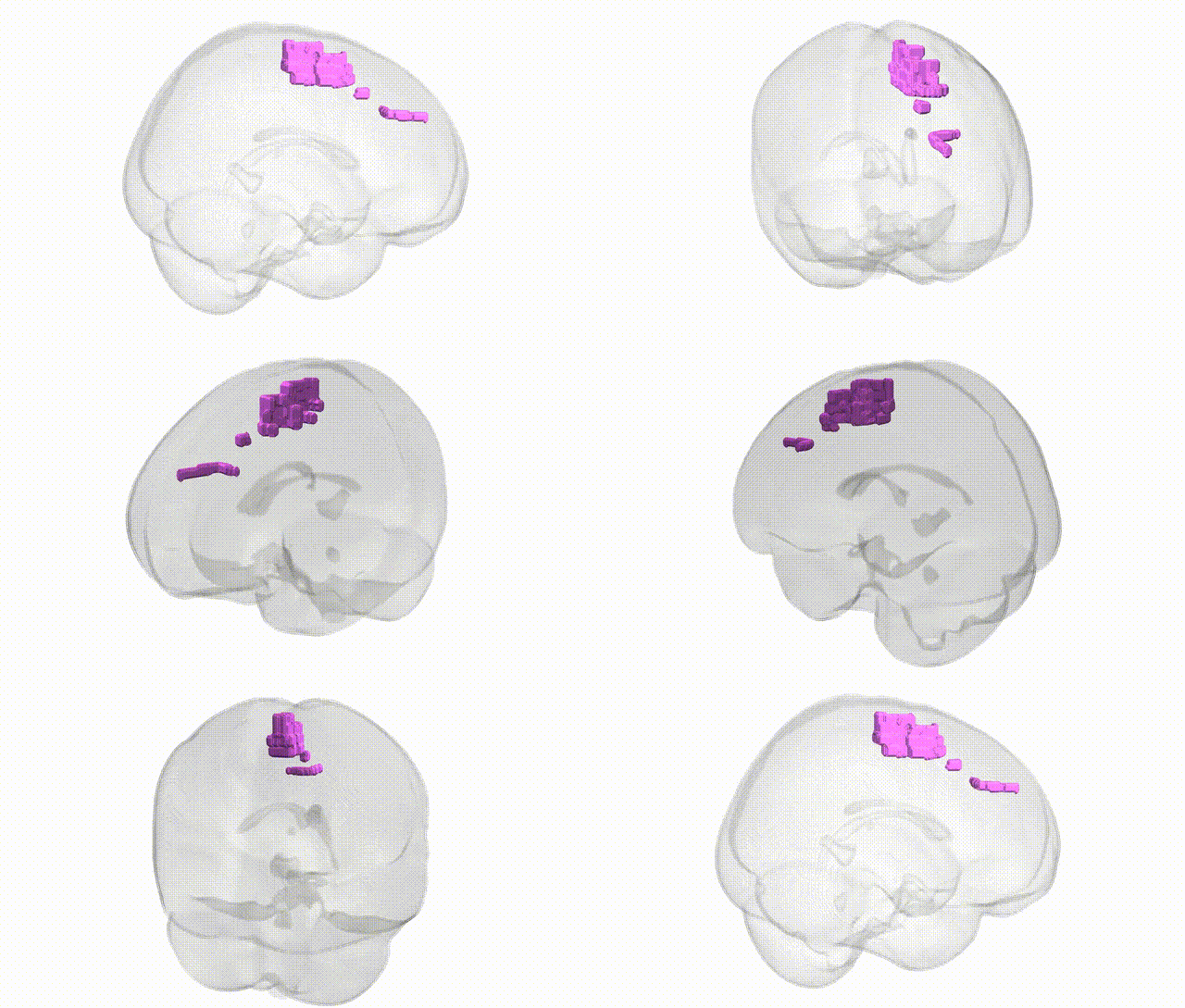
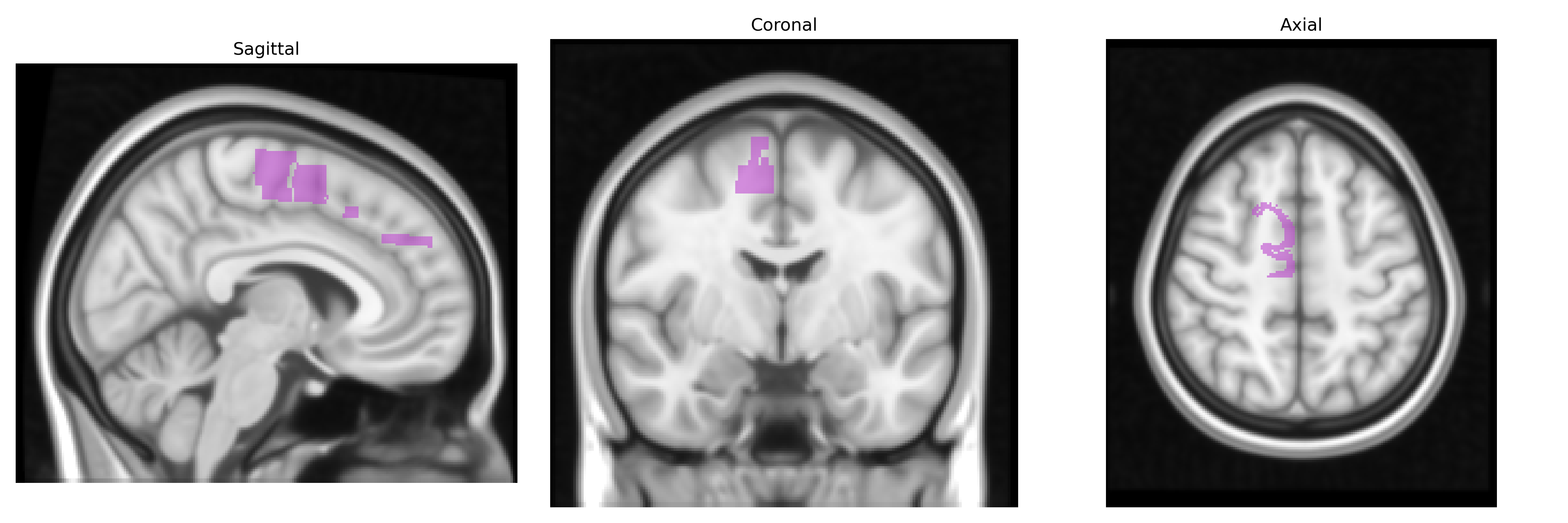
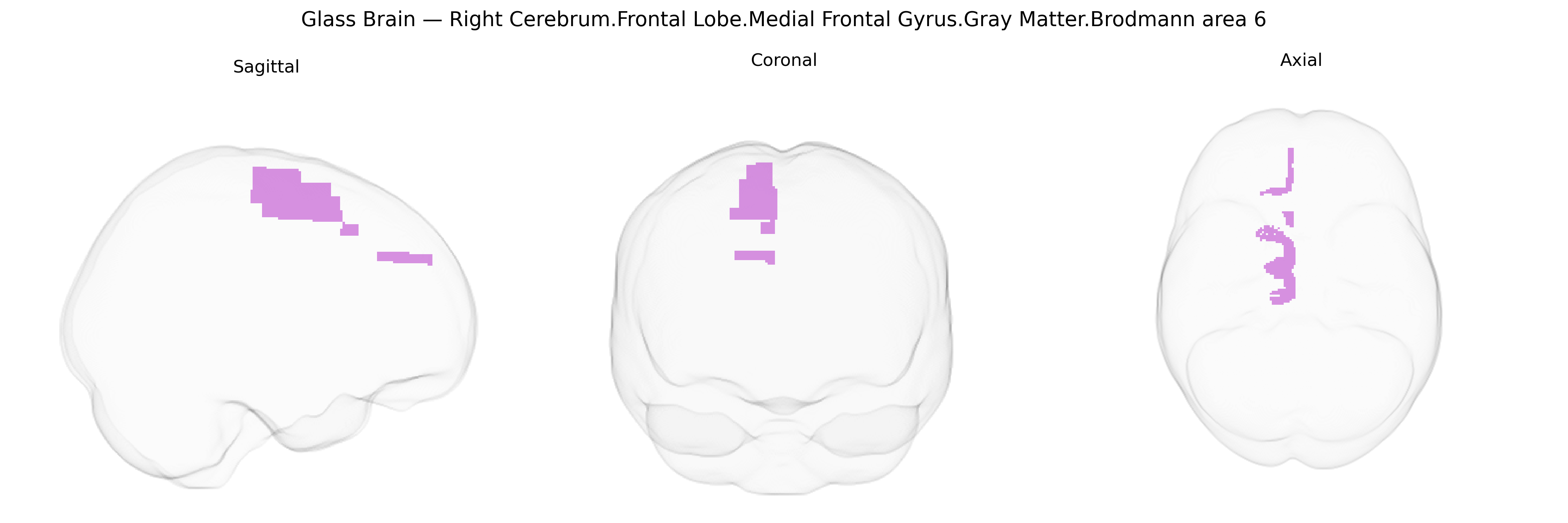
The bilateral Right Cerebrum.Frontal Lobe.Medial Frontal Gyrus.Gray Matter.Brodmann area 6 corresponds to premotor and supplementary motor cortex located on the medial aspect of the frontal lobe, anterior to the primary motor cortex (Brodmann area 4). This agranular frontal region is critically involved in planning, sequencing, and preparation of voluntary movements, motor imagery, and internally generated actions, and contributes to higher-order motor control such as bimanual coordination and postural adjustments. It receives multimodal input from parietal and prefrontal areas and projects to primary motor cortex and spinal motor pathways, integrating sensory and cognitive information into motor programs. Functionally, this territory overlaps substantially with the supplementary motor area and pre-supplementary motor area, and lesions here can lead to deficits in motor initiation and complex movement organization. Brodmann area 6
The bilateral medial frontal gyrus (right cerebrum, frontal lobe, gray matter, Brodmann area 6) is a core premotor/supplementary motor area in which genetic effects have been repeatedly demonstrated in imaging-genetics and GWAS of brain structure and function. Twin and family studies show high heritability for cortical thickness and surface area in medial premotor regions, and large-scale MRI GWAS consortia (e.g., ENIGMA, UK Biobank) have identified common variants near genes involved in neurodevelopment, axon guidance, and synaptic function (such as loci involving MAPT, microtubule-related genes, and regulatory regions affecting cortical development) that influence grey-matter volume and cortical morphology within medial frontal/premotor regions including BA6, although specific atlas-level labels such as “Right Cerebrum.Frontal Lobe.Medial Frontal Gyrus.Gray Matter.Brodmann area 6” are rarely isolated as unique GWAS phenotypes. Functional and structural changes in this region have been linked, via genetic association, to several neuropsychiatric and neurodevelopmental conditions—most prominently schizophrenia, major depressive disorder, bipolar disorder, autism spectrum disorder, and attention-deficit/hyperactivity disorder—where risk variants in synaptic, calcium-channel, and neurodevelopmental genes show downstream associations with medial frontal volume, connectivity, or activation. Additional GWAS of motor traits, cognitive control, and response inhibition implicate premotor and supplementary motor cortices, with polygenic scores for traits such as educational attainment, intelligence, and risk-taking predicting variability in medial frontal (including BA6) structure and activation, indicating that this region serves as a convergent anatomical target of diverse genetic influences on motor planning, executive function, and psychiatric liability.
Overview generated by GPT-4o (2026).
Region ID: 1011
Hemisphere: bilateral
Atlas: Talairach labels 1mm
Full Quality Version: Download MP4
Full Quality Version: Download MP4
Wali Sidiqyar*, Gaurav Rudravaram*, Elyssa M. McMaster, Trent M. Schwartz, Adam M. Saunders, Kurt G. Schilling, Bennett A. Landman "Introducing SPINS: A Shared Public Visualization Library of Neuroanatomical Structures." Medical Imaging with Deep Learning- short paper
This resource is licensed under CC0 1.0 Universal (Public Domain).