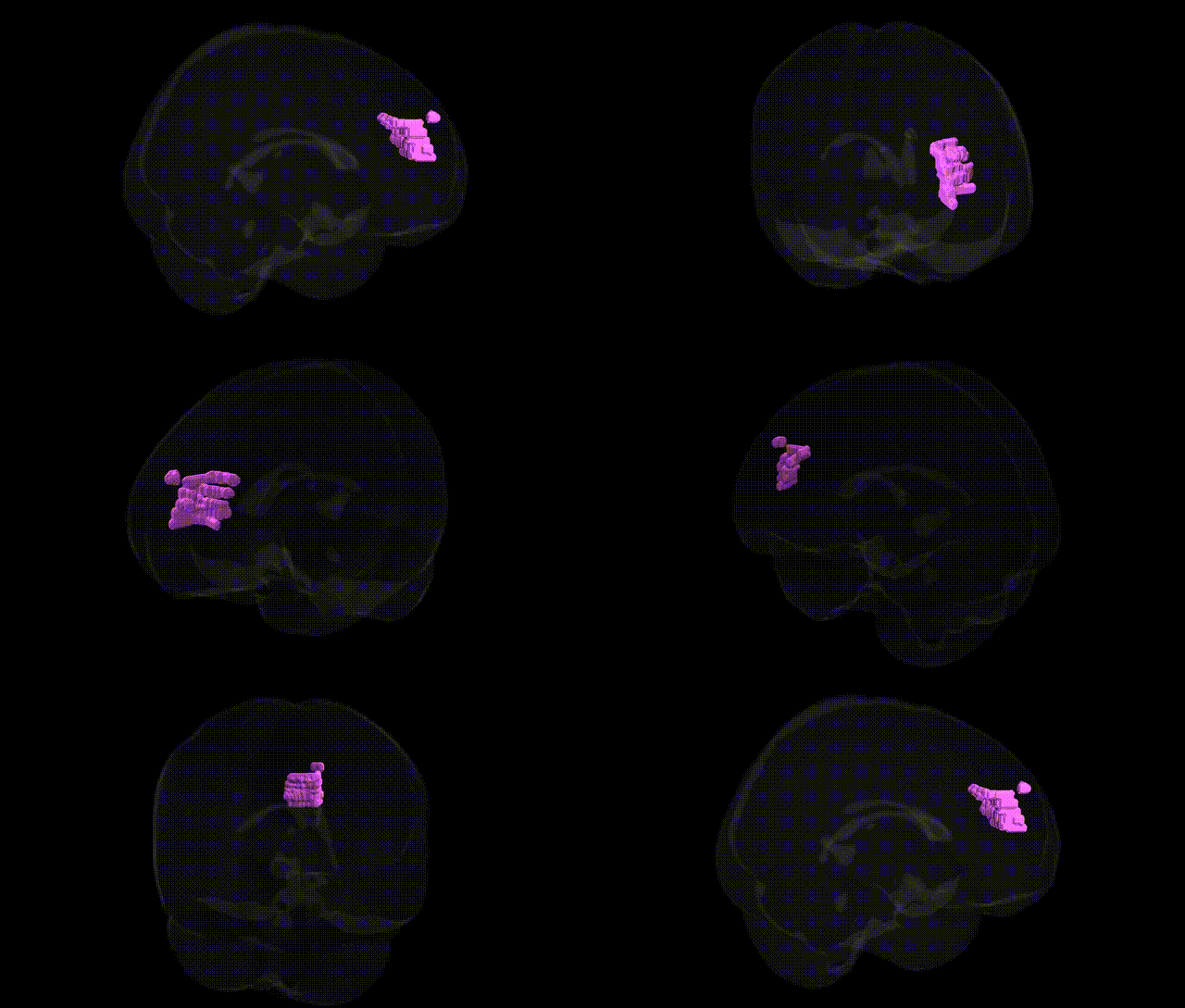
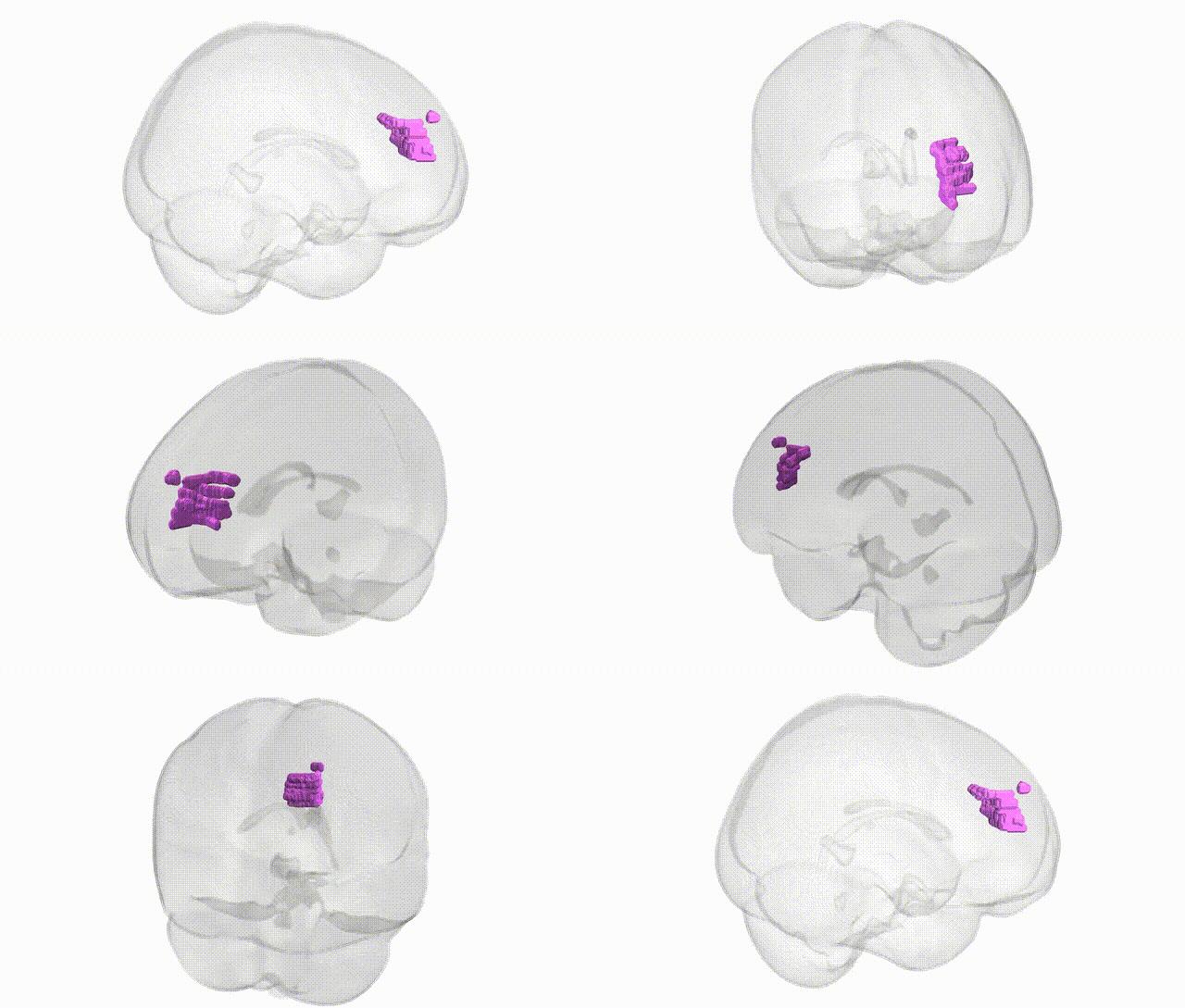
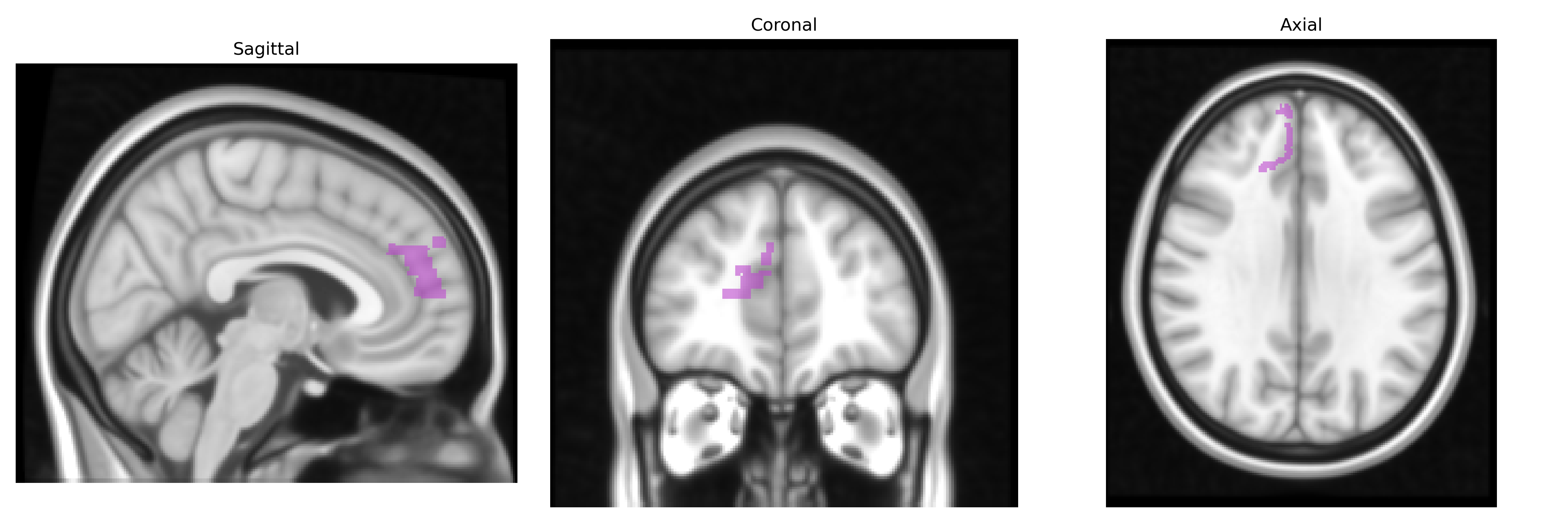
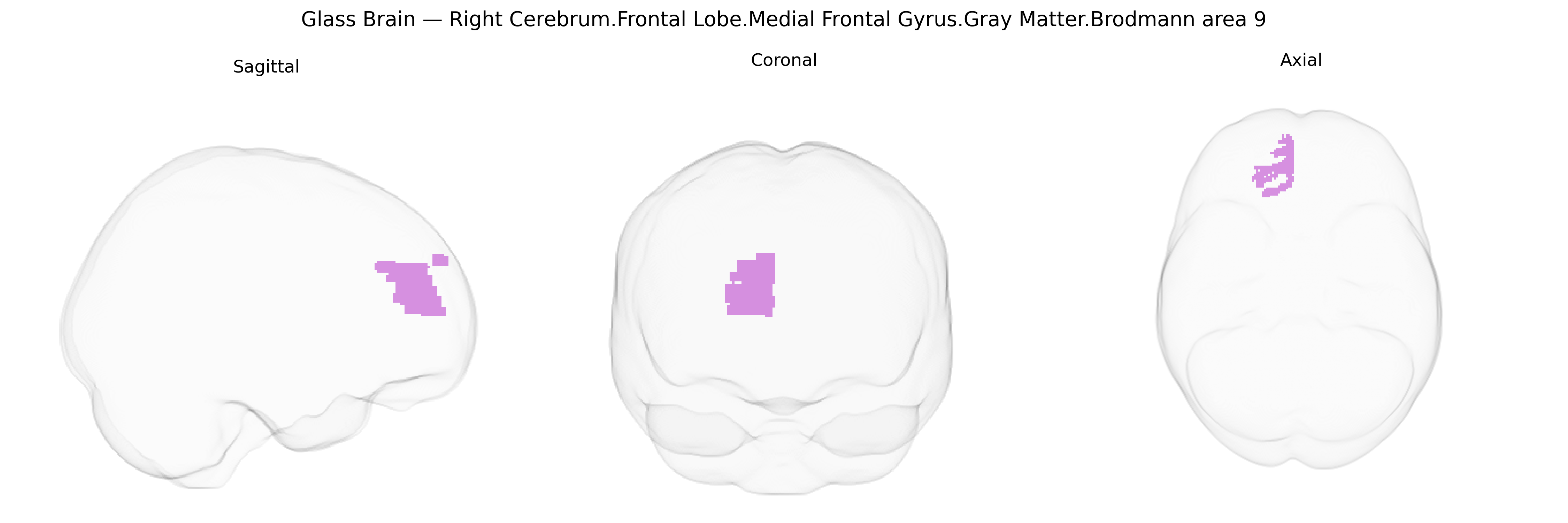
The bilateral Right Cerebrum.Frontal Lobe.Medial Frontal Gyrus.Gray Matter.Brodmann area 9 corresponds to a portion of the dorsomedial prefrontal cortex involved in higher-order cognitive and executive functions. Cytoarchitectonically defined by its granular frontal cortex, Brodmann area 9 participates in working memory, abstract reasoning, planning, attentional control, and aspects of social cognition such as mentalizing and evaluation of others’ behavior. Functionally, this region integrates internal goals with external information, supports rule-based behavior, and contributes to performance monitoring and adaptive decision-making. It is heavily interconnected with other prefrontal regions, parietal association cortex, limbic structures, and subcortical nuclei, forming part of large-scale networks that underlie cognitive control and complex behavior.
The bilateral medial frontal gyrus (Brodmann area 9) of the right frontal lobe—corresponding to a key node of the dorsomedial prefrontal / anterior cingulo‑medial network—has been repeatedly implicated in genetic and imaging–genetics studies of cognitive control, social cognition, and psychiatric vulnerability. GWAS and candidate-gene work link variation in this region’s gray matter volume, thickness, or activation to polygenic risk scores and specific variants associated with major depressive disorder (e.g., in genes affecting serotonergic and glutamatergic signaling), schizophrenia and psychosis risk (including loci near CACNA1C, MIR137, and other synaptic and calcium-channel genes), bipolar disorder, and autism spectrum conditions, often via altered medial prefrontal morphology and connectivity. Imaging–genetics studies have associated polymorphisms in COMT (val158met), BDNF (Val66Met), and dopaminergic genes more broadly with BA9 activation during working memory and executive tasks. Large-scale structural GWAS (e.g., ENIGMA and UK Biobank–based analyses) report heritable variance in medial frontal thickness and surface area linked to loci enriched for neurodevelopmental, synaptic, and myelination pathways, with overlap to genetic architectures of intelligence, educational attainment, and neuroticism. The region also appears in genetic studies of trait impulsivity, anxiety, and stress reactivity, often through shared polygenic effects on fronto-limbic networks rather than a single locus uniquely specific to BA9.
Overview generated by GPT-4o (2026).
Region ID: 815
Hemisphere: bilateral
Atlas: Talairach labels 1mm
Full Quality Version: Download MP4
Full Quality Version: Download MP4
Wali Sidiqyar*, Gaurav Rudravaram*, Elyssa M. McMaster, Trent M. Schwartz, Adam M. Saunders, Kurt G. Schilling, Bennett A. Landman "Introducing SPINS: A Shared Public Visualization Library of Neuroanatomical Structures." Medical Imaging with Deep Learning- short paper
This resource is licensed under CC0 1.0 Universal (Public Domain).