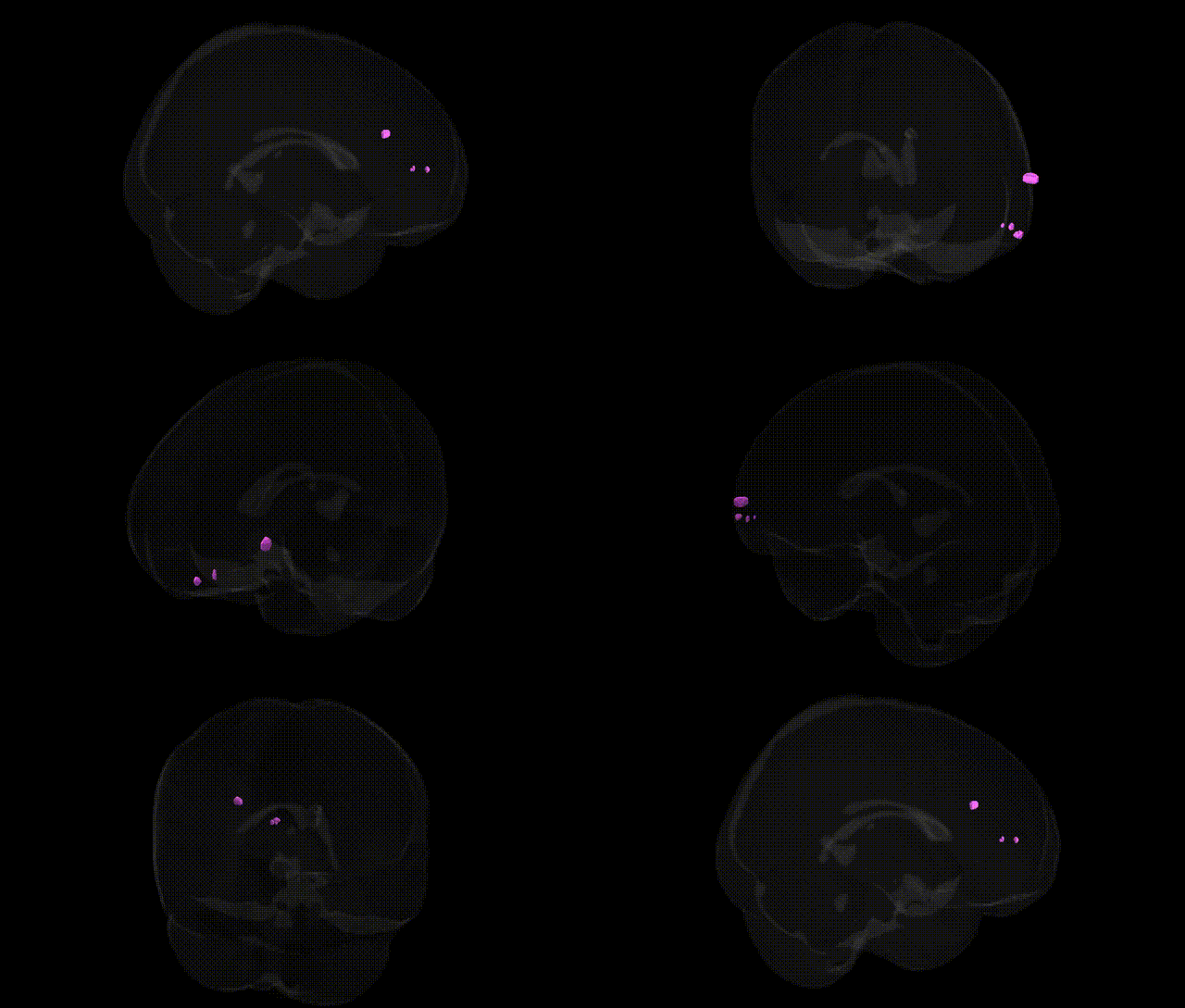
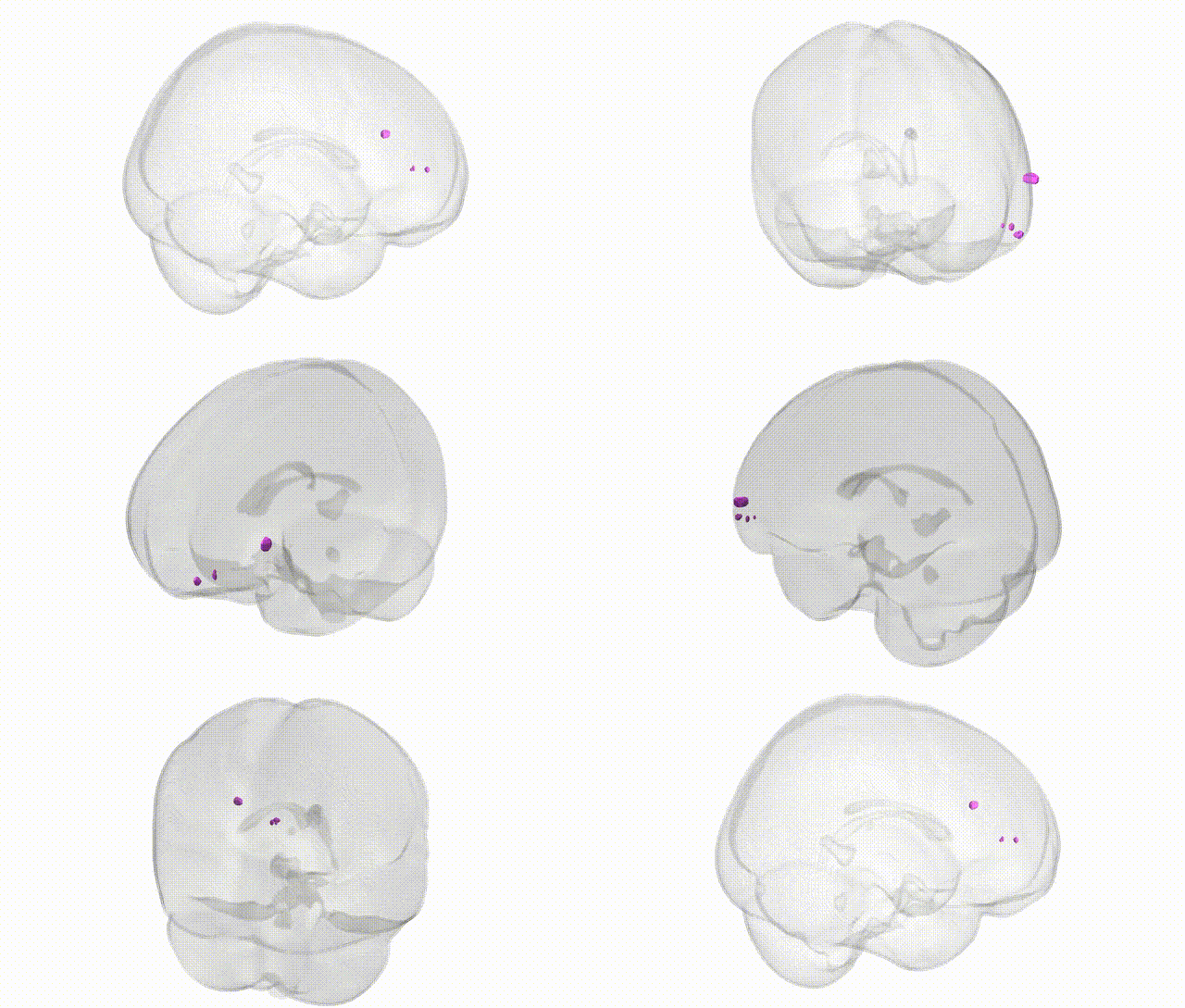
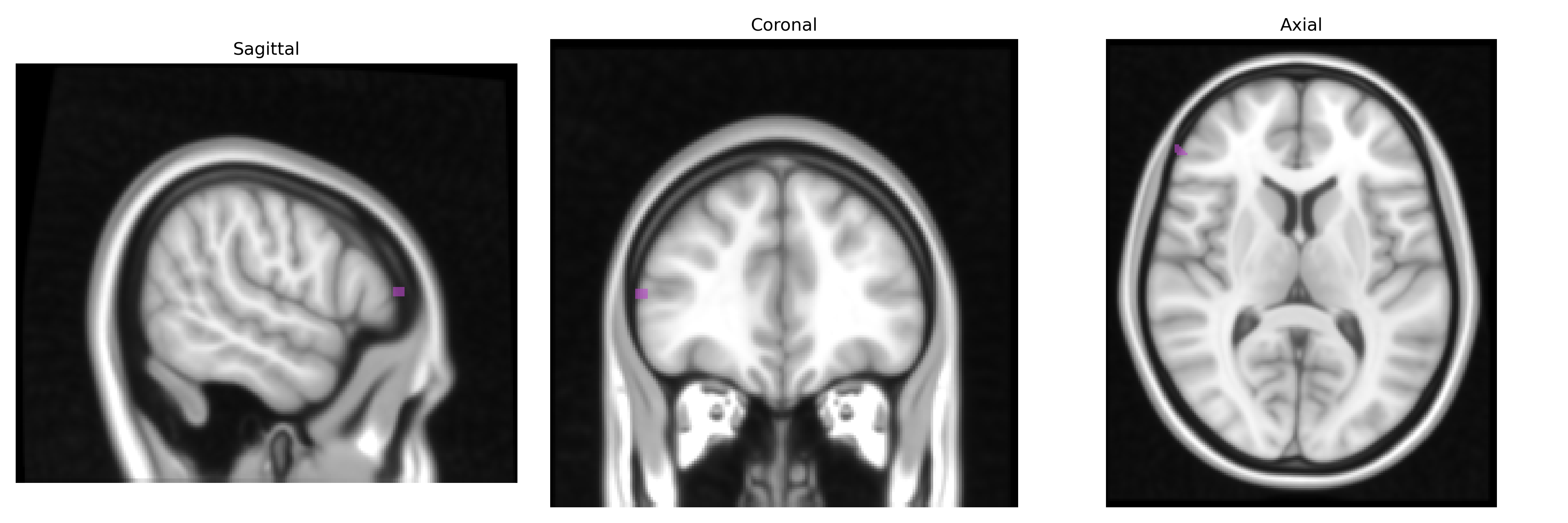
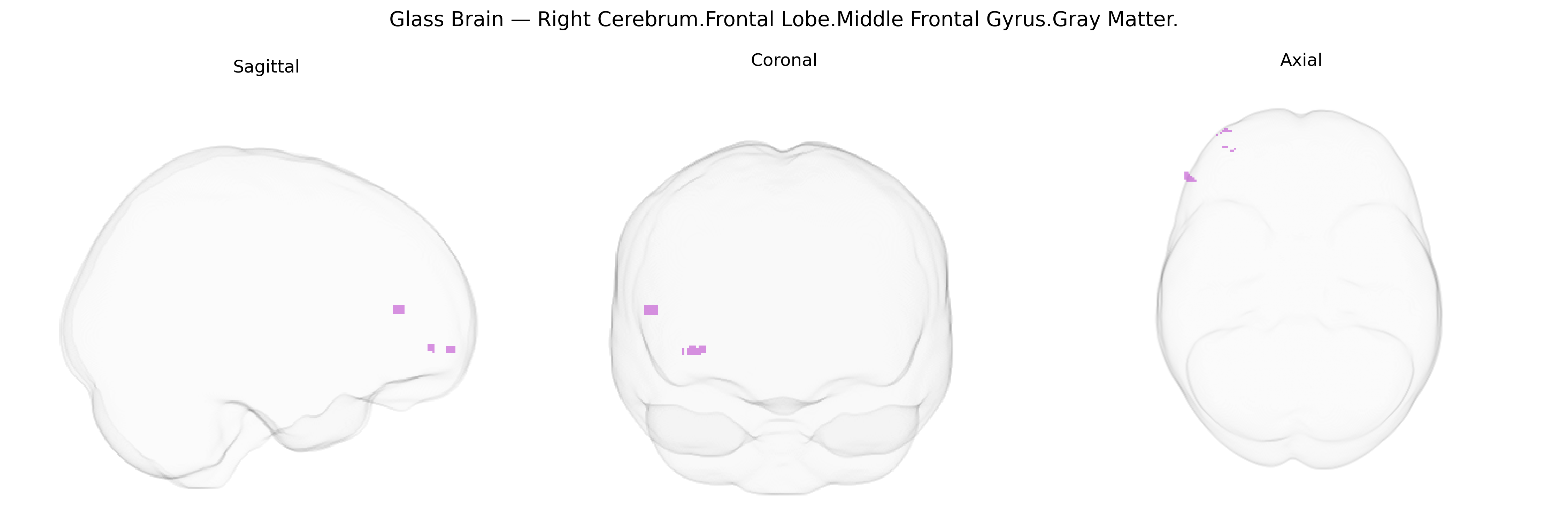
The bilateral Right Cerebrum.Frontal Lobe.Middle Frontal Gyrus.Gray Matter corresponds to cortical gray matter within the middle frontal gyrus of the right frontal lobe, a key component of the dorsolateral prefrontal cortex involved in higher-order cognitive control. This region participates in working memory, planning, attentional selection, response inhibition, and aspects of executive function, integrating sensory and mnemonic information to guide goal-directed behavior. It maintains extensive reciprocal connections with other prefrontal regions, parietal association cortex, premotor and supplementary motor areas, basal ganglia, and thalamus, supporting flexible adaptation to changing task demands. Functionally, activity in this area is often observed during tasks that require manipulation of information in working memory, decision-making under uncertainty, and regulation of behavior according to rules and context. There is no direct link for this exact Talairach label; a closely related structure is the Dorsolateral prefrontal cortex.
Genetic associations involving the bilateral right middle frontal gyrus gray matter (as defined in the Talairach 1 mm atlas) largely reflect its role within executive control, working memory, and higher-order cognitive networks rather than highly region-specific loci. GWAS of cortical structure (e.g., ENIGMA and UK Biobank studies) have identified multiple common variants influencing frontal lobe cortical thickness and surface area—particularly near genes involved in neurodevelopment and synaptic function (such as variants in or near PAX6, CENPW, TESC, KIAA0586, and others)—with some signals mapping to middle frontal and dorsolateral prefrontal regions. Polygenic risk for schizophrenia, bipolar disorder, major depressive disorder, ADHD, and autism spectrum disorder has repeatedly been linked to altered frontal gray matter volume and cortical thickness, including right middle frontal gyrus, in imaging genetics and case–control MRI studies, suggesting that many risk loci act via distributed effects on fronto-striatal and fronto-parietal circuitry rather than a single gene–region mapping. Variants in COMT (affecting dopamine metabolism) and genes impacting glutamatergic and GABAergic signaling have been associated with functional activation and connectivity of the middle frontal gyrus during working memory tasks, cognitive control, and emotion regulation, and GWAS of cognitive traits (general intelligence, educational attainment, and executive function) show enriched heritability in gene sets expressed in prefrontal cortex, consistent with morphological and functional variation of this region contributing to these traits. Additionally, neurodevelopmental and neurodegenerative risk loci (e.g., for Alzheimer’s disease, frontotemporal dementia, and small-vessel cerebrovascular disease) have been associated with patterns of frontal cortical atrophy that include the right middle frontal gyrus, though these effects are typically part of broader network-level changes rather than isolated to this specific Talairach-defined parcel.
Overview generated by GPT-4o (2026).
Region ID: 618
Hemisphere: bilateral
Atlas: Talairach labels 1mm
Full Quality Version: Download MP4
Full Quality Version: Download MP4
Wali Sidiqyar*, Gaurav Rudravaram*, Elyssa M. McMaster, Trent M. Schwartz, Adam M. Saunders, Kurt G. Schilling, Bennett A. Landman "Introducing SPINS: A Shared Public Visualization Library of Neuroanatomical Structures." Medical Imaging with Deep Learning- short paper
This resource is licensed under CC0 1.0 Universal (Public Domain).