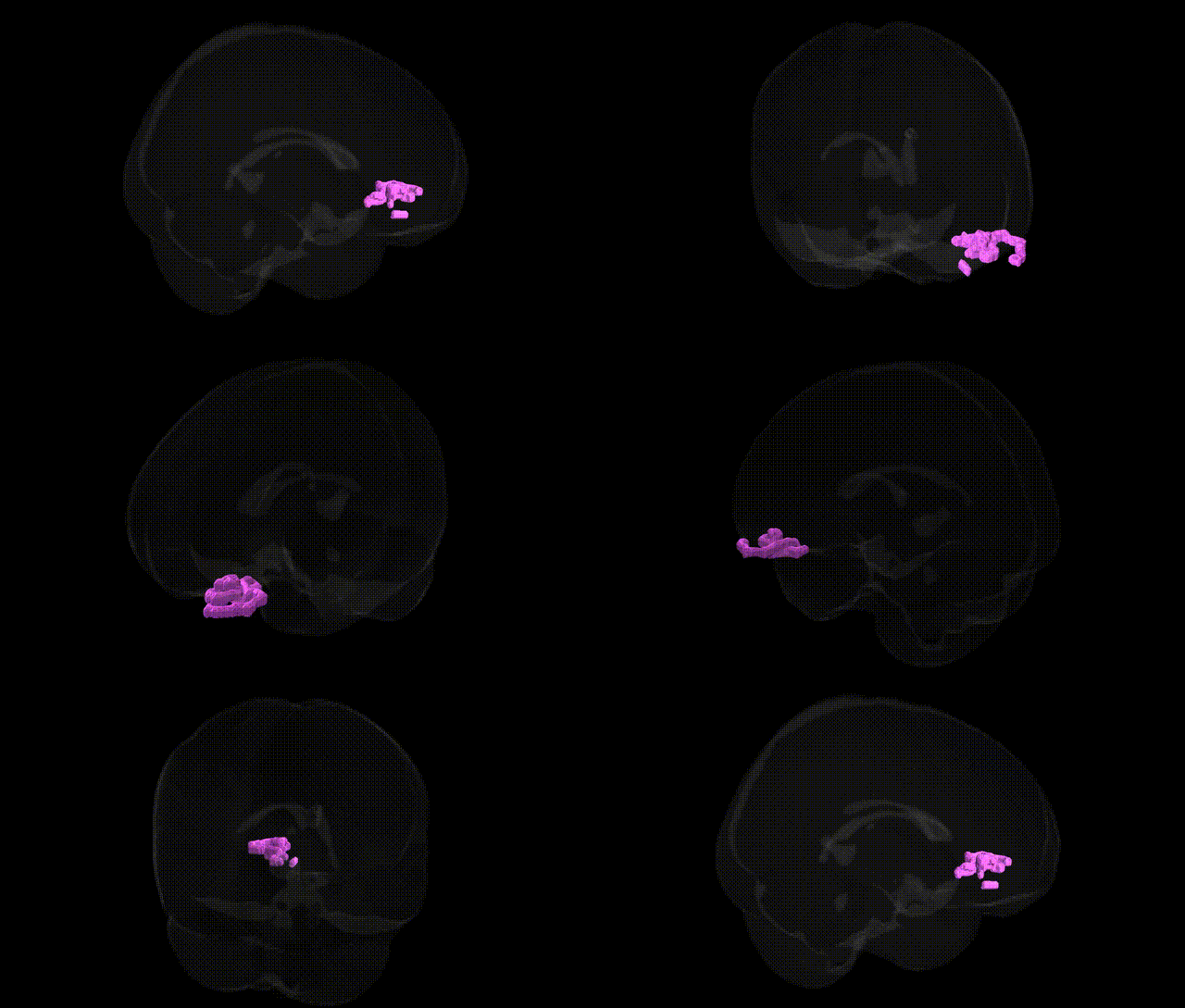
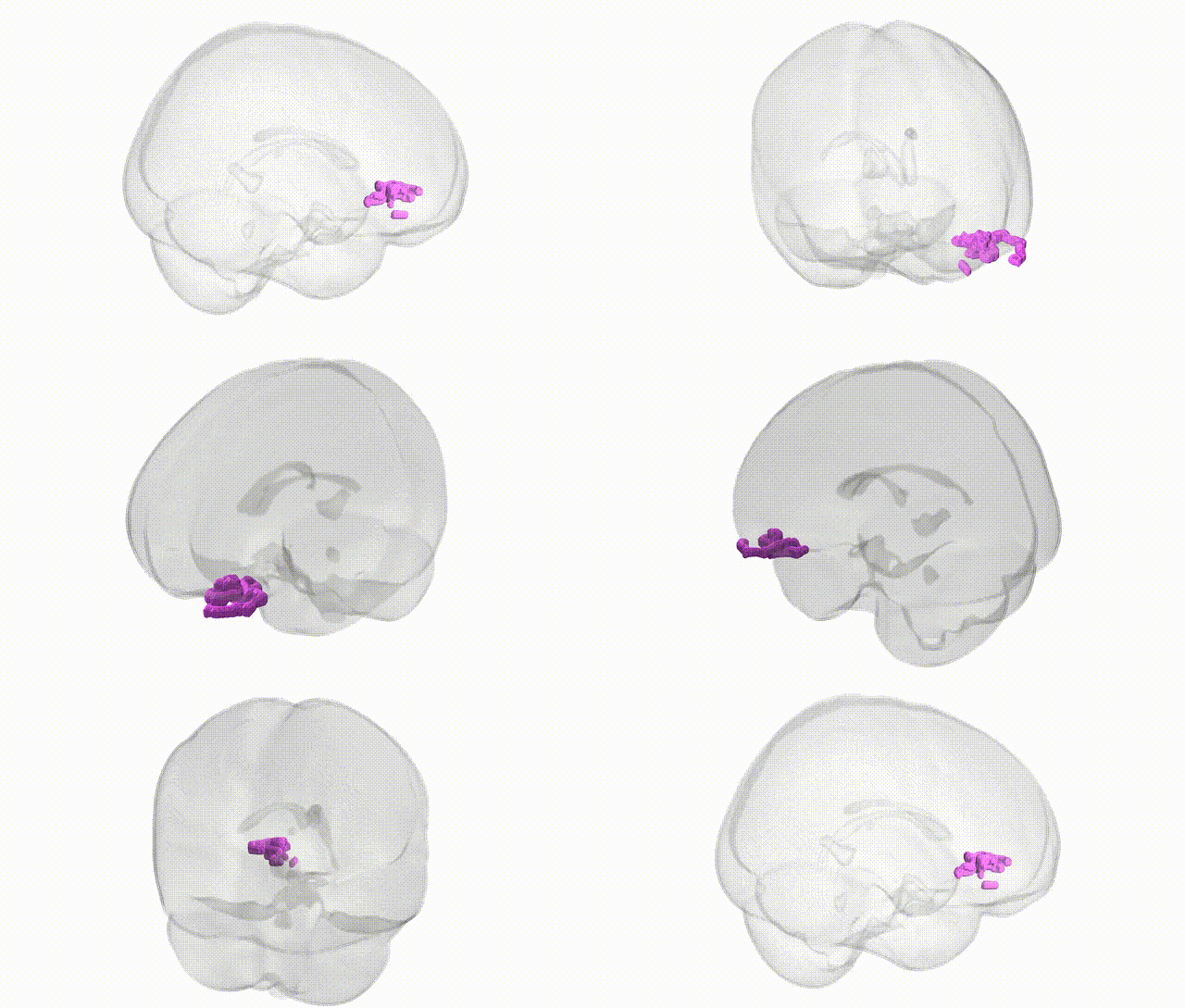
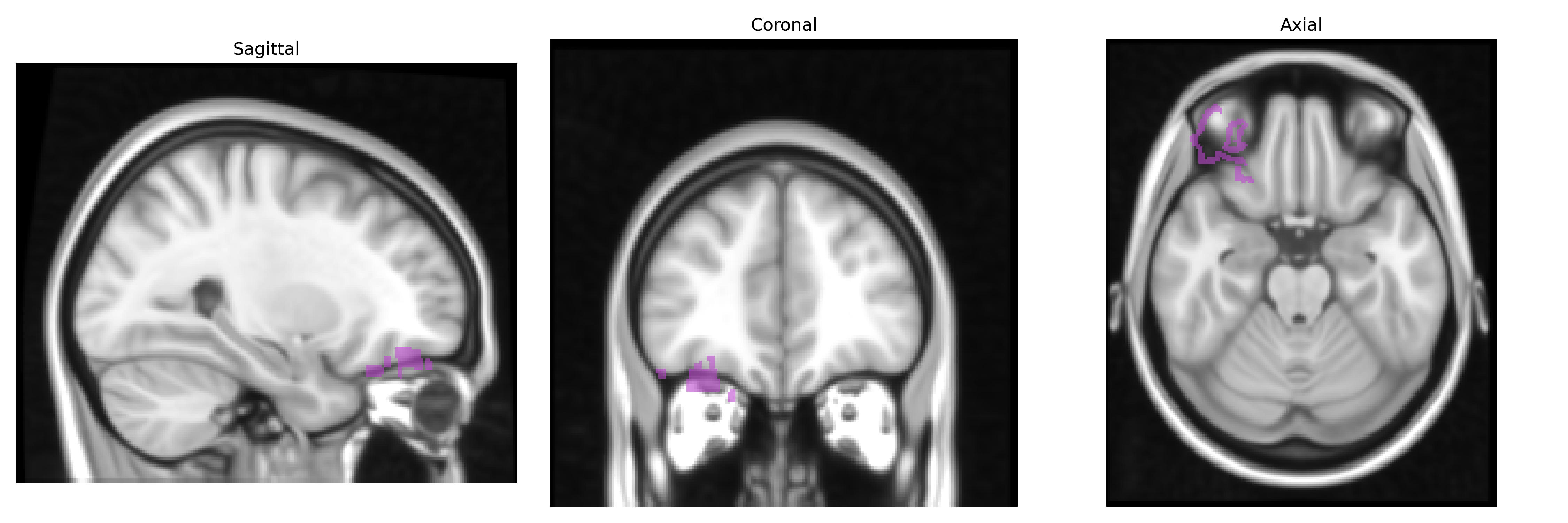
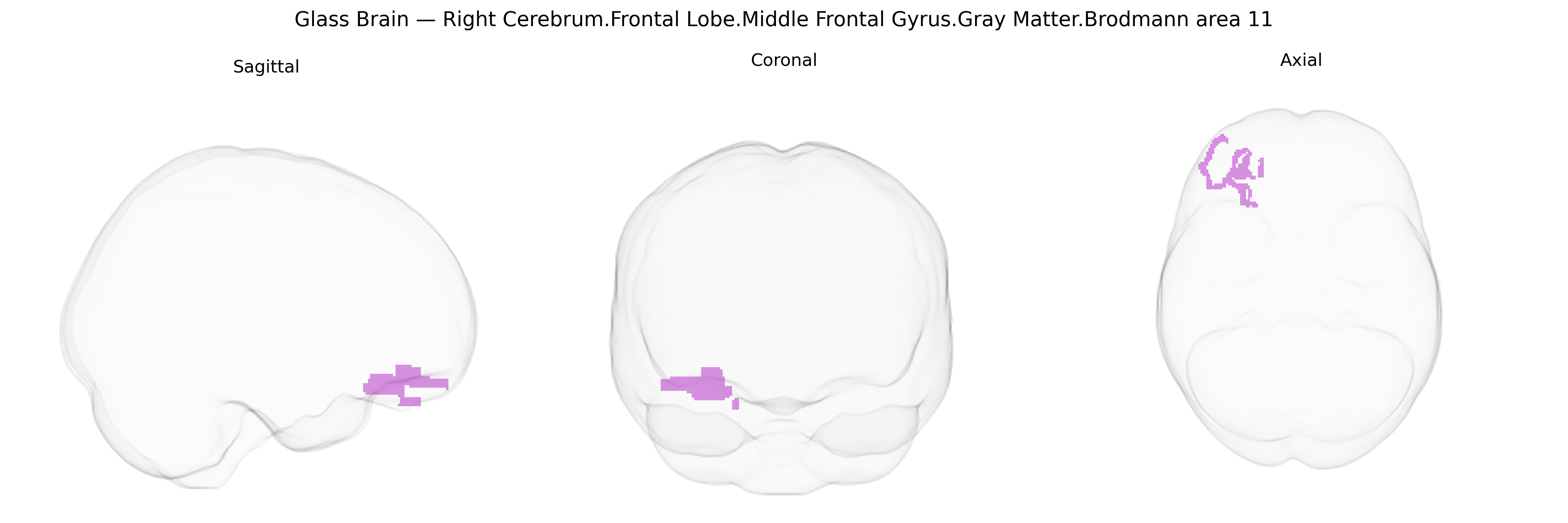
The bilateral Right Cerebrum.Frontal Lobe.Middle Frontal Gyrus.Gray Matter.Brodmann area 11 corresponds to portions of the orbitofrontal cortex located on the ventral surface of the frontal lobe, just above the orbits. This region is cytoarchitectonically defined by its granular frontal cortex characteristics and is implicated in higher-order associative processing, including evaluation of reward and punishment, integration of sensory and affective information, and modulation of decision-making and social behavior. It participates in networks involved in emotion regulation, expectation, and adaptive learning, receiving multimodal input from limbic, sensory, and prefrontal areas and projecting to subcortical structures that influence autonomic and motivational states. There is no direct link for this exact Talairach label; a closely related structure is the Orbitofrontal cortex.
The bilateral right middle frontal gyrus gray matter in Brodmann area 11 (orbitofrontal/ventromedial prefrontal territory) has been implicated in multiple imaging‑genetics and GWAS-based endophenotype studies, although few findings are specific to the “Talairach labels 1 mm” parcellation itself; rather, associations typically involve orbitofrontal or ventromedial prefrontal thickness, surface area, or activation encompassing this region. Large-scale brain-structure GWAS (e.g., ENIGMA and UK Biobank analyses) have reported common variants in genes involved in neurodevelopment, synaptic function, and neuronal proliferation (such as loci near HMGA2, MIR-9-2, MAPT, and others) associated with cortical thickness or surface area in orbitofrontal and adjacent middle frontal regions that overlap BA11. Functional imaging-genetic work links dopaminergic (e.g., DRD2, COMT), serotonergic (e.g., 5-HTTLPR/SLC6A4), and glutamatergic variants with altered activation or gray-matter variation in orbitofrontal–middle frontal territories during reward, decision-making, and emotion tasks. Disorders with robust genetic components that repeatedly show structural or functional abnormalities in this region include major depressive disorder, bipolar disorder, schizophrenia, obsessive–compulsive disorder, substance use disorders, and anxiety disorders, with polygenic risk scores for these conditions often correlating with orbitofrontal/middle frontal cortical metrics that extend into BA11. Although no single gene–region link is conclusively specific to “right BA11 middle frontal gyrus,” convergent evidence indicates that polygenic variation influencing neurodevelopment, neurotransmission, and synaptic plasticity contributes to individual differences in the structure and function of this orbitofrontal/middle frontal sector and to its role in genetically influenced traits such as impulsivity, risk-taking, reward sensitivity, and affective regulation.
Overview generated by GPT-4o (2026).
Region ID: 198
Hemisphere: bilateral
Atlas: Talairach labels 1mm
Full Quality Version: Download MP4
Full Quality Version: Download MP4
Wali Sidiqyar*, Gaurav Rudravaram*, Elyssa M. McMaster, Trent M. Schwartz, Adam M. Saunders, Kurt G. Schilling, Bennett A. Landman "Introducing SPINS: A Shared Public Visualization Library of Neuroanatomical Structures." Medical Imaging with Deep Learning- short paper
This resource is licensed under CC0 1.0 Universal (Public Domain).