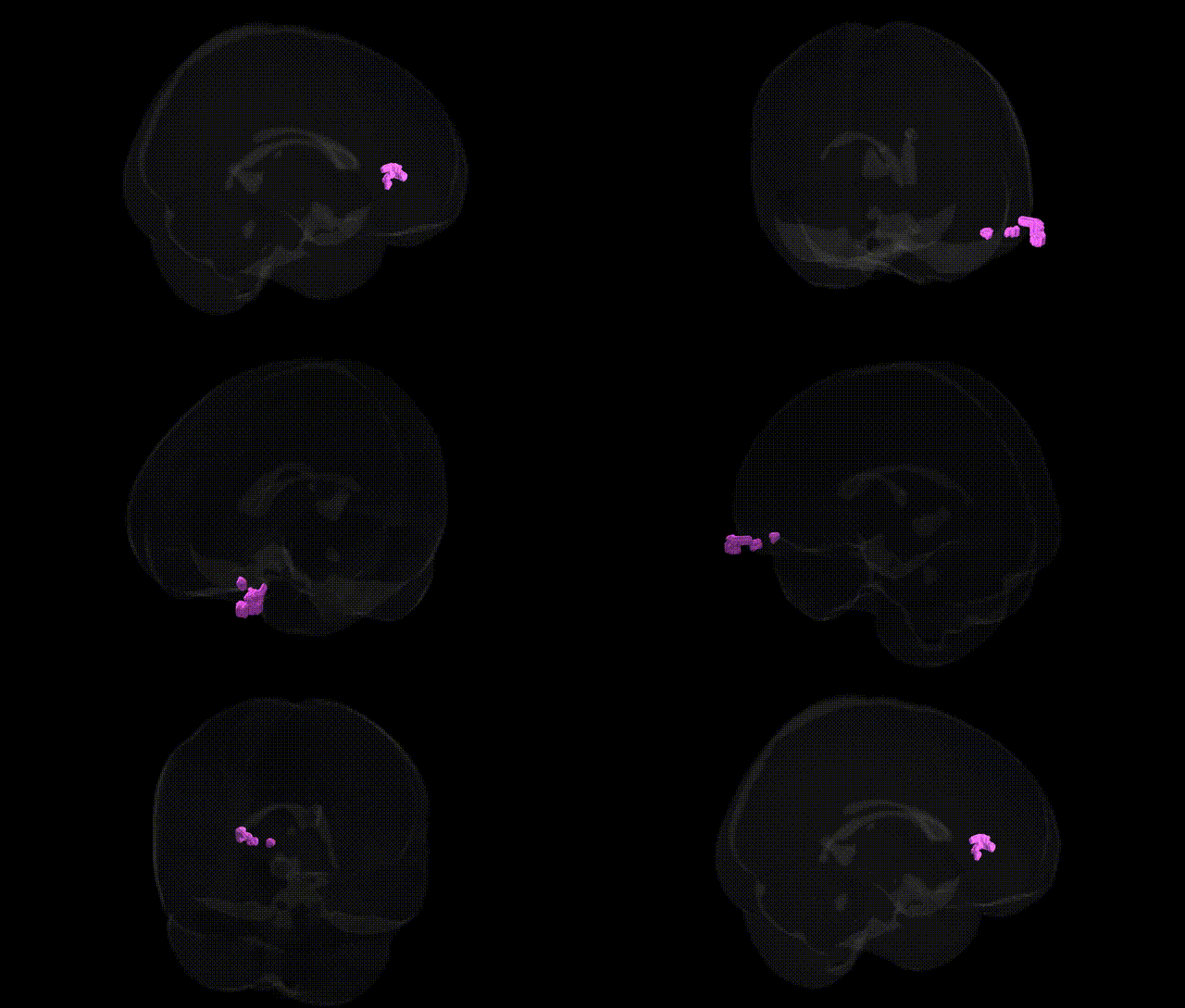
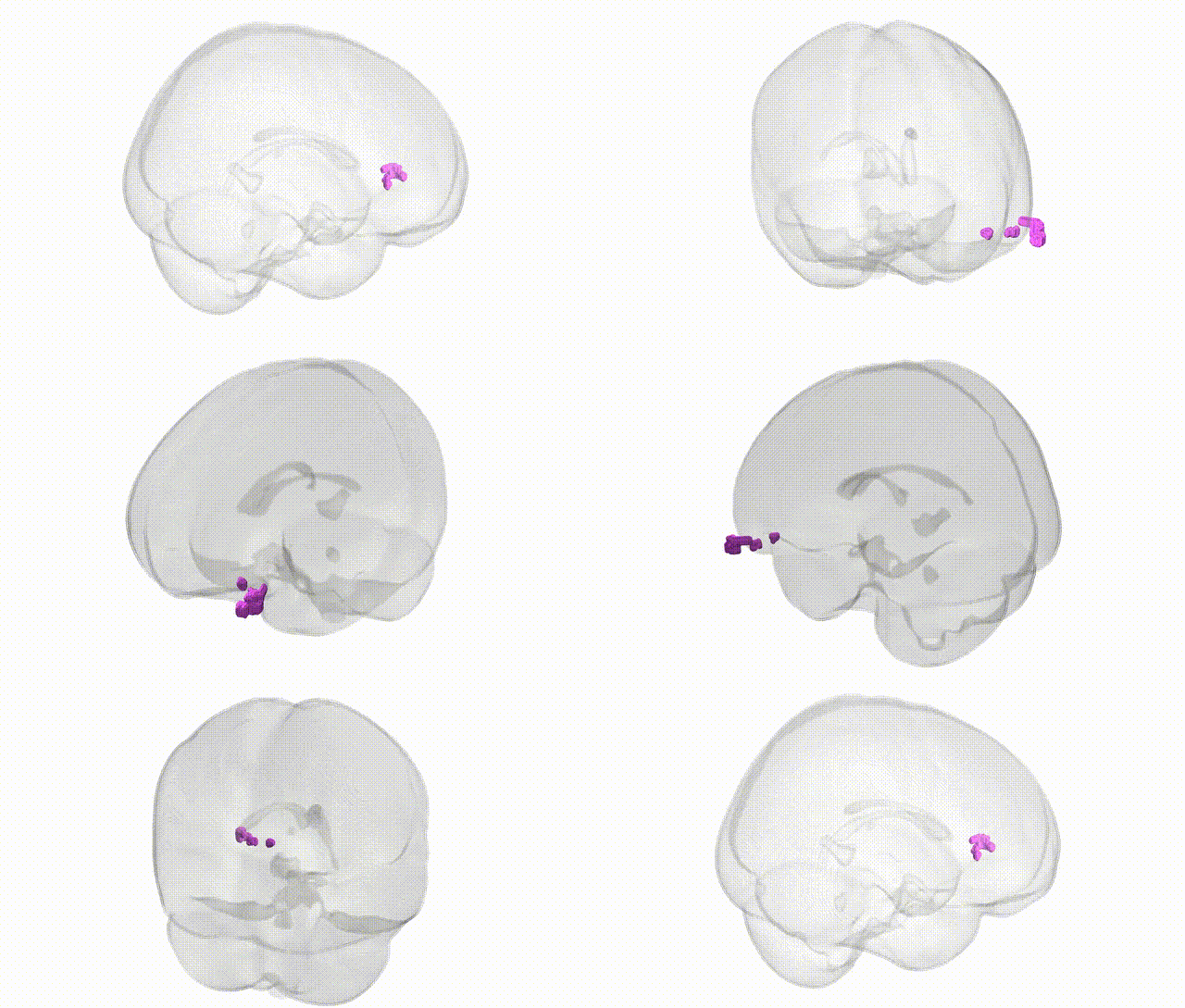
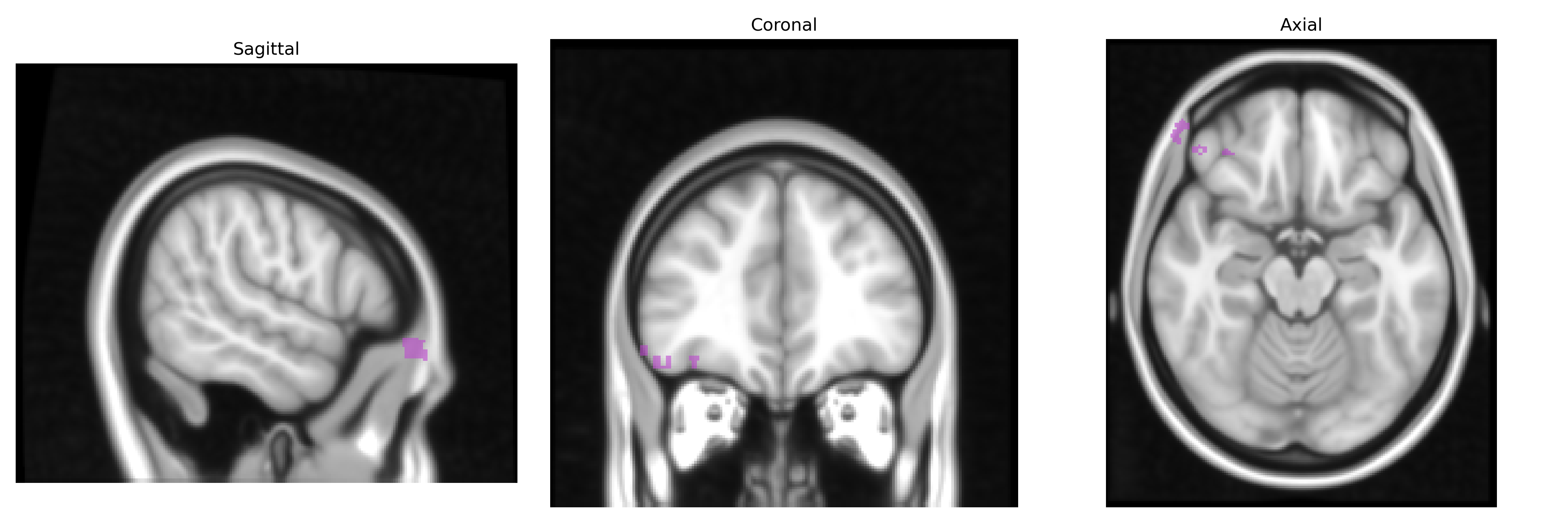
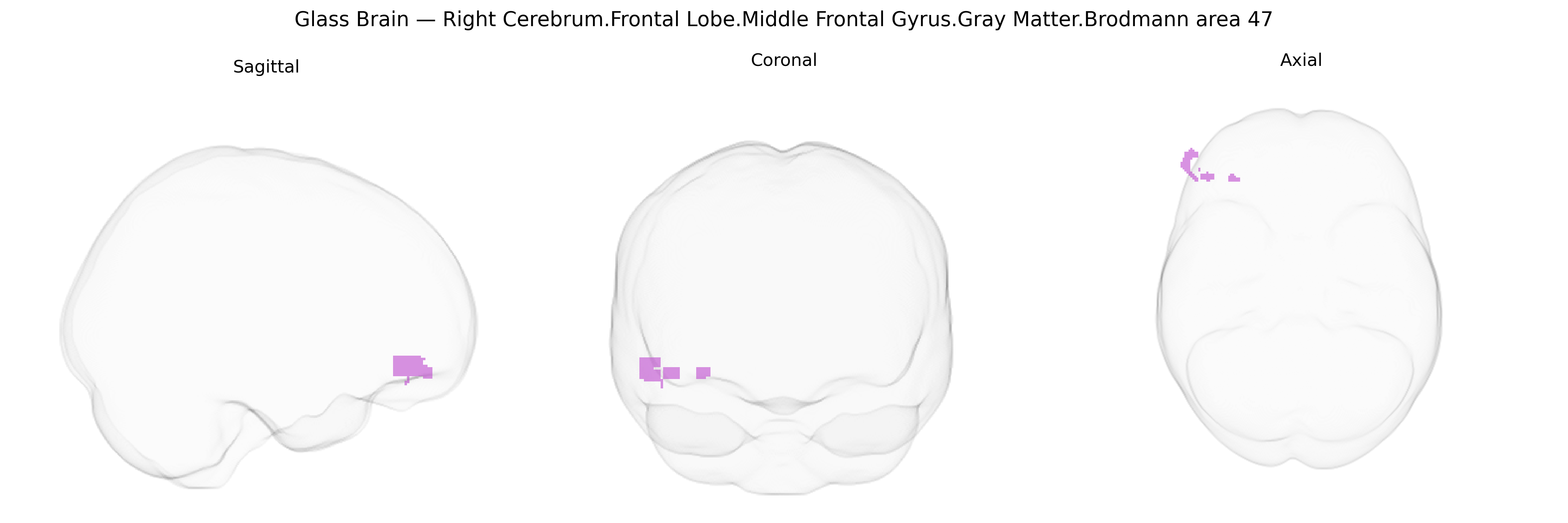
The bilateral Right Cerebrum.Frontal Lobe.Middle Frontal Gyrus.Gray Matter.Brodmann area 47 corresponds primarily to the orbital portion of the inferior frontal gyrus extending into the ventrolateral prefrontal cortex, localized in the frontal lobe’s basal and lateral aspects according to the Talairach 1 mm Atlas. Brodmann area 47 is cytoarchitectonically defined by its granular frontal cortex and is heavily interconnected with limbic, temporal, and parietal regions, supporting functions related to language processing (particularly semantic and syntactic operations), controlled retrieval of information, affective evaluation of stimuli, and aspects of decision-making and inhibitory control. In the right hemisphere, this region is frequently implicated in emotional prosody, social and reward-related evaluation, and integration of sensory and affective information to guide behavior, reflecting its role as part of the broader orbitofrontal and ventrolateral prefrontal networks. Brodmann area 47
The bilateral right middle frontal gyrus of Brodmann area 47 (inferior/middle frontal–orbitofrontal territory in the Talairach 1 mm atlas) is frequently implicated in imaging genetics and GWAS of brain structure and function, where variants in genes involved in neurodevelopment, synaptic plasticity, and neurotransmission (such as BDNF, COMT, DRD2/ANKK1, and serotonin-related genes) have been associated with gray matter volume, cortical thickness, or activity in this region, though many findings show small effect sizes and limited replication. Large-scale MRI-GWAS consortia (e.g., ENIGMA, UK Biobank–based studies) have reported common variants near genes regulating neuronal proliferation, axon guidance, and cortical patterning that influence frontal lobe morphometry, including orbitofrontal and ventrolateral prefrontal areas overlapping BA47, but these studies typically report parcel- or lobe-level effects rather than Talairach BA47–specific loci. Functionally, BA47 participates in cognitive control, reward and punishment processing, and language-related functions, and genetic associations with psychiatric and behavioral traits—such as major depressive disorder, bipolar disorder, schizophrenia, substance use (alcohol, nicotine, and other drugs), obsessive–compulsive disorder, and anxiety—often converge on altered structure or functional activation in this region, with implicated genes spanning dopaminergic, glutamatergic, GABAergic, and neurotrophic pathways. Polygenic risk scores for schizophrenia, depression, and ADHD have been linked to reduced or altered right frontal gray matter, including orbitofrontal/middle frontal territories overlapping BA47, suggesting that many small-effect variants collectively shape the development and integrity of this area. However, no single gene or variant is uniquely or consistently tied to the bilateral right BA47 region across studies; instead, this territory appears as one node in distributed fronto-striatal and fronto-limbic circuits whose structure and function are modestly modulated by widely distributed genetic risk architectures for neuropsychiatric and cognitive phenotypes.
Overview generated by GPT-4o (2026).
Region ID: 302
Hemisphere: bilateral
Atlas: Talairach labels 1mm
Full Quality Version: Download MP4
Full Quality Version: Download MP4
Wali Sidiqyar*, Gaurav Rudravaram*, Elyssa M. McMaster, Trent M. Schwartz, Adam M. Saunders, Kurt G. Schilling, Bennett A. Landman "Introducing SPINS: A Shared Public Visualization Library of Neuroanatomical Structures." Medical Imaging with Deep Learning- short paper
This resource is licensed under CC0 1.0 Universal (Public Domain).