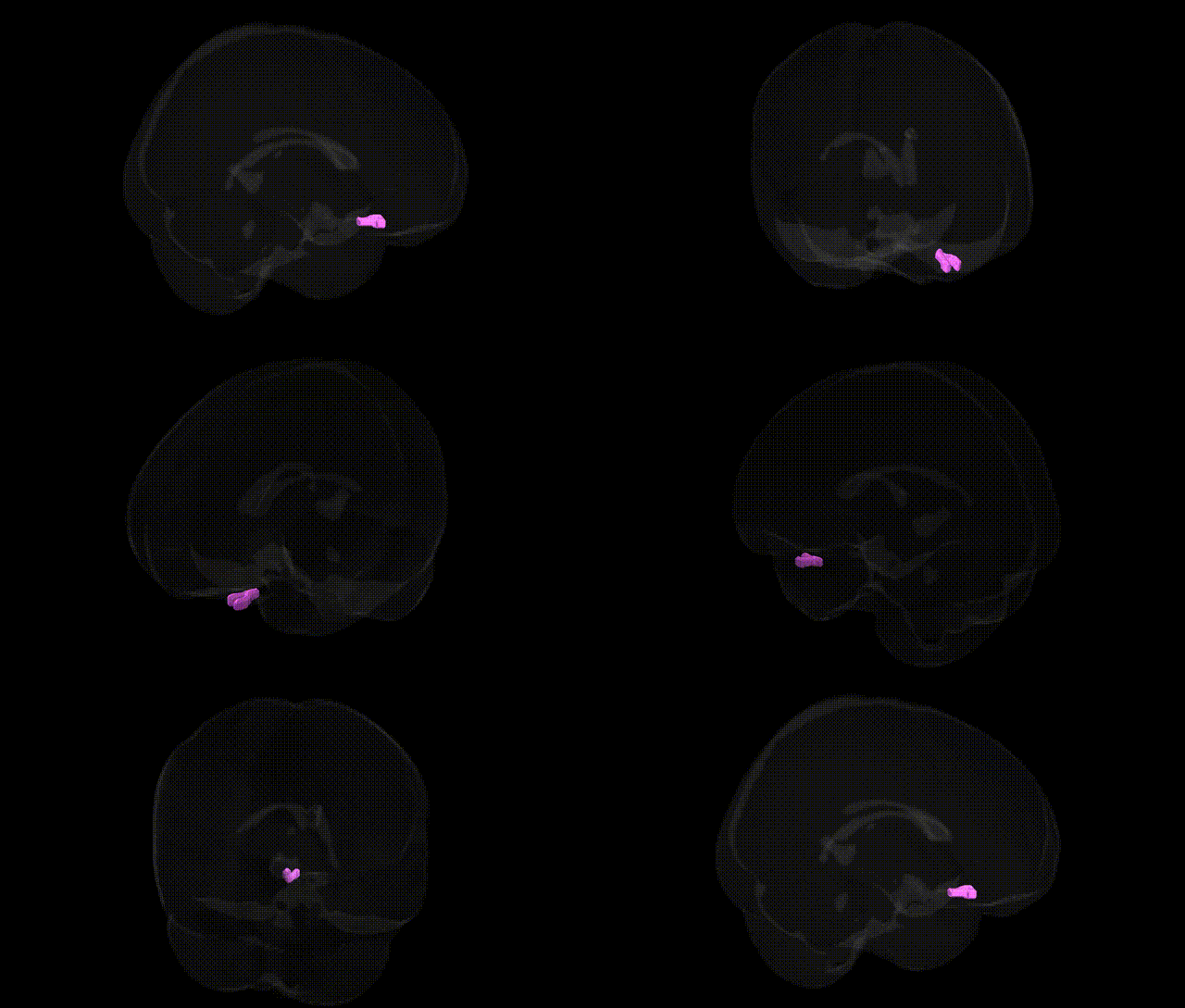
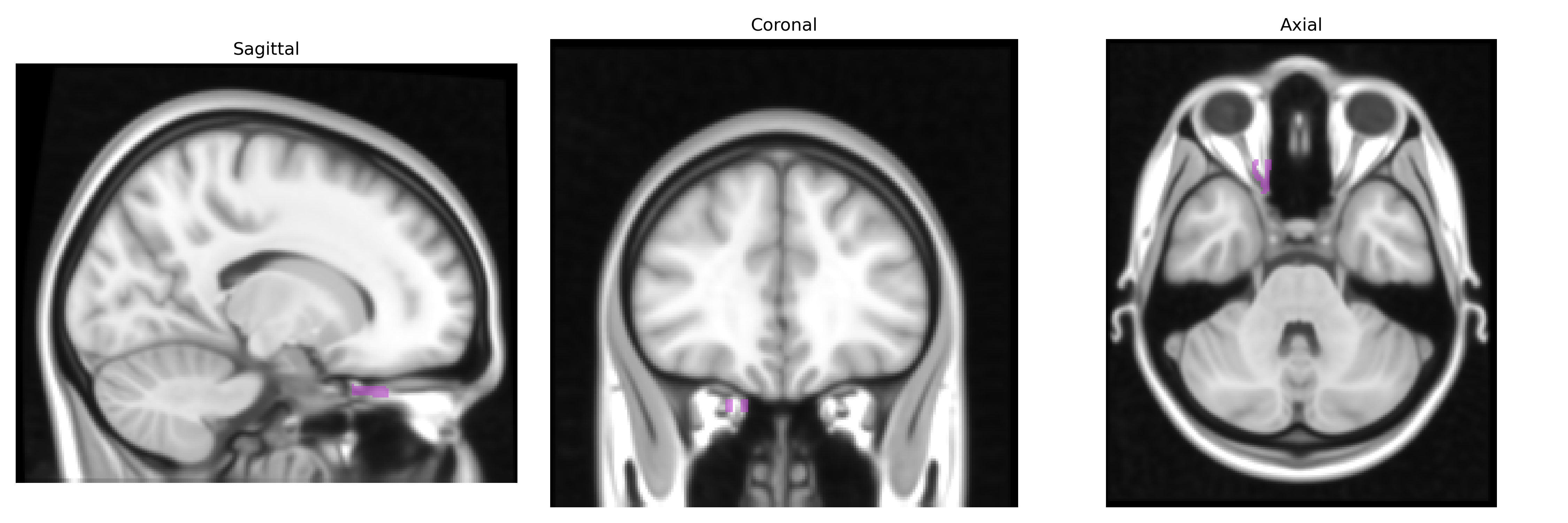
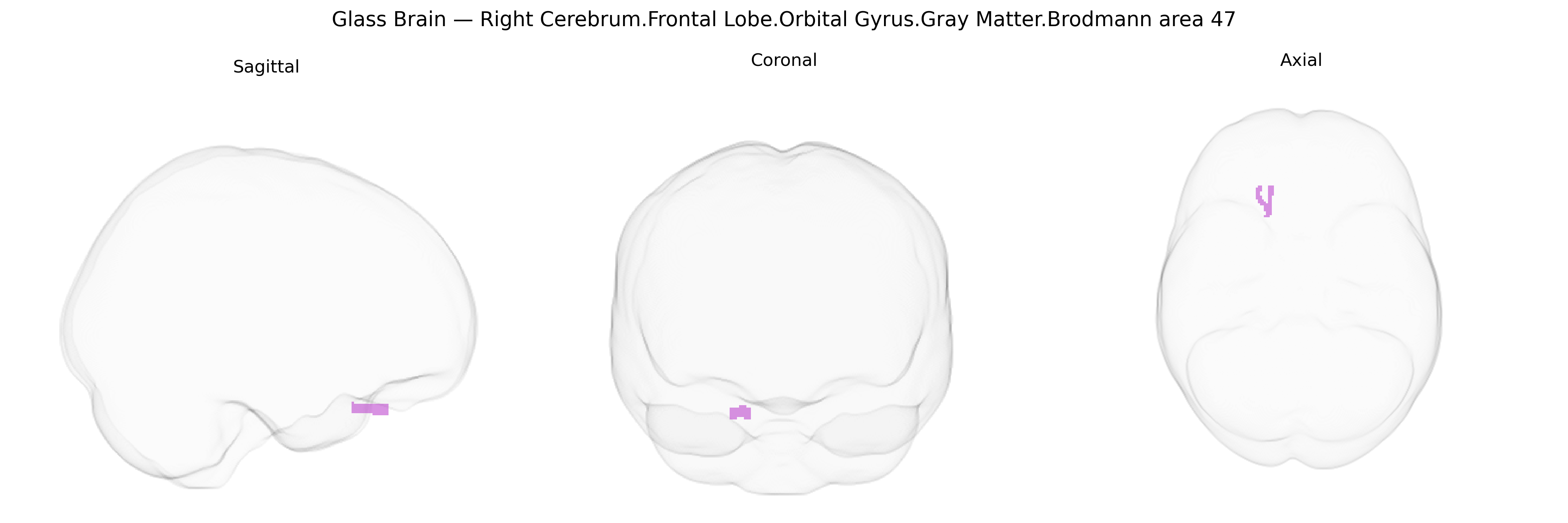
The bilateral Right Cerebrum.Frontal Lobe.Orbital Gyrus.Gray Matter.Brodmann area 47 corresponds to a portion of the ventrolateral prefrontal cortex located on the orbital surface of the frontal lobe, overlying the orbit of the eye and extending along the inferior frontal convexity. Brodmann area 47 (also referred to as the orbital part of the inferior frontal gyrus) is cytoarchitectonically defined by its granular frontal cortex characteristics and is implicated in higher-order cognitive and affective functions, including language processing (especially semantic retrieval and integration), reward valuation, decision-making under uncertainty, and modulation of emotional responses. This region is interconnected with other prefrontal, temporal, limbic, and subcortical structures, supporting its role in integrating sensory, mnemonic, and affective information for goal-directed behavior. Brodmann area 47
The bilateral right orbital part of the frontal lobe (Brodmann area 47, often within the orbitofrontal cortex) has been implicated in multiple genetic and GWAS-based associations, largely via imaging-genetics studies and disorder-focused consortia. Variants in genes involved in synaptic function, neurodevelopment, and monoaminergic signaling—such as BDNF, COMT, SLC6A4, DRD2, GRM3, and genes in glutamatergic and GABAergic pathways—have been associated with structural or functional measures of BA47/orbitofrontal cortex, including gray matter volume and cortical thickness. Large-scale GWAS of brain morphology (e.g., ENIGMA, UK Biobank) consistently identify polygenic influences on frontal and orbitofrontal cortical thickness and surface area, implicating loci near genes involved in neuronal differentiation, axon guidance, and cortical patterning (such as variants near HMGA2, IGF1, and several cadherin and cell-adhesion genes), though associations are often reported at the level of broader frontal regions rather than the specific Talairach-defined BA47. Genetic risk for major depressive disorder, bipolar disorder, schizophrenia, and obsessive-compulsive disorder has been linked to orbitofrontal/BA47 structural and functional alterations, with polygenic risk scores for these conditions correlating with reduced gray matter or altered activity in this area. GWAS of risk-taking, impulsivity, substance use (including alcohol and nicotine), and neuroticism also show associations between trait-related genetic variation and orbitofrontal/BA47 metrics, supporting a role for this region as a genetically influenced hub in reward evaluation, affect regulation, and decision-making; however, most findings are polygenic and regionally coarse, and precise, robust single-gene associations specifically targeting bilateral right BA47 gray matter in the Talairach 1 mm atlas remain limited.
Overview generated by GPT-4o (2026).
Region ID: 147
Hemisphere: bilateral
Atlas: Talairach labels 1mm
Full Quality Version: Download MP4
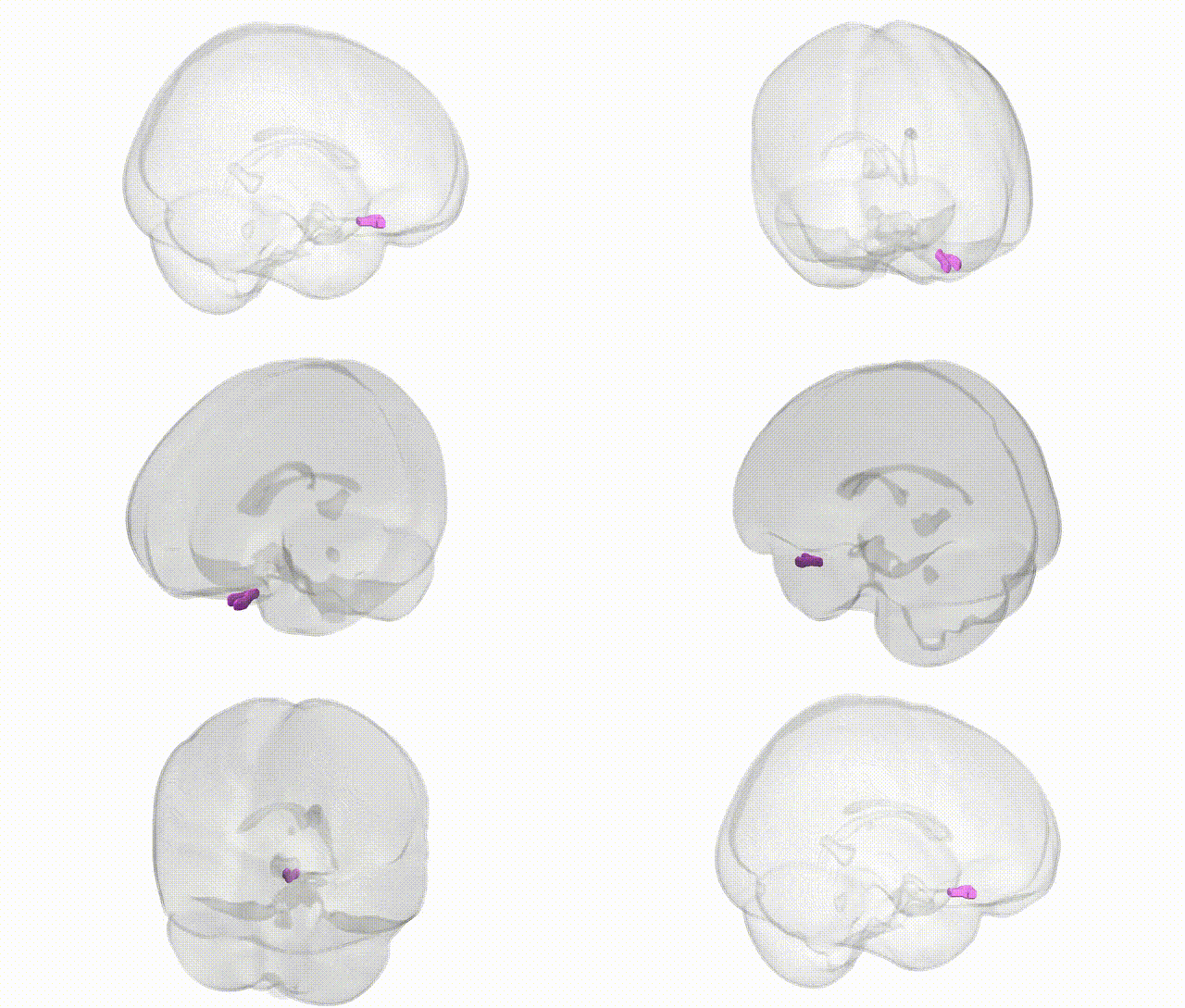
Full Quality Version: Download MP4
Wali Sidiqyar*, Gaurav Rudravaram*, Elyssa M. McMaster, Trent M. Schwartz, Adam M. Saunders, Kurt G. Schilling, Bennett A. Landman "Introducing SPINS: A Shared Public Visualization Library of Neuroanatomical Structures." Medical Imaging with Deep Learning- short paper
This resource is licensed under CC0 1.0 Universal (Public Domain).