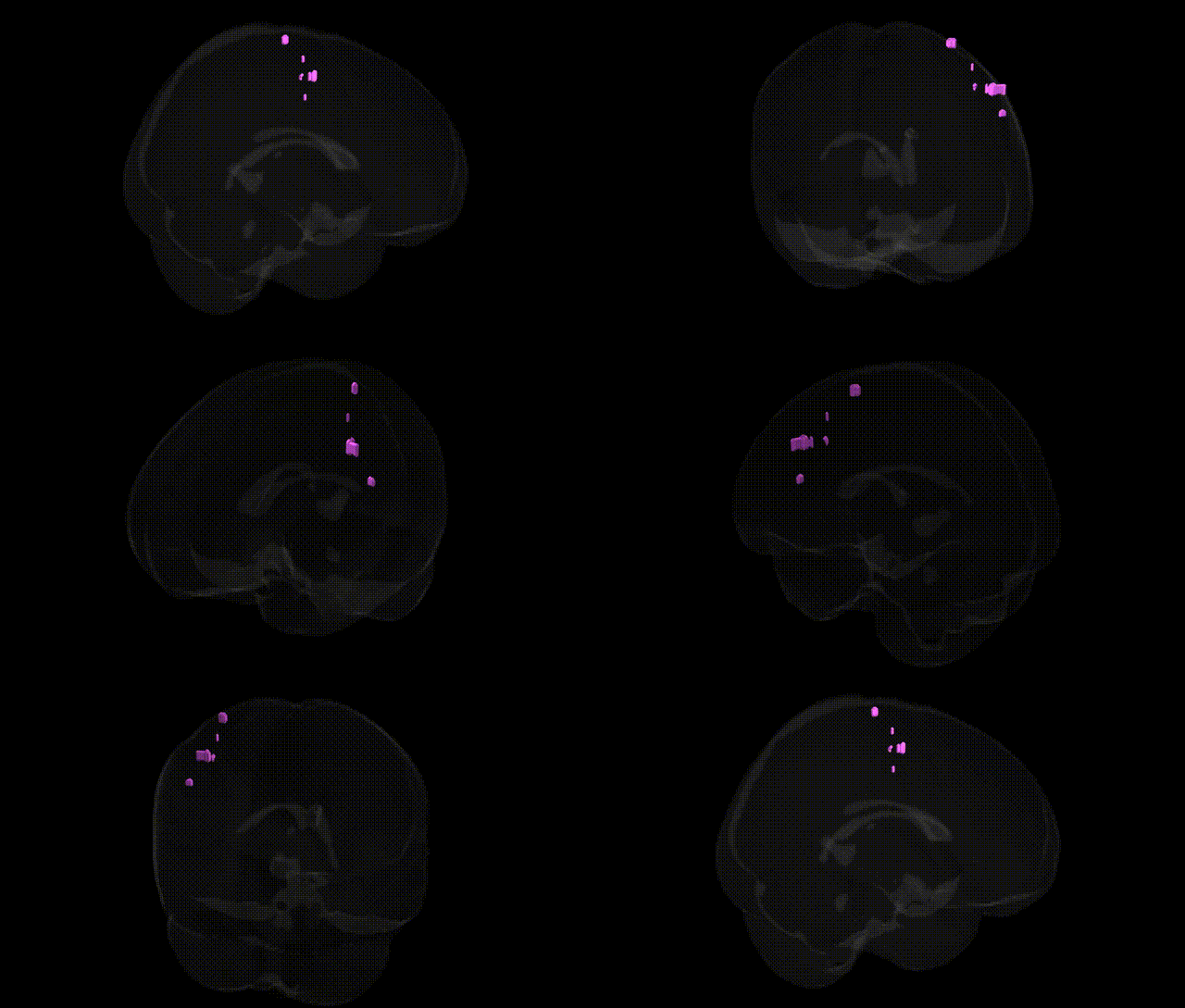
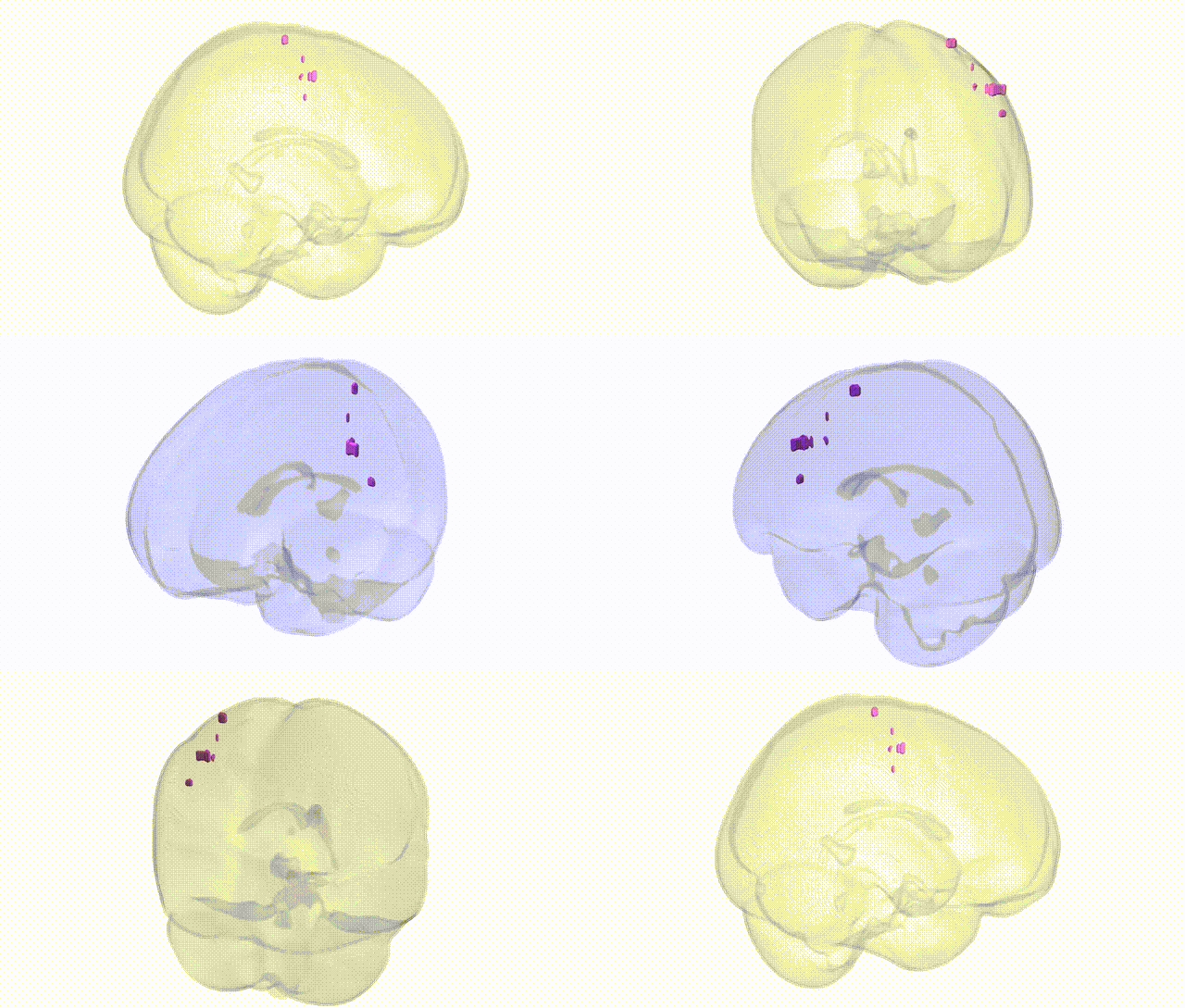
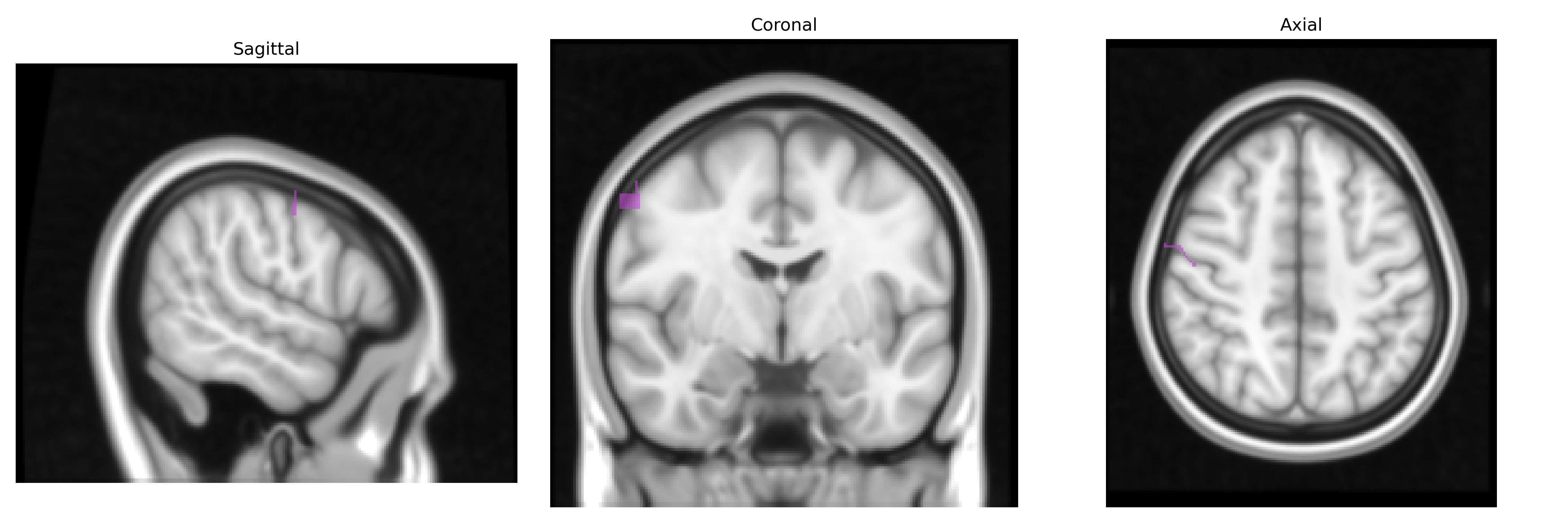
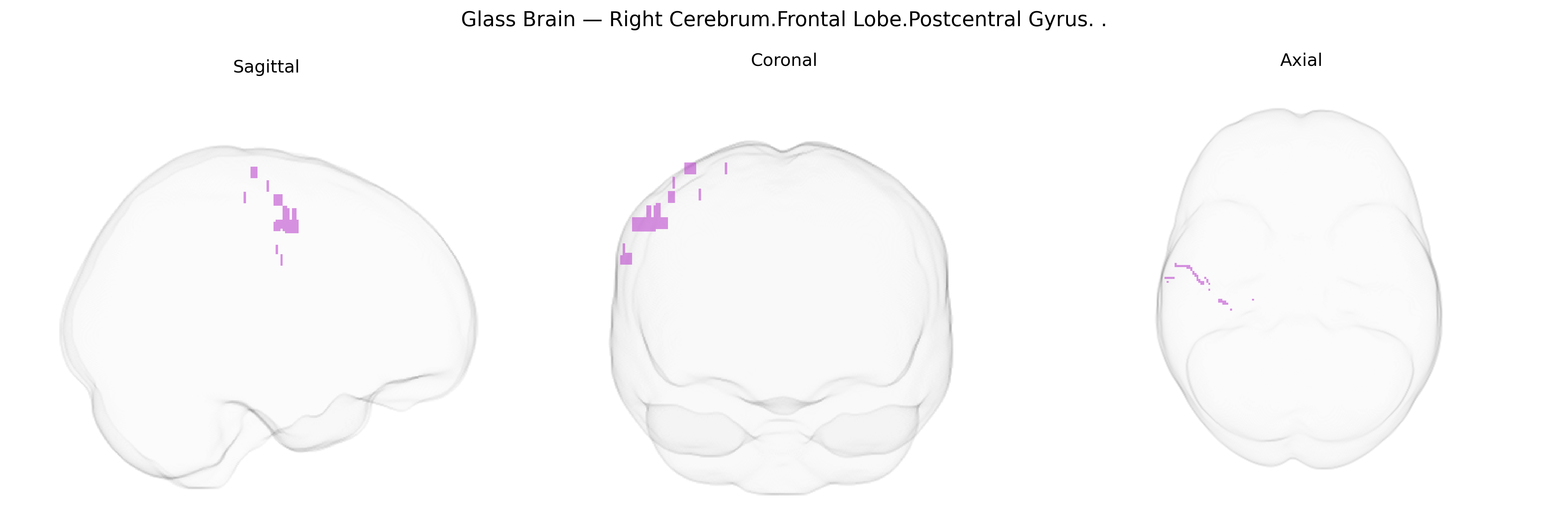
The “bilateral Right Cerebrum.Frontal Lobe.Postcentral Gyrus” label from the Talairach 1 mm atlas appears to mix hemispheric and lobar terms, but functionally corresponds most closely to the postcentral gyrus, the primary somatosensory cortex (Brodmann areas 3, 1, and 2) located in the parietal lobe immediately posterior to the central sulcus. This region receives dense thalamocortical input from the ventral posterior nucleus of the thalamus and is somatotopically organized into a sensory homunculus, processing tactile, proprioceptive, and some nociceptive information from the contralateral side of the body. Neuronal populations within the postcentral gyrus integrate cutaneous and deep sensory signals to support fine touch discrimination, limb position sense, and aspects of sensorimotor integration essential for coordinated movement and object manipulation.
Postcentral gyrus
The bilateral right postcentral gyrus (Talairach: Right Cerebrum.Frontal Lobe.Postcentral Gyrus, though functionally parietal primary somatosensory cortex) has been implicated in several genetic and GWAS-based associations, primarily through imaging-genetics and neuropsychiatric studies. Large-scale ENIGMA and UK Biobank analyses have identified common variants in genes involved in neurodevelopment and synaptic function (for example, microtubule and axon guidance genes such as MAPT-region loci and cadherin-related genes) that influence cortical thickness, surface area, or gyrification in the postcentral gyrus, often as part of broader sensorimotor or parietal networks. Polygenic risk scores for schizophrenia, major depressive disorder, and autism spectrum disorder have been linked to structural or functional alterations in primary somatosensory and adjacent sensorimotor cortices, suggesting pleiotropic genetic effects on this region’s morphology and activation patterns. GWAS of chronic pain, migraine, and touch-related or sensory phenotypes (including pain sensitivity and somatosensory thresholds) repeatedly implicate postcentral regions as intermediate phenotypes, where genetic variants in inflammatory, ion channel, and neurotransmission pathways modulate somatosensory cortex responses. Additionally, rare variants and copy-number changes in genes regulating cortical development (for example, in perisylvian or fronto-parietal malformation syndromes) can produce focal or regional abnormalities that include the postcentral gyrus, and twin/imaging heritability studies consistently show moderate to high heritability for right postcentral gyrus structure and function, placing this region within genetically constrained somatosensory and sensorimotor networks that are altered across multiple neurodevelopmental, psychiatric, and pain-related disorders.
Overview generated by GPT-4o (2026).
Region ID: 980
Hemisphere: bilateral
Atlas: Talairach labels 1mm
Full Quality Version: Download MP4
Full Quality Version: Download MP4
Wali Sidiqyar*, Gaurav Rudravaram*, Elyssa M. McMaster, Trent M. Schwartz, Adam M. Saunders, Kurt G. Schilling, Bennett A. Landman "Introducing SPINS: A Shared Public Visualization Library of Neuroanatomical Structures." Medical Imaging with Deep Learning- short paper
This resource is licensed under CC0 1.0 Universal (Public Domain).