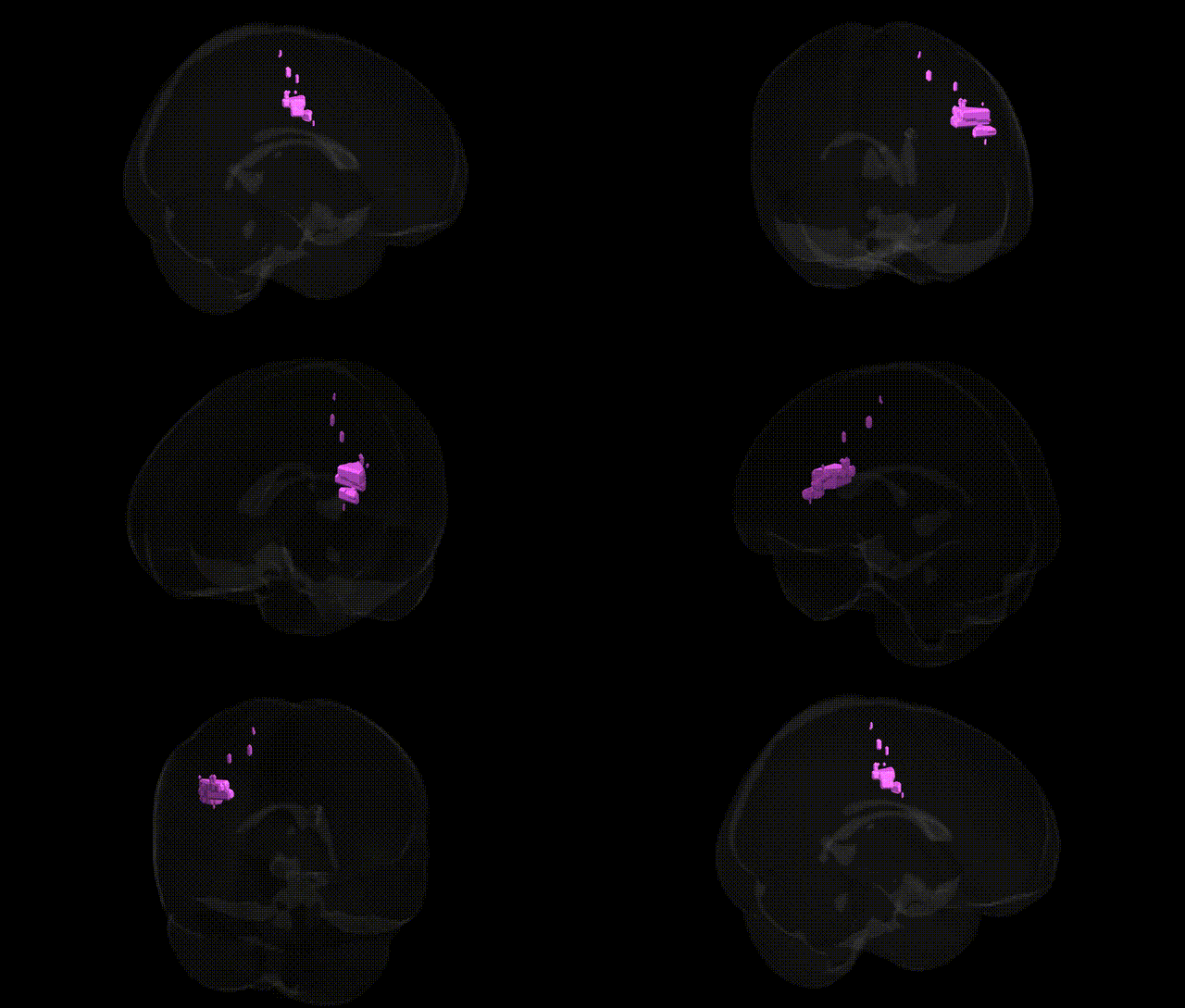
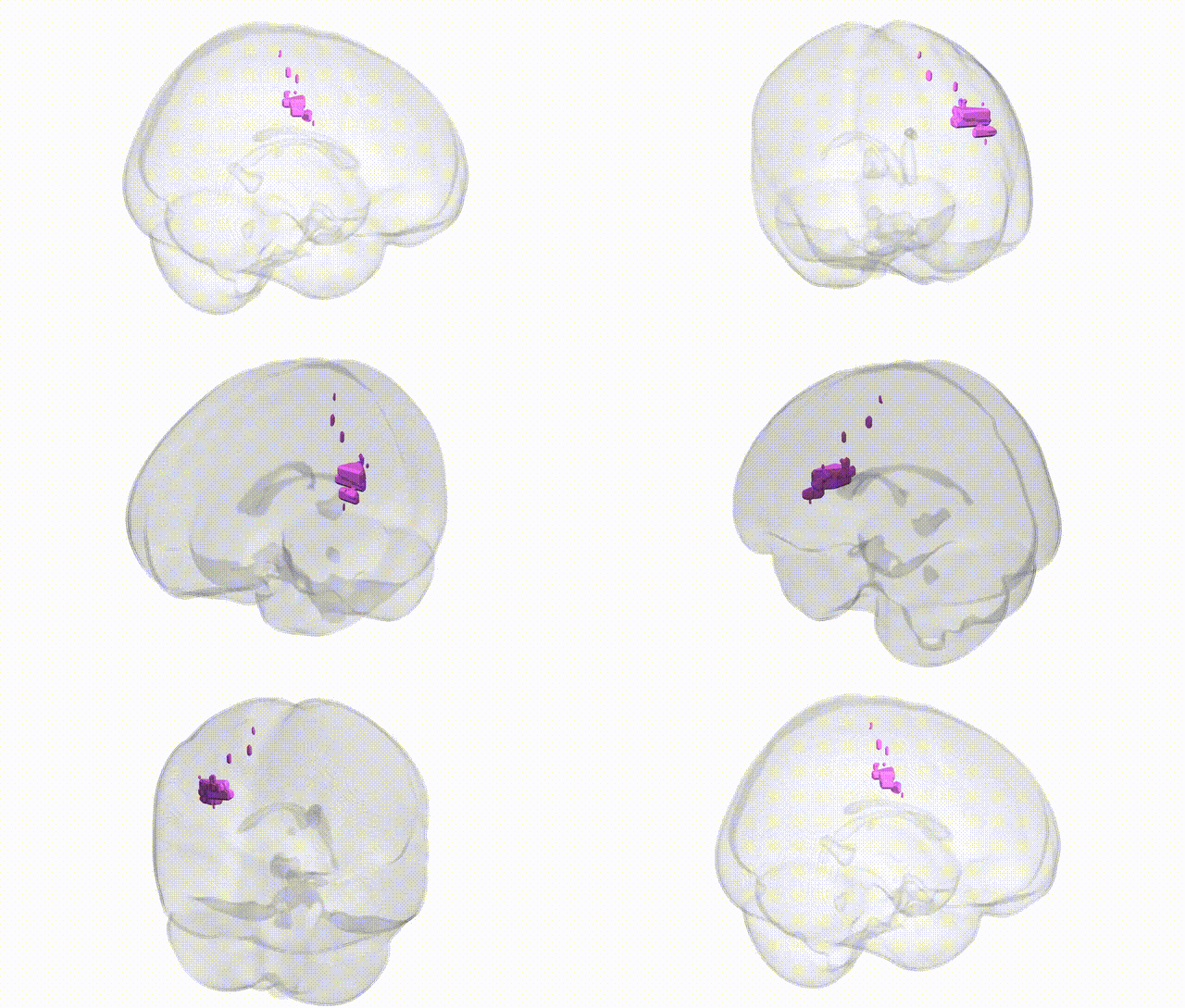
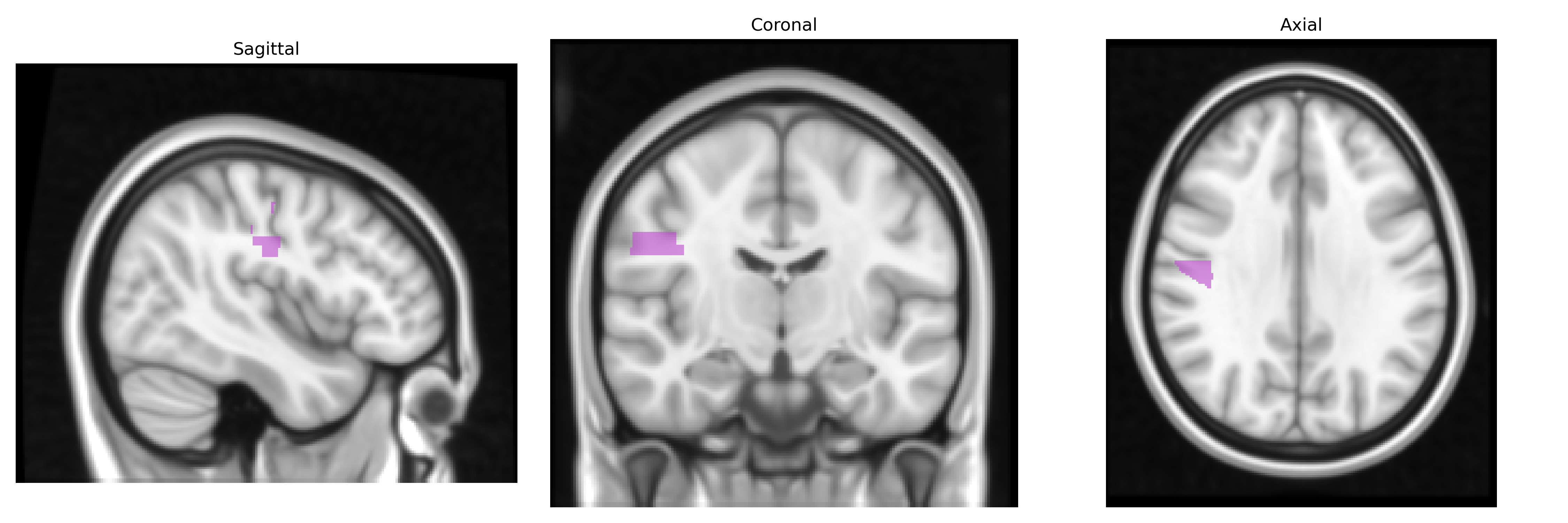
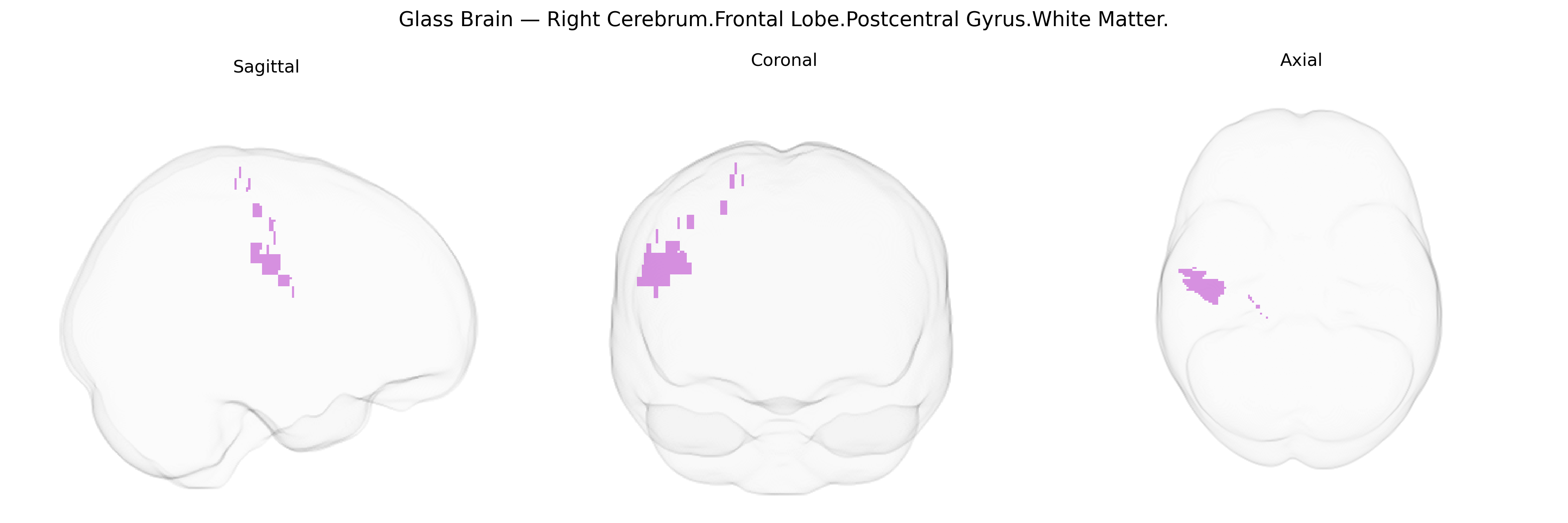
The bilateral Right Cerebrum.Frontal Lobe.Postcentral Gyrus.White Matter, as labeled in the Talairach 1 mm atlas, refers to subcortical myelinated fiber pathways located immediately deep to the postcentral gyrus, which is classically part of the parietal lobe but may fall within frontal-lobe-defined boundaries depending on the parcellation scheme. These white matter tracts contain ascending thalamocortical fibers carrying somatosensory information (touch, proprioception, vibration, and joint position sense) to the primary somatosensory cortex, as well as descending corticocortical and corticofugal fibers connecting the postcentral gyrus with adjacent frontal, parietal, and subcortical regions involved in sensorimotor integration and motor planning. Functionally, this white matter supports fine tactile discrimination, sensorimotor feedback loops, and coordination of voluntary movements by linking sensory representations in the postcentral cortex with premotor and primary motor areas in the frontal lobe. There is no direct Wikipedia article for this exact white matter region; a closely related cortical structure is the Postcentral gyrus.
The bilateral right postcentral gyrus white matter (Talairach: Right Cerebrum.Frontal Lobe.Postcentral Gyrus.White Matter, though functionally parietal-somatosensory) has been implicated in several genetic and GWAS-based findings through its role in primary somatosensory and sensorimotor networks rather than through region-specific single-gene associations. Large imaging–genetics consortia such as ENIGMA and UK Biobank have repeatedly linked common variants in neurodevelopmental and axon guidance genes (for example, genes in the MAPT locus on 17q21, NCAM1, ROBO and semaphorin pathways) to white-matter microstructure measures—fractional anisotropy and mean diffusivity—within postcentral and adjacent sensorimotor tracts. Polygenic influences on cortical morphology also extend to this area: GWAS of cortical thickness and surface area report associations between variants near genes involved in neuronal proliferation and synaptic regulation (e.g., MIR137, WNT signaling genes, and calcium-channel genes such as CACNA1C) and structural variation encompassing the postcentral region. Clinically, case–control and imaging-genetic studies in autism spectrum disorder, ADHD, and schizophrenia have linked risk variants in synaptic (e.g., NRXN, CNTNAP2) and glutamatergic genes to altered somatosensory cortex connectivity and white-matter integrity, including postcentral gyrus tracts; similarly, genetic risk for multiple sclerosis and other demyelinating or neurodegenerative disorders (e.g., HLA-DRB1, APOE, and variants in oligodendrocyte-related genes) manifests as microstructural changes in sensory white matter that often involve this region. Overall, the genetic architecture appears highly polygenic and shared with broader sensorimotor and cortical white-matter networks, with no single variant uniquely specific to the right postcentral gyrus white matter but many contributing to its development, connectivity, and vulnerability in neuropsychiatric and neurological disease.
Overview generated by GPT-4o (2026).
Region ID: 834
Hemisphere: bilateral
Atlas: Talairach labels 1mm
Full Quality Version: Download MP4
Full Quality Version: Download MP4
Wali Sidiqyar*, Gaurav Rudravaram*, Elyssa M. McMaster, Trent M. Schwartz, Adam M. Saunders, Kurt G. Schilling, Bennett A. Landman "Introducing SPINS: A Shared Public Visualization Library of Neuroanatomical Structures." Medical Imaging with Deep Learning- short paper
This resource is licensed under CC0 1.0 Universal (Public Domain).