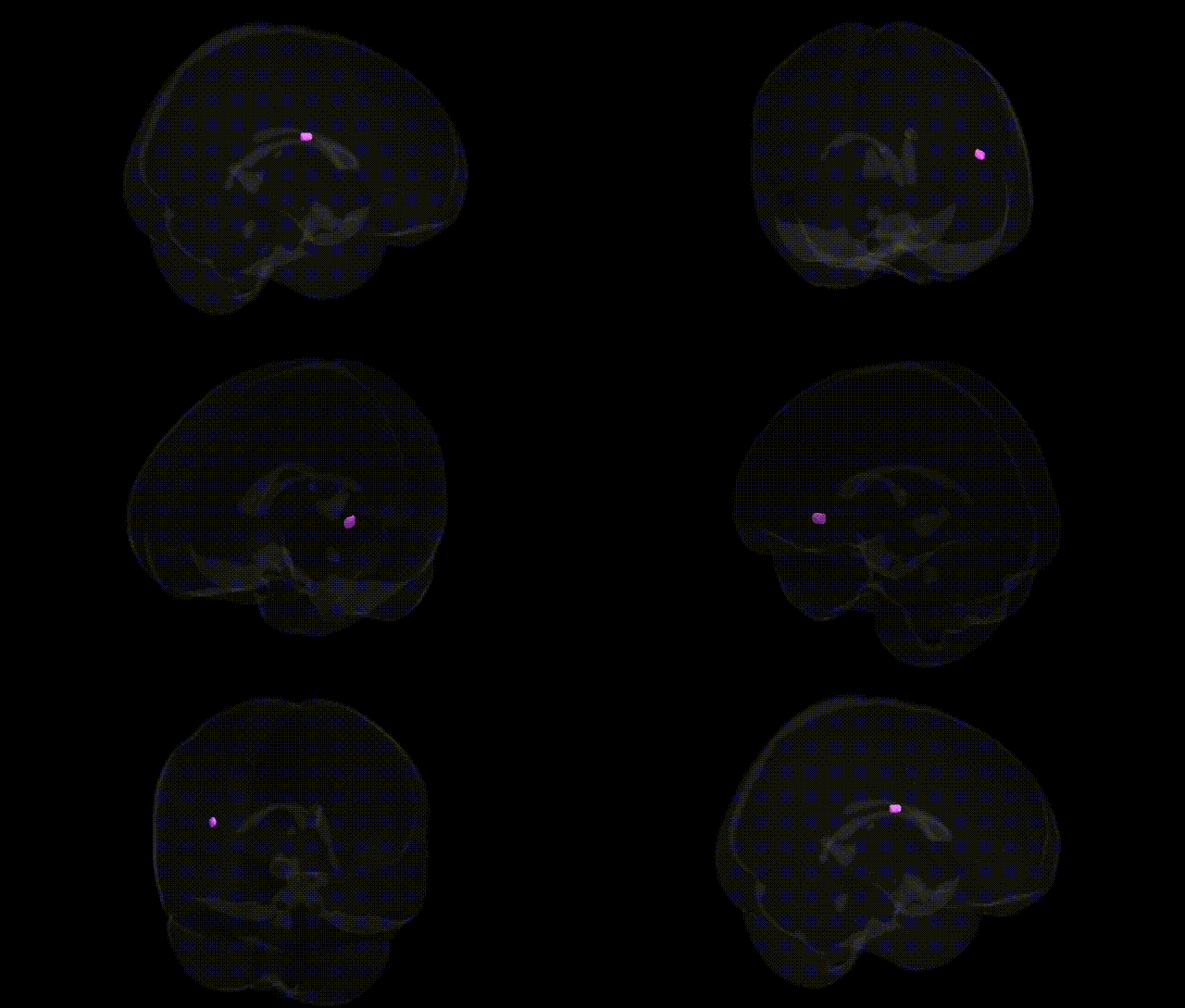
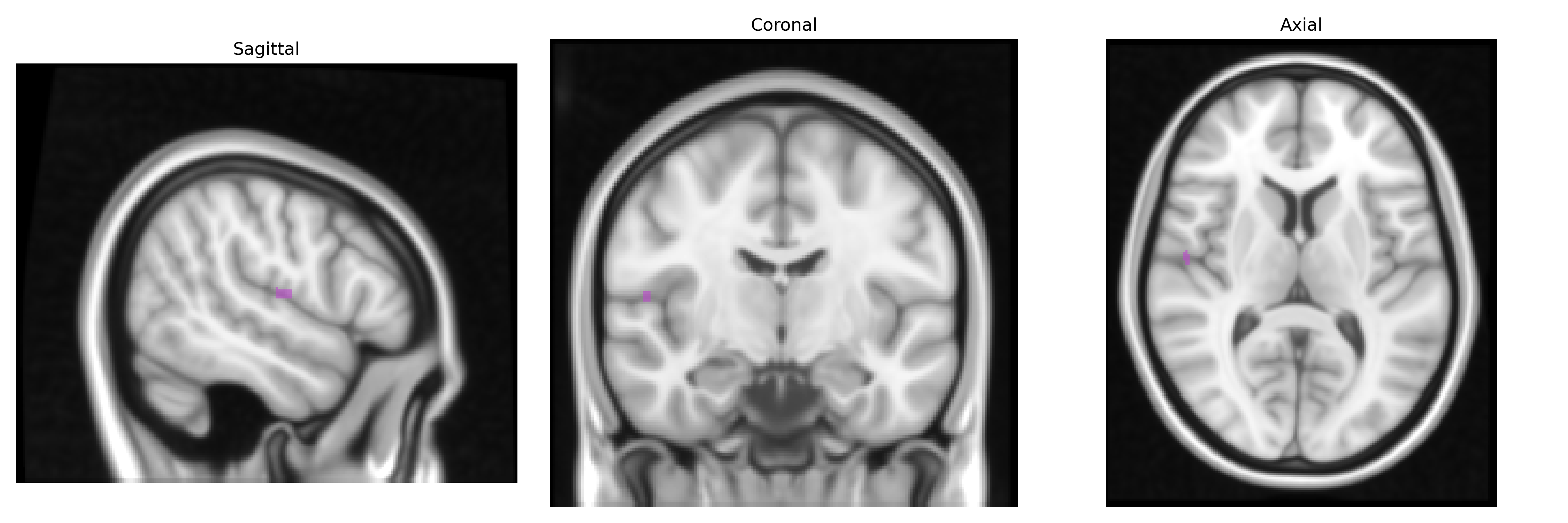
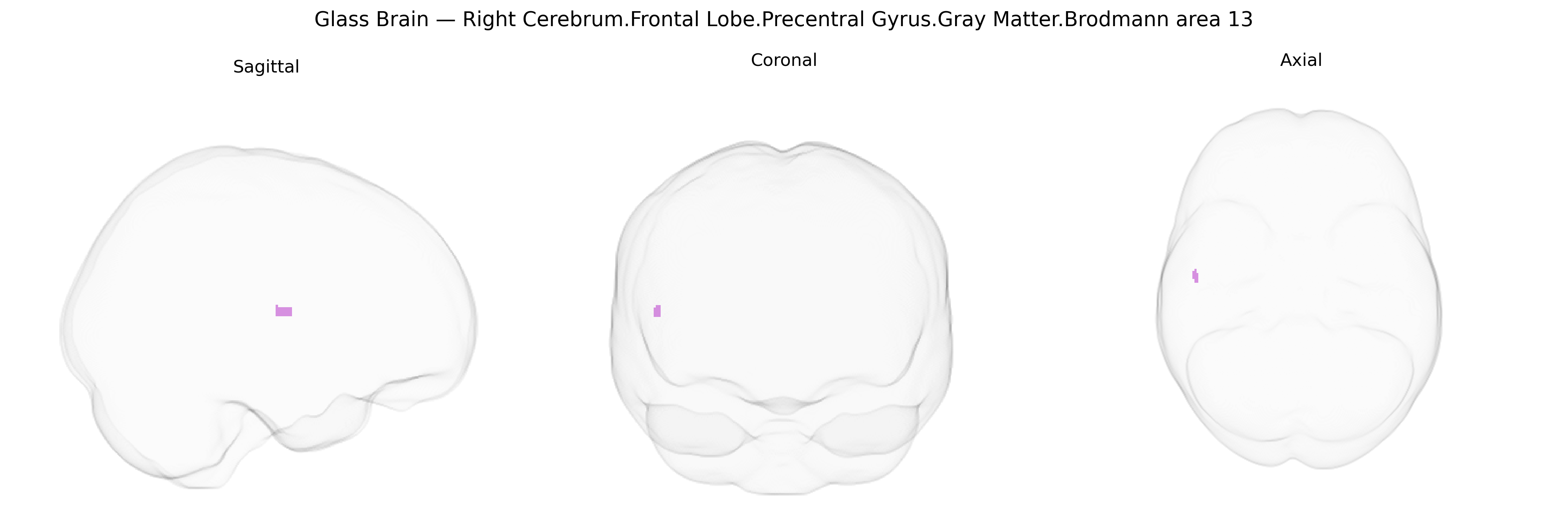
The bilateral Right Cerebrum.Frontal Lobe.Precentral Gyrus.Gray Matter.Brodmann area 13 label in the Talairach 1 mm atlas reflects a parcellation artifact rather than a canonical neuroanatomical designation, as Brodmann area 13 is classically assigned to the insular cortex and adjacent ventral frontal opercular regions rather than the precentral gyrus. Functionally, Brodmann area 13 is associated with multimodal integration of visceral, somatosensory, and affective information, contributing to interoceptive awareness, emotional processing, and aspects of decision-making and autonomic regulation, often in concert with neighboring insular and orbitofrontal territories. In many neuroimaging pipelines, this region may be grouped with the insular-opercular or paralimbic network, emphasizing its role as a hub linking sensory, limbic, and higher-order frontal systems. There is no direct Wikipedia article for this exact composite Talairach label; a related structure is the Insular cortex.
The Talairach 1 mm label “Right Cerebrum.Frontal Lobe.Precentral Gyrus.Gray Matter.Brodmann area 13” appears to reflect a mapping quirk, as Brodmann area 13 is classically insular/orbitofrontal rather than precentral, but genetic associations relevant to a right frontal-precentral/ventral premotor–orbitofrontal sector can be inferred from imaging genetics and GWAS of cortical structure and function. Large-scale cortical thickness and surface area GWAS (e.g., ENIGMA, UK Biobank) have identified common variants in genes involved in neurodevelopment (such as MAPT, SDK1, KCNK2, HMGA2, WNT signaling components, and cell-adhesion/migration genes) associated with regional morphometry in frontal and precentral regions, including adjacent inferior frontal and insular cortices overlapping BA13 territory. Polygenic risk scores for schizophrenia, bipolar disorder, major depression, and autism spectrum condition consistently correlate with altered gray matter volume or thickness in right frontal and insular/ventrolateral prefrontal cortex, with specific loci implicating synaptic and calcium-channel genes (e.g., CACNA1C, GRIN2A, DLG2) that show imaging associations in nearby regions. GWAS of motor and cognitive traits—including reaction time, general cognitive ability, and handedness—have also linked variants in neurodevelopmental and axon-guidance genes (e.g., ROBO/SLIT family, LINGO1-related pathways) to structural and functional variation in precentral and adjacent frontal areas. Although no large GWAS has isolated this Talairach-defined parcel as a unique locus, convergent evidence from imaging genetics, psychiatric and neurological risk loci, and polygenic architecture indicates that genes governing cortical development, synaptic plasticity, and fronto–insula–motor network integrity contribute to inter-individual variability and disease vulnerability in this right frontal/precentral–BA13-adjacent region.
Overview generated by GPT-4o (2026).
Region ID: 735
Hemisphere: bilateral
Atlas: Talairach labels 1mm
Full Quality Version: Download MP4
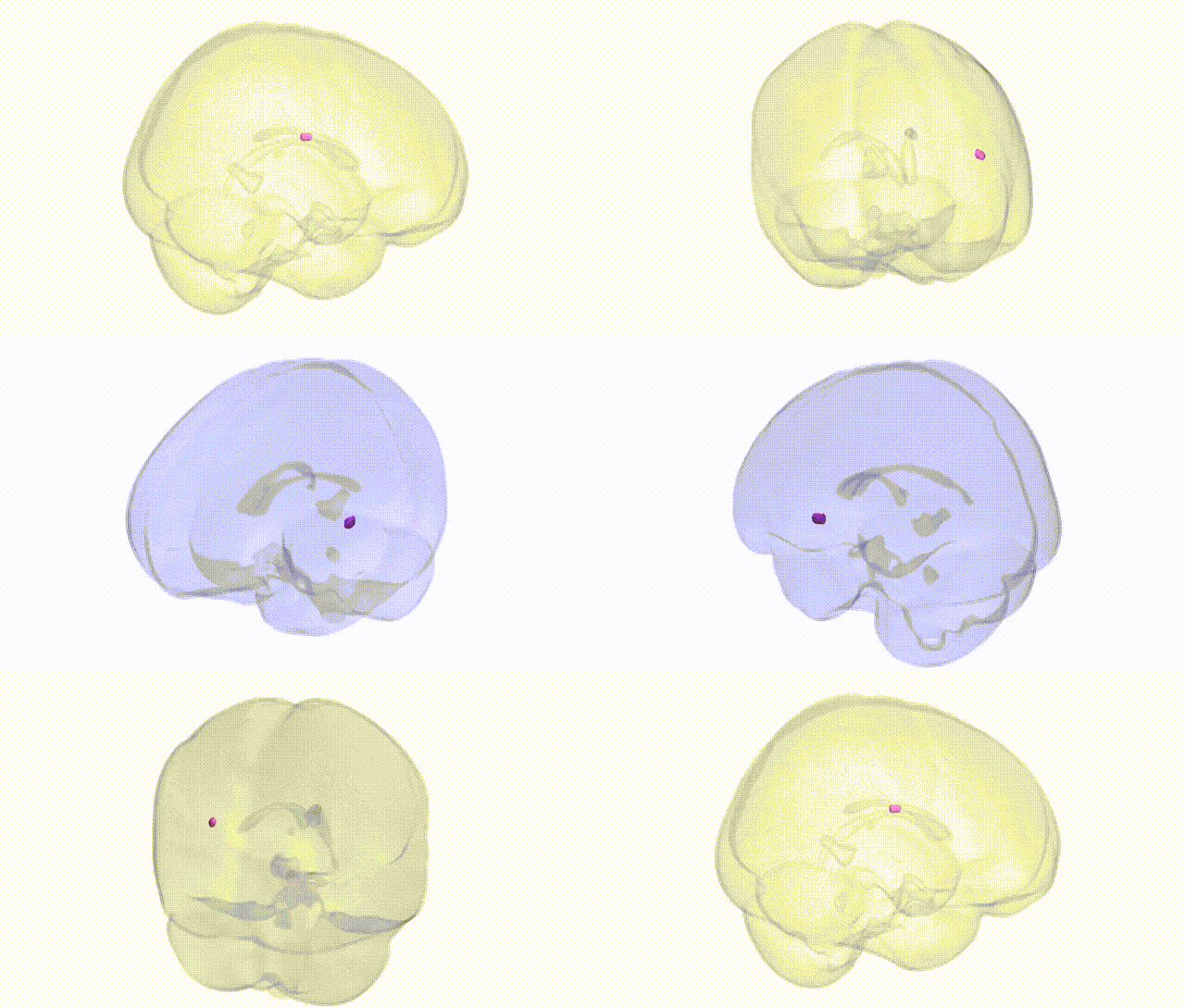
Full Quality Version: Download MP4
Wali Sidiqyar*, Gaurav Rudravaram*, Elyssa M. McMaster, Trent M. Schwartz, Adam M. Saunders, Kurt G. Schilling, Bennett A. Landman "Introducing SPINS: A Shared Public Visualization Library of Neuroanatomical Structures." Medical Imaging with Deep Learning- short paper
This resource is licensed under CC0 1.0 Universal (Public Domain).