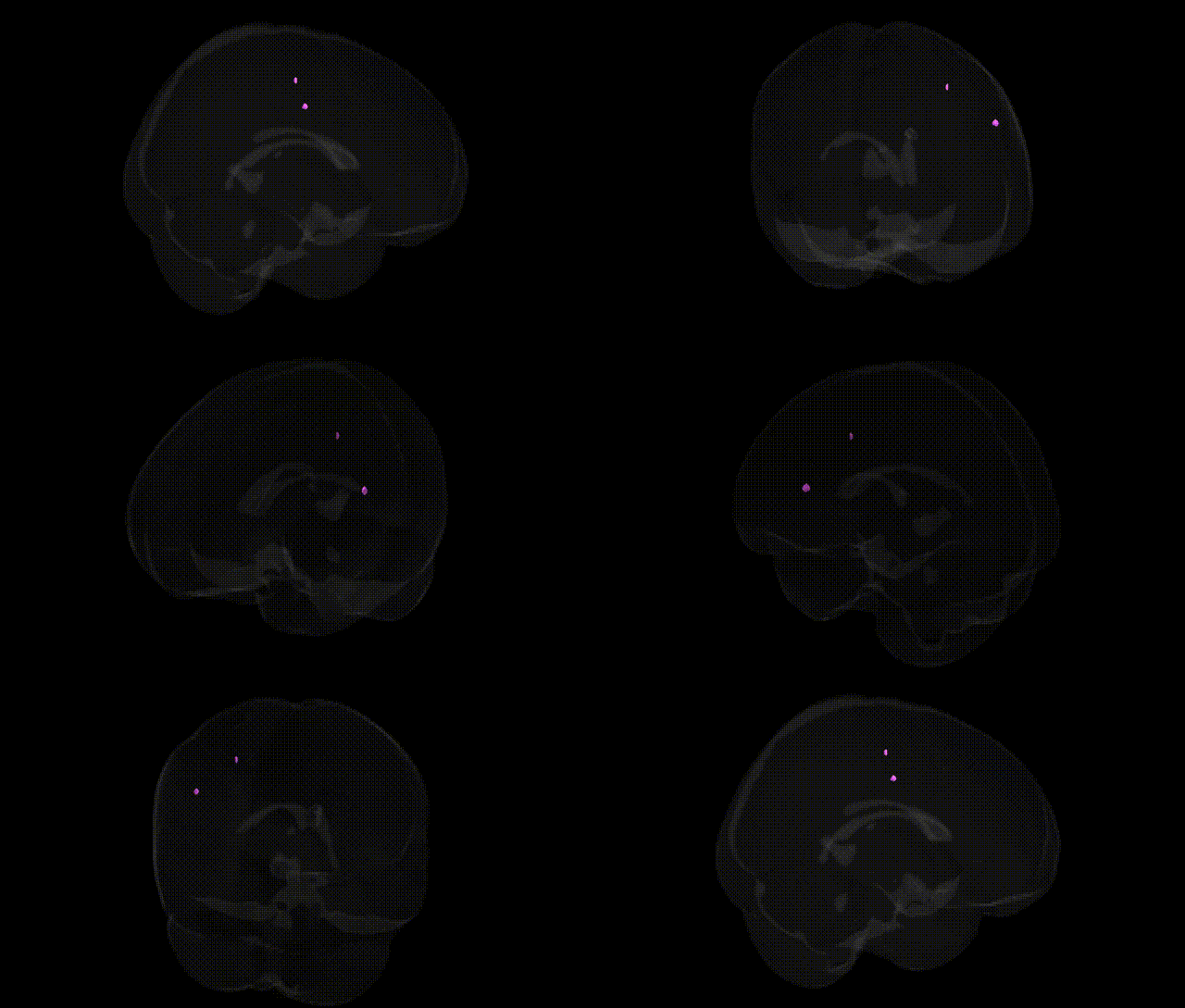
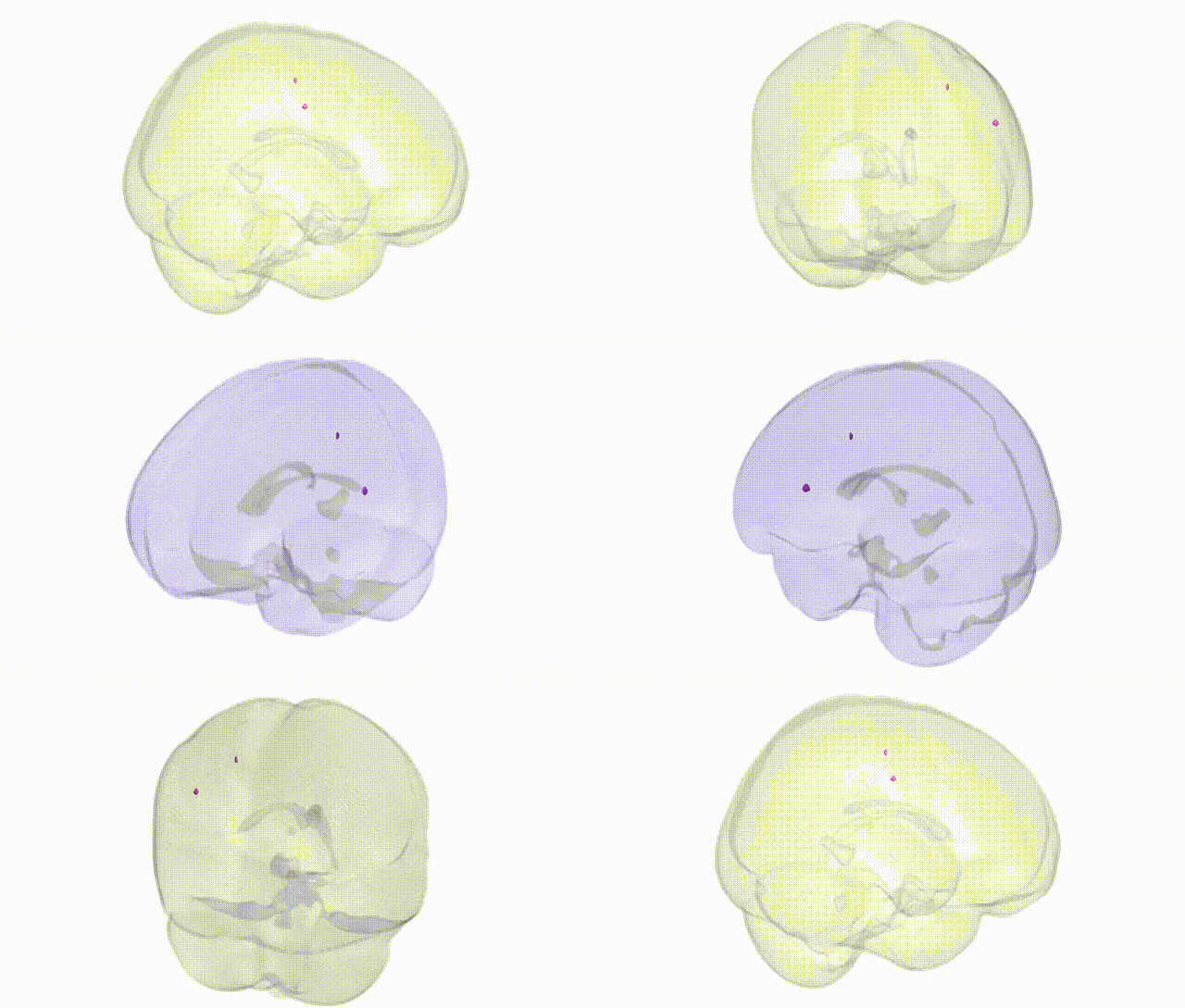
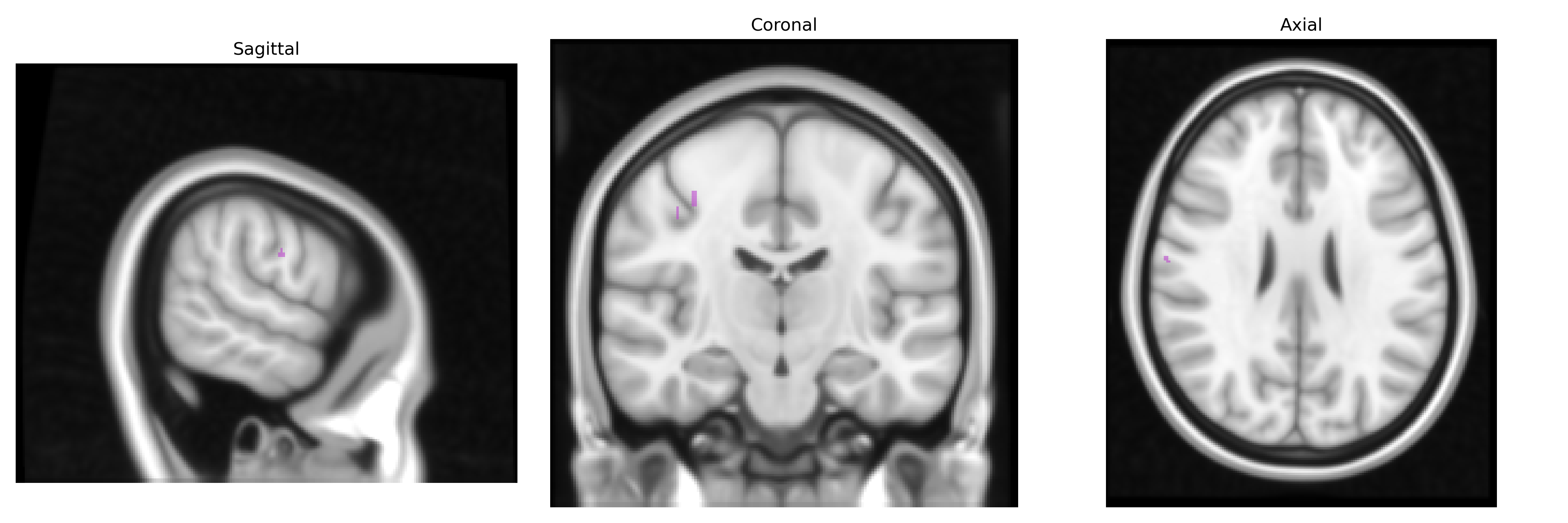
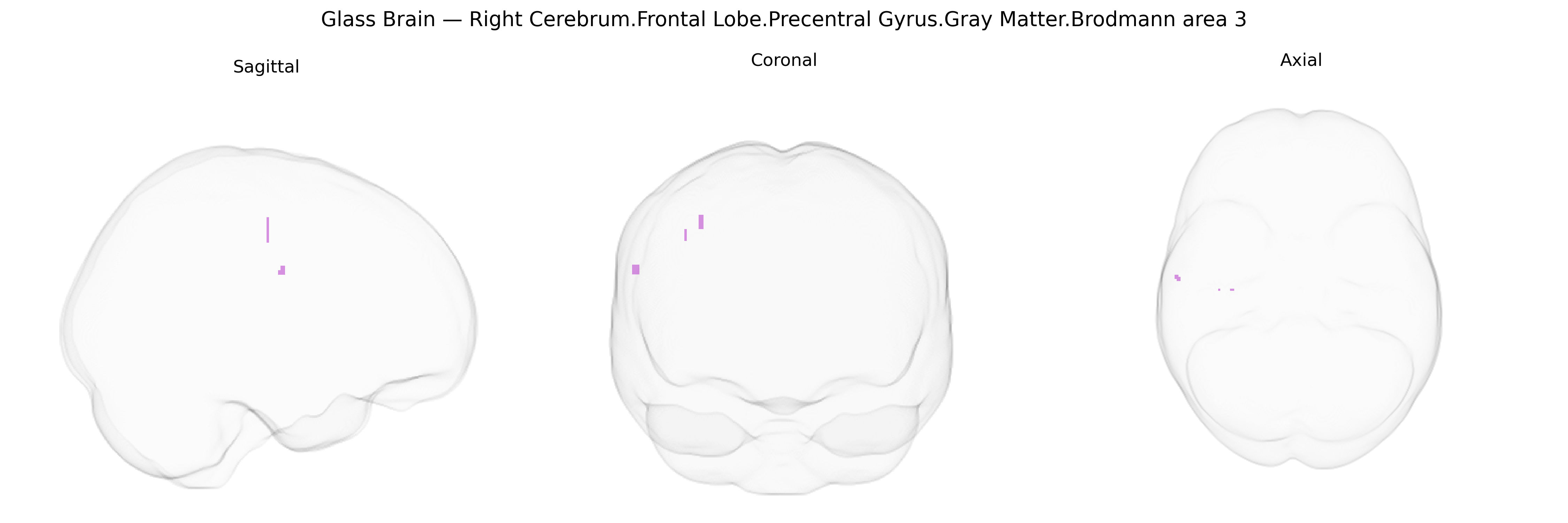
The bilateral Right Cerebrum.Frontal Lobe.Precentral Gyrus.Gray Matter.Brodmann area 3 corresponds primarily to the primary somatosensory cortex region localized near the central sulcus, though its labeling in the Talairach 1 mm atlas within the precentral gyrus reflects parcellation conventions rather than strict cytoarchitectonic boundaries. Brodmann area 3 is characterized by a granular isocortical architecture with a prominent layer IV receiving dense thalamocortical input from the ventral posterior nucleus, and is functionally specialized for high-resolution processing of cutaneous somatosensory information such as fine touch and proprioception from the contralateral body. Neurons in this region show precise somatotopic organization, contributing to the sensory homunculus, and provide critical input to adjacent somatosensory areas (BA1 and BA2) and sensorimotor integration circuits involved in motor control and feedback. There is no direct link for this exact composite label; a closely related structure is Primary somatosensory cortex.
Brodmann area 3 in the precentral gyrus—though functionally overlapping with primary somatosensory cortex often mapped to the postcentral gyrus—is frequently implicated in imaging–genetics and GWAS studies of cortical morphology, particularly for measures such as regional cortical thickness, surface area, and gray-matter volume. Large-scale ENIGMA and UK Biobank–based GWAS have identified numerous loci (e.g., variants near genes involved in neurodevelopment, synaptic regulation, and axon guidance such as MIR137, TBR1/2-related networks, and calcium channel genes) that show associations with structural variation in primary sensorimotor regions, including the precentral and adjacent postcentral gyri; these same loci often overlap with risk loci for schizophrenia, bipolar disorder, major depressive disorder, and autism spectrum disorder, suggesting shared genetic architectures between psychiatric risk and variation in sensorimotor cortex structure. Additional GWAS of motor and somatosensory traits—such as grip strength, motor coordination, and pain sensitivity—have reported enrichment of associated variants in regulatory regions active in primary sensorimotor cortex, although single-gene–to–BA3 mappings remain coarse. Imaging–genetics studies of focal dystonia, Tourette syndrome, and motor tics have reported disease-related structural or functional alterations in precentral/sensorimotor cortex that co-localize with common psychiatric risk variants, while epilepsy and migraine GWAS show polygenic enrichment in sensorimotor cortex–expressed genes. Overall, genetic associations related to the bilateral precentral Brodmann area 3 region are best characterized at the level of polygenic influences on cortical morphology and motor–somatosensory traits, with considerable overlap with neurodevelopmental and major psychiatric disorder risk loci rather than single, region-specific genes.
Overview generated by GPT-4o (2026).
Region ID: 940
Hemisphere: bilateral
Atlas: Talairach labels 1mm
Full Quality Version: Download MP4
Full Quality Version: Download MP4
Wali Sidiqyar*, Gaurav Rudravaram*, Elyssa M. McMaster, Trent M. Schwartz, Adam M. Saunders, Kurt G. Schilling, Bennett A. Landman "Introducing SPINS: A Shared Public Visualization Library of Neuroanatomical Structures." Medical Imaging with Deep Learning- short paper
This resource is licensed under CC0 1.0 Universal (Public Domain).