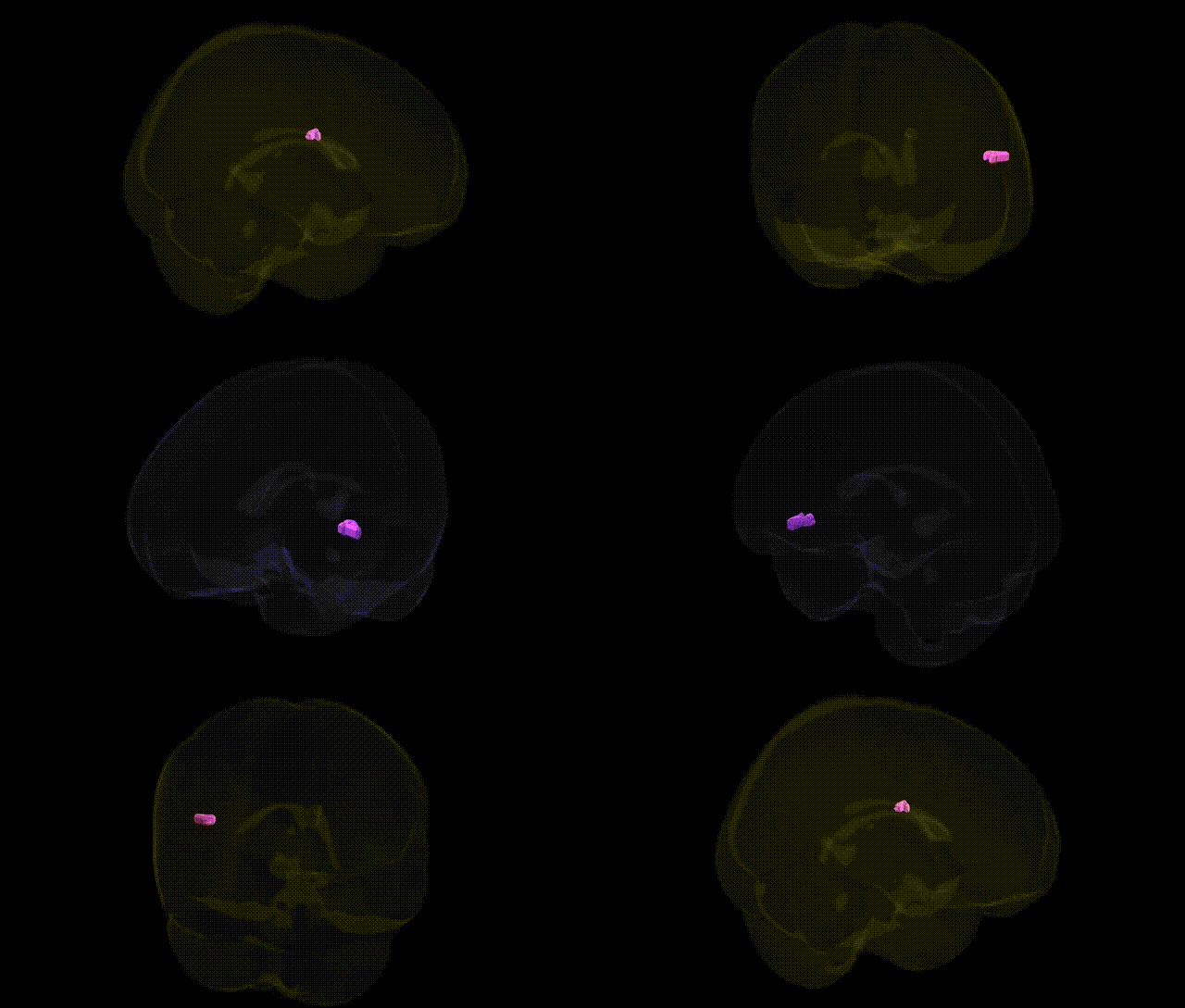
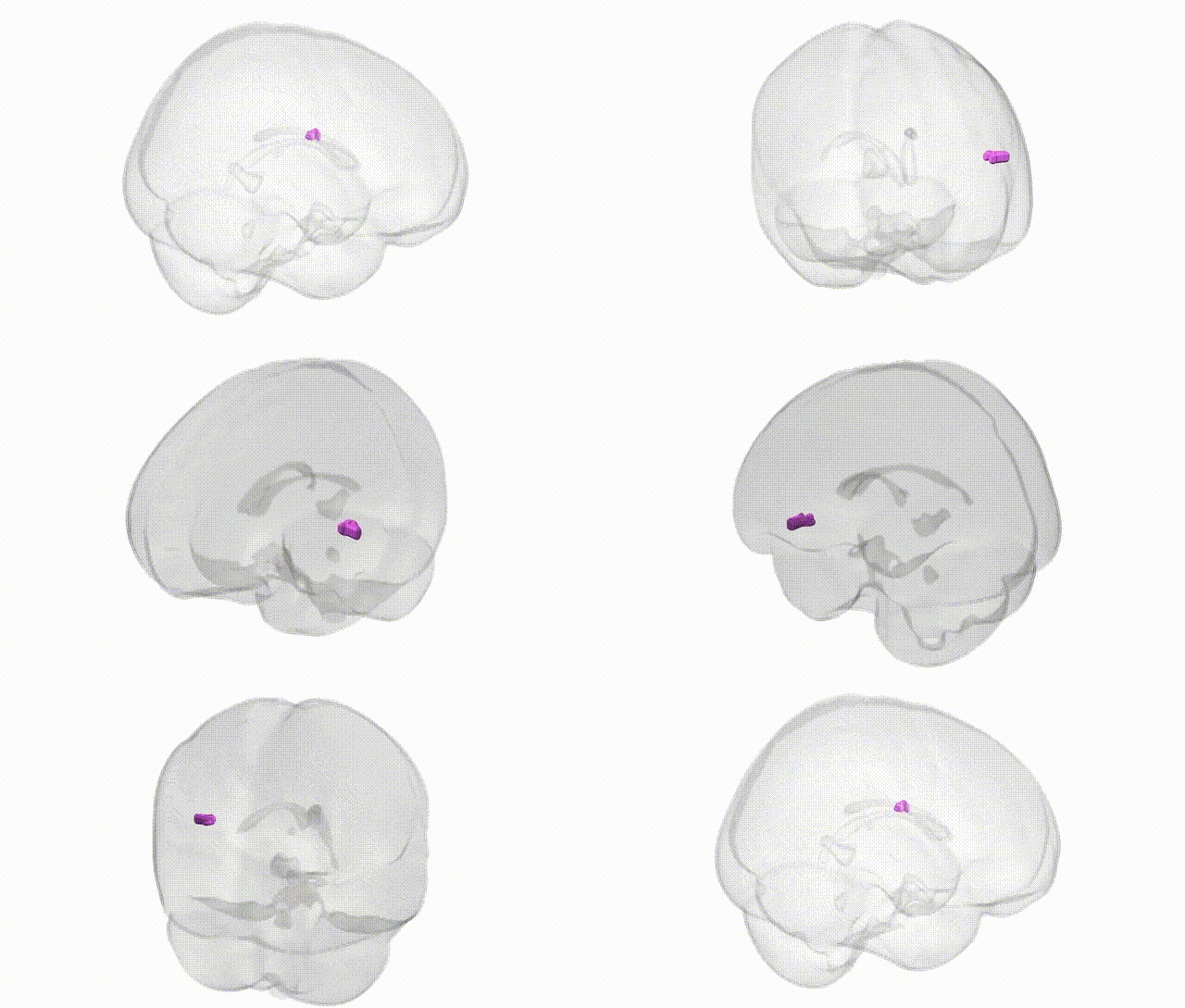
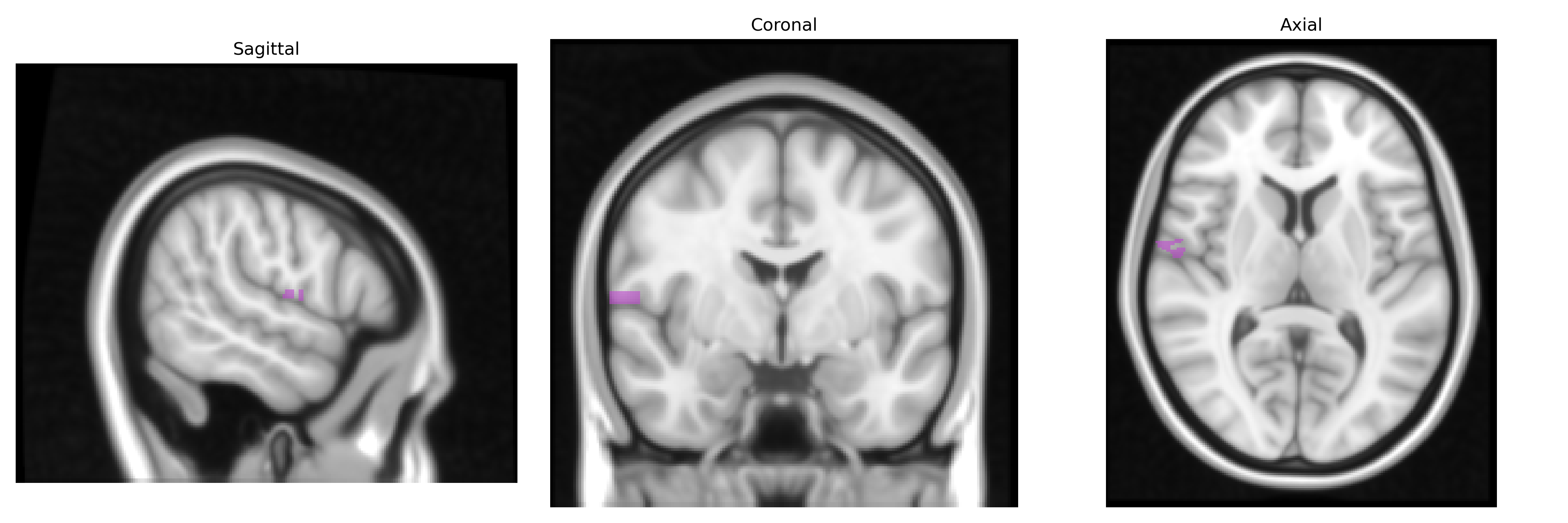
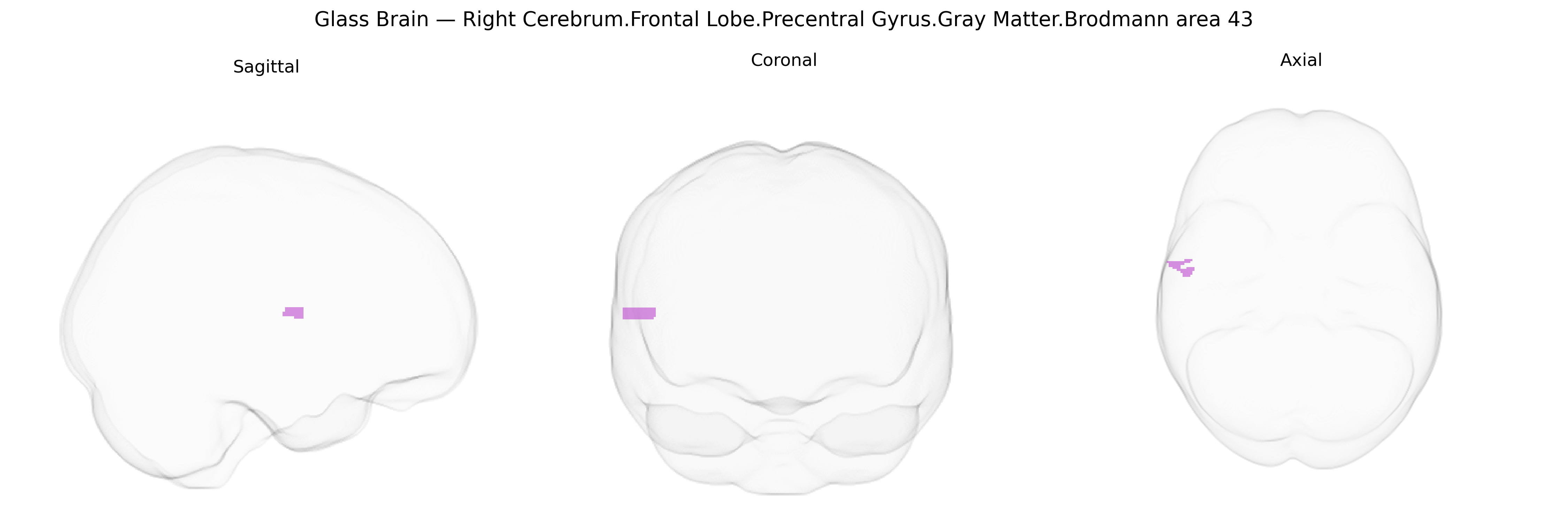
The bilateral Right Cerebrum.Frontal Lobe.Precentral Gyrus.Gray Matter.Brodmann area 43 corresponds primarily to the subcentral area situated at the junction of the frontal and parietal opercula, overlying portions of the insula and adjacent to the lateral fissure. Cytoarchitectonically, Brodmann area 43 is characterized by a granular cortical pattern and is often associated with gustatory and somatosensory processing of the oral and pharyngeal regions, including integration of tactile, proprioceptive, and possibly chemosensory input related to mastication, swallowing, and speech articulation. Functionally, this region participates in sensorimotor control of the face and mouth, interacting with adjacent primary motor and somatosensory cortices in the precentral and postcentral gyri. There is no direct link for Brodmann area 43; a related structure is the Insular cortex.
Genetic associations specifically targeting the bilateral Right Cerebrum.Frontal Lobe.Precentral Gyrus.Gray Matter.Brodmann area 43 (a region at the ventral precentral/postcentral border often linked to orofacial sensorimotor and gustatory functions) remain sparse, but broader imaging–genetics and GWAS work implicating adjacent precentral and inferior frontal regions provides indirect evidence. Large-scale brain-morphometry GWAS (e.g., ENIGMA, UK Biobank) have identified common variants in genes involved in neurodevelopment, axon guidance, and synaptic function—such as MIR137, HMGA2, and MAPT loci—associated with cortical thickness or surface area in frontal motor regions that encompass or border BA43. Polygenic risk for neuropsychiatric disorders (schizophrenia, bipolar disorder, major depression, autism) has been related to altered morphology and connectivity in ventral precentral and inferior frontal gyri, regions that partly overlap BA43, while motor-related traits (handedness, fine motor performance) show associations with variants near genes such as PCSK6 and LRRTM1 that modulate structural and functional asymmetries in motor cortices. In addition, genetic risk for disorders affecting orofacial and speech motor control (e.g., developmental stuttering, apraxia of speech) has been linked to variants in FOXP2 and associated networks that show altered activation in the ventral precentral/inferior frontal region, likely including BA43, indicating that this area may be a convergence zone for genetic influences on motor, speech, and sensory integration, even though BA43-specific GWAS signals have not yet been clearly isolated.
Overview generated by GPT-4o (2026).
Region ID: 740
Hemisphere: bilateral
Atlas: Talairach labels 1mm
Full Quality Version: Download MP4
Full Quality Version: Download MP4
Wali Sidiqyar*, Gaurav Rudravaram*, Elyssa M. McMaster, Trent M. Schwartz, Adam M. Saunders, Kurt G. Schilling, Bennett A. Landman "Introducing SPINS: A Shared Public Visualization Library of Neuroanatomical Structures." Medical Imaging with Deep Learning- short paper
This resource is licensed under CC0 1.0 Universal (Public Domain).