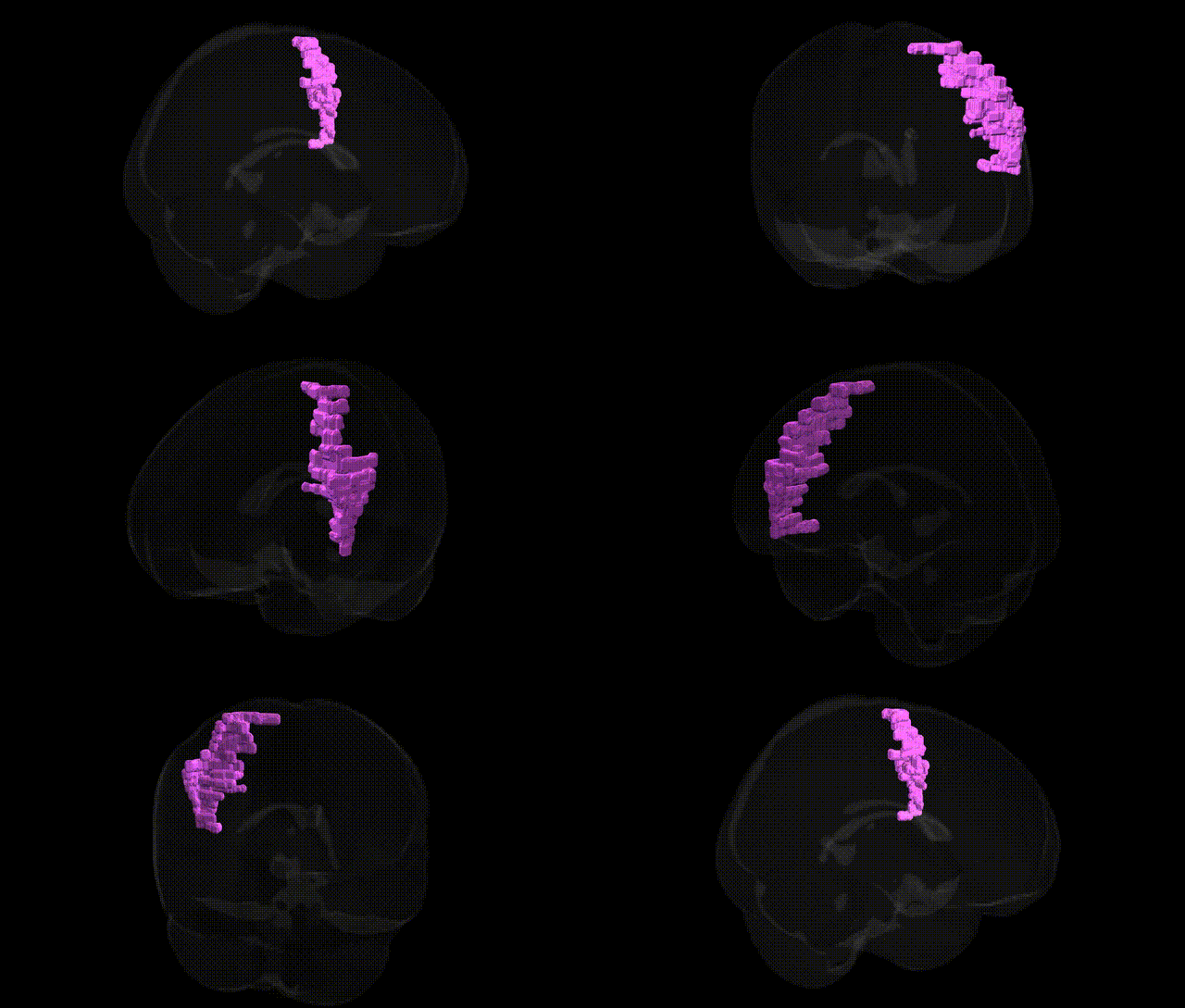
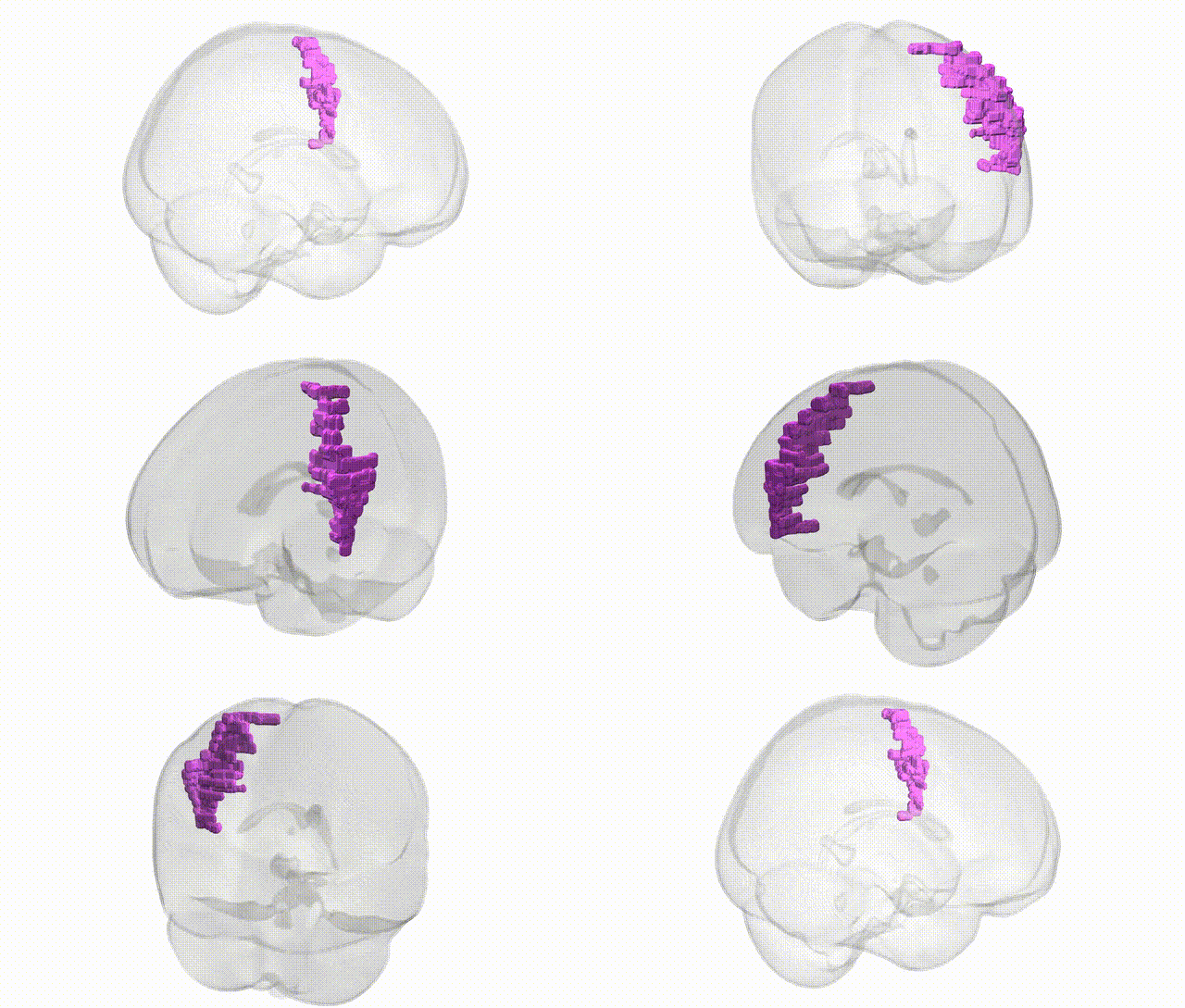
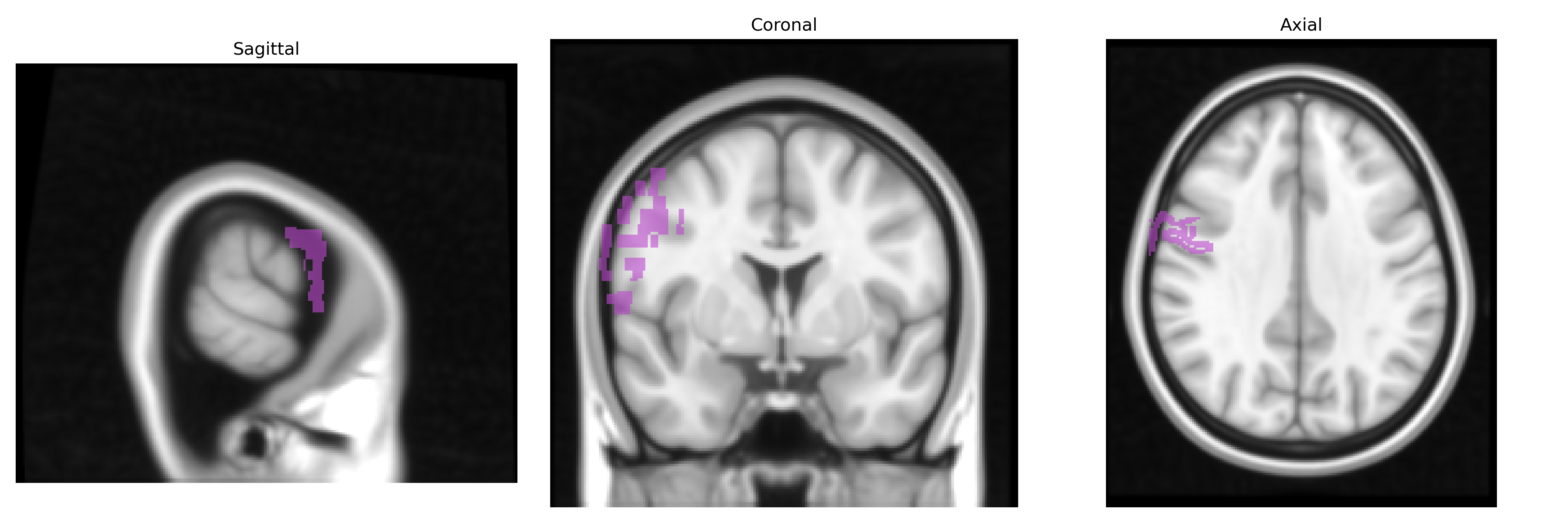
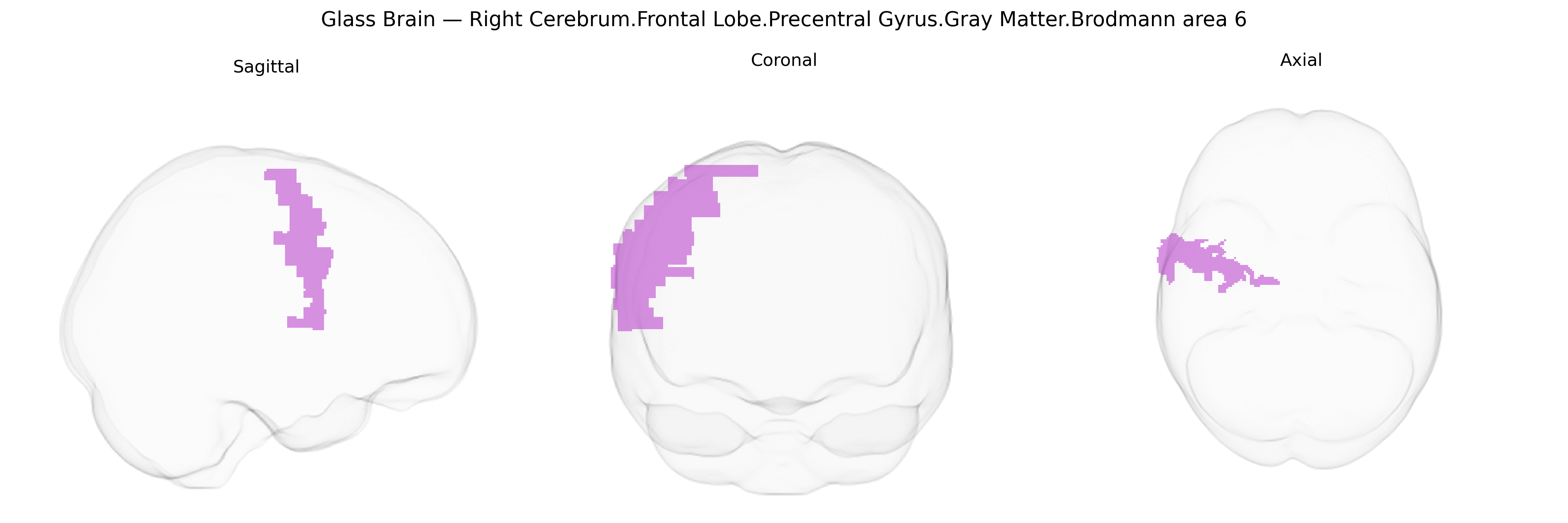
The bilateral Right Cerebrum.Frontal Lobe.Precentral Gyrus.Gray Matter.Brodmann area 6 corresponds primarily to the dorsal and lateral portions of the premotor cortex and supplementary motor-related fields anterior to the primary motor cortex in the frontal lobe. This agranular cortical region is involved in higher-order motor control, including planning, sequencing, and preparation of voluntary movements, integration of sensory cues for movement guidance, and coordination of complex, learned motor behaviors. Neurons in Brodmann area 6 play a key role in transforming intention into motor programs, contributing to posture, proximal limb control, and bimanual coordination, and are interconnected with primary motor cortex, parietal association cortices, basal ganglia, and cerebellar circuits. There is no direct Wikipedia article for this exact composite Talairach label; a closely related and encompassing structure is Brodmann area 6.
Brodmann area 6 in the right precentral gyrus (premotor/supplementary motor cortex) has been repeatedly implicated in imaging-genetics and GWAS-based neuroimaging studies, which link common variants to regional gray matter volume, cortical thickness, and activation patterns during motor planning and response inhibition. Large-scale ENIGMA and UK Biobank analyses have identified associations between this region’s structural measures and variants in genes involved in neurodevelopment and synaptic function (for example, MAPT, CNTNAP2, and several loci near calcium-channel and glutamatergic genes), although most effects are small and distributed. Functionally, genetic variation influencing dopaminergic and glutamatergic systems (such as DRD2 and GRIN2B) has been related to altered BA6 activation during motor sequencing and cognitive control tasks. Clinically, polygenic risk for schizophrenia, autism spectrum disorder, and attention-deficit/hyperactivity disorder shows correlations with premotor/supplementary motor cortical morphology or connectivity, and rare or high-impact variants (including some copy number variants and mutations in FOXP1/FOXP2-related pathways) have been associated with motor planning deficits and altered activity in BA6. In neurodegenerative and movement disorders, genetic risk factors for Parkinson’s disease (for example, LRRK2, SNCA) and atypical parkinsonian syndromes, as well as for frontotemporal lobar degeneration and ALS, have been linked to structural and functional changes in premotor areas including BA6, where gray matter alterations often co-occur with disease-related genetic burdens.
Overview generated by GPT-4o (2026).
Region ID: 683
Hemisphere: bilateral
Atlas: Talairach labels 1mm
Full Quality Version: Download MP4
Full Quality Version: Download MP4
Wali Sidiqyar*, Gaurav Rudravaram*, Elyssa M. McMaster, Trent M. Schwartz, Adam M. Saunders, Kurt G. Schilling, Bennett A. Landman "Introducing SPINS: A Shared Public Visualization Library of Neuroanatomical Structures." Medical Imaging with Deep Learning- short paper
This resource is licensed under CC0 1.0 Universal (Public Domain).