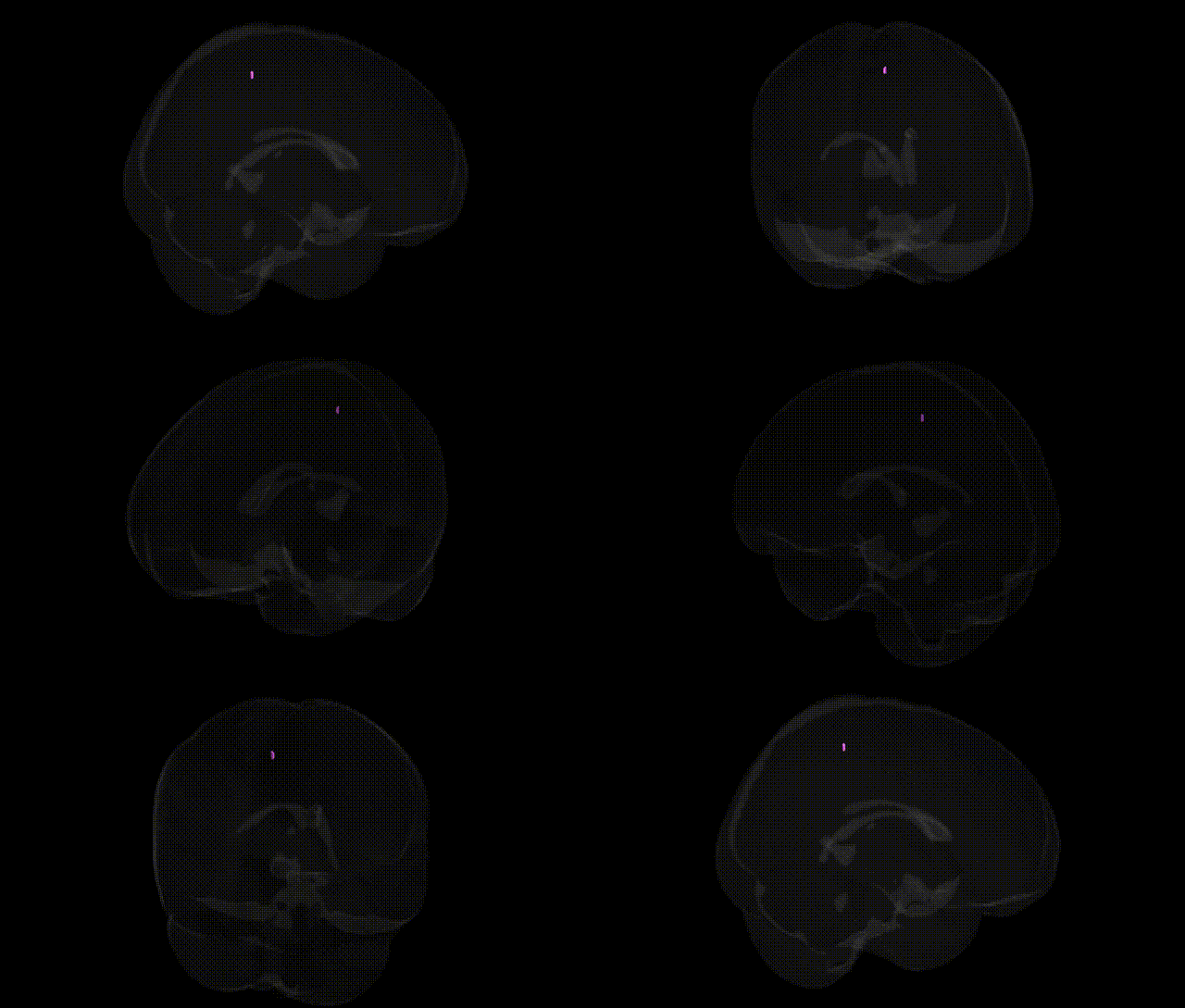
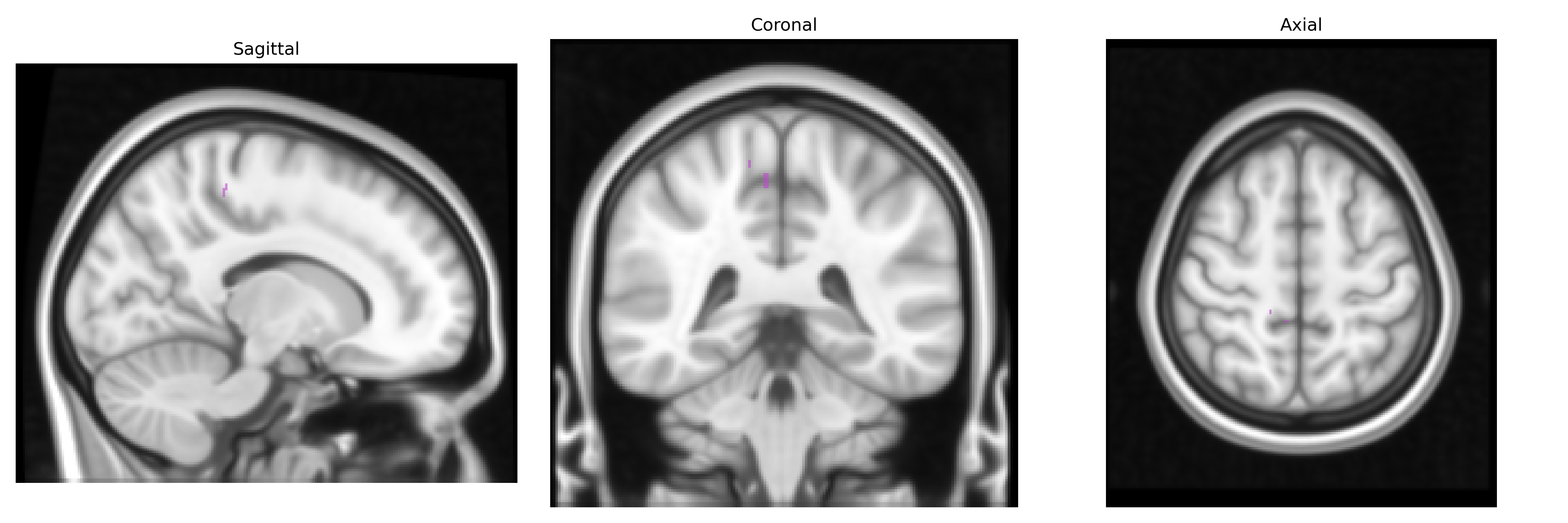
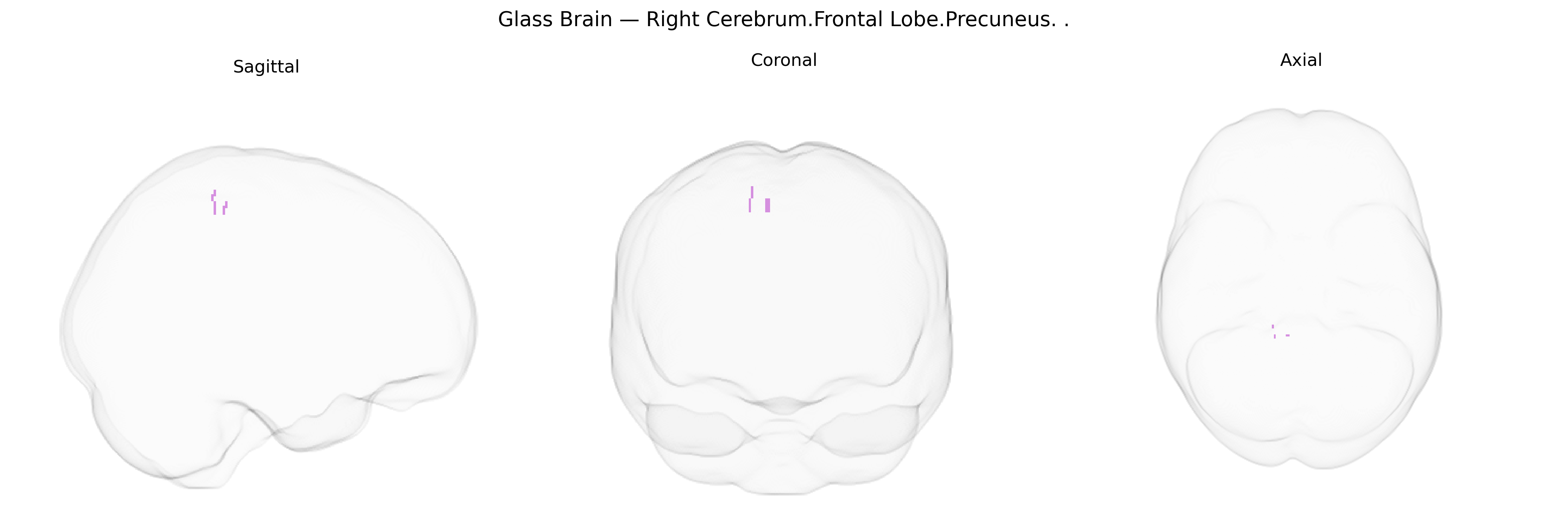
The bilateral Right Cerebrum.Frontal Lobe.Precuneus, as labeled in the Talairach 1 mm atlas, refers to a medial parietal cortex region (the precuneus) whose Talairach labeling can extend into or border the medial frontal lobe, reflecting atlas-based rather than strict cytoarchitectonic boundaries. The precuneus is a key hub in the default mode network, implicated in self-referential processing, visuospatial imagery, episodic memory retrieval, and aspects of consciousness and awareness. It maintains extensive connectivity with frontal association areas, posterior cingulate cortex, inferior parietal lobule, and subcortical structures, supporting integration of internal mentation, attention shifting, and integration of sensory with mnemonic information. There is no direct Wikipedia article for “Right Cerebrum.Frontal Lobe.Precuneus”; a related and broader structure is the Precuneus.
Genetic associations involving the bilateral Right Cerebrum.Frontal Lobe.Precuneus region (as defined in the Talairach 1 mm atlas, though “precuneus” is classically parietal, not frontal) largely derive from imaging genetics studies and GWAS of brain morphology and function rather than direct region-specific gene mapping. Large-scale GWAS of cortical thickness, surface area, and gyrification (e.g., ENIGMA and UK Biobank consortia) have identified variants in genes such as HMGA2, TESC, KIAA0586, and others that influence global and regional cortical measures, including medial parietal and frontal areas that encompass or neighbor the precuneus, with downstream links to general cognitive ability, educational attainment, and brain volume. Functional imaging genetics has implicated APOE variants (especially ε4) and CLU, CR1, and BIN1 in altered precuneus and adjacent medial frontal activation and connectivity in Alzheimer’s disease and preclinical risk states, reflecting this region’s role in the default mode network and early amyloid-related dysfunction. Polygenic risk for schizophrenia, major depressive disorder, autism spectrum disorder, and ADHD has been associated with structural and functional alterations in medial fronto-parietal/default mode network regions including the precuneus, suggesting that common risk alleles exert effects on large-scale networks rather than single loci. Additionally, GWAS of traits such as mind-wandering, introspective cognition, and sleep patterns show overlaps with genes that modulate default mode network activity, indirectly implicating genetic modulation of precuneus-medial frontal circuitry, although specific, uniquely “precuneus” genes have not been clearly delineated, and many findings reflect shared genetic influences on distributed cortical systems.
Overview generated by GPT-4o (2026).
Region ID: 1069
Hemisphere: bilateral
Atlas: Talairach labels 1mm
Full Quality Version: Download MP4
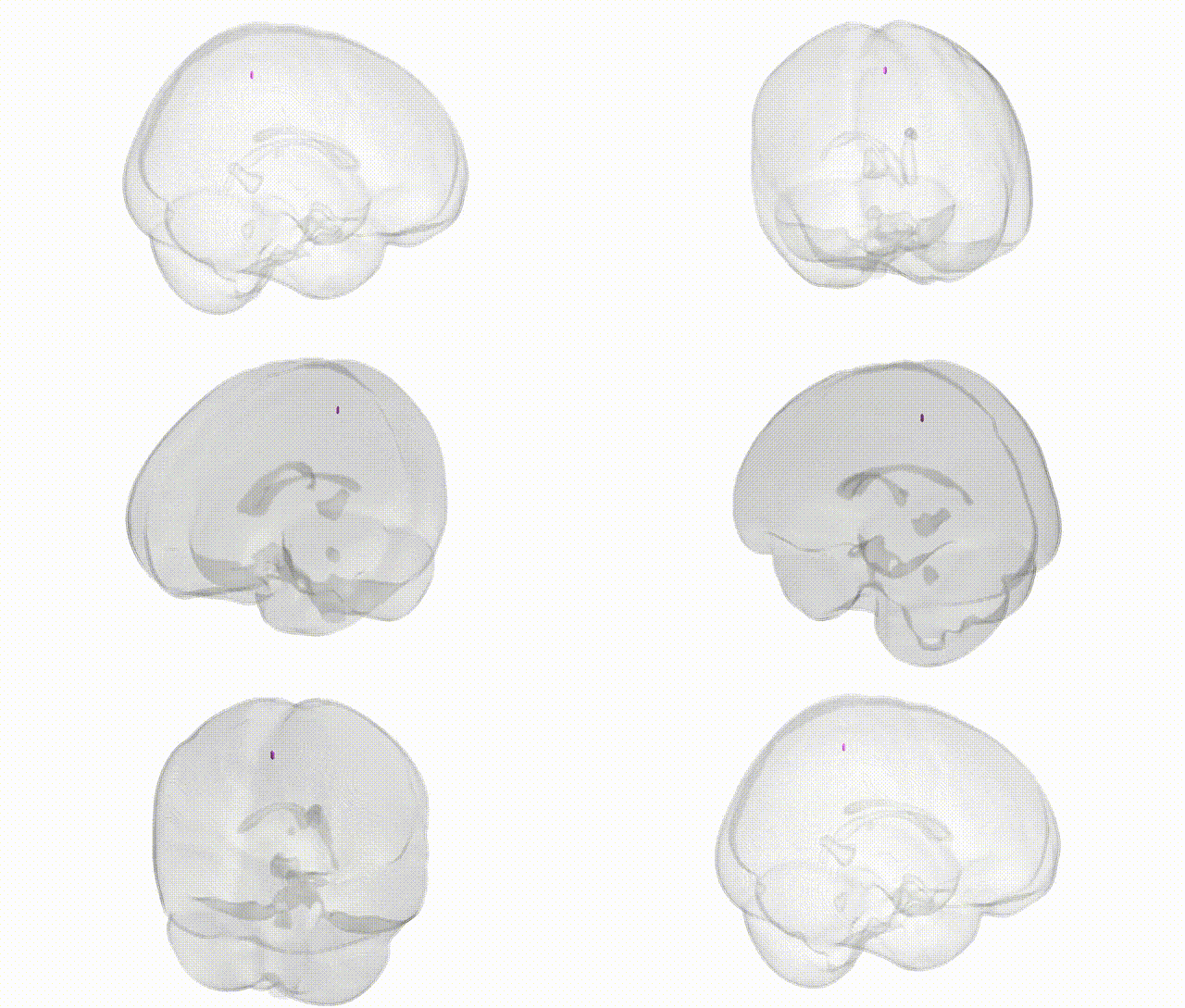
Full Quality Version: Download MP4
Wali Sidiqyar*, Gaurav Rudravaram*, Elyssa M. McMaster, Trent M. Schwartz, Adam M. Saunders, Kurt G. Schilling, Bennett A. Landman "Introducing SPINS: A Shared Public Visualization Library of Neuroanatomical Structures." Medical Imaging with Deep Learning- short paper
This resource is licensed under CC0 1.0 Universal (Public Domain).