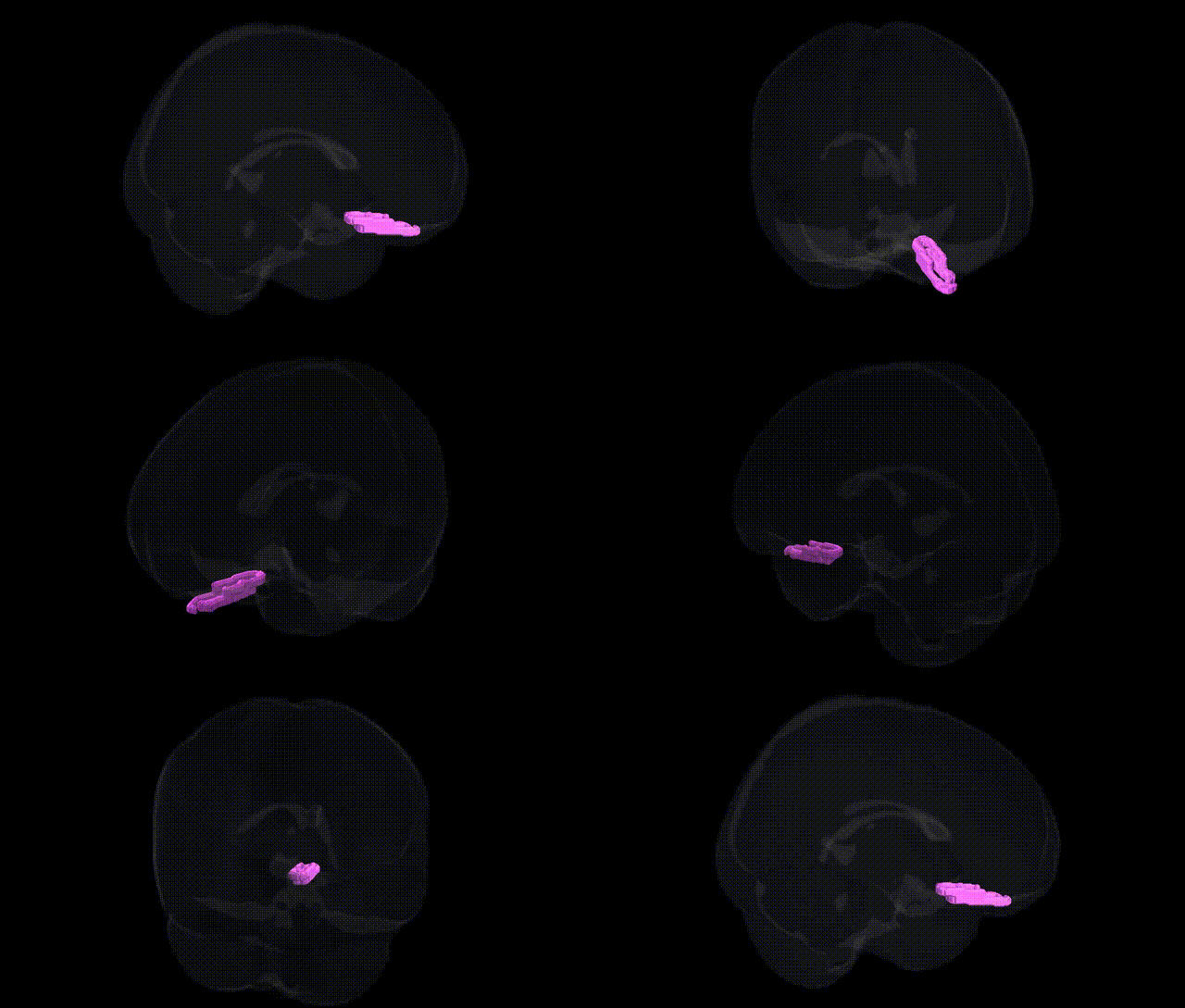
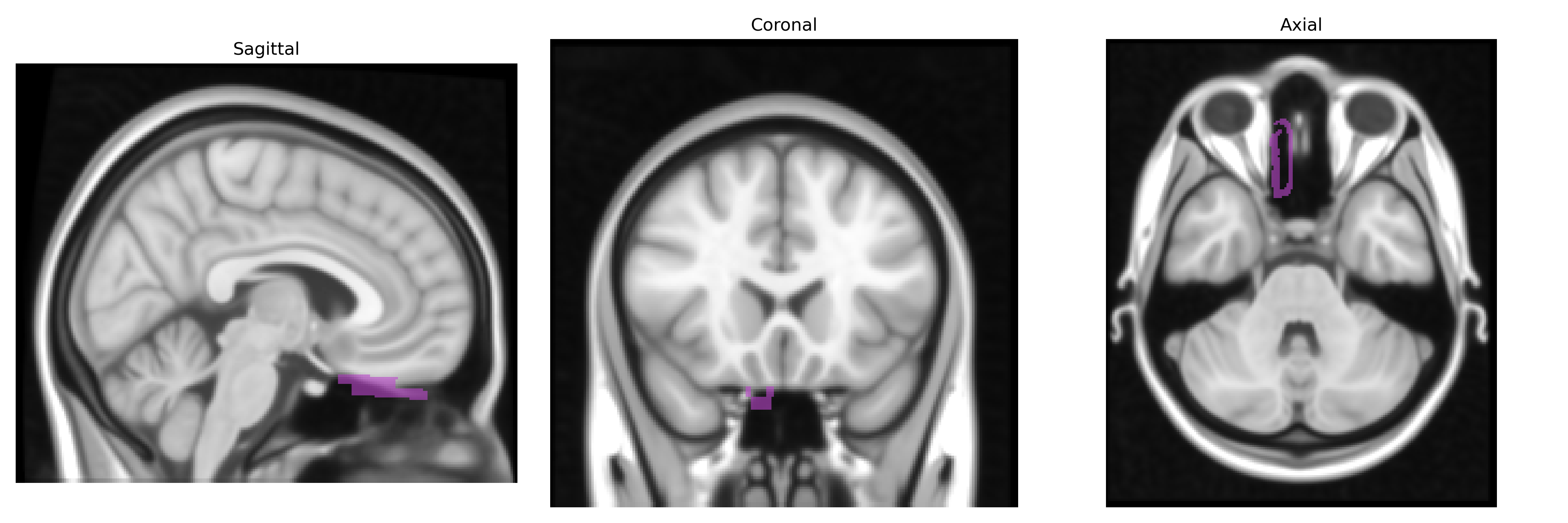
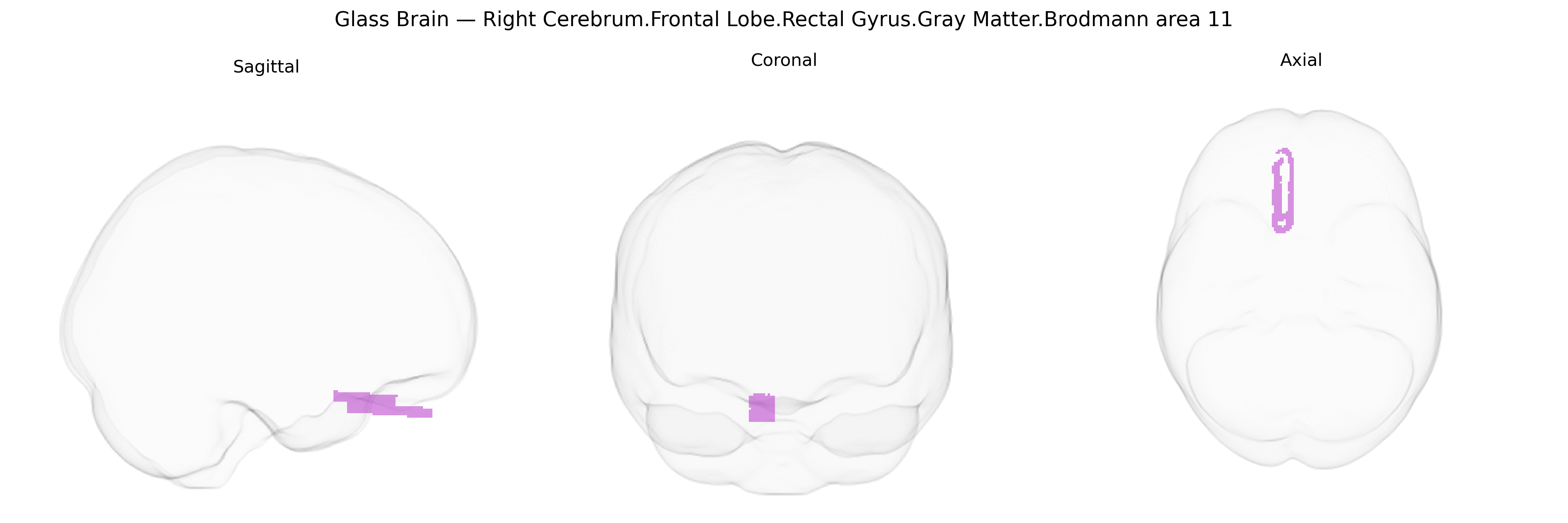
The bilateral Right Cerebrum.Frontal Lobe.Rectal Gyrus.Gray Matter.Brodmann area 11, as defined in the Talairach 1 mm atlas, refers to gray matter within Brodmann area 11 located in the rectal (gyrus rectus) portion of the orbitofrontal cortex along the medial aspect of the frontal lobe, adjacent to the olfactory sulcus and lying superior to the orbital surface of the frontal bone. This region is part of the prefrontal cortex and is implicated in higher-order functions such as reward evaluation, decision-making, emotional regulation, and integration of sensory and visceral information, often in connection with limbic and autonomic systems. In neuroimaging and lesion studies, activity and integrity within BA11 and neighboring orbitofrontal areas have been associated with adaptive behavioral responses, social cognition, and modulation of affective states. There is no direct Wikipedia article for this exact Talairach label; a closely related structure is Brodmann area 11.
The bilateral right rectal gyrus (gyrus rectus) of the frontal lobe, corresponding largely to Brodmann area 11 in the orbitofrontal cortex, has been implicated in multiple genetic and GWAS-based associations, primarily via imaging genetics and psychiatric genomics. Variants in genes influencing neurodevelopment, synaptic function, and fronto-limbic circuitry (for example, CACNA1C, DISC1, and BDNF in candidate-gene and small imaging-genetics studies) have been linked to structural and functional differences in orbitofrontal/BA11 regions, including altered gray matter volume, cortical thickness, and activation during reward, emotion, and decision-making tasks. Large-scale neuroimaging GWAS consortia (e.g., ENIGMA, UK Biobank) have reported polygenic influences on frontal orbital cortical morphology, with significant SNP heritability and associations near loci related to neuronal development, axon guidance, and myelination, though specific rectal gyrus–restricted findings are often aggregated within broader medial/orbitofrontal parcels rather than this Talairach-defined label alone. Genetic risk for major depressive disorder, bipolar disorder, schizophrenia, obsessive–compulsive disorder, and substance use disorders has been associated with orbitofrontal/BA11 alterations, suggesting that polygenic risk scores for these conditions partly act through fronto-orbital circuitry; similarly, GWAS of personality traits (e.g., neuroticism) and cognitive/affective measures have linked risk alleles to structural and functional variation in adjacent medial/orbitofrontal regions encompassing BA11. Overall, current evidence supports a genetically influenced role of the gyrus rectus/BA11 region in reward valuation, mood regulation, and decision-making, but explicit GWAS signals resolved at the level of the Talairach “Right Cerebrum.Frontal Lobe.Rectal Gyrus.Gray Matter.Brodmann area 11” label remain indirect, inferred largely from broader orbitofrontal or medial prefrontal genetic associations.
Overview generated by GPT-4o (2026).
Region ID: 145
Hemisphere: bilateral
Atlas: Talairach labels 1mm
Full Quality Version: Download MP4
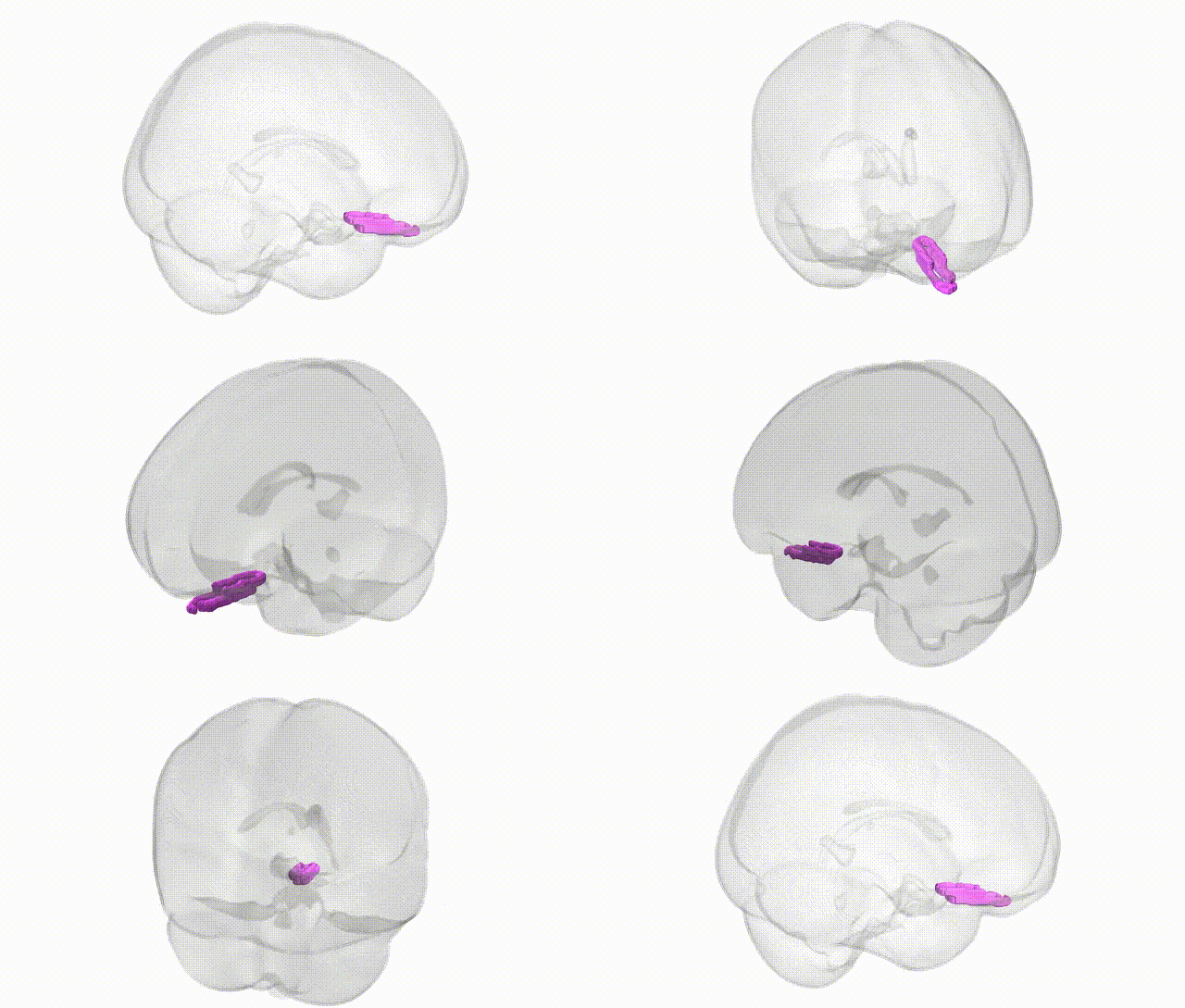
Full Quality Version: Download MP4
Wali Sidiqyar*, Gaurav Rudravaram*, Elyssa M. McMaster, Trent M. Schwartz, Adam M. Saunders, Kurt G. Schilling, Bennett A. Landman "Introducing SPINS: A Shared Public Visualization Library of Neuroanatomical Structures." Medical Imaging with Deep Learning- short paper
This resource is licensed under CC0 1.0 Universal (Public Domain).