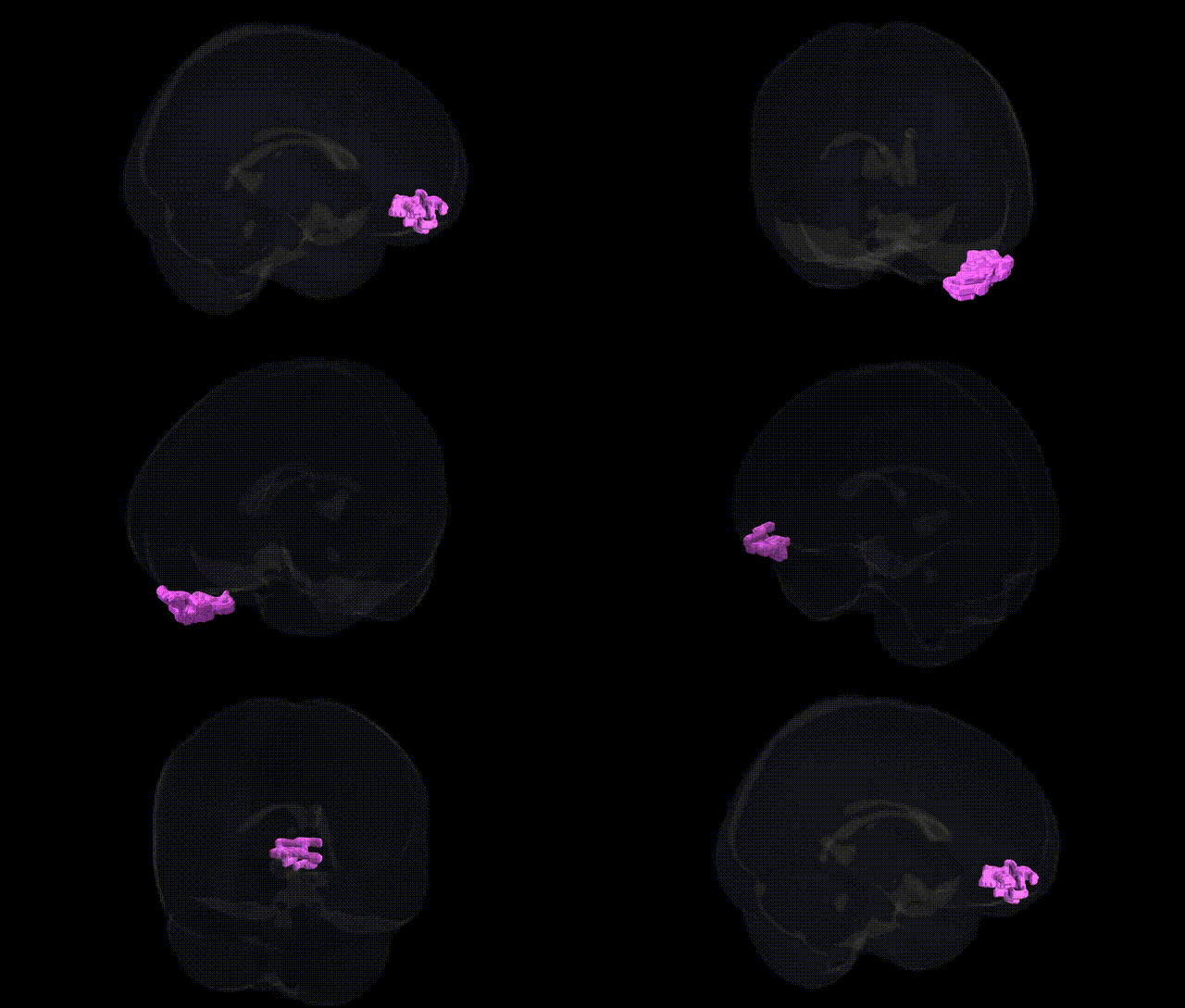
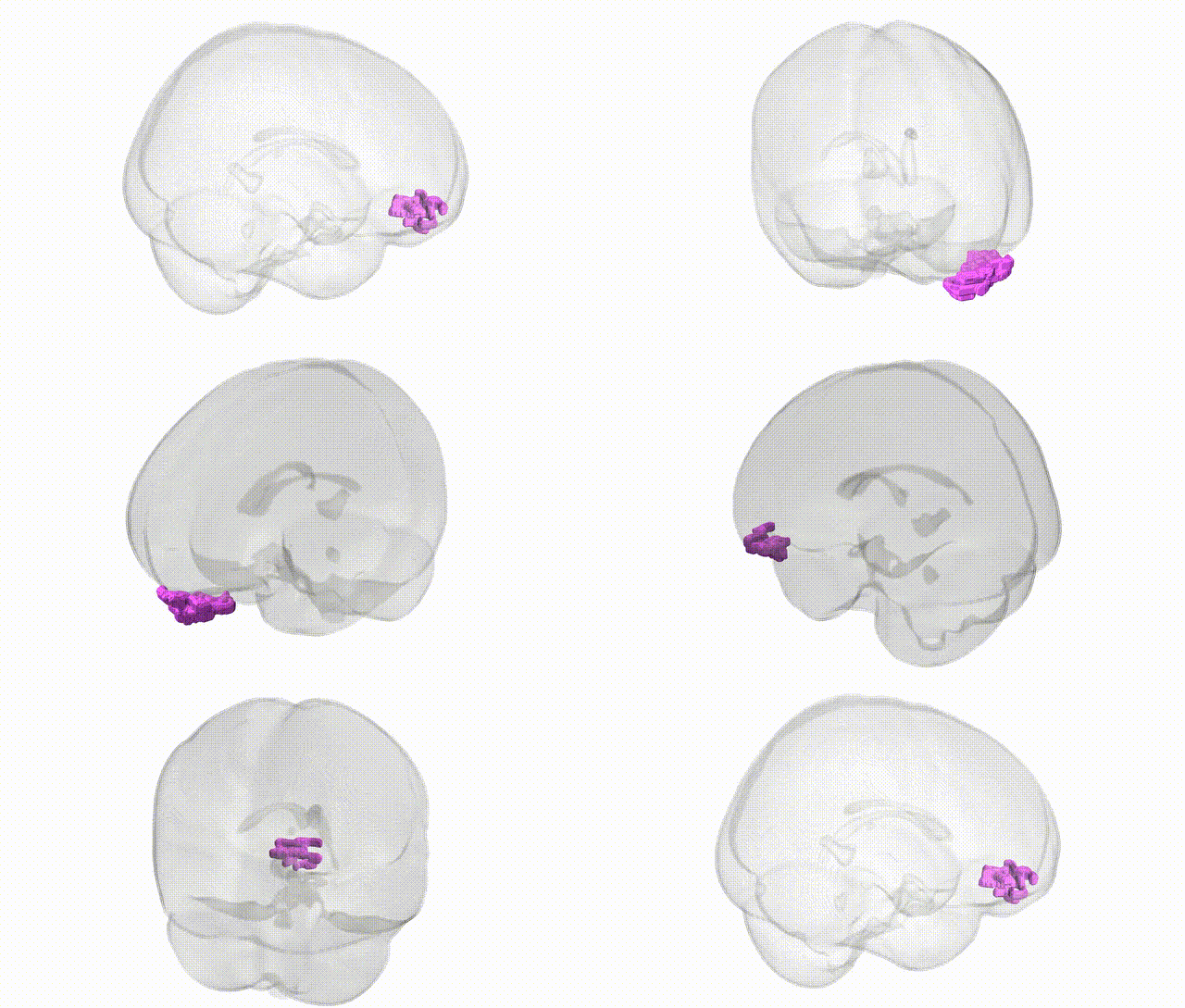
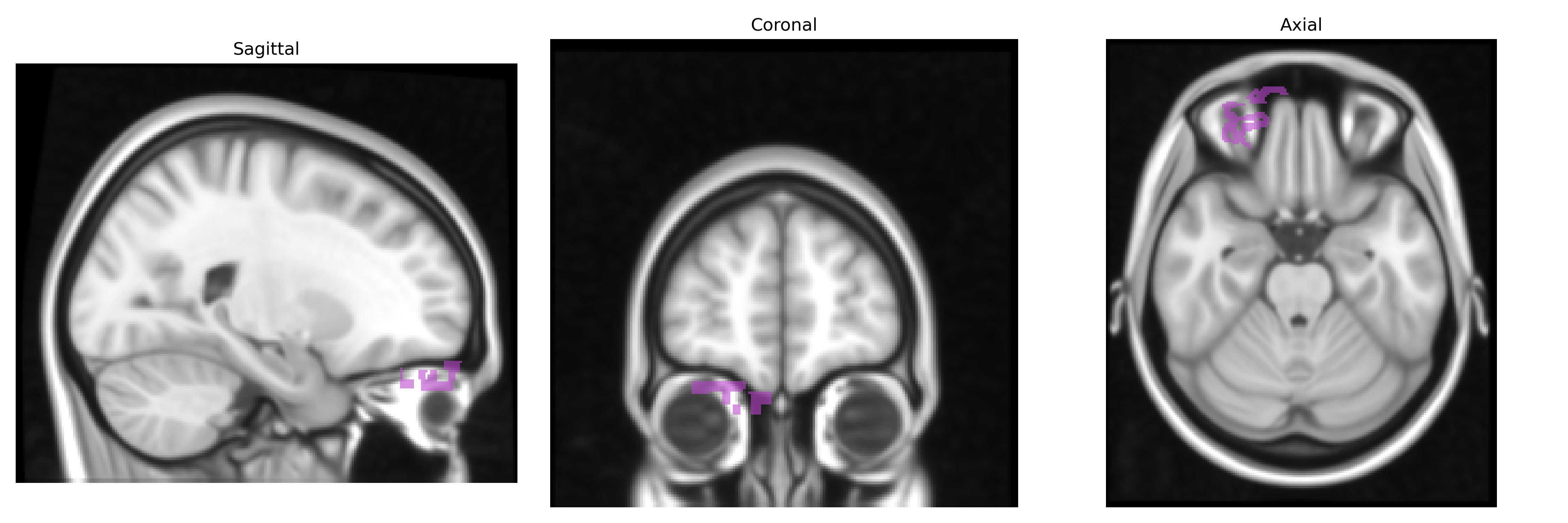
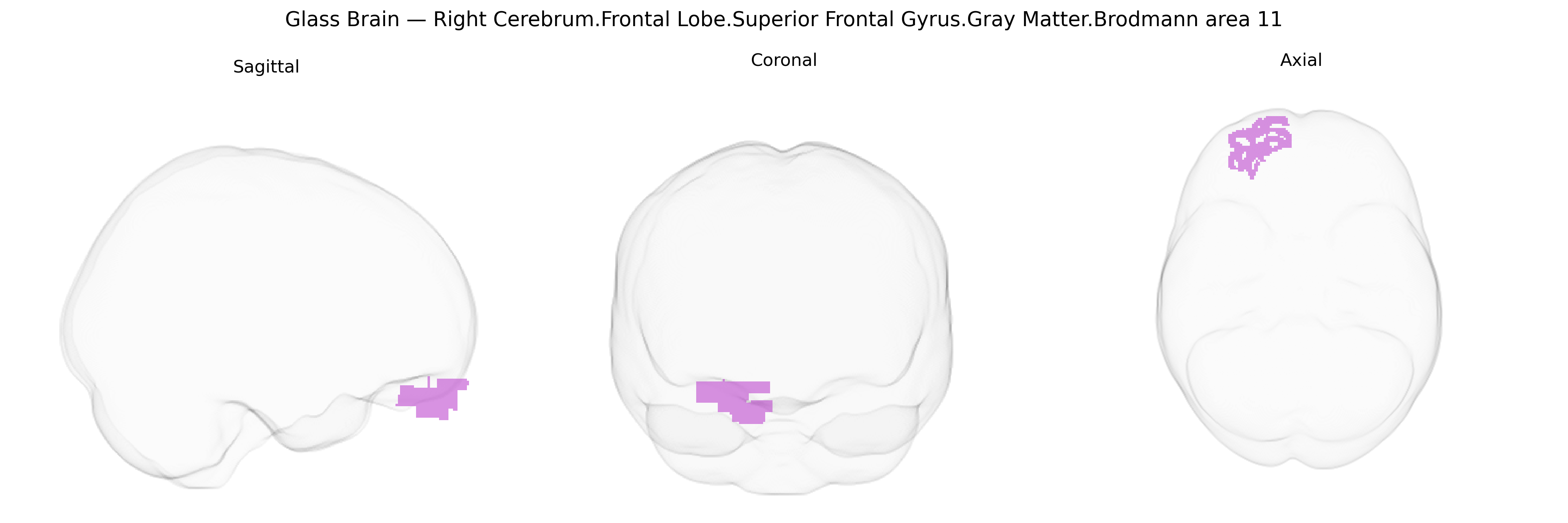
The bilateral Right Cerebrum.Frontal Lobe.Superior Frontal Gyrus.Gray Matter.Brodmann area 11 corresponds to the orbital portion of the prefrontal cortex located on the ventral (orbital) surface of the frontal lobe within the superior frontal gyrus region as defined in the Talairach 1 mm atlas. Brodmann area 11 forms part of the orbitofrontal cortex, a prefrontal territory heavily interconnected with limbic, sensory, and autonomic structures, including the amygdala, hypothalamus, and sensory association cortices. It is implicated in reward-based decision making, evaluation of stimulus value, emotional regulation, and the integration of affective and sensory information to guide goal-directed behavior and social conduct. Damage or dysfunction in this region has been associated with altered judgment, impaired reversal learning and adaptive decision-making, and changes in personality and affect. There is no direct link for this exact Talairach label; a closely related structure is Orbitofrontal cortex.
The bilateral right superior frontal gyrus gray matter in Brodmann area 11 (orbitofrontal/ventromedial prefrontal cortex) has been repeatedly implicated in genetic studies of brain structure, cognition, and psychiatric risk, although findings are typically reported at the level of broader orbitofrontal or dorsomedial prefrontal regions rather than this exact Talairach label. Large-scale imaging–genetics GWAS (e.g., ENIGMA, UK Biobank) have identified common variants in genes related to neurodevelopment (such as DRD2, GRM3, NRGN, and MAPT loci, among others) associated with cortical thickness, surface area, or gray matter volume in medial and orbitofrontal prefrontal regions encompassing BA11. Polygenic risk scores for schizophrenia, bipolar disorder, major depressive disorder, and ADHD are associated with structural and functional differences in medial/orbitofrontal prefrontal cortex, including superior frontal areas, and some risk loci (e.g., in CACNA1C, ZNF804A, and other synaptic and calcium-channel genes) show convergent effects on both disorder liability and prefrontal morphology or activation. GWAS of personality, cognitive function, and risk-taking/impulsivity have also noted associations between variants in dopaminergic, glutamatergic, and synaptic plasticity genes and structural or functional measures in BA10/11 regions involved in valuation and decision making. Overall, the genetic architecture of this region appears highly polygenic and overlapping with that of major psychiatric and cognitive traits, with no single locus uniquely or exclusively tied to the Talairach-defined bilateral right superior frontal gyrus BA11, but with consistent enrichment of neurodevelopmental and synaptic genes influencing its gray matter properties and related behavioral phenotypes.
Overview generated by GPT-4o (2026).
Region ID: 153
Hemisphere: bilateral
Atlas: Talairach labels 1mm
Full Quality Version: Download MP4
Full Quality Version: Download MP4
Wali Sidiqyar*, Gaurav Rudravaram*, Elyssa M. McMaster, Trent M. Schwartz, Adam M. Saunders, Kurt G. Schilling, Bennett A. Landman "Introducing SPINS: A Shared Public Visualization Library of Neuroanatomical Structures." Medical Imaging with Deep Learning- short paper
This resource is licensed under CC0 1.0 Universal (Public Domain).