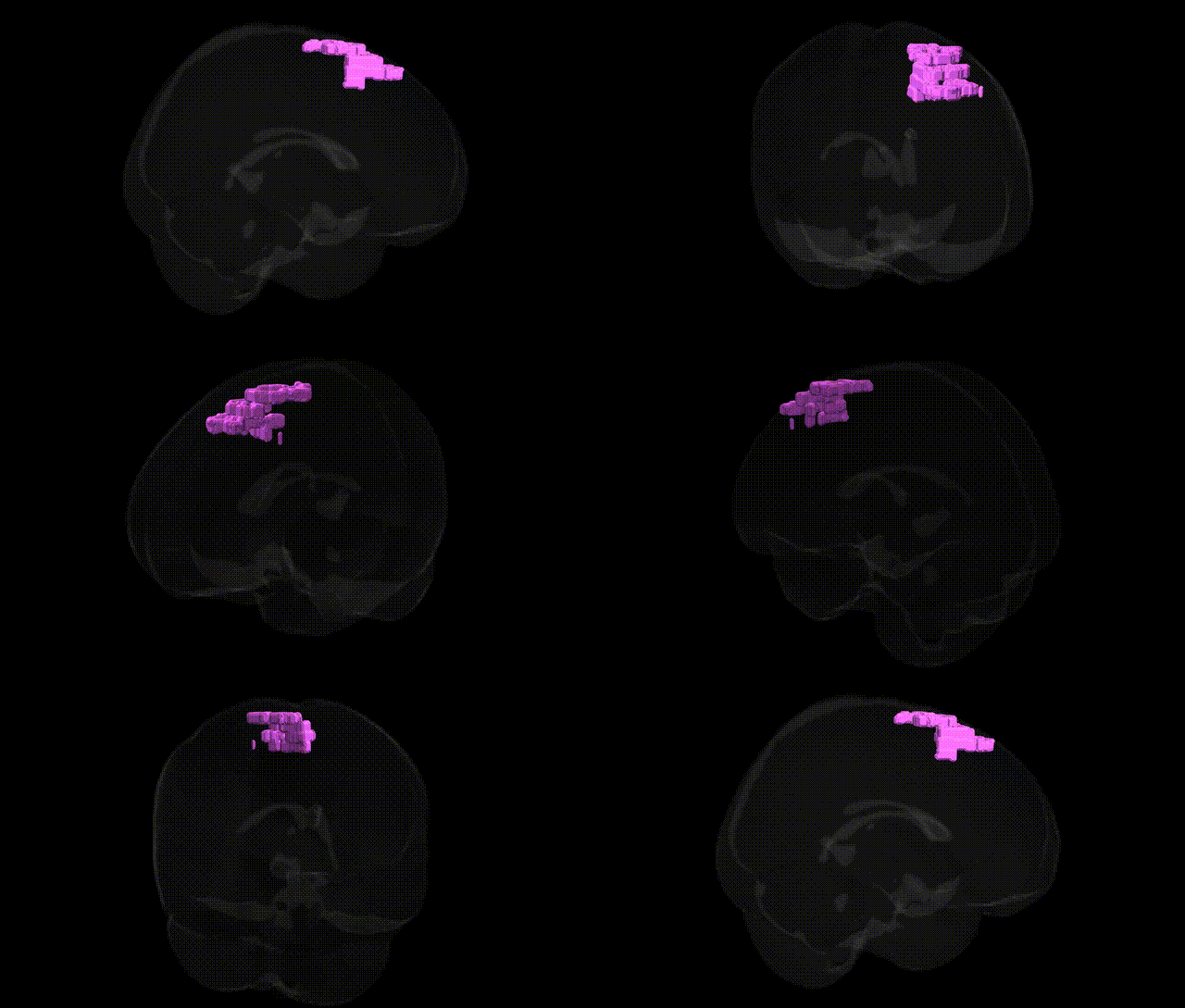
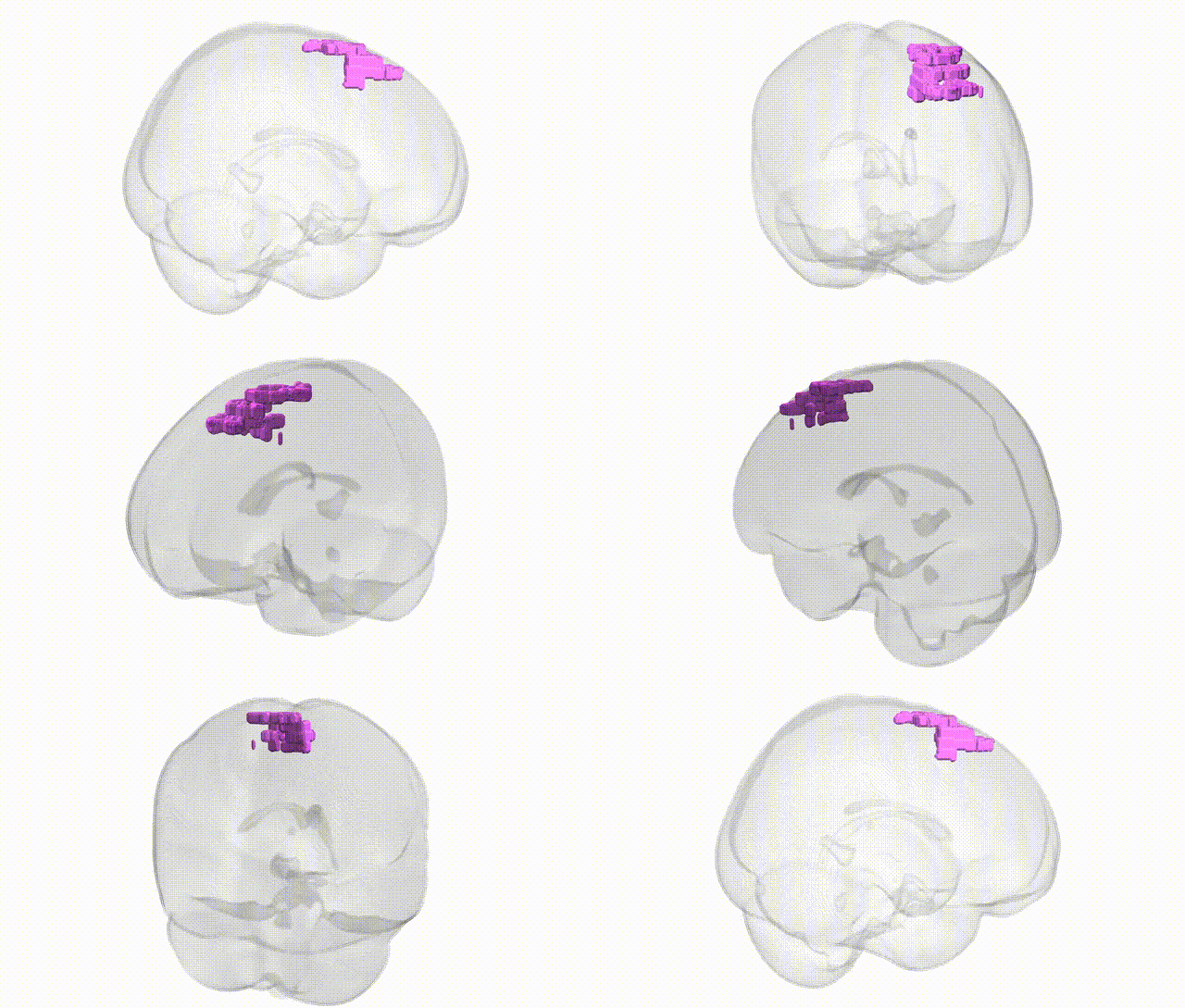
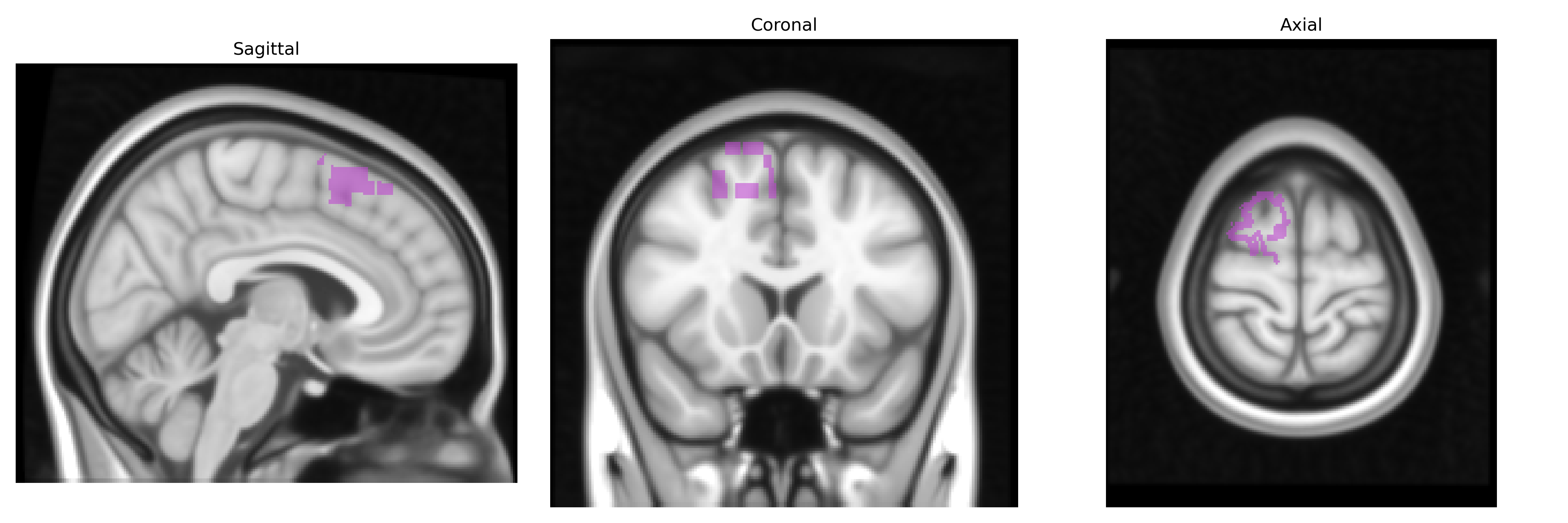
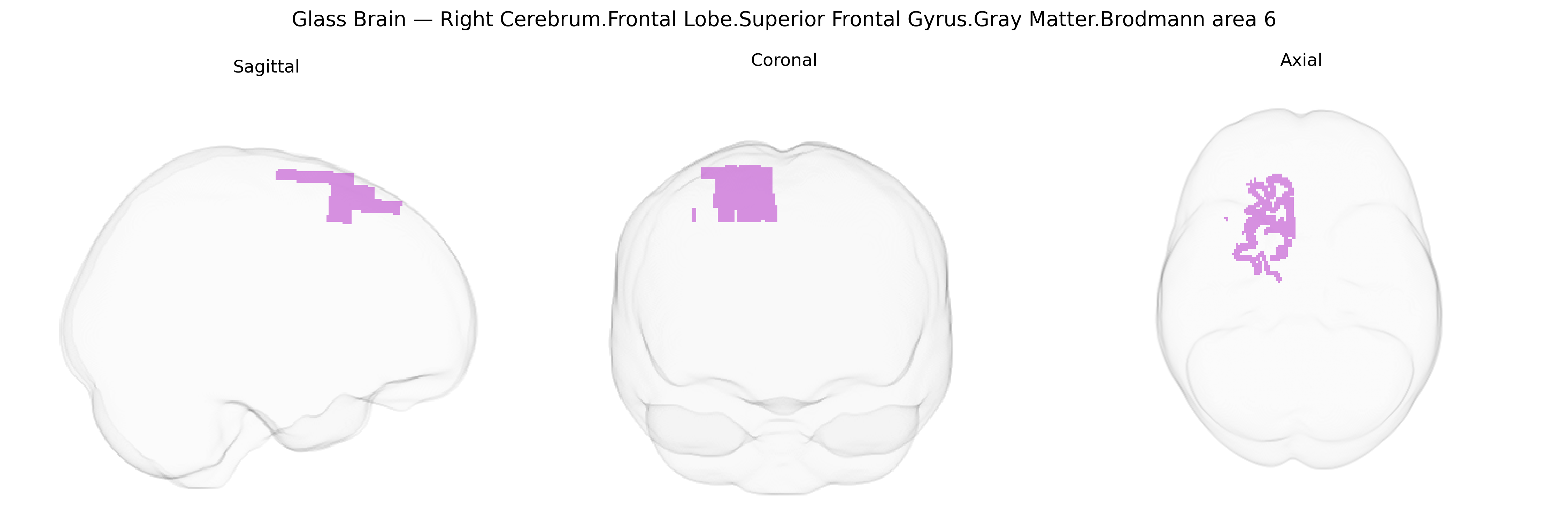
The bilateral Right Cerebrum.Frontal Lobe.Superior Frontal Gyrus.Gray Matter.Brodmann area 6 corresponds primarily to the premotor cortex and supplementary motor area located anterior to the primary motor cortex (Brodmann area 4) on the superior frontal gyrus of the frontal lobe. This agranular cortical region is involved in higher-order motor control, including planning, preparation, and sequencing of voluntary movements, integration of sensory and motor information, and coordination of complex, learned motor behaviors. It receives input from parietal and prefrontal areas and projects to primary motor and spinal motor structures, contributing to both externally cued and internally generated actions, motor imagery, and aspects of motor attention. There is no direct link for this exact Talairach label; a closely related structure is Brodmann area 6.
The bilateral right superior frontal gyrus (Brodmann area 6) in the frontal lobe, corresponding functionally to portions of the premotor cortex and supplementary motor area, has been implicated in multiple genetic and genome‑wide association studies via imaging genetics and neuropsychiatric GWAS. Variants in genes influencing cortical development, synaptic function, and myelination (for example, pathways involving BDNF, DISC1, NRG1, GRIN2B, and CACNA1C) have been associated with differences in gray matter volume, cortical thickness, or activation of this region, often in the context of schizophrenia, bipolar disorder, and major depressive disorder. Large-scale imaging GWAS consortia such as ENIGMA and UK Biobank have identified polygenic influences on frontal lobe morphometry, including BA6, with distributed effects from thousands of common variants linked to neurodevelopmental and synaptic genes; these polygenic scores overlap with risk for psychiatric conditions, general cognitive ability, and educational attainment. The right superior frontal gyrus/BA6 has also been implicated in GWAS of attention-deficit/hyperactivity disorder, autism spectrum conditions, and obsessive–compulsive traits through convergent evidence showing that risk alleles for these disorders predict altered structure or function in this premotor–supplementary motor network. Additionally, motor-related and movement disorder genetics (including Parkinson’s disease and dystonia risk loci) show downstream effects on BA6 circuitry via cortico–basal ganglia–thalamic loops, though associations are typically indirect and mediated by broader motor network genes rather than region-specific loci.
Overview generated by GPT-4o (2026).
Region ID: 1078
Hemisphere: bilateral
Atlas: Talairach labels 1mm
Full Quality Version: Download MP4
Full Quality Version: Download MP4
Wali Sidiqyar*, Gaurav Rudravaram*, Elyssa M. McMaster, Trent M. Schwartz, Adam M. Saunders, Kurt G. Schilling, Bennett A. Landman "Introducing SPINS: A Shared Public Visualization Library of Neuroanatomical Structures." Medical Imaging with Deep Learning- short paper
This resource is licensed under CC0 1.0 Universal (Public Domain).