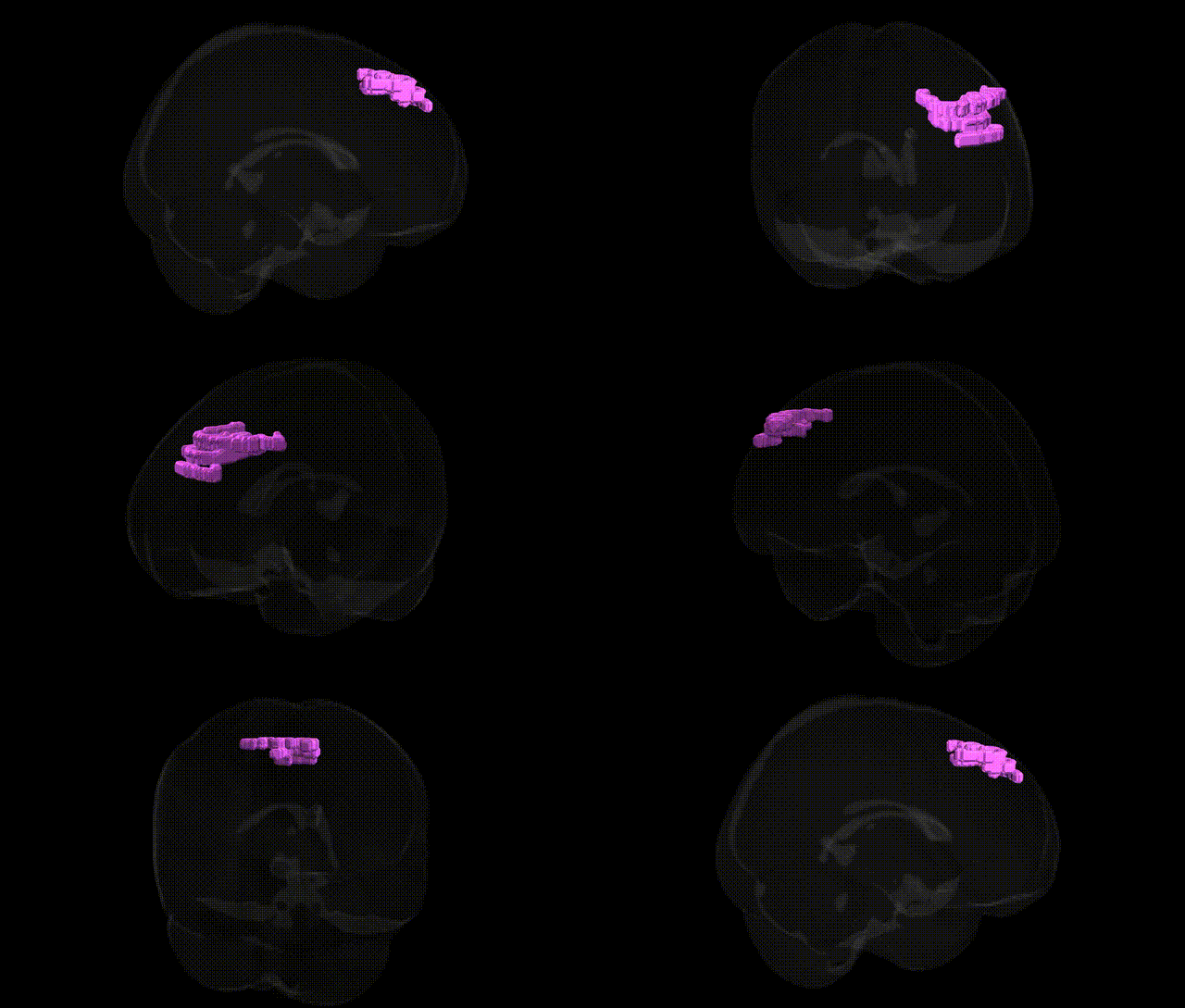
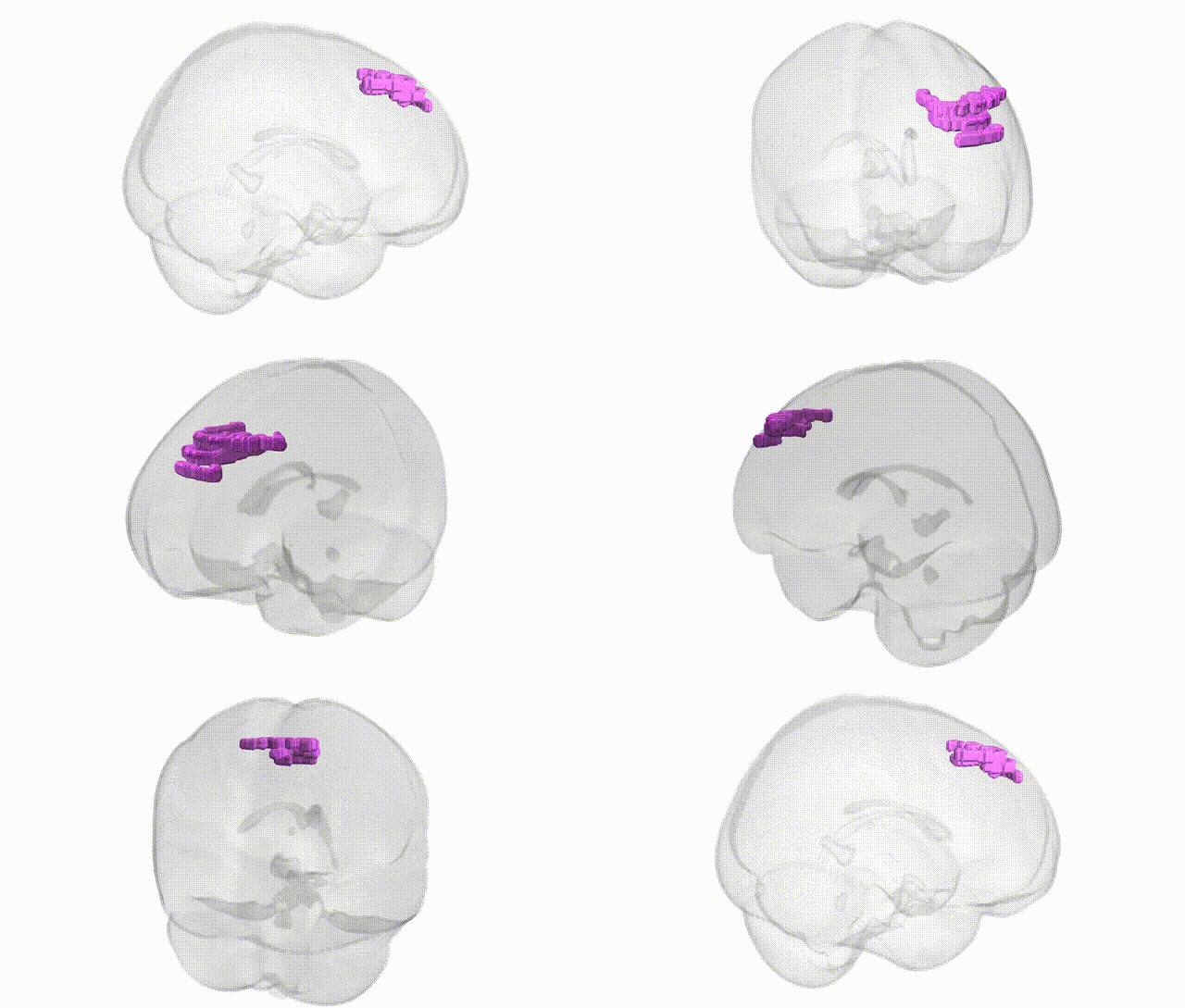
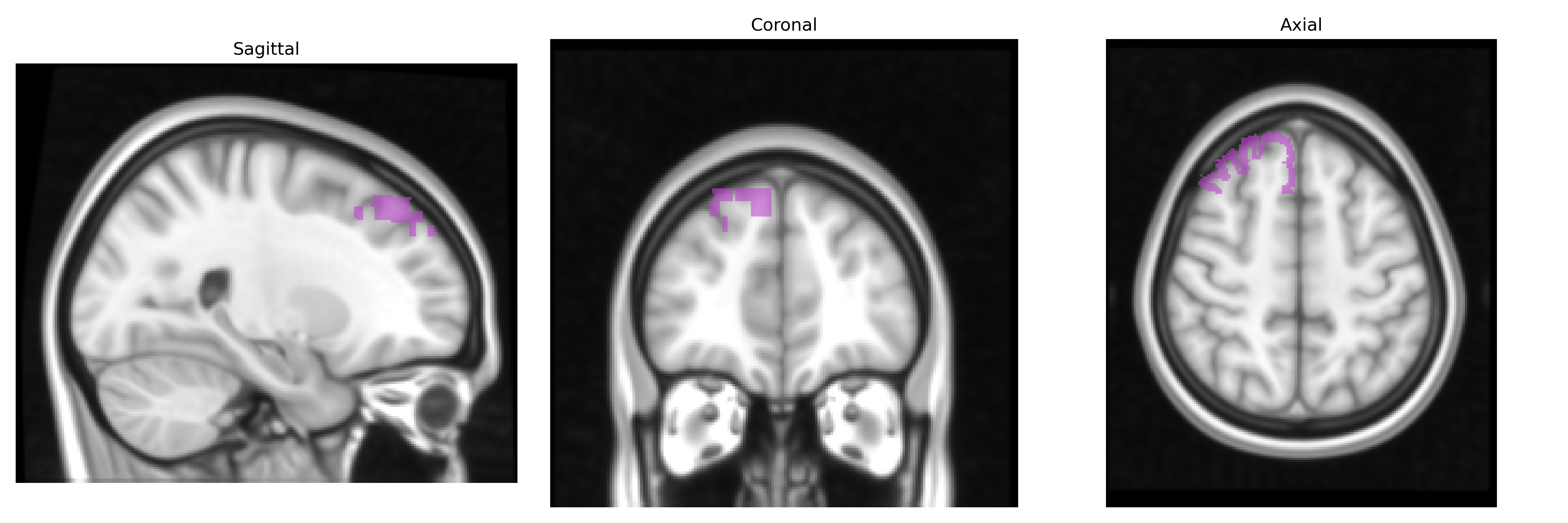
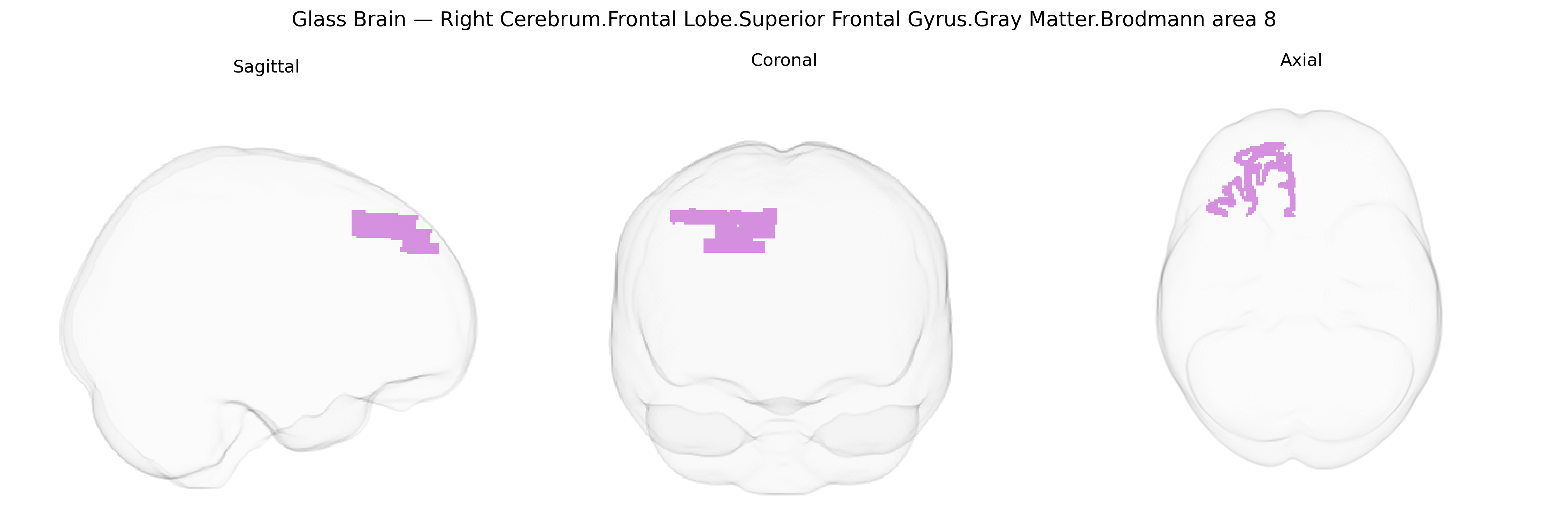
Bilateral Right Cerebrum.Frontal Lobe.Superior Frontal Gyrus.Gray Matter.Brodmann area 8 corresponds to a dorsolateral frontal cortical region implicated in higher-order motor control, oculomotor planning, and aspects of executive function. Brodmann area 8 contains the frontal eye fields, which are critical for voluntary saccadic eye movements and visual attention, and participates in the integration of sensory inputs with planned actions, contributing to goal-directed behavior and decision-making. Its location in the superior frontal gyrus positions it within prefrontal networks involved in working memory, response selection, and the modulation of motor and premotor areas. There is no direct Wikipedia article for this exact composite region; a closely related structure is Brodmann area 8.
The bilateral right superior frontal gyrus (Brodmann area 8), encompassing frontal executive and oculomotor control regions, has been implicated in multiple genetic and GWAS findings, although most studies report associations at the level of frontal cortical thickness, surface area, or functional networks rather than the Talairach label specifically. Large neuroimaging GWAS consortia such as ENIGMA and UK Biobank have identified common variants influencing superior frontal cortical morphology and activation, including loci near genes involved in neurodevelopment (e.g., MAPT, CNTNAP2, DCC, and multiple synaptic and axon-guidance genes), with effects on frontal thickness and connectivity that overlap Brodmann area 8. Genetic risk for schizophrenia, bipolar disorder, and major depressive disorder has been associated with altered structure and function in the superior frontal gyrus, where polygenic risk scores correlate with reduced gray-matter volume or abnormal activation during working memory and cognitive control tasks; similar frontal findings appear in ADHD and autism spectrum disorder, consistent with genetic influences on frontostriatal and frontoparietal networks. GWAS of cognitive traits, such as general intelligence, working memory, and educational attainment, frequently identify variants affecting frontal cortical regions, including superior frontal areas, and imaging-genetic studies link higher polygenic scores for cognitive performance to increased superior frontal surface area or more efficient task-related activation. Additionally, risk alleles for neurodegenerative and neuropsychiatric disorders (e.g., APOE in Alzheimer’s disease, and multiple loci in frontotemporal dementia and obsessive–compulsive disorder) have been associated with structural or functional changes involving the superior frontal gyrus, suggesting that Brodmann area 8 participates in genetically influenced circuits underlying executive function, eye movement control, higher-order cognition, and vulnerability to psychiatric and cognitive disorders.
Overview generated by GPT-4o (2026).
Region ID: 1036
Hemisphere: bilateral
Atlas: Talairach labels 1mm
Full Quality Version: Download MP4
Full Quality Version: Download MP4
Wali Sidiqyar*, Gaurav Rudravaram*, Elyssa M. McMaster, Trent M. Schwartz, Adam M. Saunders, Kurt G. Schilling, Bennett A. Landman "Introducing SPINS: A Shared Public Visualization Library of Neuroanatomical Structures." Medical Imaging with Deep Learning- short paper
This resource is licensed under CC0 1.0 Universal (Public Domain).