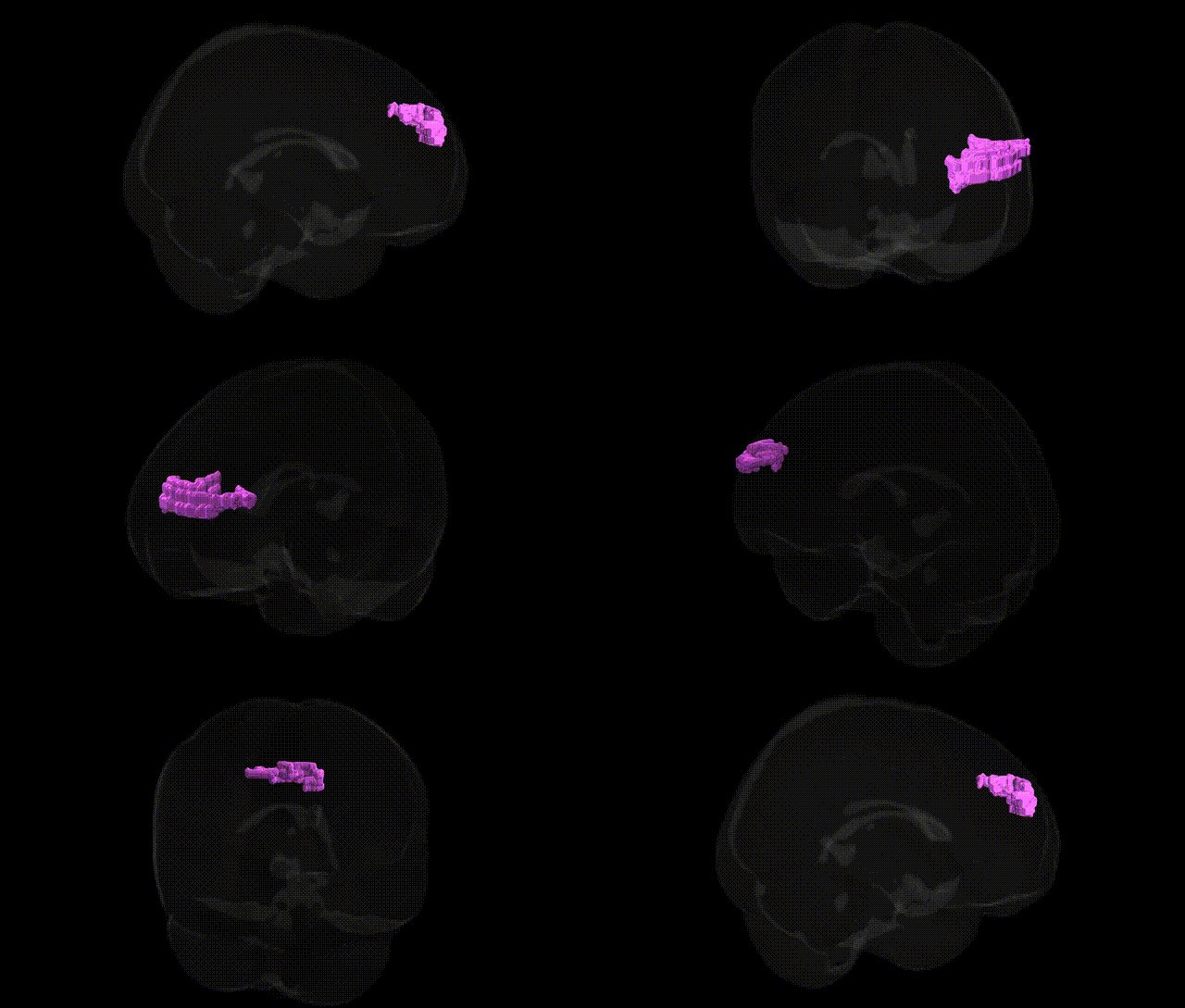
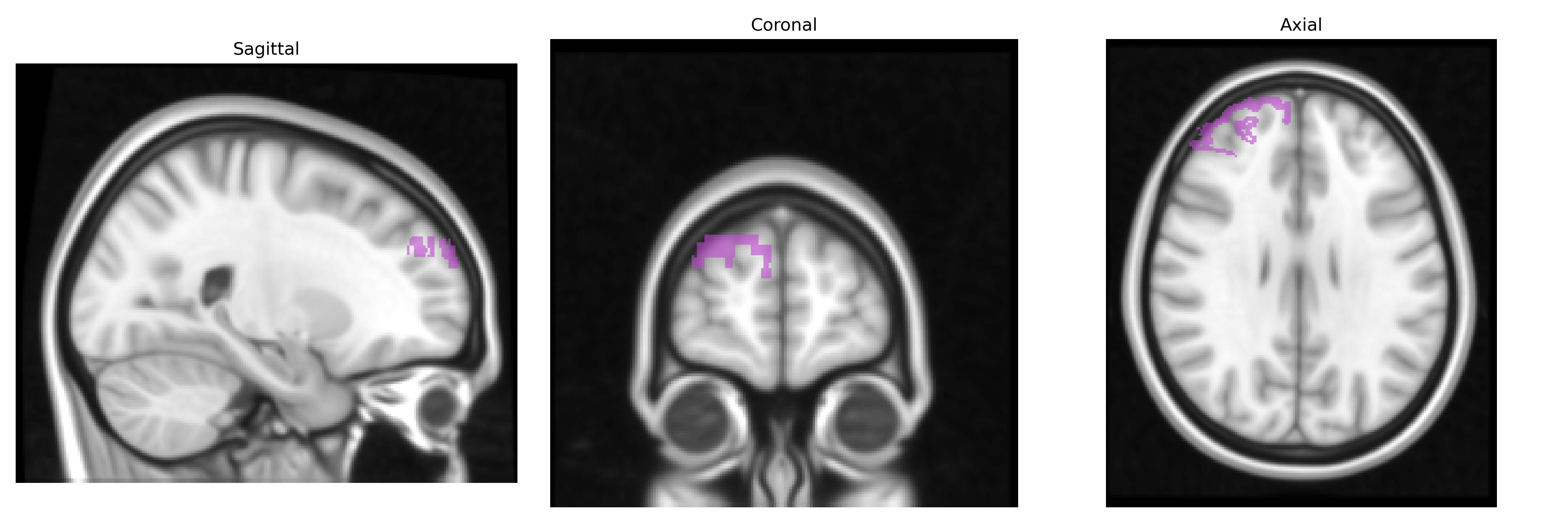
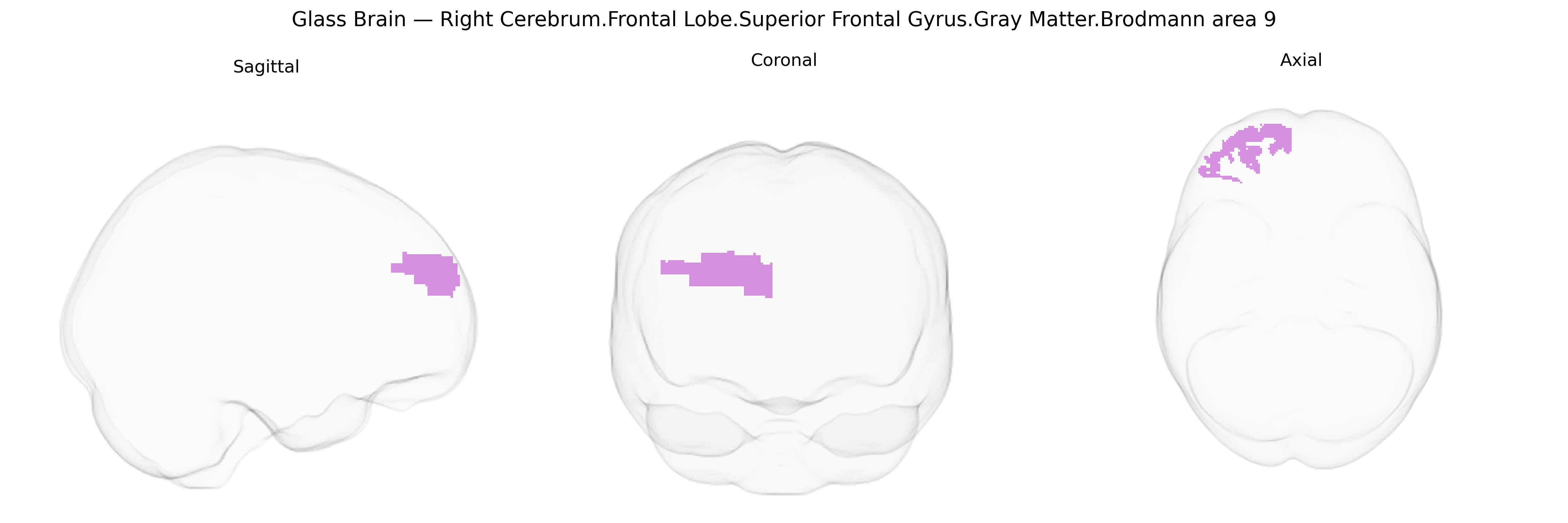
Bilateral Right Cerebrum.Frontal Lobe.Superior Frontal Gyrus.Gray Matter.Brodmann area 9 corresponds to a dorsolateral prefrontal cortical region situated in the superior frontal gyrus, anterior to premotor areas and superior to area 46, with laminar architecture characteristic of granular prefrontal cortex (well-developed layer IV and prominent pyramidal neurons in layers III and V). Functionally, Brodmann area 9 is implicated in higher-order executive processes including working memory, sustained and selective attention, cognitive flexibility, and aspects of decision-making and social cognition, particularly the monitoring and manipulation of information and the evaluation of internally generated actions or plans. This region forms part of large-scale frontoparietal control and default mode networks, with dense connectivity to other prefrontal, cingulate, parietal, and limbic structures, and exhibits lateralized contributions to reasoning, language-related internal speech, and metacognitive evaluation of behavior. There is no direct link for this exact composite label; a related structure is Brodmann area 9.
The bilateral right superior frontal gyrus (Brodmann area 9) in the frontal lobe has been implicated in multiple genetic and GWAS-based associations through its roles in executive control, working memory, and higher-order cognition. Imaging–genetics and large-scale GWAS of cortical thickness and surface area (e.g., ENIGMA and UK Biobank studies) have linked common variants in genes involved in neurodevelopment and synaptic function—such as FOXP2, BDNF, CNTNAP2, and COMT—to structural and functional variation in BA9, including gray matter volume and activation during cognitive tasks. Polygenic risk scores for schizophrenia, bipolar disorder, and major depressive disorder show associations with altered morphology and connectivity in this region, and specific loci near genes such as ZNF804A, CACNA1C, and DISC1 have been repeatedly tied to dorsolateral prefrontal (including BA9) abnormalities in case–control and endophenotype studies. GWAS of intelligence and educational attainment identify enrichment of associated variants in frontal cortical regulatory elements, and BA9 gray matter measures appear in multivariate genetic architectures underlying general cognitive ability. Additional associations include genetic correlations between right superior frontal morphology and ADHD, autism spectrum traits, and neuroticism, suggesting that variants affecting this region contribute to a spectrum of cognitive and affective phenotypes, although the genetic architecture is highly polygenic and no single locus is specific to this Talairach-defined area.
Overview generated by GPT-4o (2026).
Region ID: 903
Hemisphere: bilateral
Atlas: Talairach labels 1mm
Full Quality Version: Download MP4
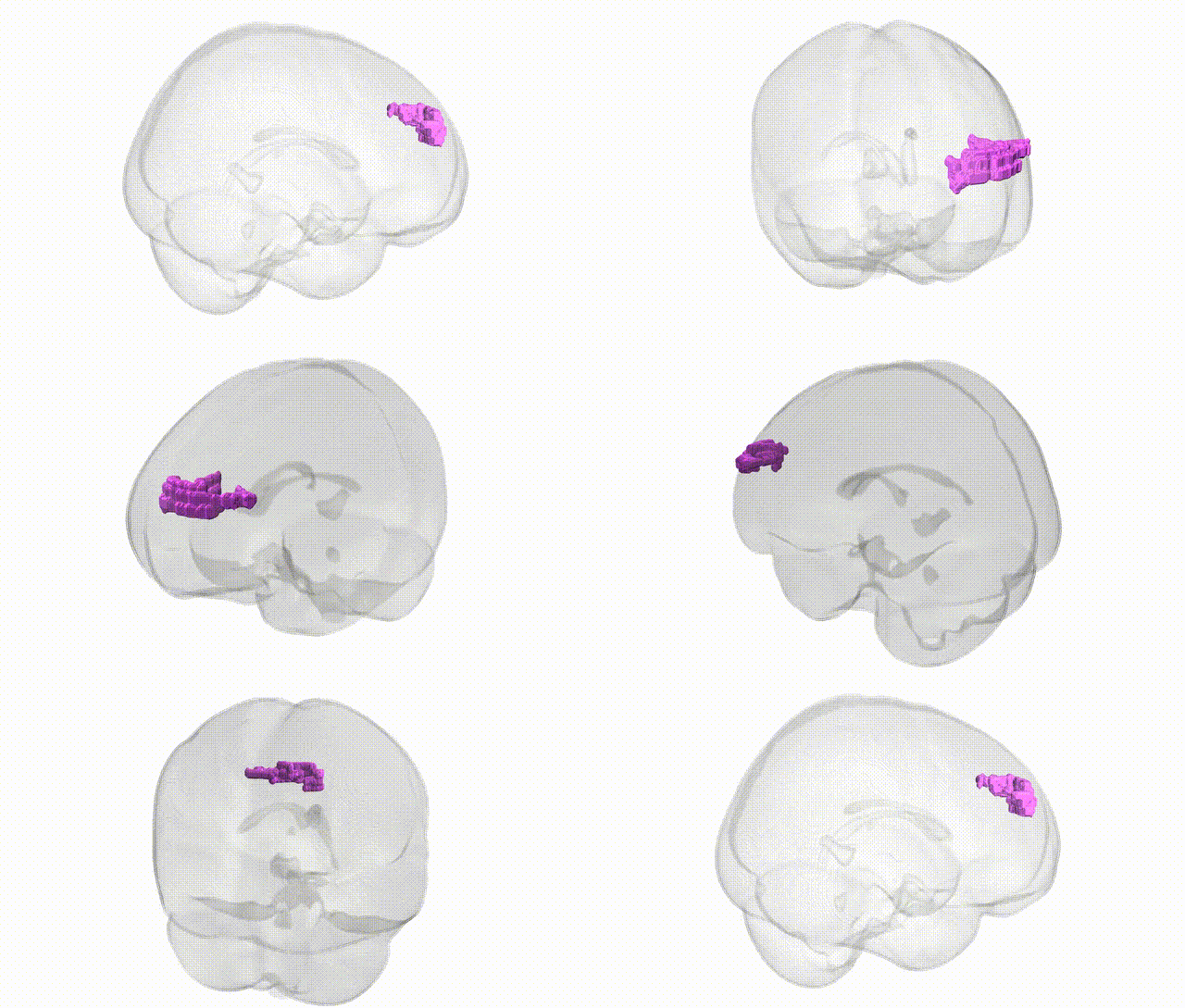
Full Quality Version: Download MP4
Wali Sidiqyar*, Gaurav Rudravaram*, Elyssa M. McMaster, Trent M. Schwartz, Adam M. Saunders, Kurt G. Schilling, Bennett A. Landman "Introducing SPINS: A Shared Public Visualization Library of Neuroanatomical Structures." Medical Imaging with Deep Learning- short paper
This resource is licensed under CC0 1.0 Universal (Public Domain).