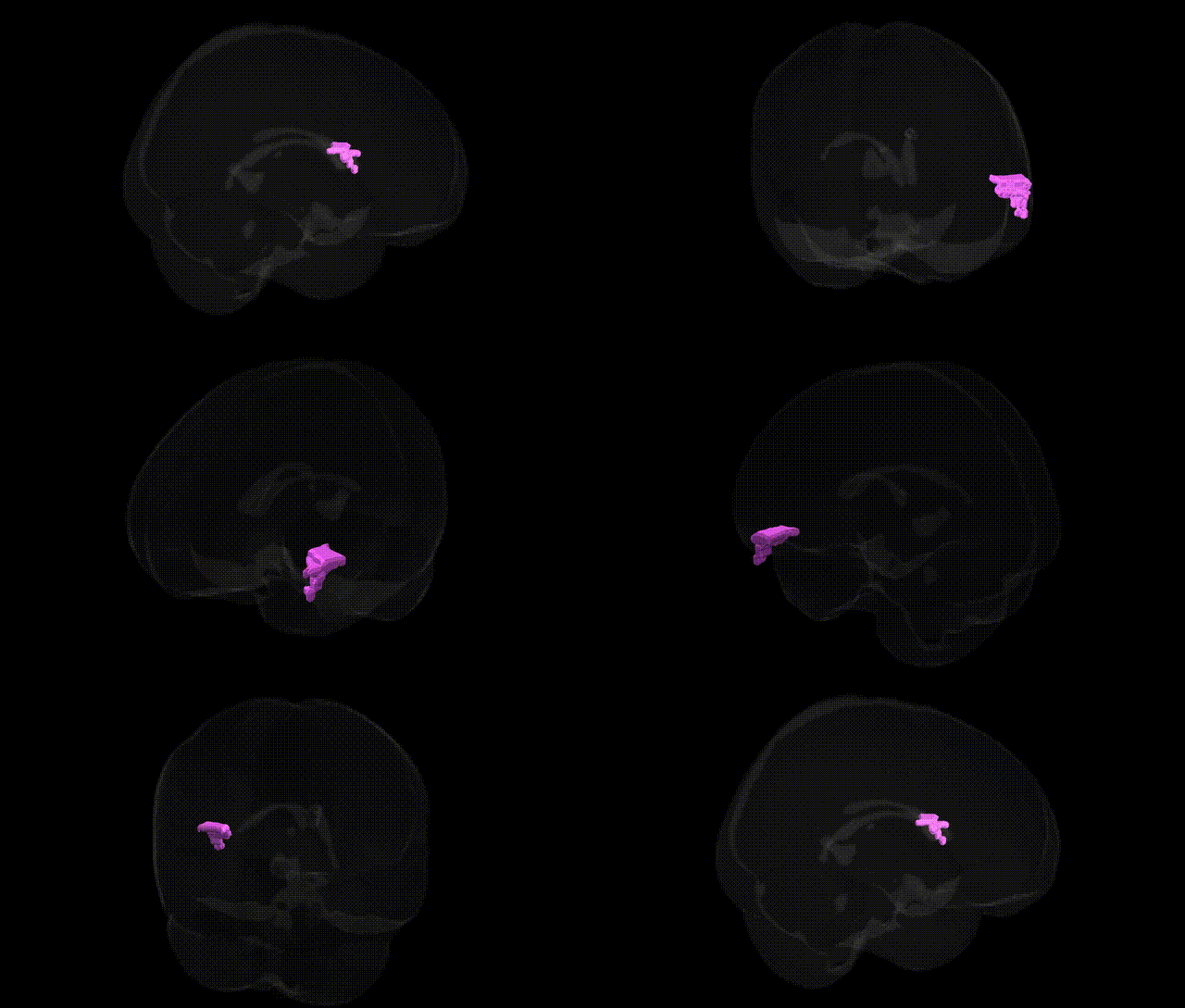
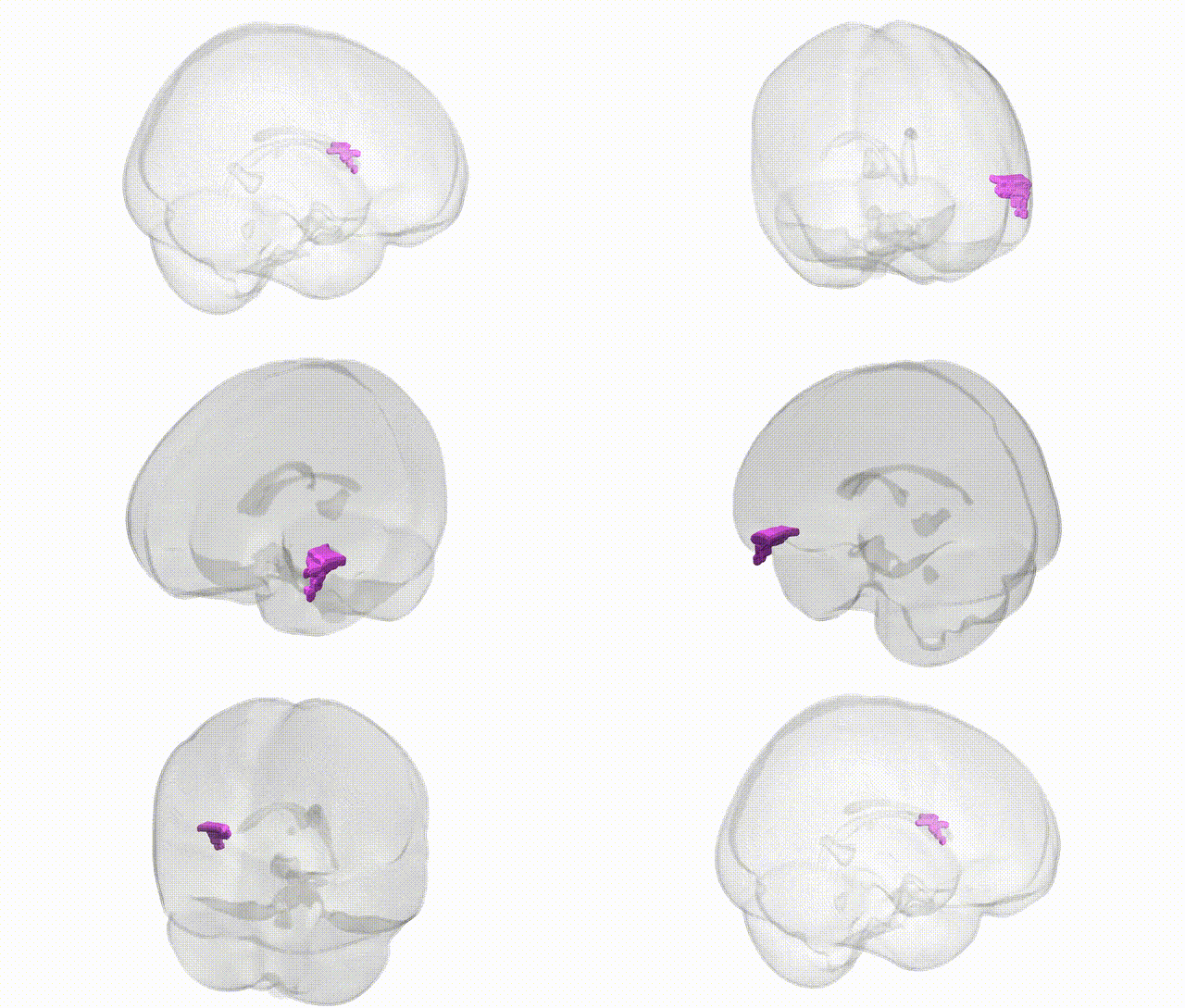
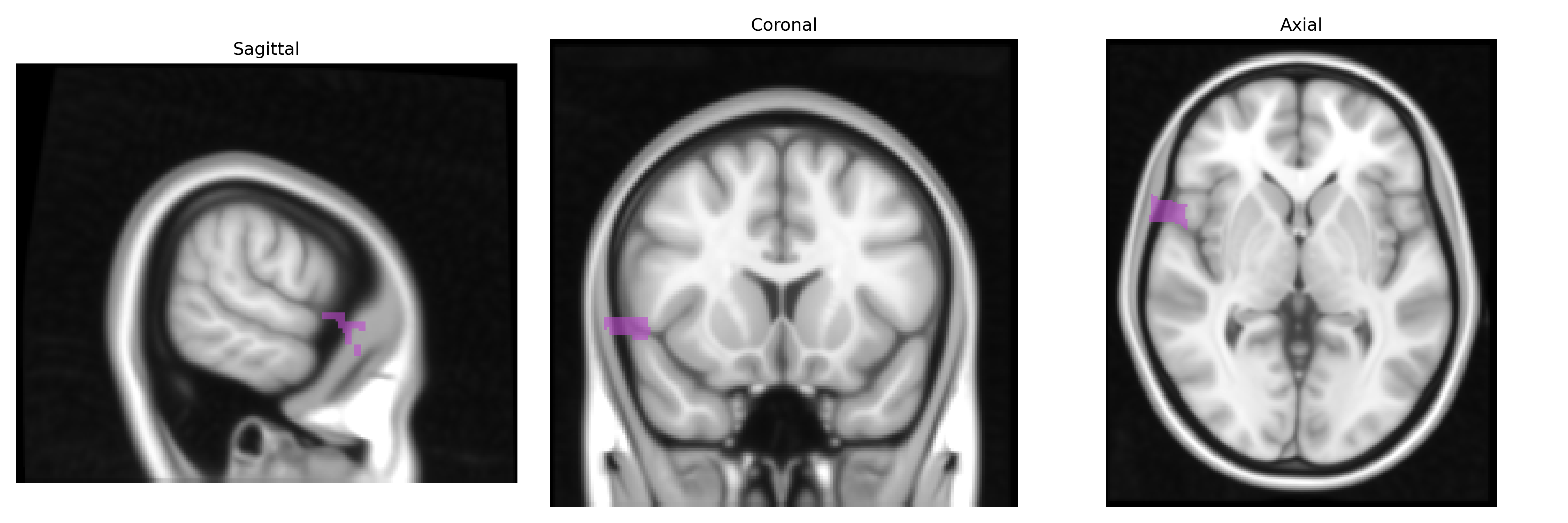
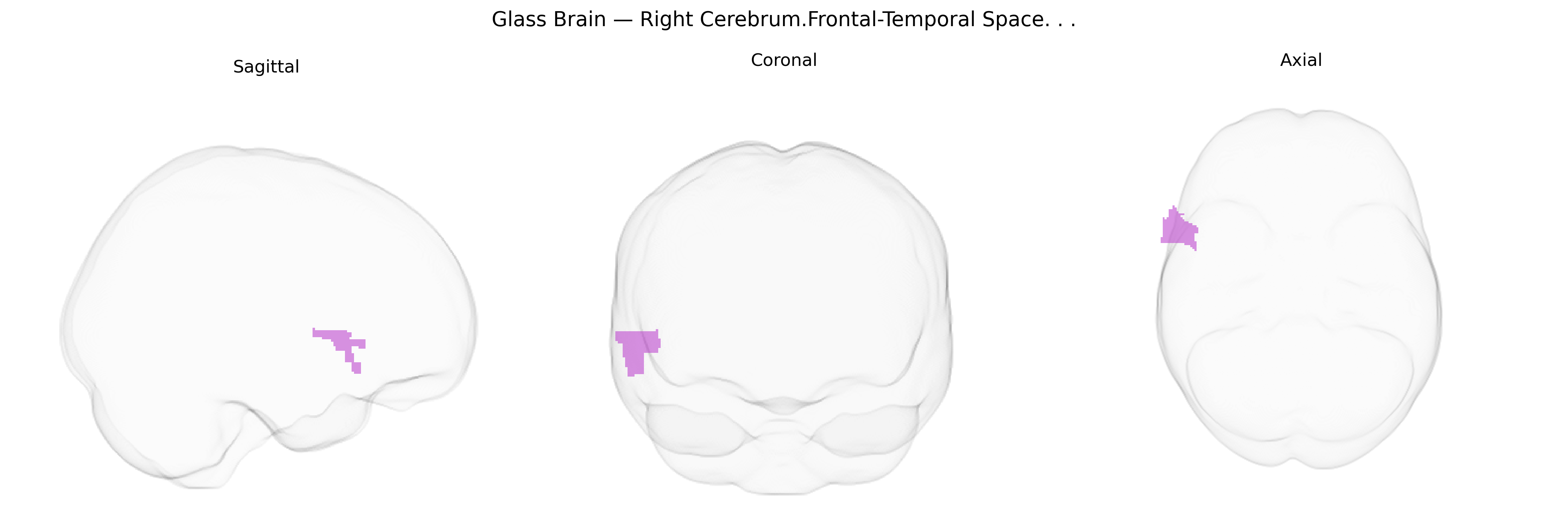
The bilateral Right Cerebrum.Frontal-Temporal Space, as defined in the Talairach 1 mm atlas, refers to a composite volumetric region spanning portions of the right frontal and temporal lobes, encompassing association cortices involved in higher-order cognitive, linguistic, and socio-emotional processing. This space typically includes parts of the inferior and middle frontal gyri contiguous with anterior temporal structures along the lateral sulcus, overlapping territories linked to expressive and receptive language functions, working memory, decision-making, and integration of multimodal sensory input. Functionally, it serves as a key interface between frontal executive systems and temporal memory and language networks, supporting complex behaviors such as semantic processing, narrative comprehension, and context-dependent emotional evaluation. There is no direct Wikipedia article for this composite atlas label; a closely related structure is the Temporal lobe.
The bilateral right cerebrum frontal–temporal space, an interposed region spanning inferior frontal and anterior temporal territories, has been implicated in several genetic and GWAS-based associations through its overlap with right inferior frontal gyrus, frontal operculum, and anterior temporal cortex. Variants in genes related to synaptic development and plasticity (e.g., CNTNAP2, FOXP2, GRIN2B) have been associated with structural and functional differences in adjacent right frontal–temporal networks, particularly in language, social cognition, and inhibitory control. Large-scale imaging genetics consortia (such as ENIGMA) have reported that common variants in loci near genes involved in neurodevelopment (e.g., HMGA2, MAPT region on 17q21, and several glutamatergic and GABAergic pathway genes) contribute to variation in cortical thickness and surface area of nearby frontal and temporal regions, which encompass portions of this space. GWAS of neuropsychiatric disorders including schizophrenia, bipolar disorder, major depressive disorder, and autism spectrum disorder have repeatedly identified risk loci whose effects are partly mediated by altered structure or connectivity in right frontotemporal networks, while studies of impulsivity, attention-deficit/hyperactivity disorder, and addiction traits highlight genetic influences on right-lateralized frontal–temporal circuitry subserving response inhibition and salience processing. Additionally, genetic liability to frontotemporal dementia, particularly involving mutations in MAPT, GRN, and C9orf72, has been associated with atrophy patterns that often include right frontal–temporal transition zones comparable to this Talairach-defined space.
Overview generated by GPT-4o (2026).
Region ID: 397
Hemisphere: bilateral
Atlas: Talairach labels 1mm
Full Quality Version: Download MP4
Full Quality Version: Download MP4
Wali Sidiqyar*, Gaurav Rudravaram*, Elyssa M. McMaster, Trent M. Schwartz, Adam M. Saunders, Kurt G. Schilling, Bennett A. Landman "Introducing SPINS: A Shared Public Visualization Library of Neuroanatomical Structures." Medical Imaging with Deep Learning- short paper
This resource is licensed under CC0 1.0 Universal (Public Domain).