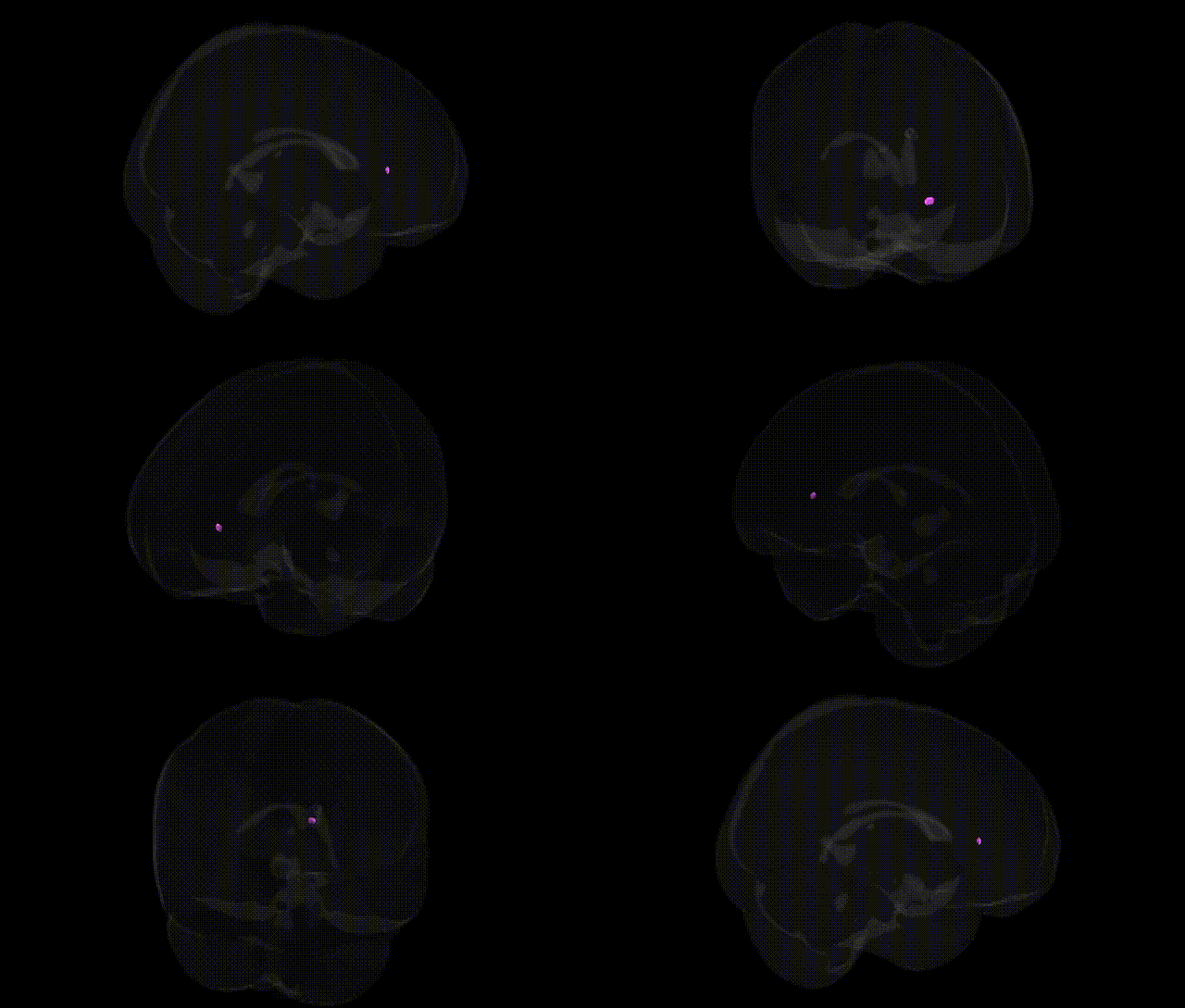
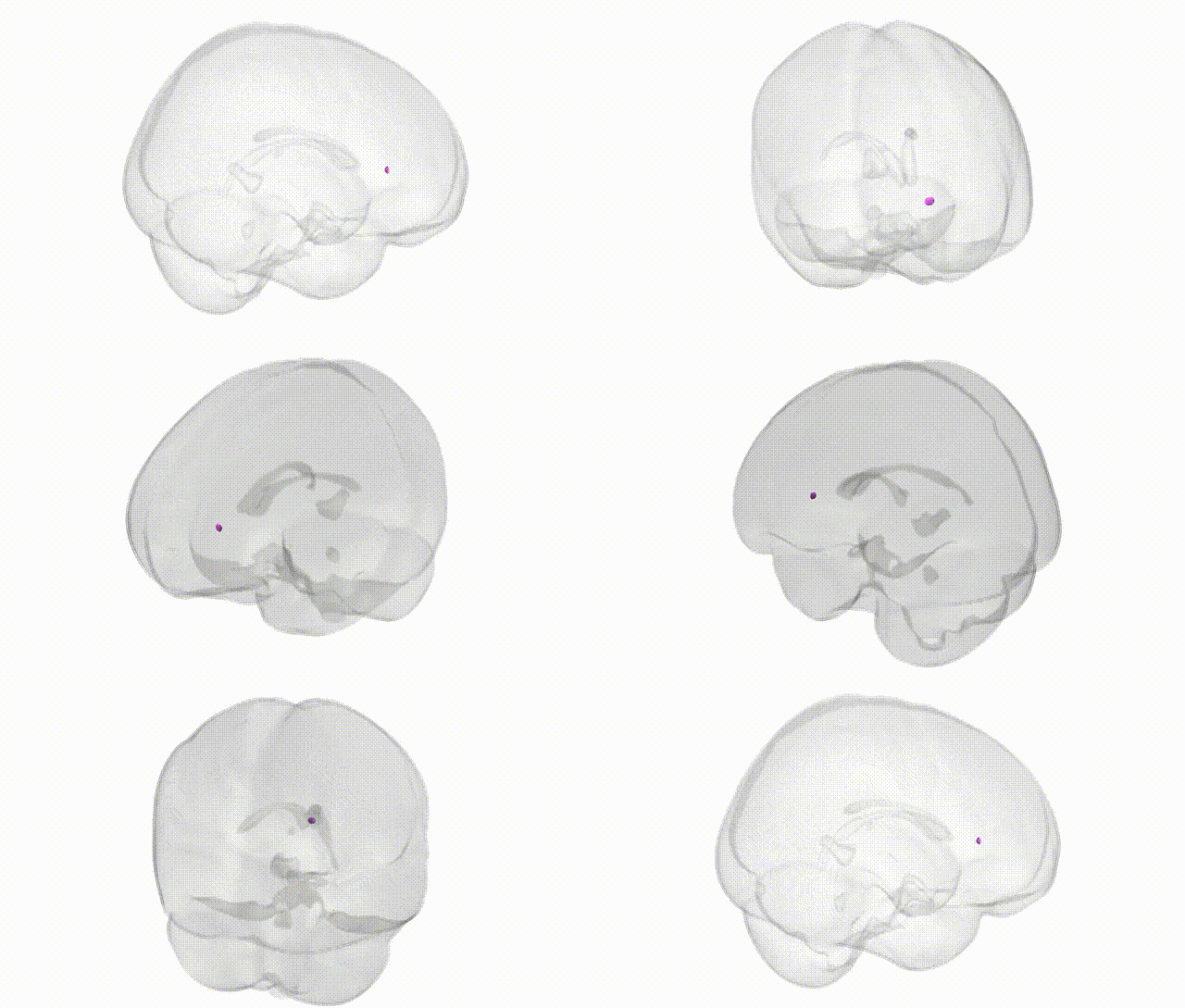
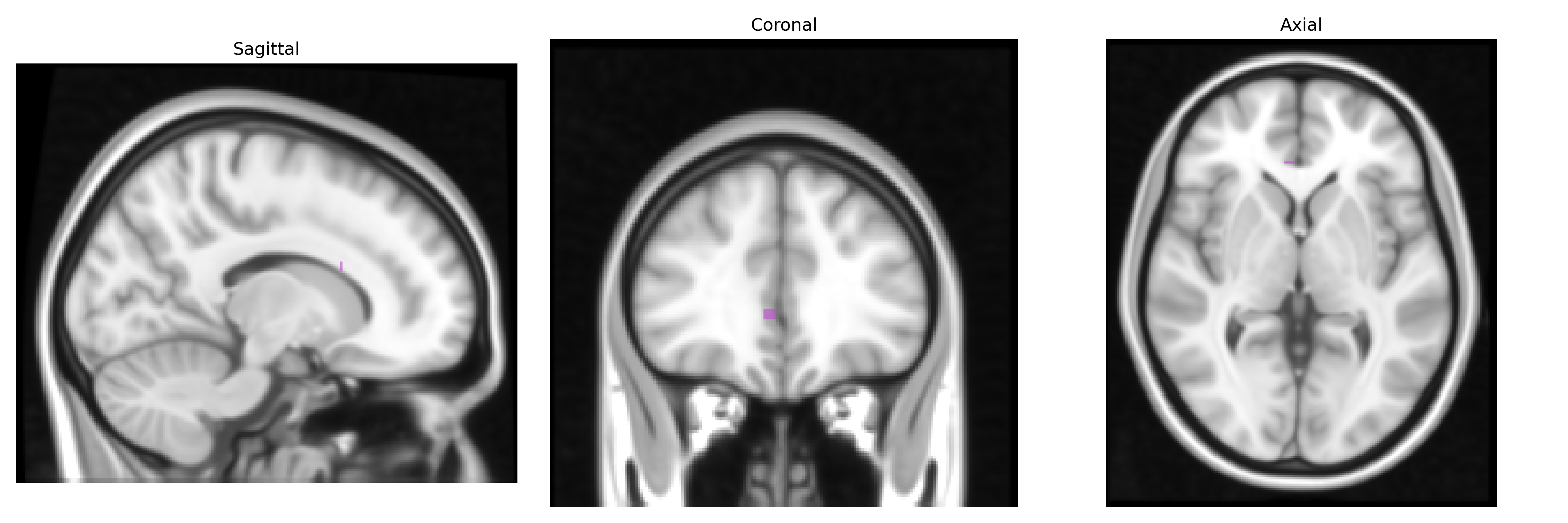
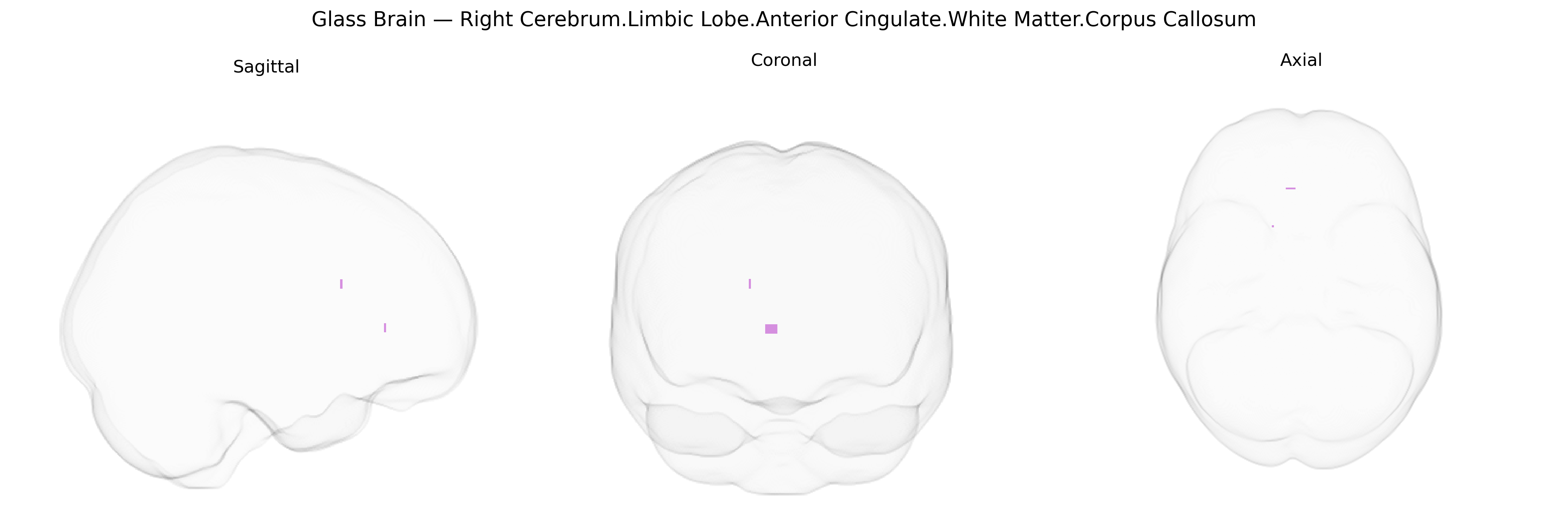
The bilateral Right Cerebrum Limbic Lobe Anterior Cingulate White Matter Corpus Callosum region corresponds to interhemispheric commissural fibers linking anterior cingulate cortices across the midline via the corpus callosum, particularly involving the genu and adjacent callosal segments. Functionally, this white matter tract supports integration of limbic and prefrontal information, contributing to emotional regulation, conflict monitoring, motivation, and aspects of cognitive control mediated by the anterior cingulate cortex. As part of the largest commissural pathway in the brain, these fibers facilitate coordinated activity between homologous cingulate regions in both hemispheres, influencing mood, pain processing, autonomic responses, and higher-order executive functions. There is no direct Wikipedia article for this specific Talairach-defined region; a closely related structure is the Corpus Callosum.
The bilateral right anterior cingulate white matter and adjacent corpus callosum—corresponding to the Talairach “Right Cerebrum.Limbic Lobe.Anterior Cingulate.White Matter.Corpus Callosum” label—has been implicated in multiple imaging‑genetics and GWAS-based studies through structural and microstructural measures such as callosal thickness, volume, and fractional anisotropy, which show significant heritability and polygenic influences. Large consortia (e.g., ENIGMA, UK Biobank) have linked common variants in genes related to myelination and axonal integrity (including loci near or within genes such as NRG1, MAG, and CNTN4, depending on study) to variability in callosal and cingulate white-matter properties, while polygenic risk scores for schizophrenia, bipolar disorder, major depressive disorder, and autism spectrum disorder correlate with altered anterior cingulate and callosal white-matter structure or connectivity. Specific susceptibility loci for schizophrenia (e.g., in the MHC region and CACNA1C), major depression (e.g., SLC6A15 and other synaptic genes), and ADHD (e.g., DRD4 and DAT1-related networks) have been associated with reduced integrity or abnormal development of callosal and cingulate tracts in case-control and family-based studies, suggesting that genetic risk for these disorders may manifest partly through disrupted interhemispheric and cingulo-cortical connectivity. In addition, GWAS of cognitive traits (processing speed, intelligence), pain sensitivity, and emotional regulation report overlapping genetic architectures with anterior cingulate/corpus callosum measures, reinforcing the role of this region’s white matter as a neural substrate through which polygenic influences on cognition, affect, and psychopathology exert their effects.
Overview generated by GPT-4o (2026).
Region ID: 695
Hemisphere: bilateral
Atlas: Talairach labels 1mm
Full Quality Version: Download MP4
Full Quality Version: Download MP4
Wali Sidiqyar*, Gaurav Rudravaram*, Elyssa M. McMaster, Trent M. Schwartz, Adam M. Saunders, Kurt G. Schilling, Bennett A. Landman "Introducing SPINS: A Shared Public Visualization Library of Neuroanatomical Structures." Medical Imaging with Deep Learning- short paper
This resource is licensed under CC0 1.0 Universal (Public Domain).