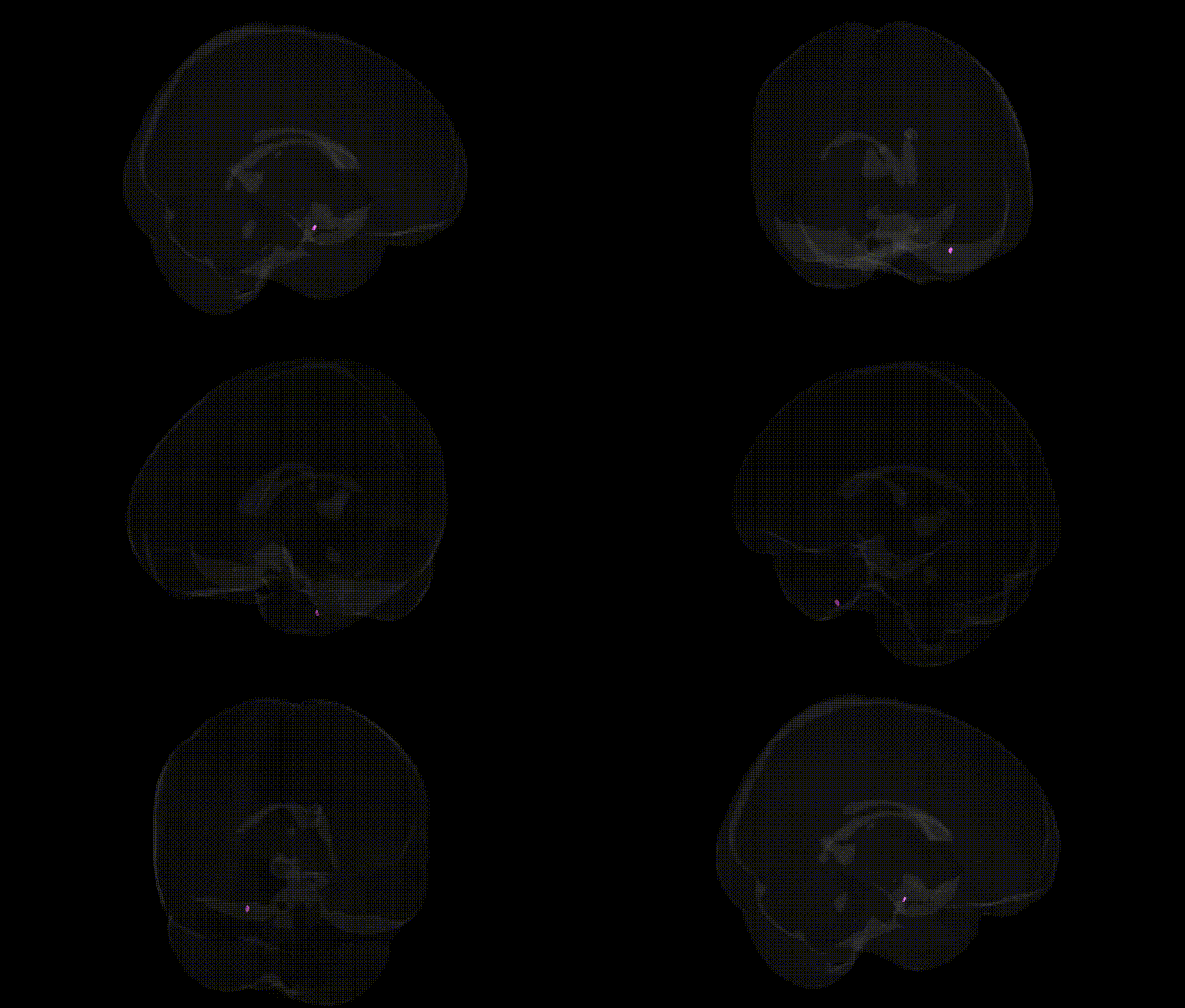
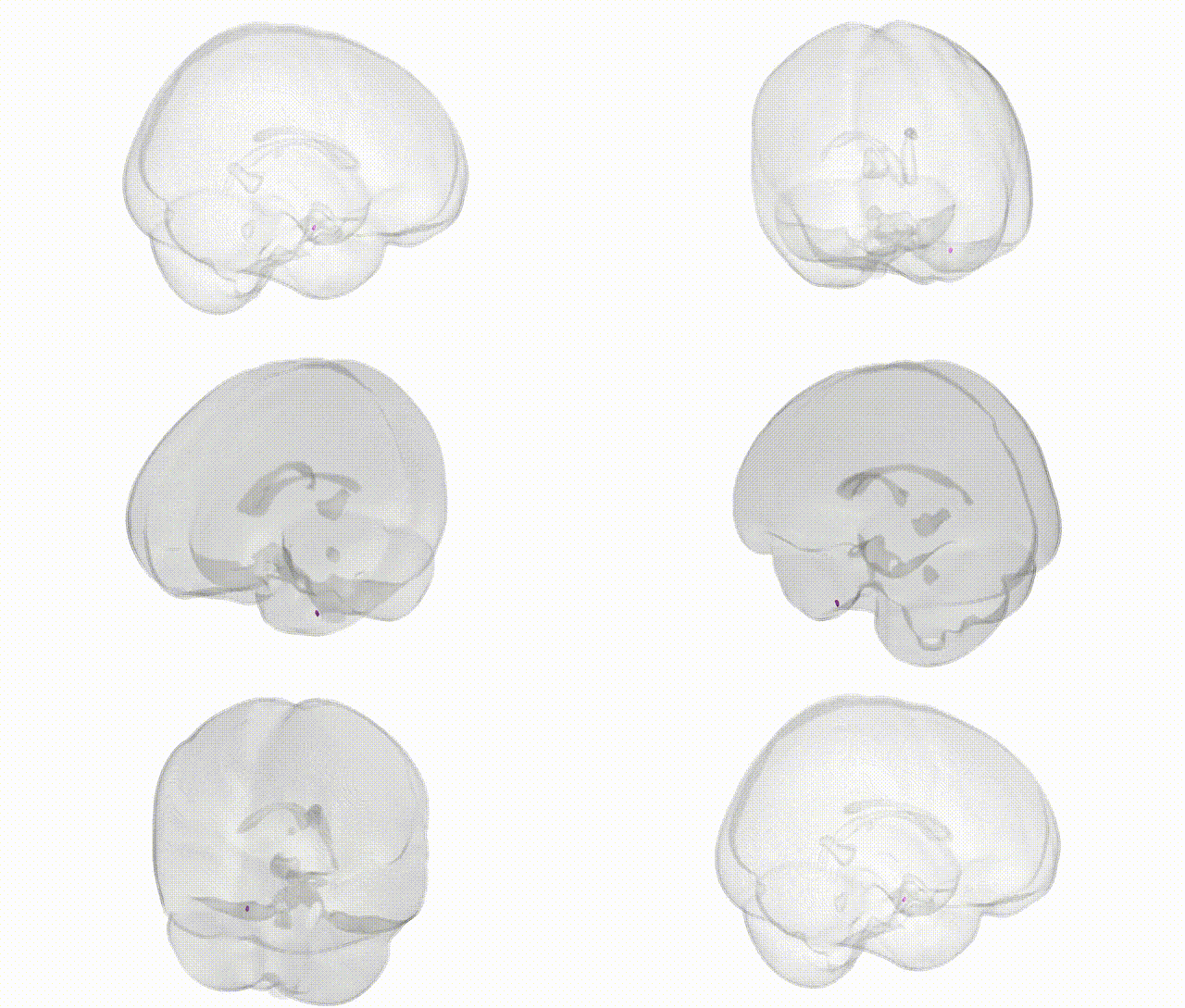
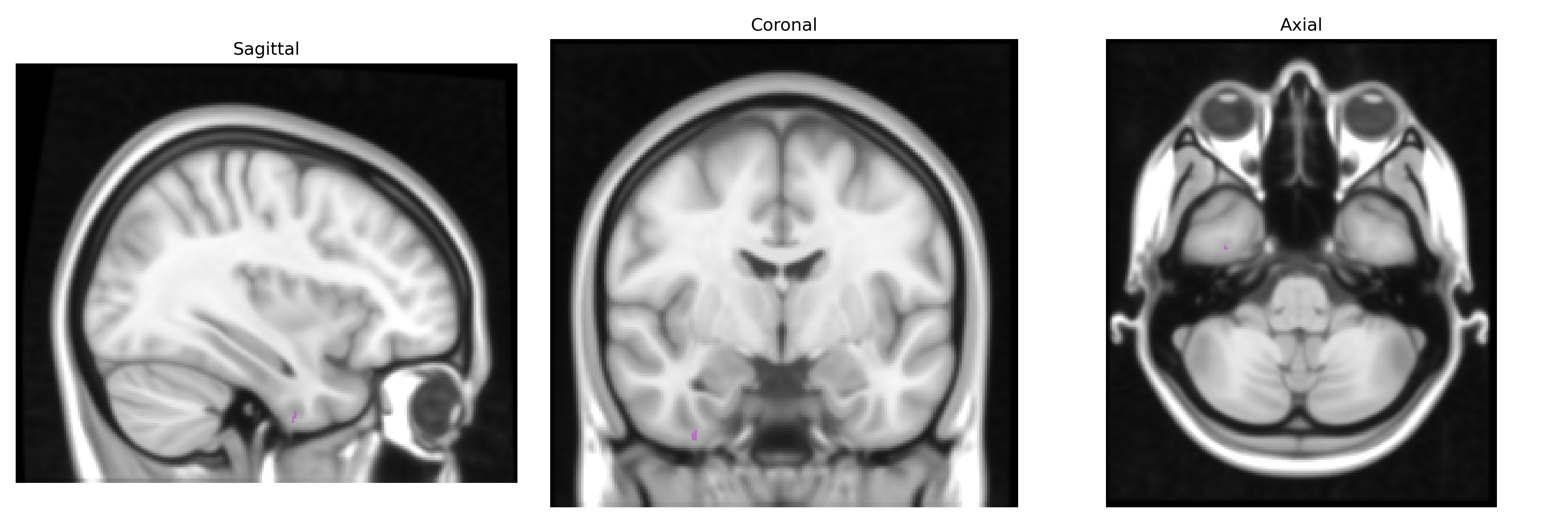
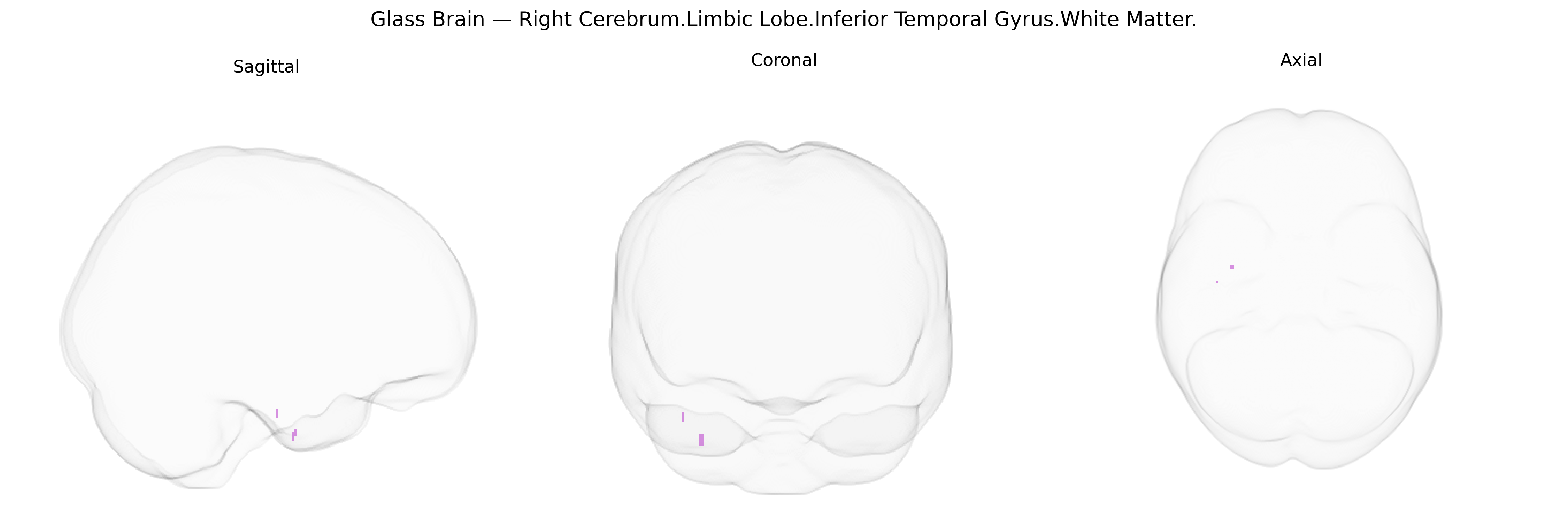
The bilateral Right Cerebrum Limbic Lobe Inferior Temporal Gyrus white matter corresponds to the deep fiber tracts underlying the inferior temporal gyrus in the temporal lobe, implicated in high-level visual processing, object recognition, and aspects of memory and emotional association through its connections with limbic structures such as the hippocampus and amygdala. These white matter pathways include portions of long-range association bundles (e.g., the inferior longitudinal fasciculus) that link occipital visual areas with anterior temporal and limbic regions, supporting integration of visual information with semantic, mnemonic, and affective processes. While there is no direct Wikipedia article for this exact Talairach label, it is closely related to the Inferior temporal gyrus.
The bilateral Right Cerebrum Limbic Lobe Inferior Temporal Gyrus White Matter, as defined in the Talairach 1 mm atlas, corresponds primarily to long-range association and projection fibers connecting inferior temporal and limbic structures involved in visual object processing, semantic memory, and aspects of socio-emotional cognition. Although few GWAS report findings explicitly mapped to this narrowly defined white‑matter parcel, large neuroimaging‑genetics consortia (e.g., ENIGMA, UK Biobank) have identified polygenic influences on adjacent inferior temporal cortical thickness and temporal-limbic white‑matter microstructure, implicating genes involved in synaptic plasticity, axon guidance, and myelination (such as BDNF, NRG1, CNTNAP2, and multiple oligodendrocyte-related loci). Variants affecting temporal-limbic connectivity have been associated with schizophrenia, autism spectrum disorder, major depressive disorder, and Alzheimer’s disease, where diffusion MRI studies frequently report altered fractional anisotropy and mean diffusivity in inferior temporal and adjacent fusiform/uncinate tracts linked to polygenic risk scores for these conditions. GWAS of cognitive traits, including general intelligence, language ability, and face/object recognition, also show enrichment of associated loci in networks that include inferior temporal regions and their white matter connections, suggesting that genetic effects on this parcel are highly polygenic and distributed rather than driven by single, region-specific variants.
Overview generated by GPT-4o (2026).
Region ID: 50
Hemisphere: bilateral
Atlas: Talairach labels 1mm
Full Quality Version: Download MP4
Full Quality Version: Download MP4
Wali Sidiqyar*, Gaurav Rudravaram*, Elyssa M. McMaster, Trent M. Schwartz, Adam M. Saunders, Kurt G. Schilling, Bennett A. Landman "Introducing SPINS: A Shared Public Visualization Library of Neuroanatomical Structures." Medical Imaging with Deep Learning- short paper
This resource is licensed under CC0 1.0 Universal (Public Domain).