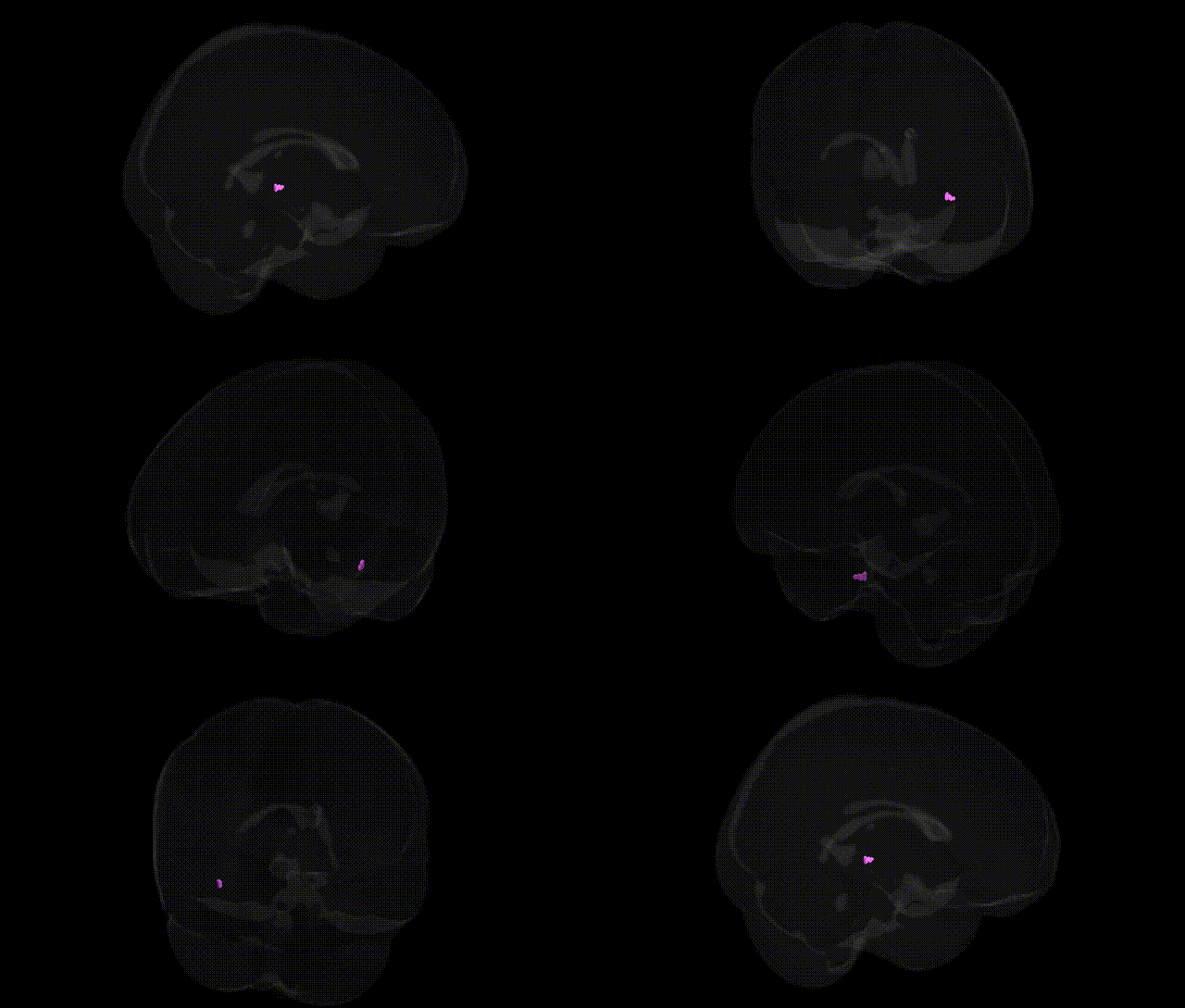
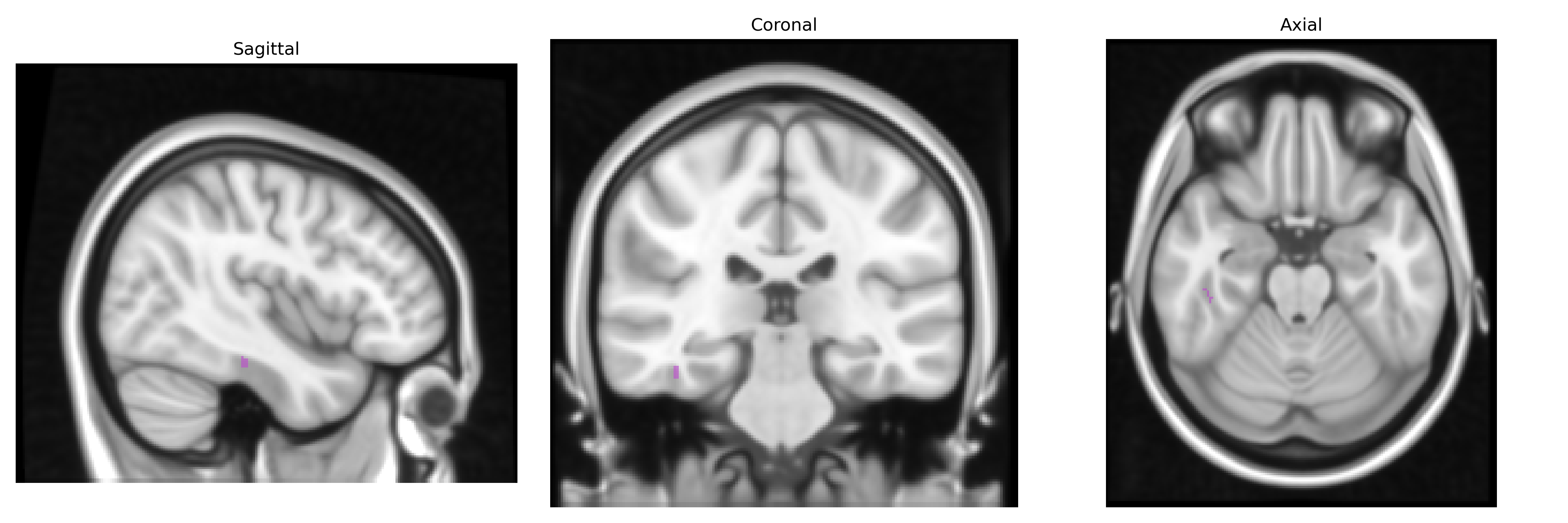
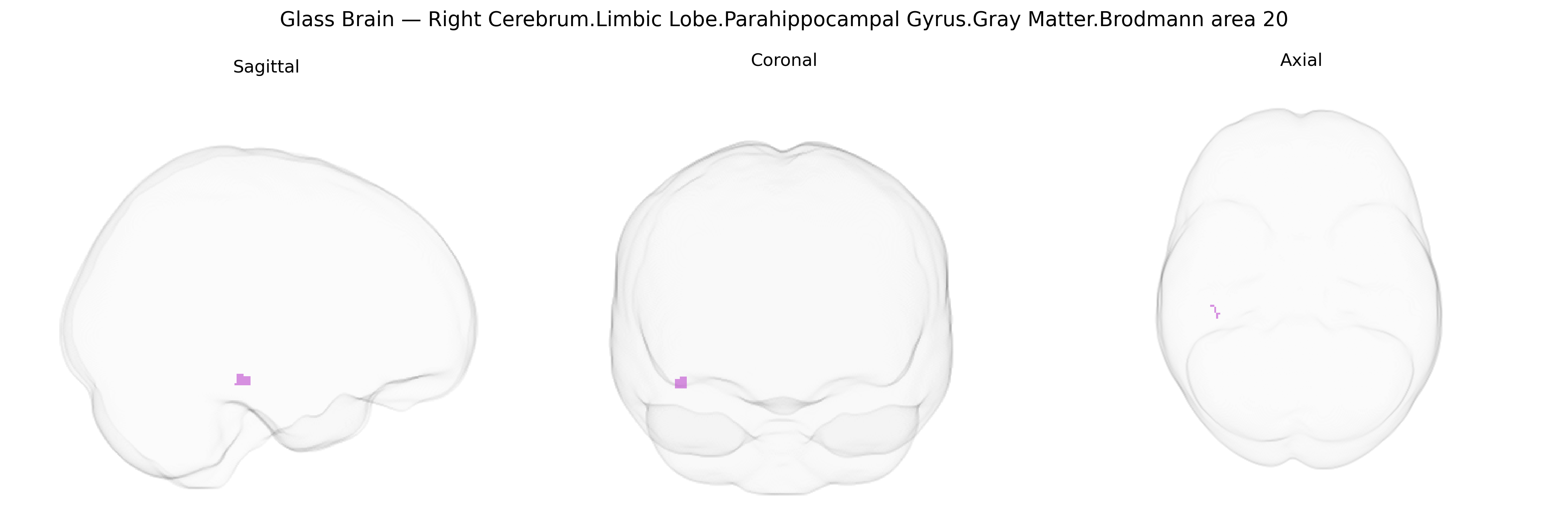
The bilateral Right Cerebrum.Limbic Lobe.Parahippocampal Gyrus.Gray Matter.Brodmann area 20 corresponds to a ventral temporal–limbic cortical field located in the parahippocampal gyrus, adjacent to the hippocampal formation and extending into the inferior temporal cortex. Brodmann area 20 is characterized by a highly developed granular layer IV and well-differentiated supragranular layers, supporting complex visual object and scene processing, multimodal integration, and higher-order aspects of memory and semantic representation. In the parahippocampal context, this region participates in encoding and retrieval of contextual and spatial information, contributing to recognition of places and environmental layouts, and interfacing with hippocampal circuitry for declarative memory. There is no direct link for this exact composite region; a related structure is the Parahippocampal gyrus.
The bilateral right parahippocampal gyrus gray matter in Brodmann area 20, as defined in the Talairach 1 mm atlas, lies at the intersection of medial temporal-limbic circuitry and higher-order ventral visual processing, and genetic associations typically reflect this dual role in memory, contextual processing, and socio-emotional cognition rather than being specific to BA20 alone. GWAS and imaging-genetics studies have linked common variants in genes involved in synaptic plasticity and neurodevelopment (e.g., BDNF, APOE, GRIN2B, KIBRA/WFS1, and genes in glutamatergic and GABAergic pathways) to parahippocampal and adjacent temporal cortical volume or activity, often in the context of episodic memory performance, spatial/contextual memory, and default mode network connectivity. APOE ε4 and multiple Alzheimer’s disease GWAS loci (such as CLU, PICALM, CR1, SORL1, and others identified in large meta-analyses) are associated with atrophy and altered functional connectivity in medial temporal regions including parahippocampal and BA20 territory, paralleling early neurodegenerative changes. Psychiatric GWAS implicating polygenic risk for major depressive disorder, schizophrenia, bipolar disorder, and autism spectrum disorder have shown effects on temporal–limbic cortical thickness and surface area, with parahippocampal and inferior temporal regions (overlapping BA20) frequently emerging as mediators of genetic risk for aberrant emotional memory and social perception. Additional GWAS of traits such as general cognitive ability, educational attainment, neuroticism, and anxiety-related phenotypes have reported associations with structural and functional measures in parahippocampal and inferior temporal cortex, suggesting that polygenic variation shaping synaptic signaling, neuronal migration, and myelination contributes to individual differences in this region’s morphology and connectivity, though current evidence does not support highly region-specific single-gene effects restricted to bilateral right BA20.
Overview generated by GPT-4o (2026).
Region ID: 218
Hemisphere: bilateral
Atlas: Talairach labels 1mm
Full Quality Version: Download MP4
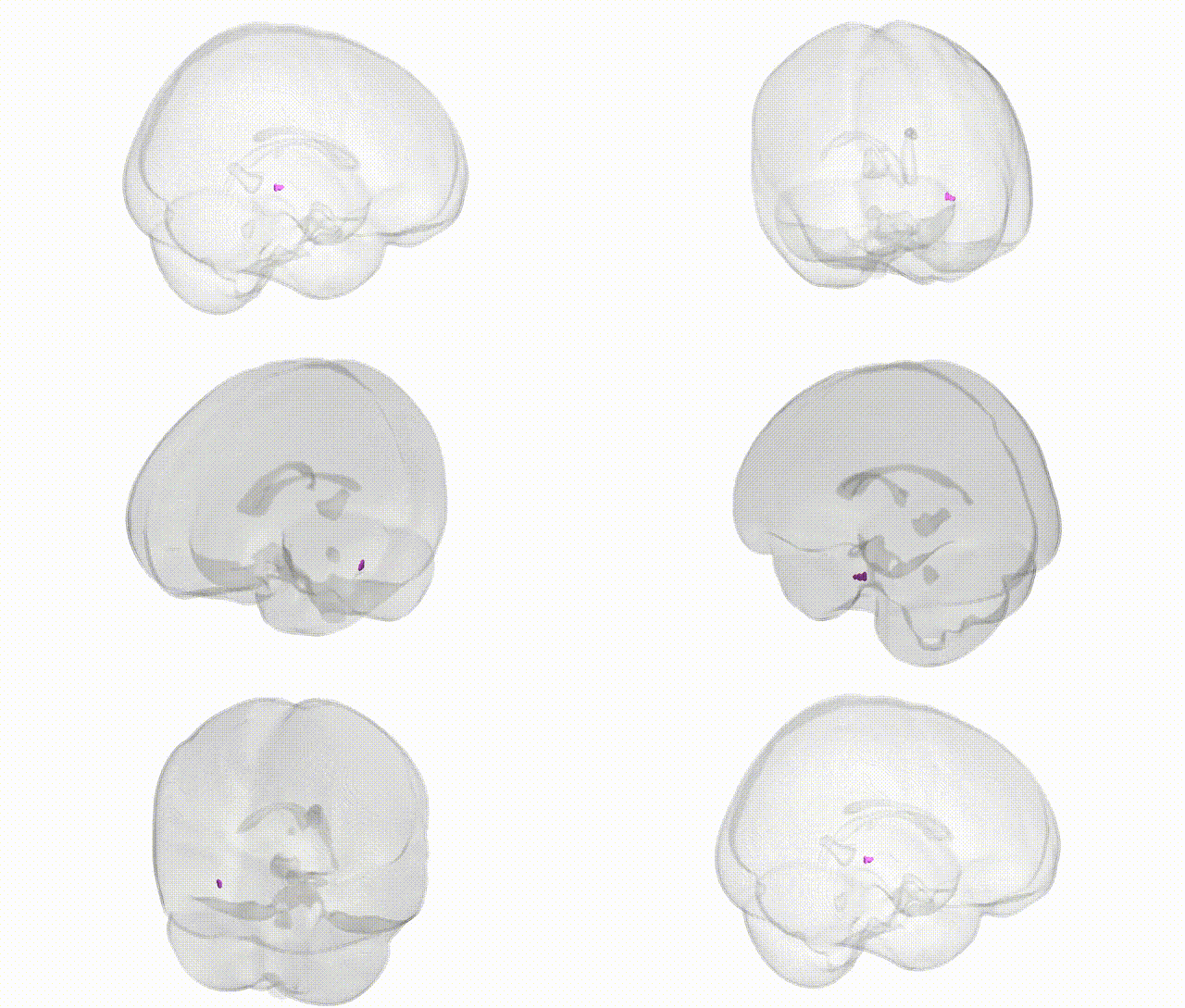
Full Quality Version: Download MP4
Wali Sidiqyar*, Gaurav Rudravaram*, Elyssa M. McMaster, Trent M. Schwartz, Adam M. Saunders, Kurt G. Schilling, Bennett A. Landman "Introducing SPINS: A Shared Public Visualization Library of Neuroanatomical Structures." Medical Imaging with Deep Learning- short paper
This resource is licensed under CC0 1.0 Universal (Public Domain).