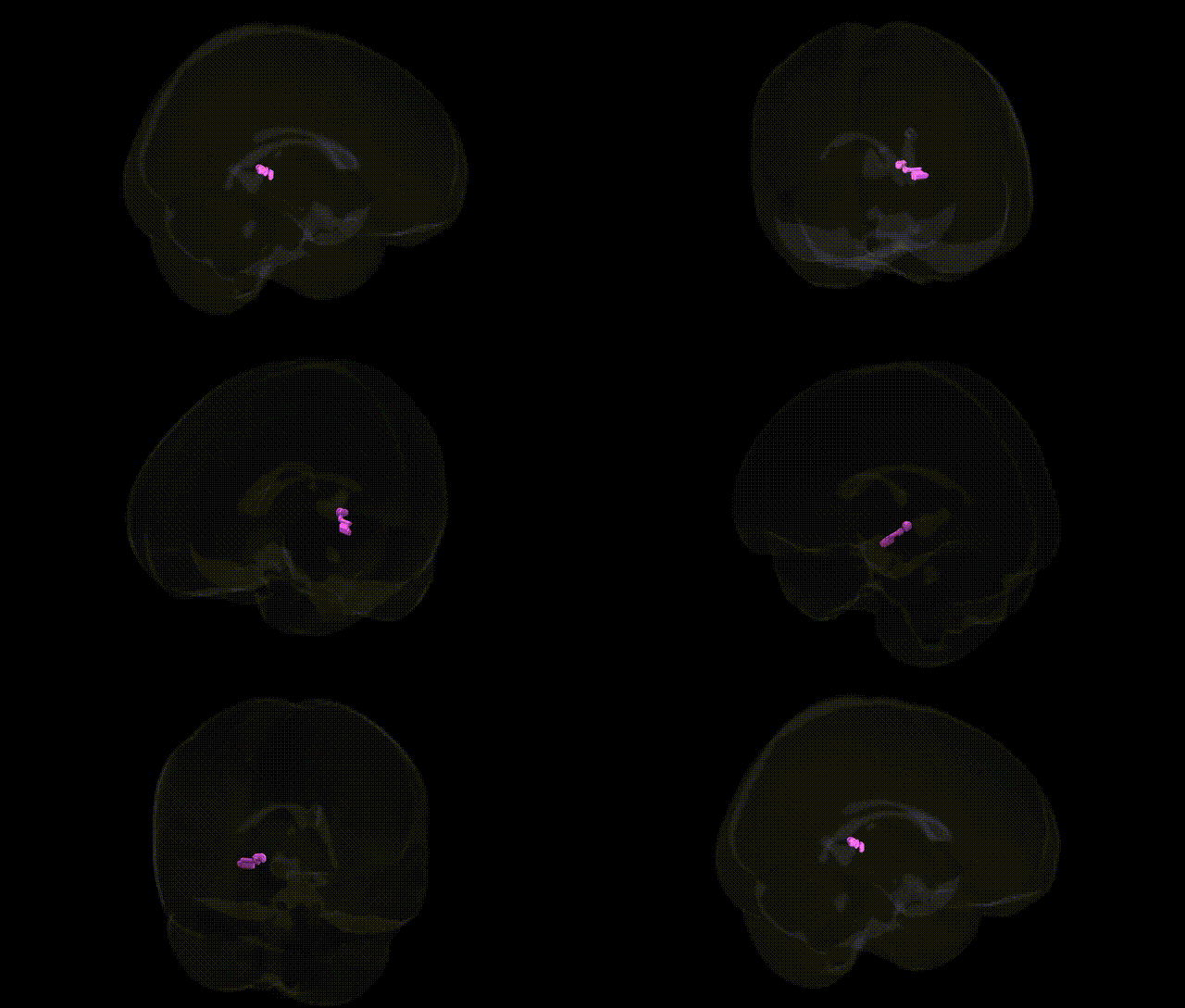
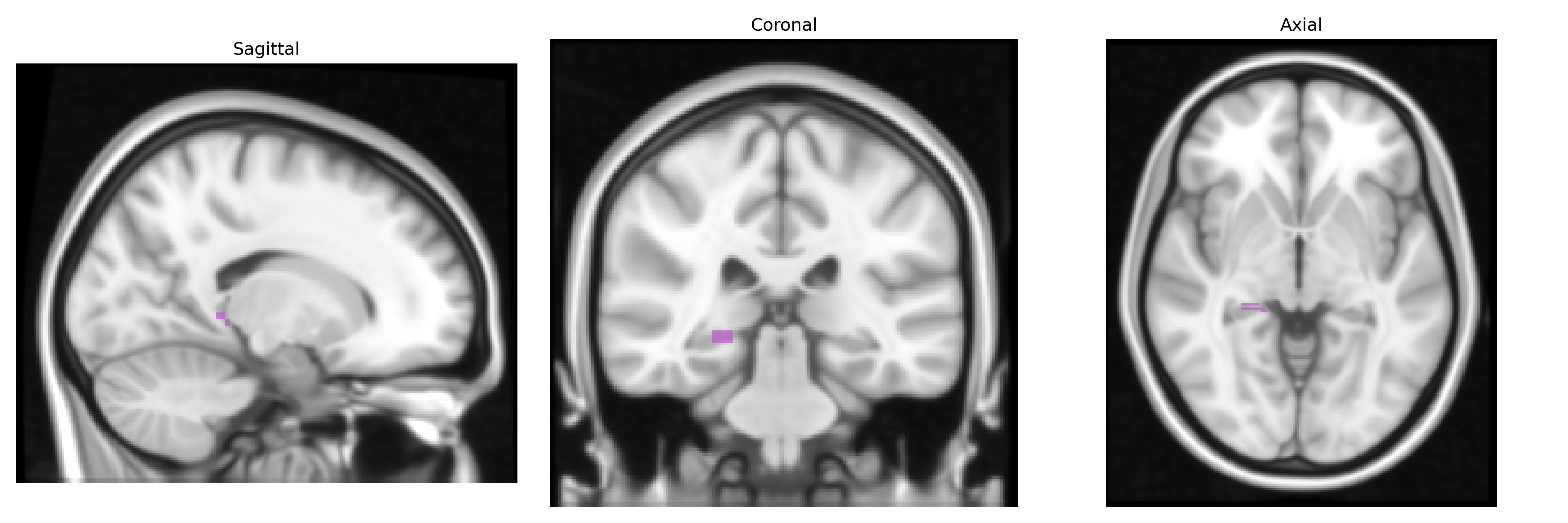
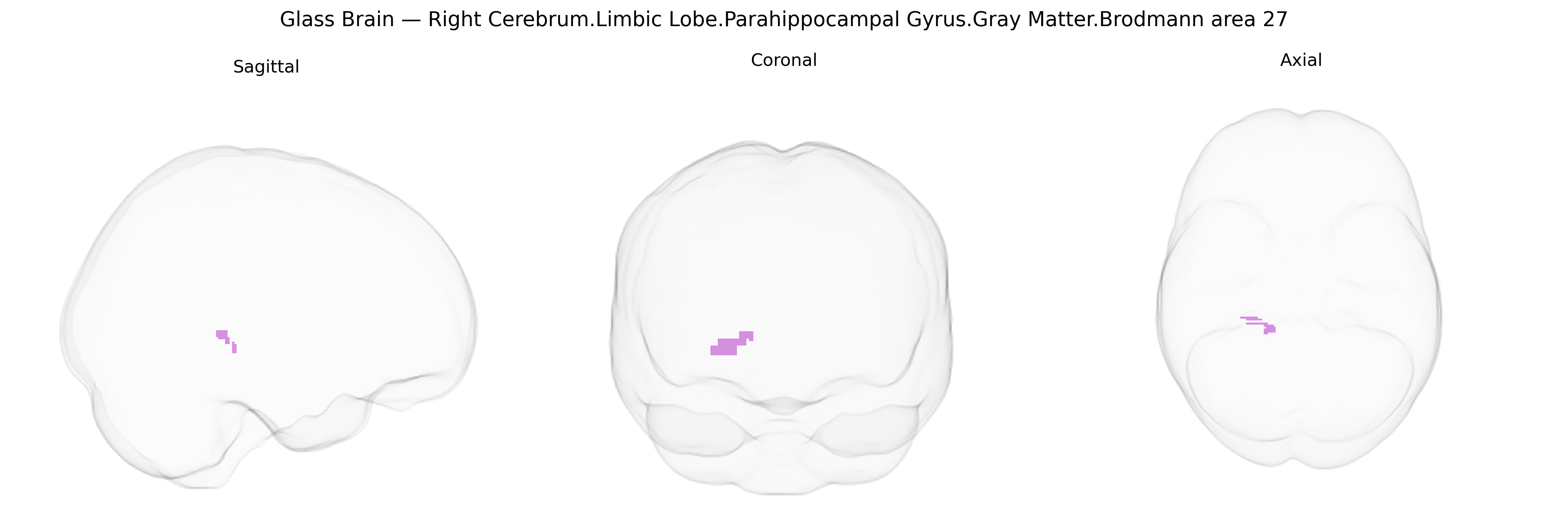
The bilateral Right Cerebrum.Limbic Lobe.Parahippocampal Gyrus.Gray Matter.Brodmann area 27 corresponds to the presubiculum, a cytoarchitectonically defined subregion of the parahippocampal gyrus situated in the medial temporal lobe. Brodmann area 27 is composed of cortical gray matter with a distinct laminar organization and is closely associated with the hippocampal formation, particularly the subicular complex, playing an important role in spatial orientation, head-direction signaling, and integration of multimodal contextual information. Functionally, it participates in navigation-relevant processing and contributes to the broader limbic circuitry involved in memory, environmental mapping, and internally guided behavior. There is no direct link for Brodmann area 27; a closely related structure is the Parahippocampal gyrus.
The parahippocampal gyrus gray matter in Brodmann area 27 (presubiculum/retrosplenial region) has been implicated in multiple genetic and GWAS-based associations, largely through imaging-genetics and psychiatric-neurological studies that map SNPs to regional volume, cortical thickness, or functional activation. Variants in genes involved in synaptic plasticity and neurodevelopment (such as BDNF, particularly Val66Met; APOE, especially ε4; and several glutamatergic and GABAergic pathway genes) have been associated with structural and functional differences in parahippocampal regions that include or border BA27, often in relation to memory performance and medial temporal lobe atrophy. Large-scale GWAS of subcortical and medial temporal structures (e.g., ENIGMA and UK Biobank imaging GWAS) have identified polygenic influences on parahippocampal and presubicular morphology, with implicated loci including genes related to axon guidance, myelination, and neuronal migration, though most effects are small and highly polygenic. Genetic risk for Alzheimer’s disease and other dementias (APOE, CLU, PICALM, BIN1, and additional AD-risk loci) shows robust associations with parahippocampal and presubicular atrophy and hypometabolism; similar though more modest links exist for schizophrenia, major depression, bipolar disorder, and PTSD, where polygenic risk scores correlate with altered structure or connectivity in limbic/parahippocampal circuitry. GWAS of episodic memory, spatial navigation, and scene processing also converge on medial temporal and retrosplenial networks that include BA27, with multiple common variants (e.g., in KIBRA/WWC1 and other synaptic genes) influencing performance and corresponding parahippocampal activation. Overall, genetic associations for this specific bilateral BA27 region are indirect, reflecting distributed polygenic effects on medial temporal and limbic networks rather than single strong locus–region links, but consistently tie this area to heritable vulnerability for memory-related disorders and limbic psychiatric conditions.
Overview generated by GPT-4o (2026).
Region ID: 433
Hemisphere: bilateral
Atlas: Talairach labels 1mm
Full Quality Version: Download MP4
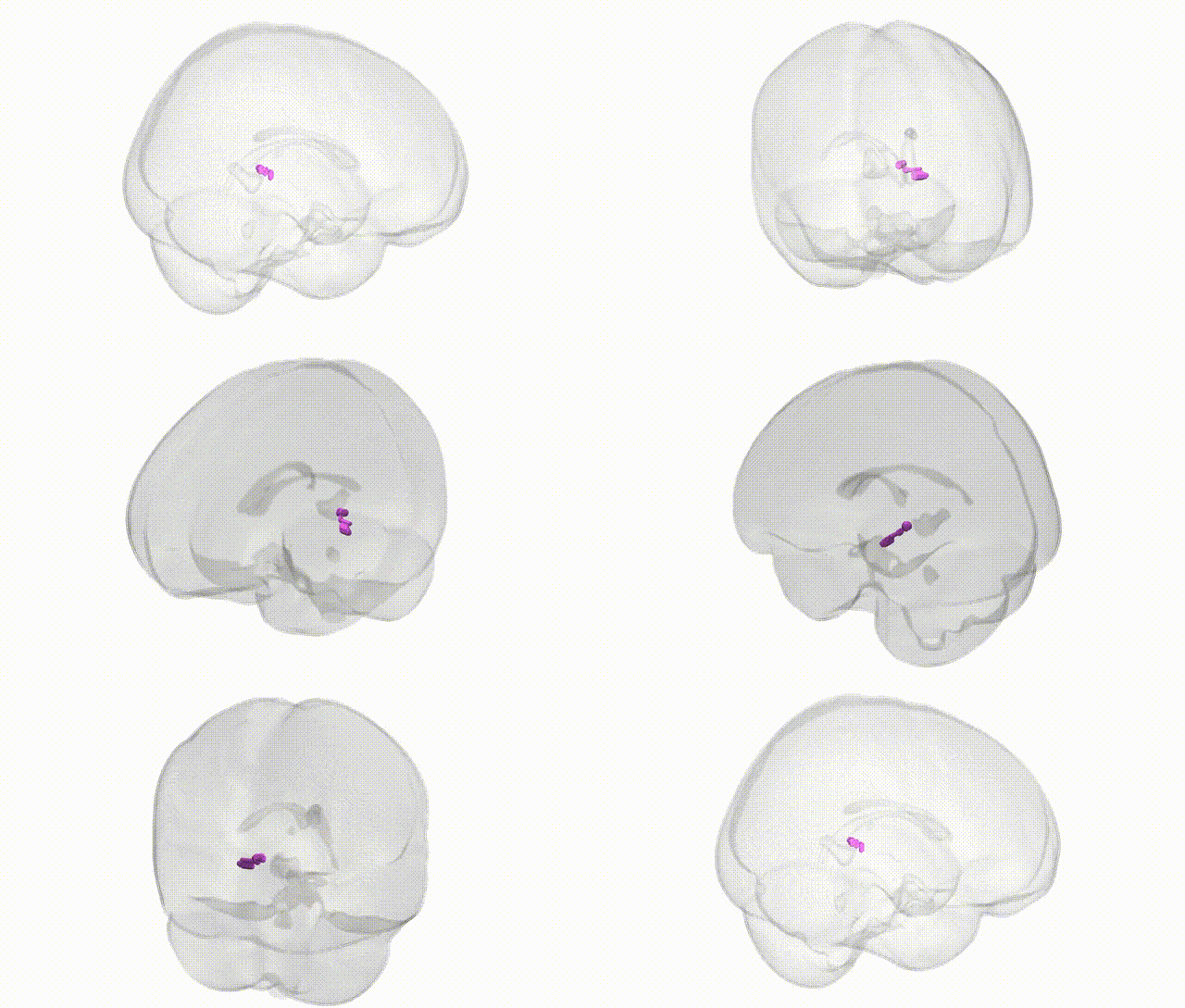
Full Quality Version: Download MP4
Wali Sidiqyar*, Gaurav Rudravaram*, Elyssa M. McMaster, Trent M. Schwartz, Adam M. Saunders, Kurt G. Schilling, Bennett A. Landman "Introducing SPINS: A Shared Public Visualization Library of Neuroanatomical Structures." Medical Imaging with Deep Learning- short paper
This resource is licensed under CC0 1.0 Universal (Public Domain).