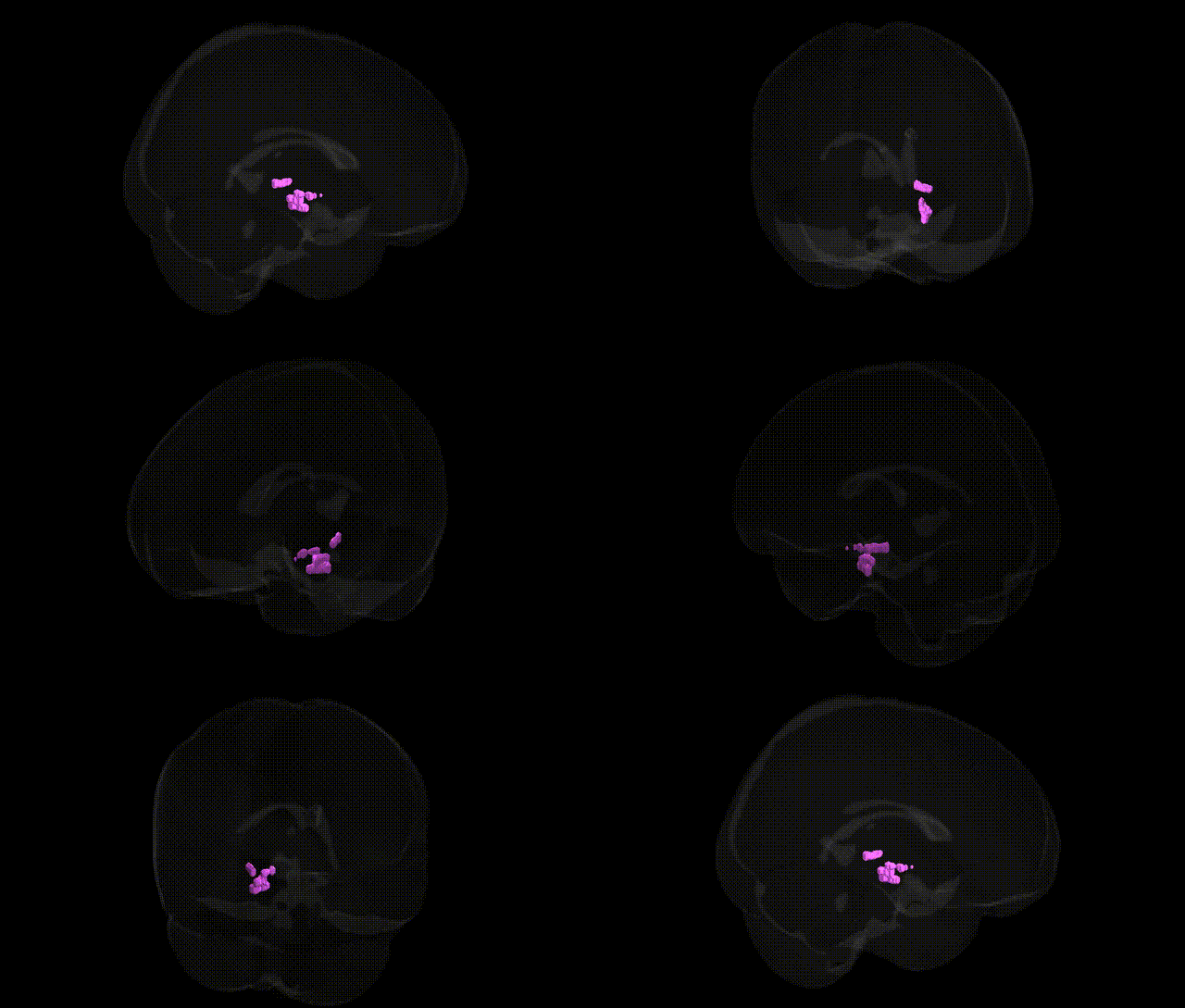
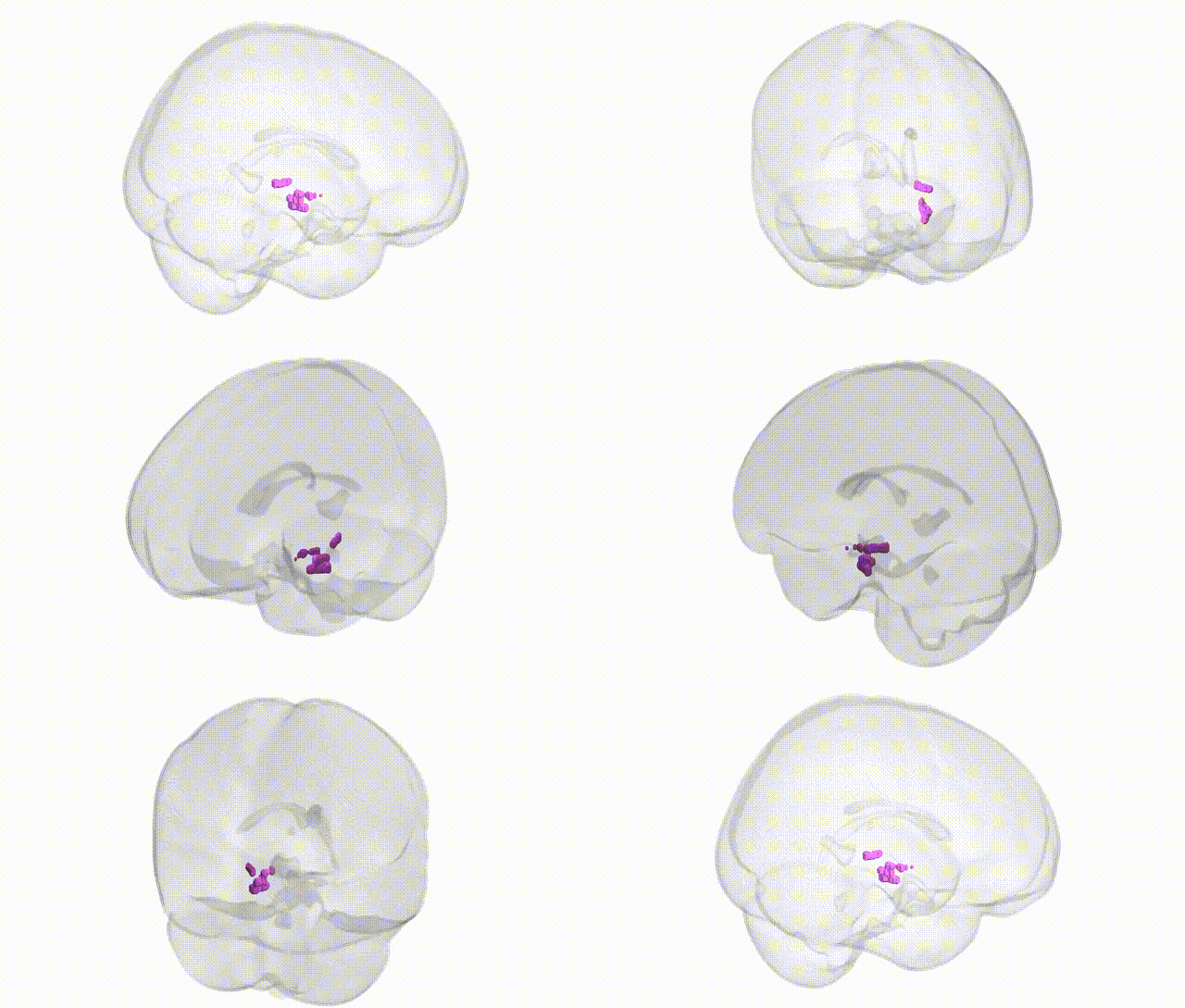
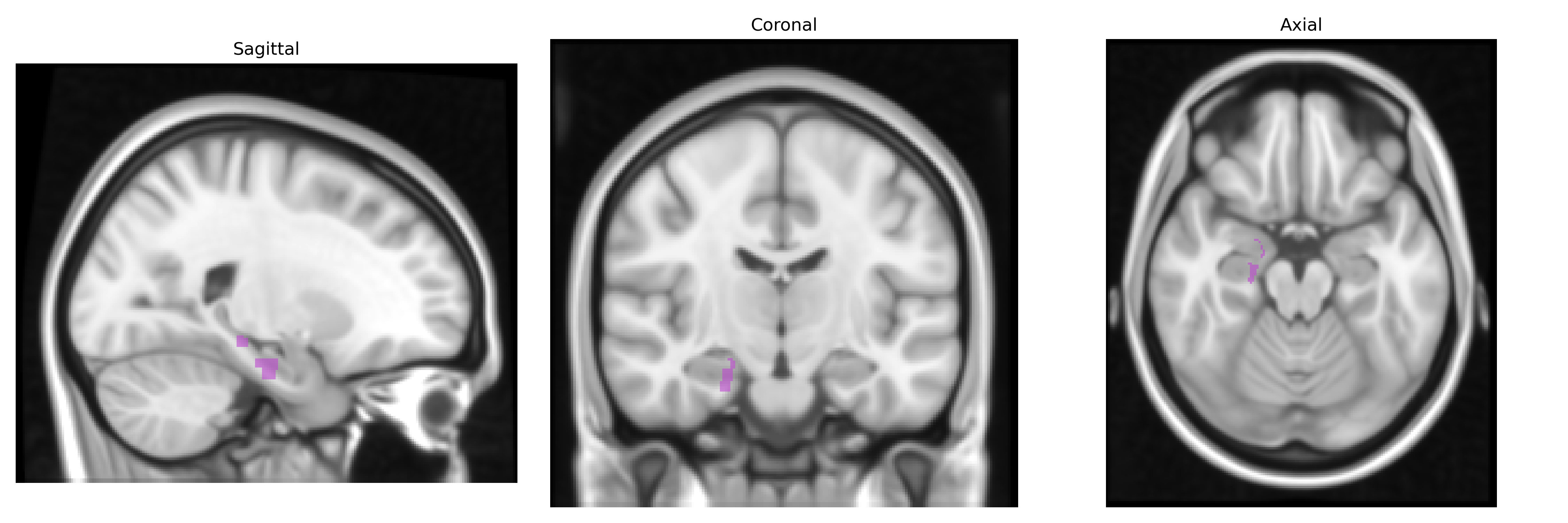
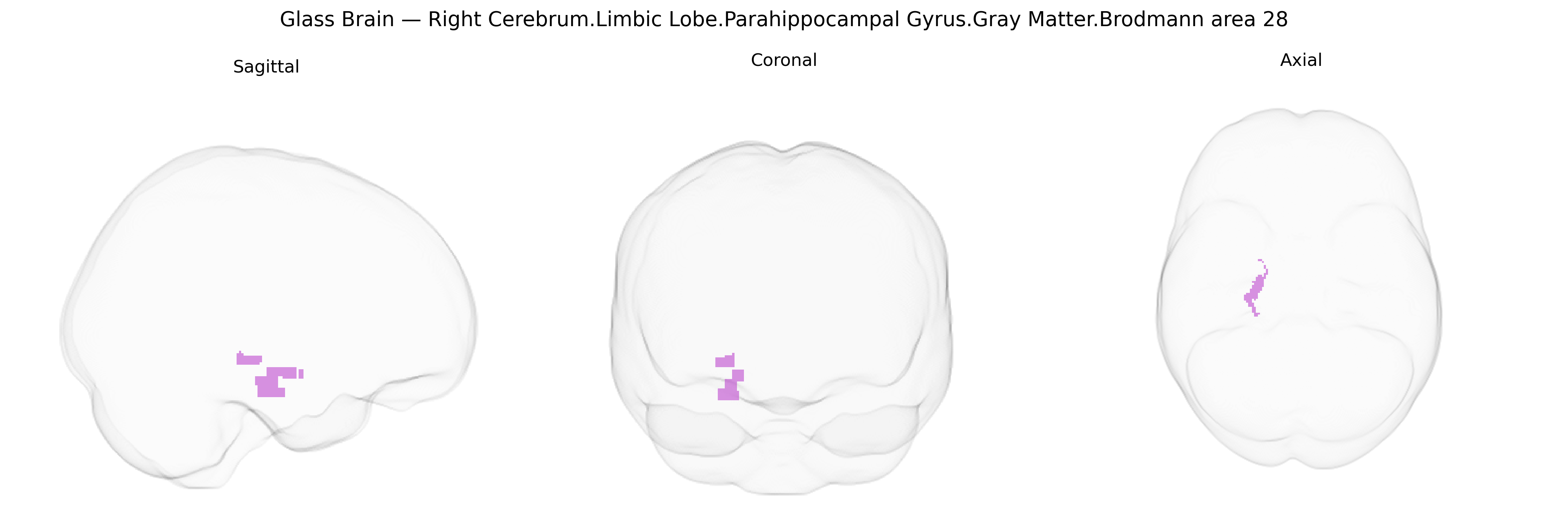
The bilateral Right Cerebrum.Limbic Lobe.Parahippocampal Gyrus.Gray Matter.Brodmann area 28 corresponds primarily to the entorhinal cortex, a medial temporal lobe structure forming a major interface between neocortex and hippocampal formation. Cytoarchitectonically, Brodmann area 28 is characterized by a transitional allocortical organization, with fewer layers than typical neocortex and a prominent lamina dissecans. Functionally, this region plays a key role in episodic memory, spatial navigation, and consolidation processes, serving as a principal input–output hub for hippocampal circuitry and participating in limbic networks supporting emotional and contextual processing. It is also one of the earliest cortical regions affected in Alzheimer’s disease and related neurodegenerative conditions, reflecting its vulnerability and centrality in memory-related pathology. There is no direct link for Brodmann area 28; a closely related structure is the Entorhinal cortex.
The bilateral right parahippocampal gyrus gray matter in Brodmann area 28 (entorhinal cortex region) has been implicated in several genetic and GWAS findings, particularly in relation to neurodegenerative and psychiatric disorders, as well as cognitive traits. Common Alzheimer’s disease risk variants—most notably in APOE (especially ε4), BIN1, CLU, PICALM, CR1, TREM2, and SORL1—have been associated with entorhinal/parahippocampal atrophy and altered cortical thickness, consistent with this region’s role as an early site of tau and amyloid pathology; imaging–genetics studies using MRI-derived entorhinal or parahippocampal volumes from cohorts such as ADNI and UK Biobank frequently identify APOE and other AD GWAS loci as significant predictors. Variants in genes involved in synaptic plasticity and neurodevelopment (for example, BDNF Val66Met, DISC1, and selected glutamatergic and GABAergic genes) have been linked to structural and functional variation in the parahippocampal/entorhinal region, often in the context of memory performance, schizophrenia, and bipolar disorder. Large-scale GWAS of brain morphology and cortical thickness have reported associations between entorhinal/parahippocampal measures and loci near genes related to axon guidance, neurogenesis, and extracellular matrix organization, while polygenic risk scores for Alzheimer’s disease, major depression, and schizophrenia show correlations with reduced gray matter volume or altered activation in this region. Additionally, GWAS of episodic memory, spatial navigation, and general cognitive ability sometimes implicate entorhinal/parahippocampal structure or function as an imaging intermediate phenotype influenced by distributed polygenic effects rather than a single region-specific gene.
Overview generated by GPT-4o (2026).
Region ID: 170
Hemisphere: bilateral
Atlas: Talairach labels 1mm
Full Quality Version: Download MP4
Full Quality Version: Download MP4
Wali Sidiqyar*, Gaurav Rudravaram*, Elyssa M. McMaster, Trent M. Schwartz, Adam M. Saunders, Kurt G. Schilling, Bennett A. Landman "Introducing SPINS: A Shared Public Visualization Library of Neuroanatomical Structures." Medical Imaging with Deep Learning- short paper
This resource is licensed under CC0 1.0 Universal (Public Domain).