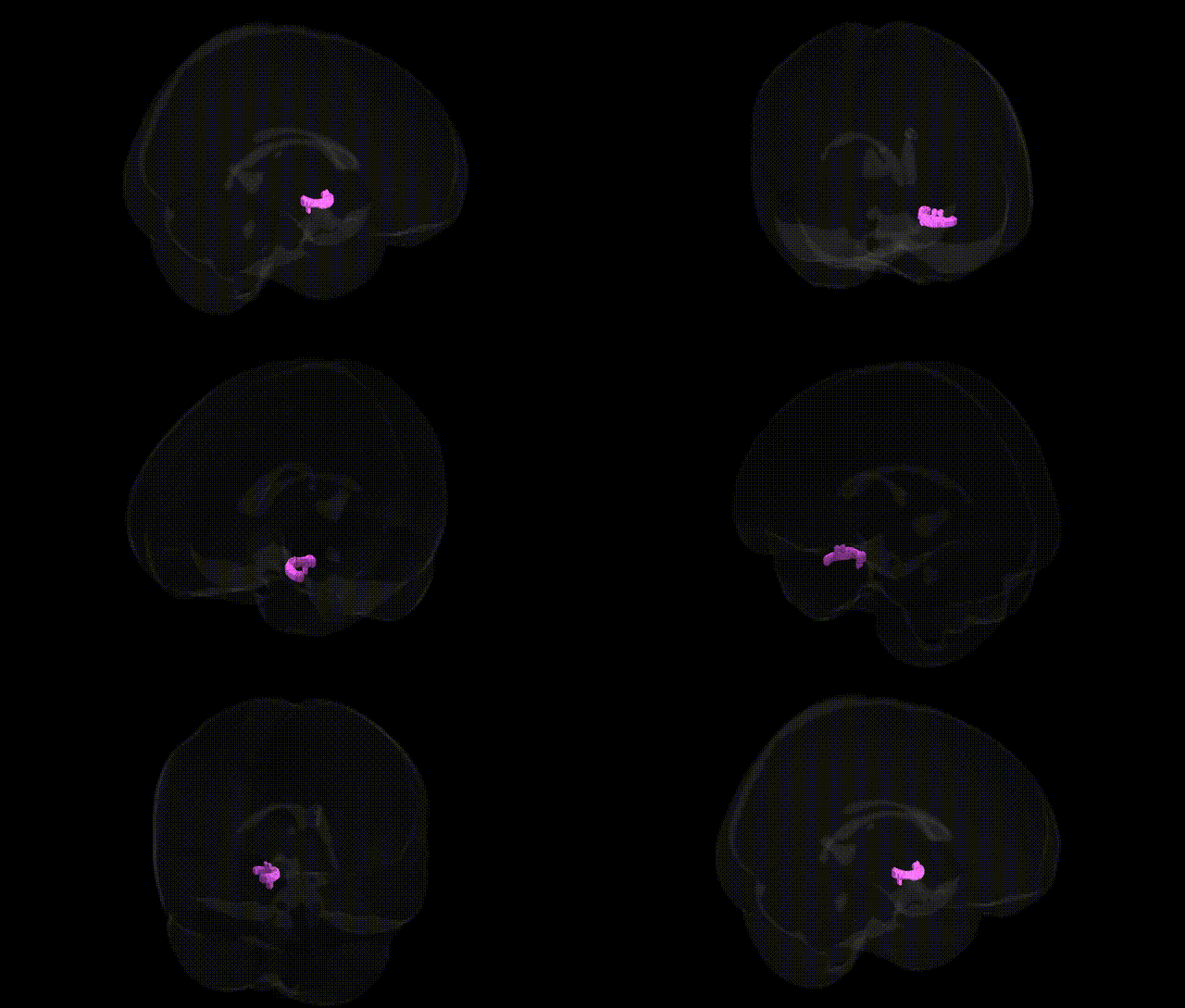
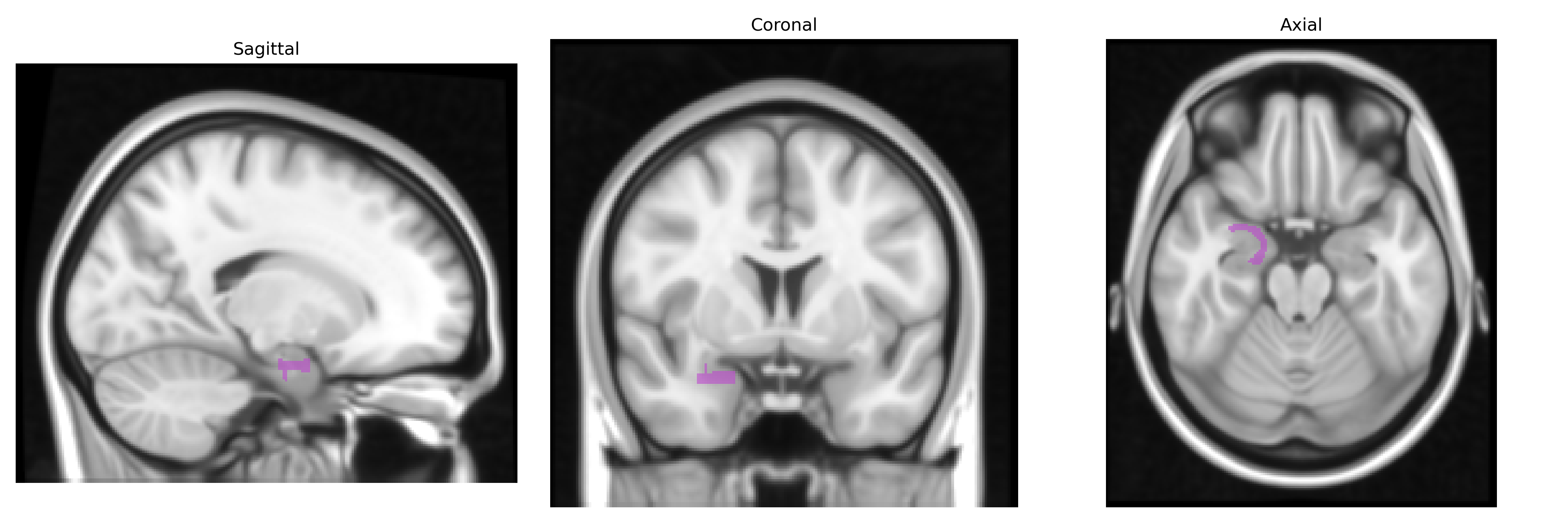
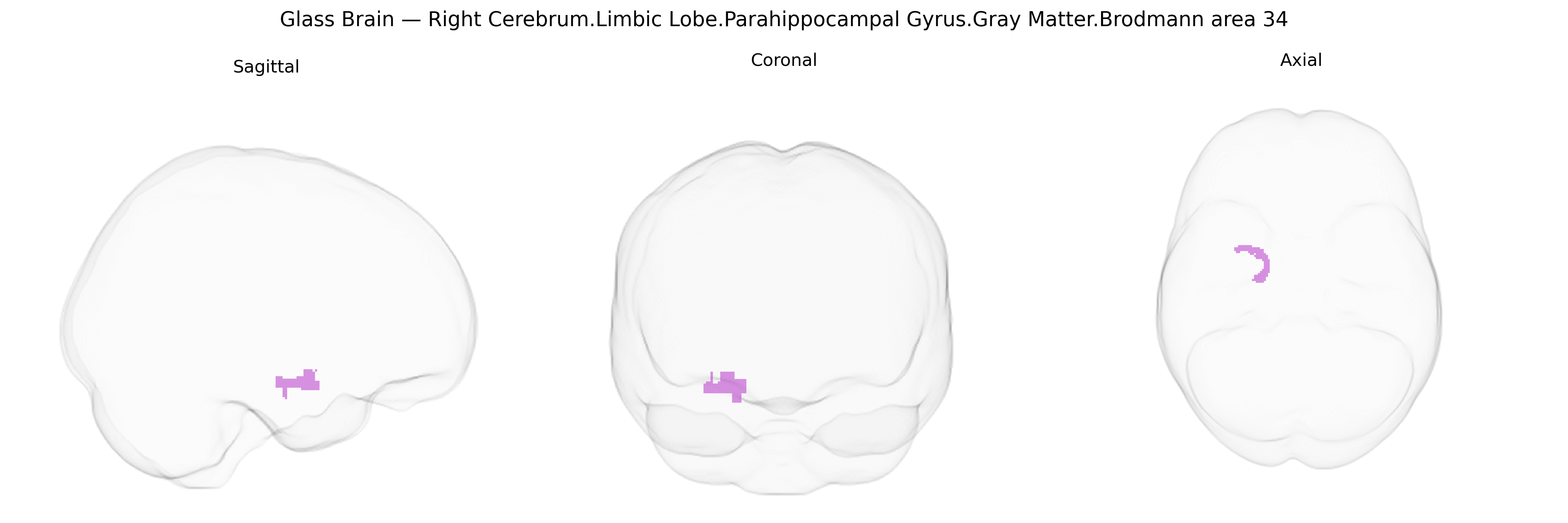
The bilateral Right Cerebrum.Limbic Lobe.Parahippocampal Gyrus.Gray Matter.Brodmann area 34 corresponds to a small, allocortical region located in the anterior medial temporal lobe, forming part of the parahippocampal gyrus adjacent to the entorhinal cortex and hippocampal formation. Histologically, Brodmann area 34 is characterized by a simplified laminar architecture typical of paleocortex, and functionally it participates in olfactory processing, emotional and visceral associations, and memory-related integration via dense reciprocal connections with the hippocampus, amygdala, and other limbic structures. In the Talairach 1 mm atlas, this region is classified within the limbic lobe gray matter and is often grouped with structures involved in episodic memory encoding, contextual processing, and the affective components of sensory experience. There is no direct link for “Brodmann area 34”; a related structure is the Parahippocampal gyrus.
The bilateral right parahippocampal gyrus gray matter in Brodmann area 34 (BA34), a key limbic region involved in contextual memory, emotion, and olfaction, has been implicated in multiple genetic and GWAS-derived associations, though often under broader labels such as “parahippocampal gyrus,” “entorhinal cortex,” or “medial temporal lobe” rather than BA34 specifically. Imaging-genetics and large-scale GWAS of brain structure (e.g., ENIGMA and UK Biobank–based analyses) have identified common variants influencing parahippocampal and entorhinal thickness/volume near or within genes involved in neurodevelopment, synaptic plasticity, and neurodegeneration, including APOE (notably ε4), BIN1, CLU, and PICALM in the context of Alzheimer’s disease, as well as loci such as TESC, SLC39A8, and MAPT in broader medial temporal measures. These structural and functional measures of BA34/parahippocampal cortex are genetically correlated with risk for Alzheimer’s disease, other dementias, and cognitive traits (memory performance, general cognitive ability) and show polygenic overlap with schizophrenia, major depression, and anxiety-related traits, consistent with this region’s role in episodic memory and emotional processing. Additional GWAS and candidate-gene work link parahippocampal activation and morphology to variation in BDNF, COMT, and serotonin transporter genes, especially in relation to memory encoding, fear conditioning, and stress-related disorders such as post-traumatic stress disorder; however, many associations remain at the level of the broader medial temporal/parahippocampal region rather than specifically and conclusively localized to BA34 in the Talairach 1 mm atlas.
Overview generated by GPT-4o (2026).
Region ID: 178
Hemisphere: bilateral
Atlas: Talairach labels 1mm
Full Quality Version: Download MP4
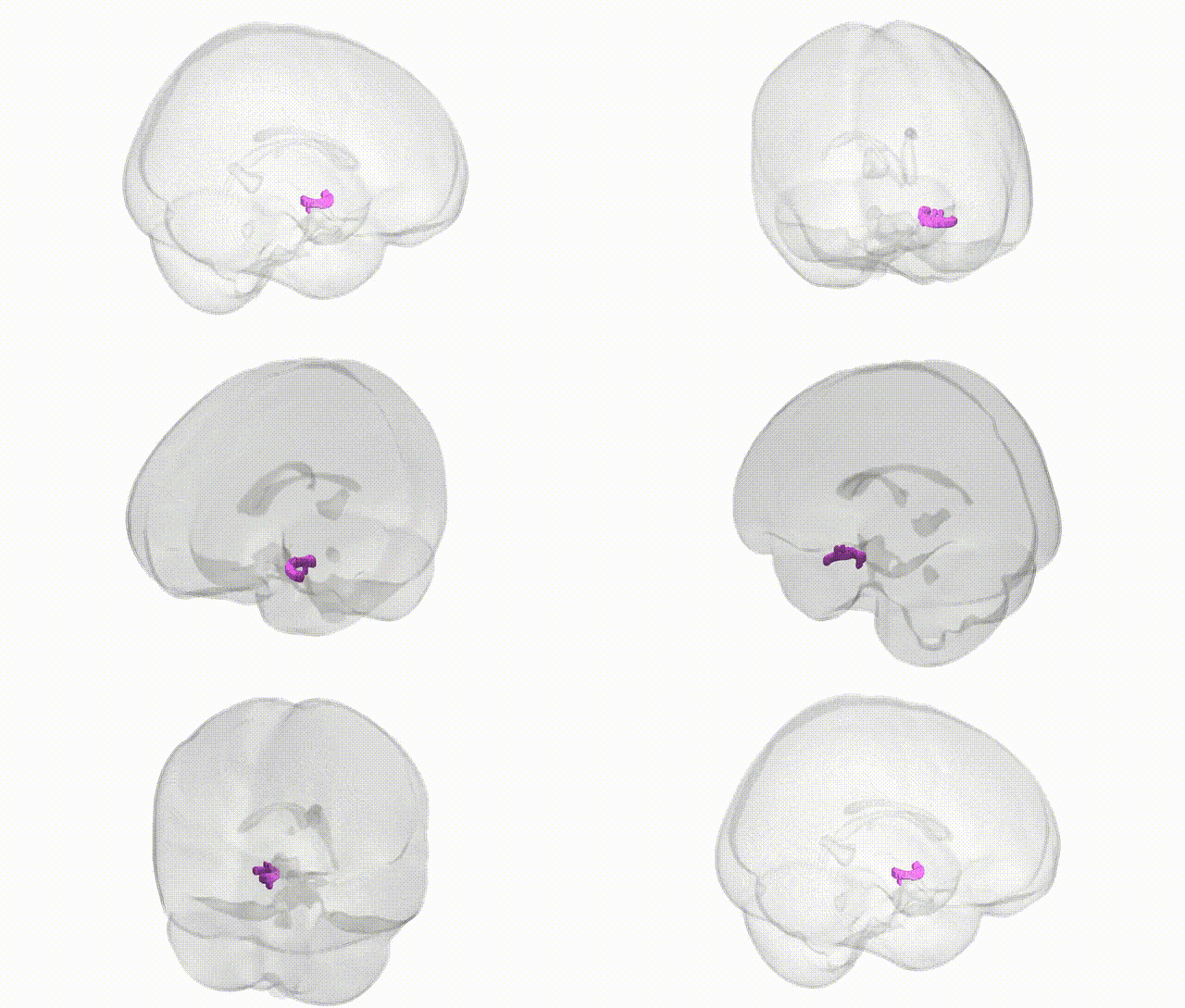
Full Quality Version: Download MP4
Wali Sidiqyar*, Gaurav Rudravaram*, Elyssa M. McMaster, Trent M. Schwartz, Adam M. Saunders, Kurt G. Schilling, Bennett A. Landman "Introducing SPINS: A Shared Public Visualization Library of Neuroanatomical Structures." Medical Imaging with Deep Learning- short paper
This resource is licensed under CC0 1.0 Universal (Public Domain).