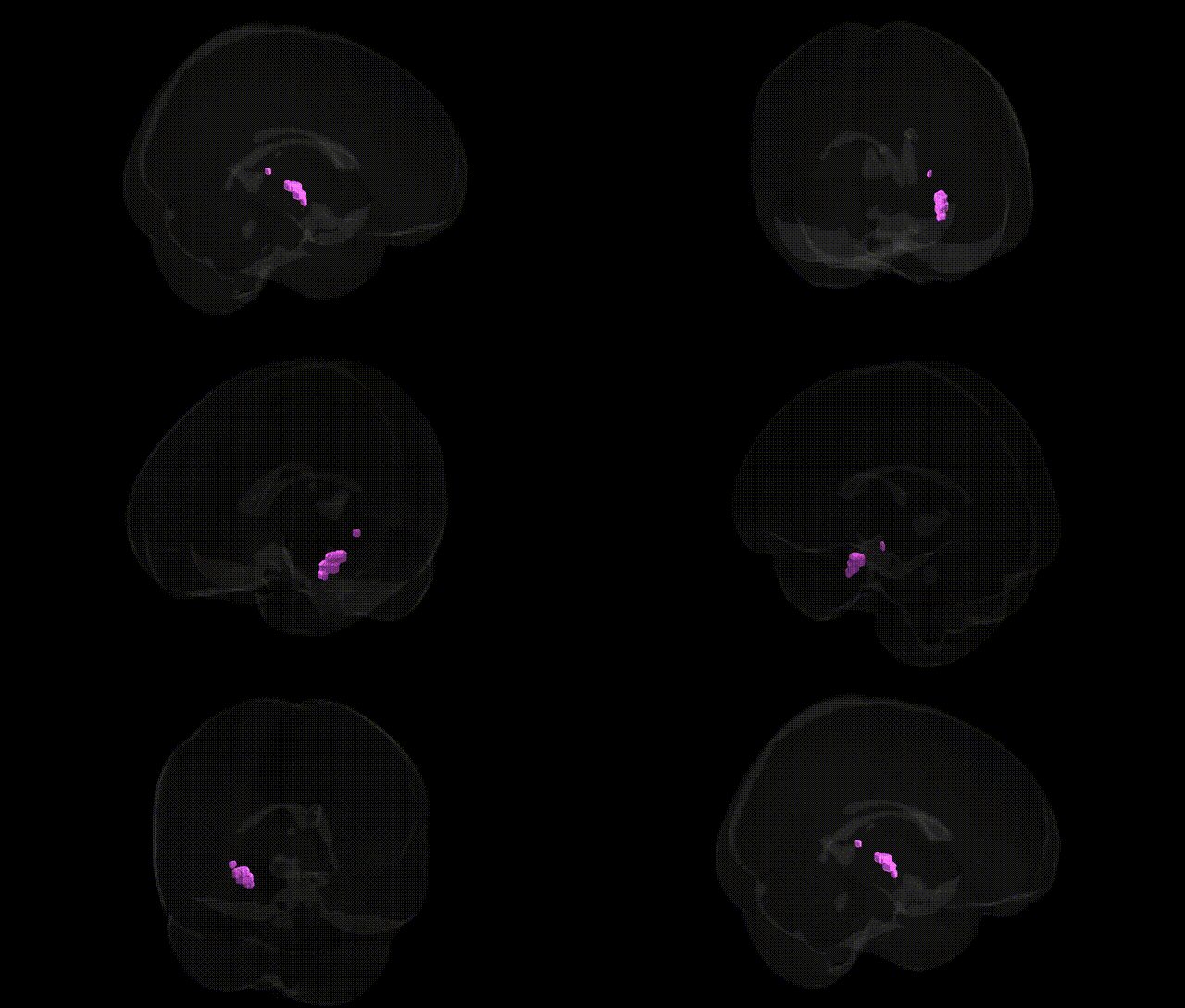
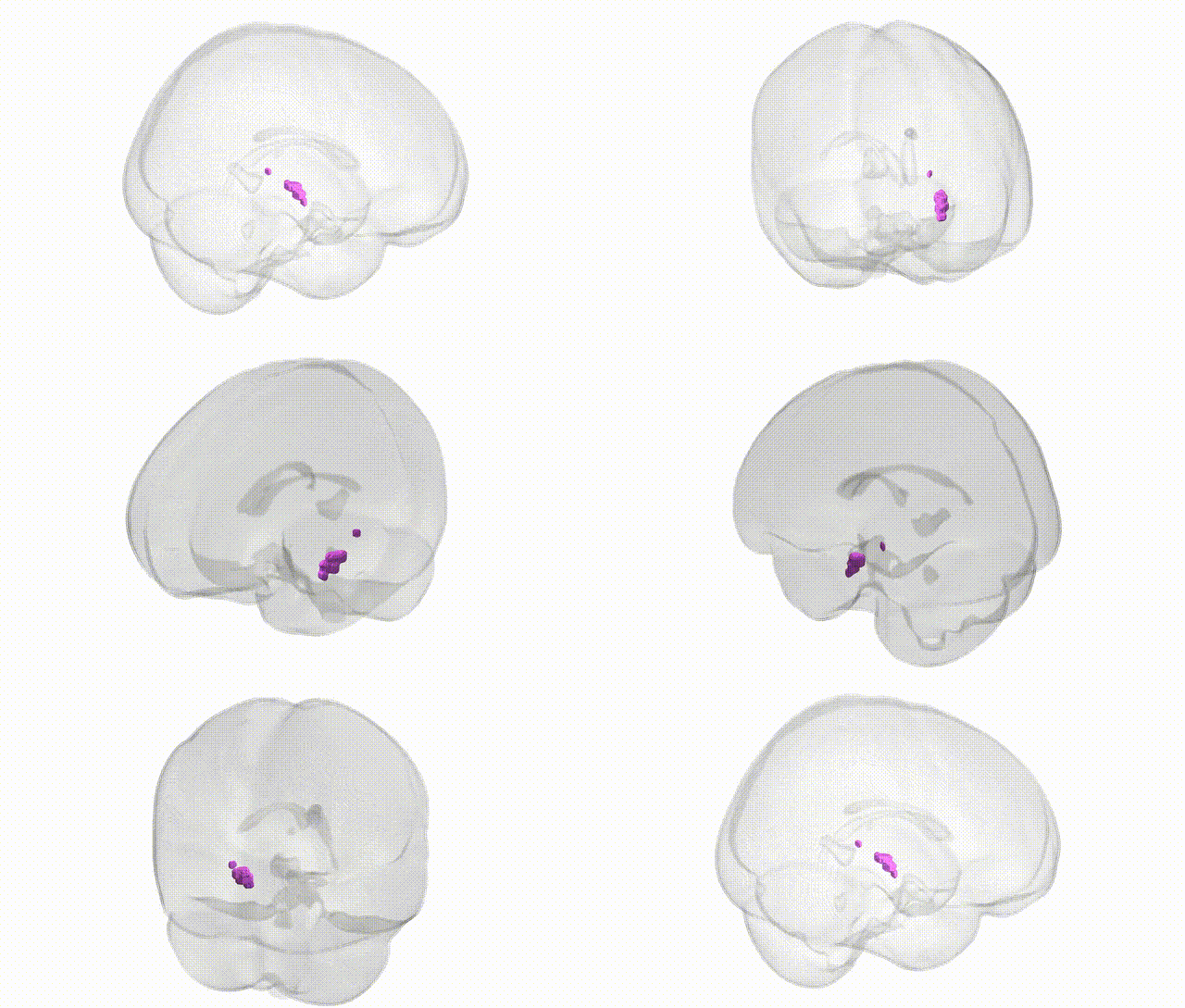
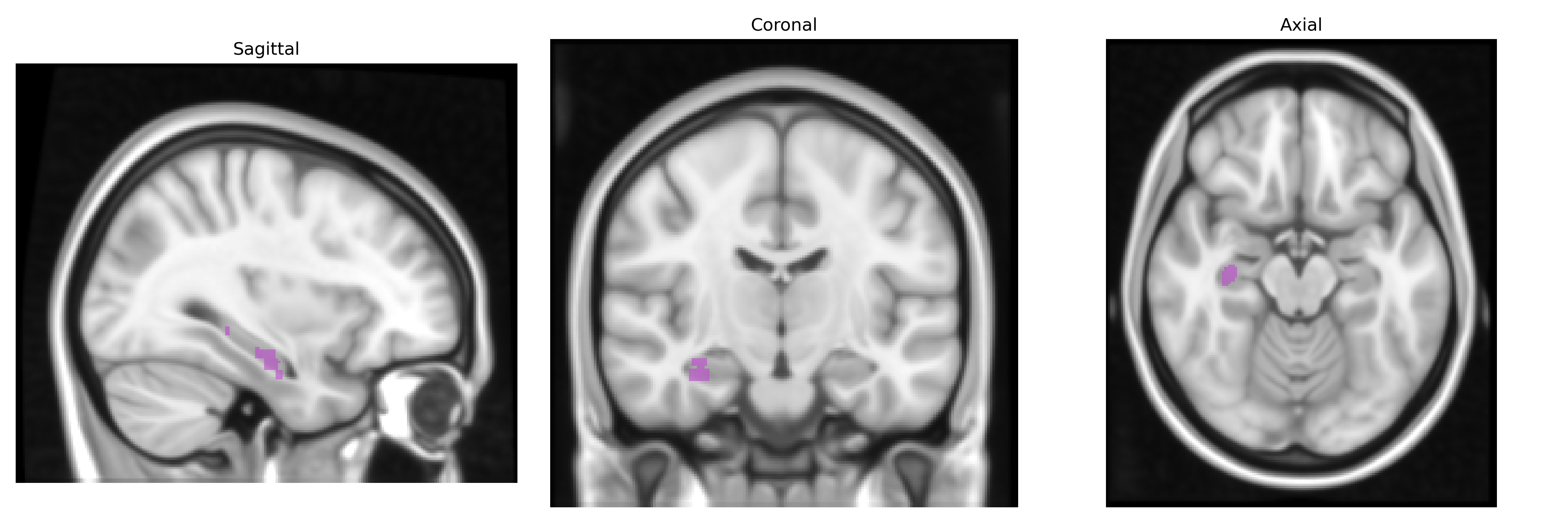
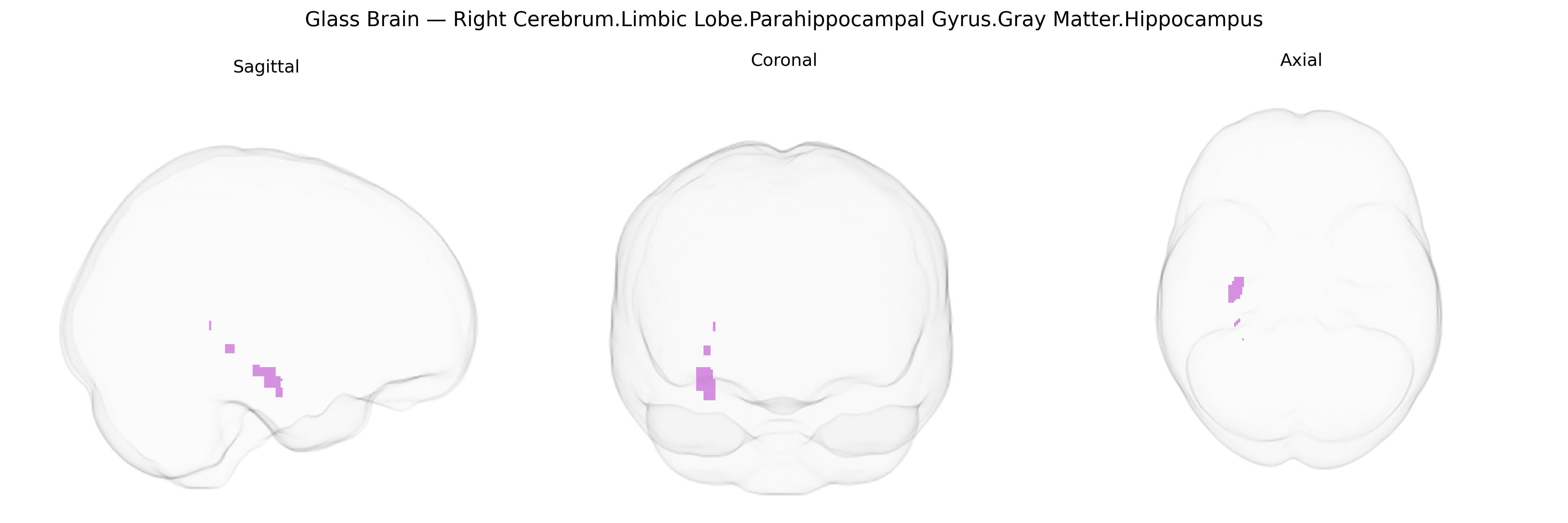
The bilateral Right Cerebrum.Limbic Lobe.Parahippocampal Gyrus.Gray Matter.Hippocampus corresponds to the hippocampal formation within the medial temporal lobe, a laminated gray matter structure of the limbic system critically involved in episodic memory encoding, spatial navigation, and contextual learning. It comprises subfields such as CA1–CA4, dentate gyrus, and subiculum, and receives multimodal input primarily via the entorhinal cortex while projecting through major efferent pathways including the fornix to septal nuclei, hypothalamus, and other limbic structures. Histologically, it is characterized by a three-layered allocortex and is highly plastic but also particularly vulnerable to hypoxia, neurodegenerative processes (notably in Alzheimer’s disease), and medial temporal lobe epilepsy. Functionally, bilateral hippocampal integrity is essential for forming new declarative memories, with hemispheric contributions often showing a bias toward verbal material on the left and visuospatial/contextual information on the right. Hippocampus
The bilateral right parahippocampal gyrus and hippocampus (Talairach: Right Cerebrum.Limbic Lobe.Parahippocampal Gyrus.Gray Matter.Hippocampus) are key hubs in memory, spatial navigation, and affective processing, and numerous genetic associations implicate this region across neuropsychiatric and neurodegenerative traits. Large GWAS of hippocampal and medial temporal lobe volume have identified loci in and around genes such as TMEM106B, WIF1, SLC4A10, DPP4, MSRB3, HRK, and others, many of which relate to neurodevelopment, synaptic function, or neuroprotection, while APOE ε4 remains the strongest common variant associated with hippocampal atrophy and Alzheimer’s disease risk. Polygenic risk for Alzheimer’s disease, schizophrenia, major depression, and bipolar disorder shows robust correlations with structural and functional variation in the right hippocampal–parahippocampal complex, with specific risk loci including CACNA1C, ZNF804A, and other synaptic and calcium-channel genes contributing to altered medial temporal lobe connectivity and volumes. GWAS of PTSD, anxiety, and neuroticism implicate variants affecting stress-response and HPA-axis genes (for example, CRHR1, FKBP5, and related loci) in shaping hippocampal/parahippocampal volume and responsiveness, while memory performance and educational attainment GWAS highlight overlapping polygenic influences on this region’s structure and activity. Overall, convergent imaging-genetics and GWAS evidence supports a highly polygenic architecture in which many small-effect variants related to synaptic plasticity, neurodevelopment, lipid metabolism, and stress regulation collectively shape vulnerability of the right parahippocampal–hippocampal region to atrophy, functional dysregulation, and disease across Alzheimer’s disease, psychotic and mood disorders, and stress-related conditions.
Overview generated by GPT-4o (2026).
Region ID: 176
Hemisphere: bilateral
Atlas: Talairach labels 1mm
Full Quality Version: Download MP4
Full Quality Version: Download MP4
Wali Sidiqyar*, Gaurav Rudravaram*, Elyssa M. McMaster, Trent M. Schwartz, Adam M. Saunders, Kurt G. Schilling, Bennett A. Landman "Introducing SPINS: A Shared Public Visualization Library of Neuroanatomical Structures." Medical Imaging with Deep Learning- short paper
This resource is licensed under CC0 1.0 Universal (Public Domain).