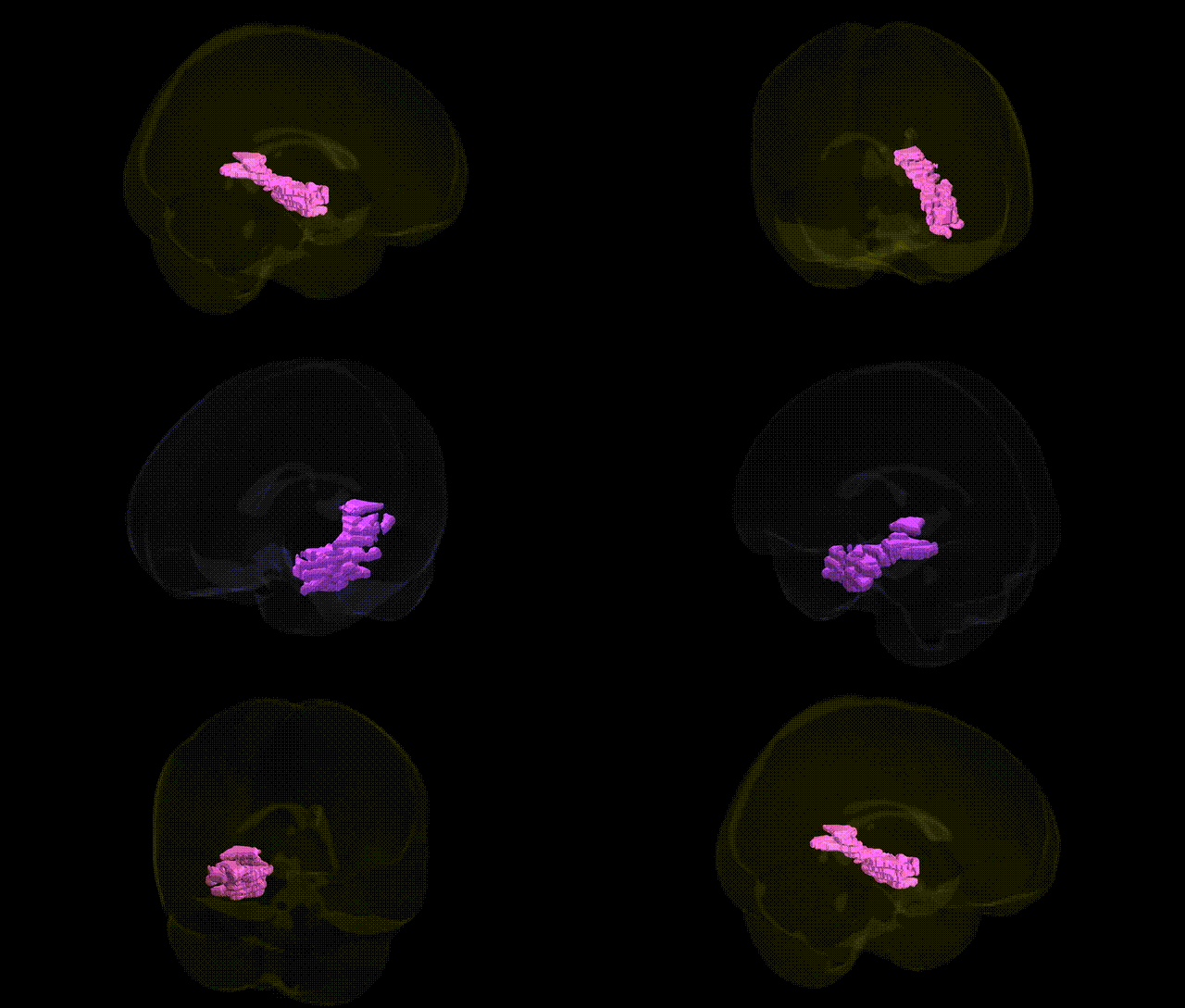
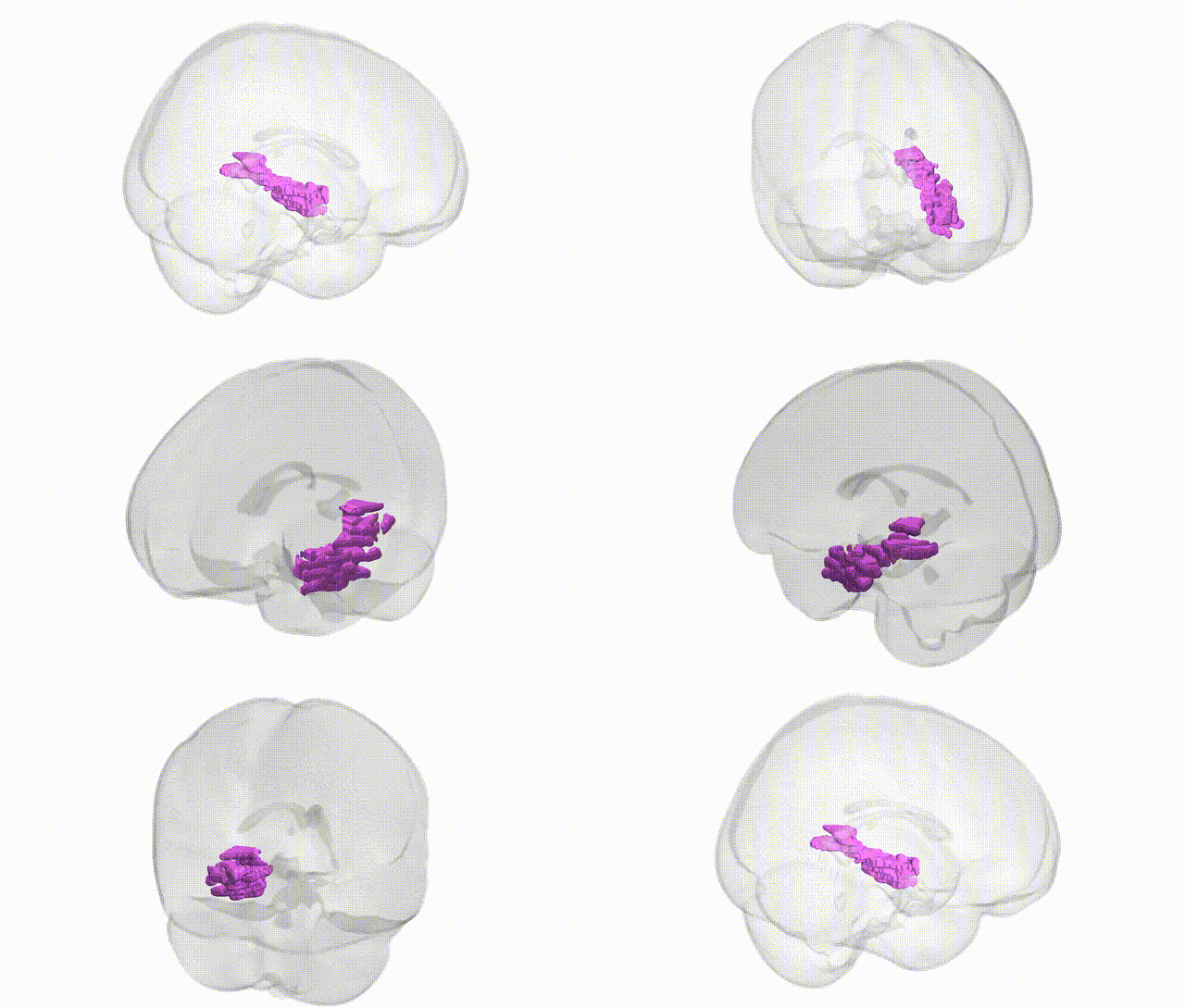
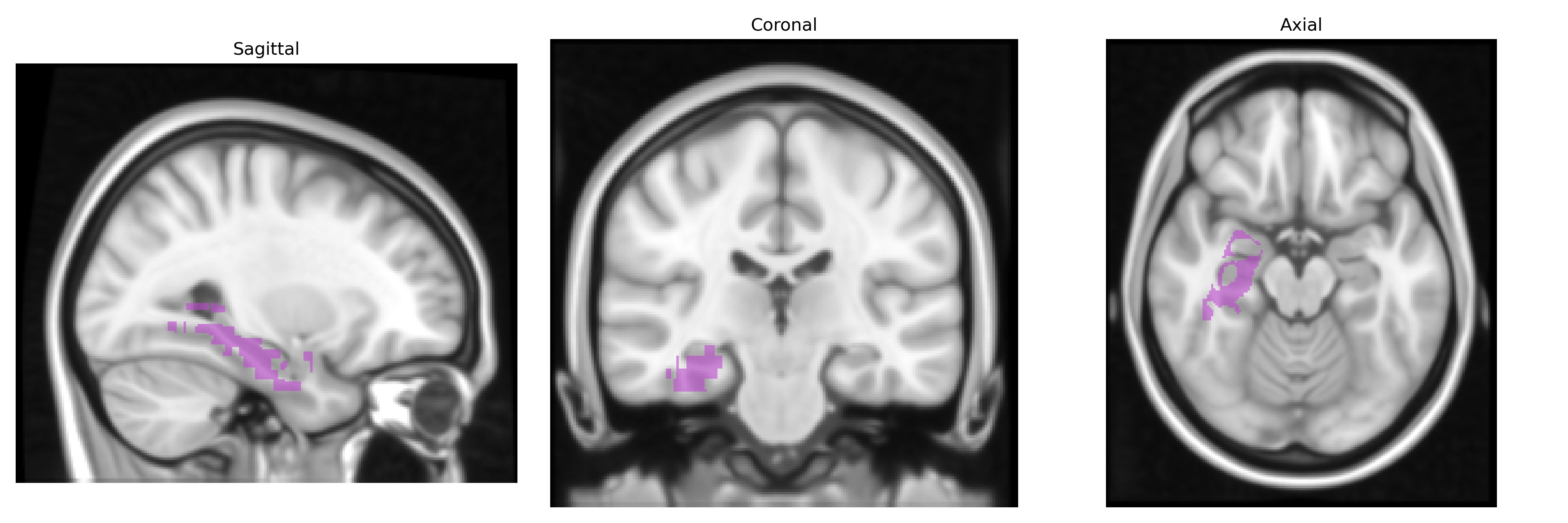
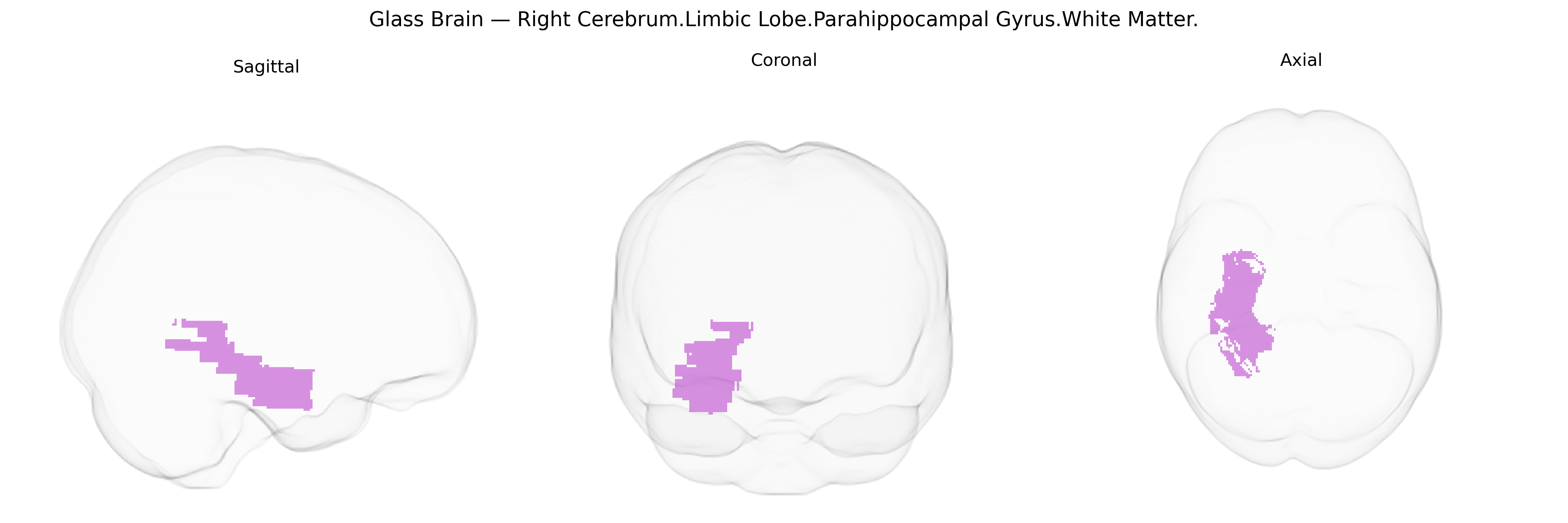
The bilateral right cerebrum limbic lobe parahippocampal gyrus white matter comprises the subcortical fiber pathways underlying the parahippocampal gyrus, a key component of the medial temporal lobe and limbic system. These white matter tracts include association and projection fibers that interconnect the parahippocampal cortex with the hippocampus, entorhinal cortex, amygdala, and broader neocortical regions, facilitating the transmission of information critical for declarative memory, spatial navigation, and contextual processing of sensory input. They contribute to major limbic circuits, including the Papez circuit, and help integrate mnemonic and emotional signals with higher-order cognitive networks. There is no direct link for this specific white matter subdivision; a related structure is the Parahippocampal gyrus.
The bilateral right parahippocampal gyrus white matter, as defined in the Talairach 1 mm atlas, has been implicated indirectly in several genetic and GWAS findings through its role in medial temporal circuitry supporting memory, emotion, and spatial processing. Large-scale imaging genetics consortia (e.g., ENIGMA) and UK Biobank–based GWAS of regional brain volumes and diffusion metrics have identified associations between common variants in genes related to neurodevelopment, axonal guidance, and myelination (such as those in the MAPT region on 17q21, BDNF, and several cell-adhesion and synaptic genes) and structural measures encompassing parahippocampal and adjacent temporal white matter. Variants in and near APOE, CLU, and other Alzheimer’s disease–risk loci have been linked to microstructural changes and atrophy within medial temporal and parahippocampal pathways, which are among the earliest affected in Alzheimer’s disease and amnestic mild cognitive impairment. Additional GWAS have associated polymorphisms affecting glutamatergic and GABAergic signaling, neuroinflammation, and oligodendrocyte function with white-matter integrity measures that prominently involve right medial temporal/parahippocampal tracts, showing relevance to disorders such as schizophrenia, bipolar disorder, major depression, post-traumatic stress disorder, and autism spectrum conditions, as well as to cognitive traits including episodic memory, spatial navigation, and general cognitive performance, although precise, region-exclusive genetic associations specifically restricted to the Talairach-defined “Right Cerebrum.Limbic Lobe.Parahippocampal Gyrus.White Matter” label are not yet firmly delineated.
Overview generated by GPT-4o (2026).
Region ID: 134
Hemisphere: bilateral
Atlas: Talairach labels 1mm
Full Quality Version: Download MP4
Full Quality Version: Download MP4
Wali Sidiqyar*, Gaurav Rudravaram*, Elyssa M. McMaster, Trent M. Schwartz, Adam M. Saunders, Kurt G. Schilling, Bennett A. Landman "Introducing SPINS: A Shared Public Visualization Library of Neuroanatomical Structures." Medical Imaging with Deep Learning- short paper
This resource is licensed under CC0 1.0 Universal (Public Domain).